Gursky’s Spectral Tarsier (Tarsius spectrumgurskyae) is a small nocturnal primate of North Sulawesi, Indonesia.[1] It probably lives in small groups and sings a duet near dawn.[1][2] It has been a species of its own since 2017, before which most tarsiers of Sulawesi were called the Spectral Tarsier.[3] The IUCN lists it as Vulnerable.[1]
Quick facts
Description
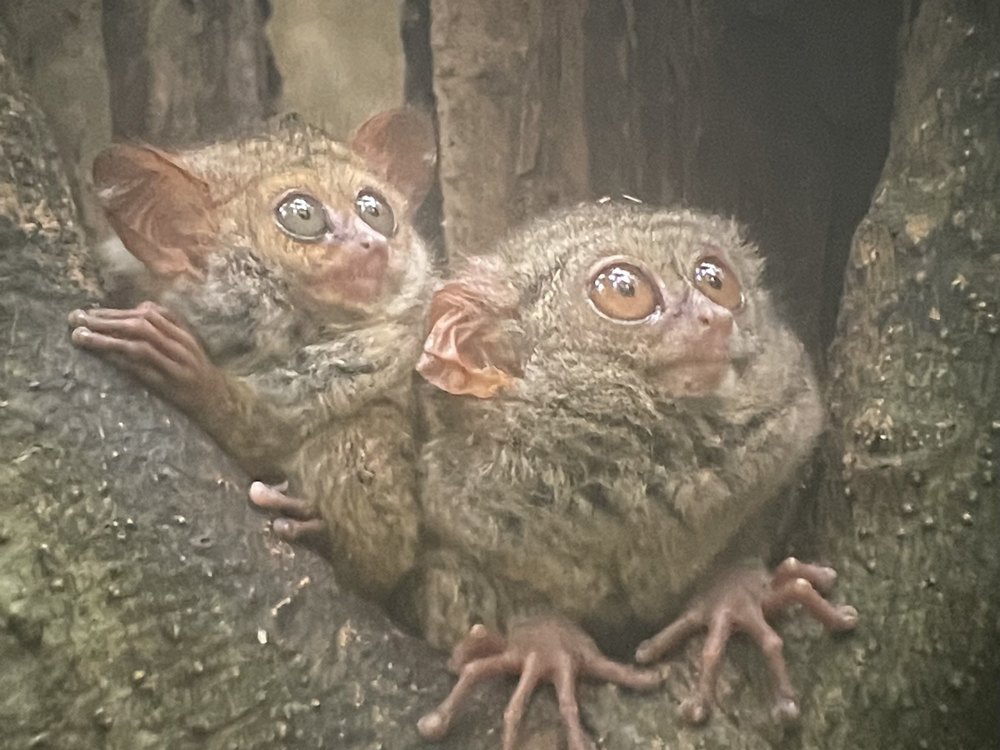
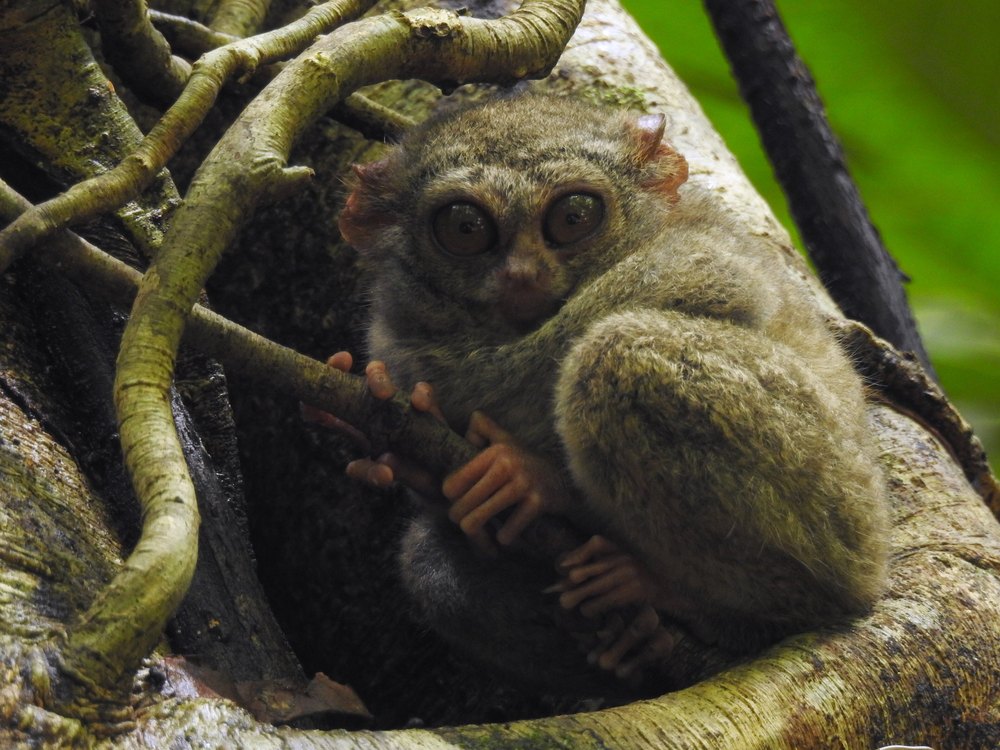
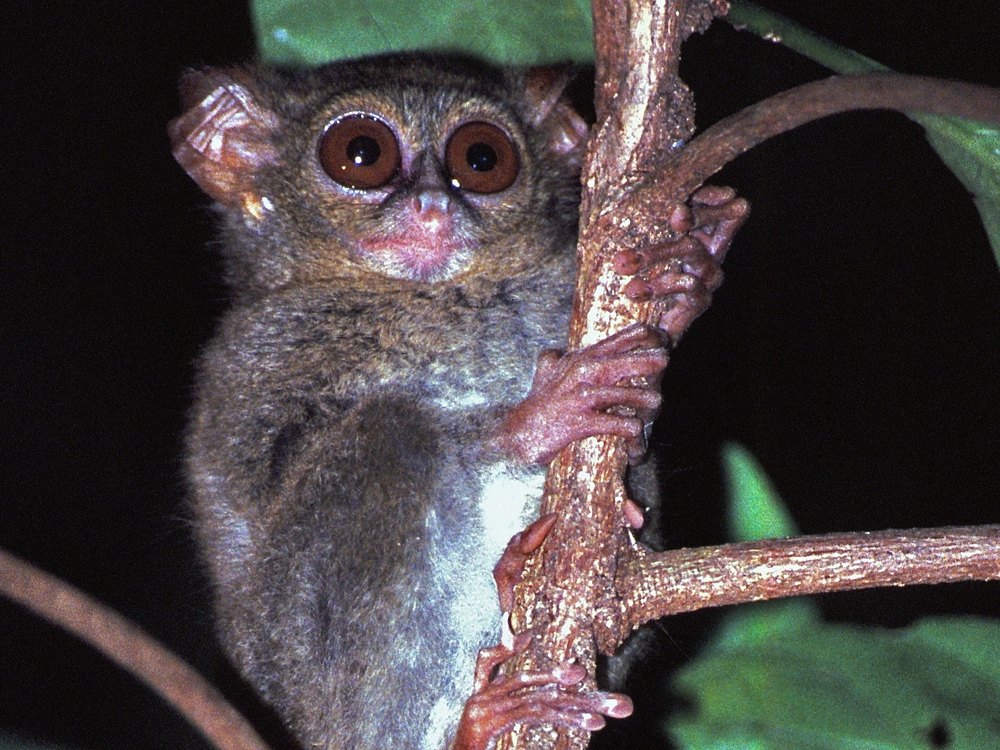
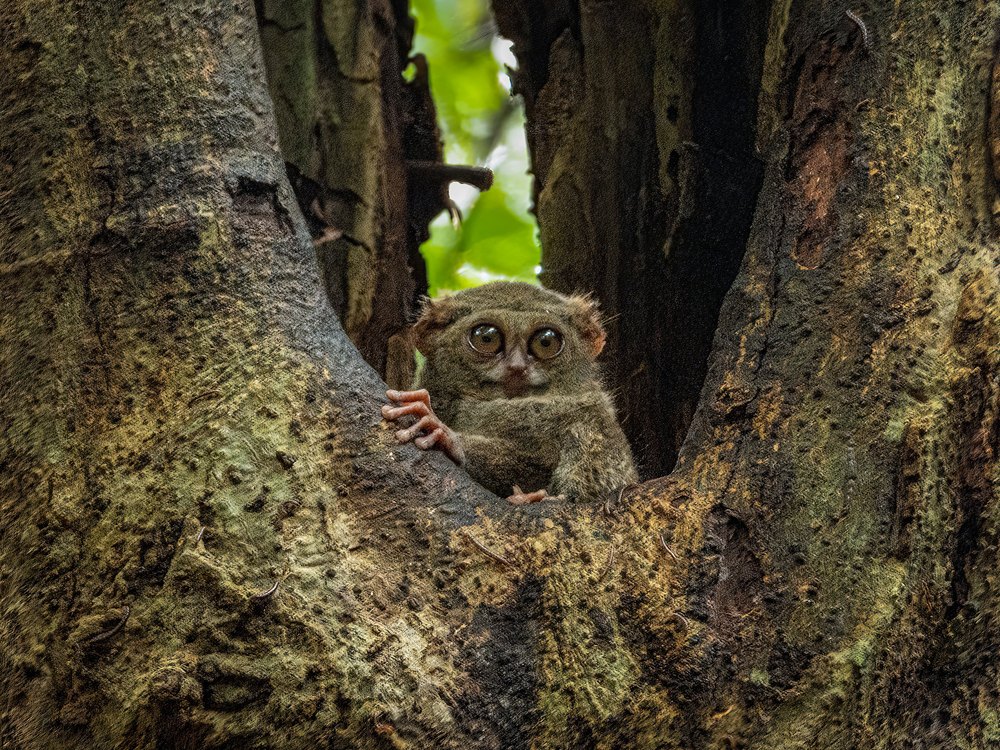
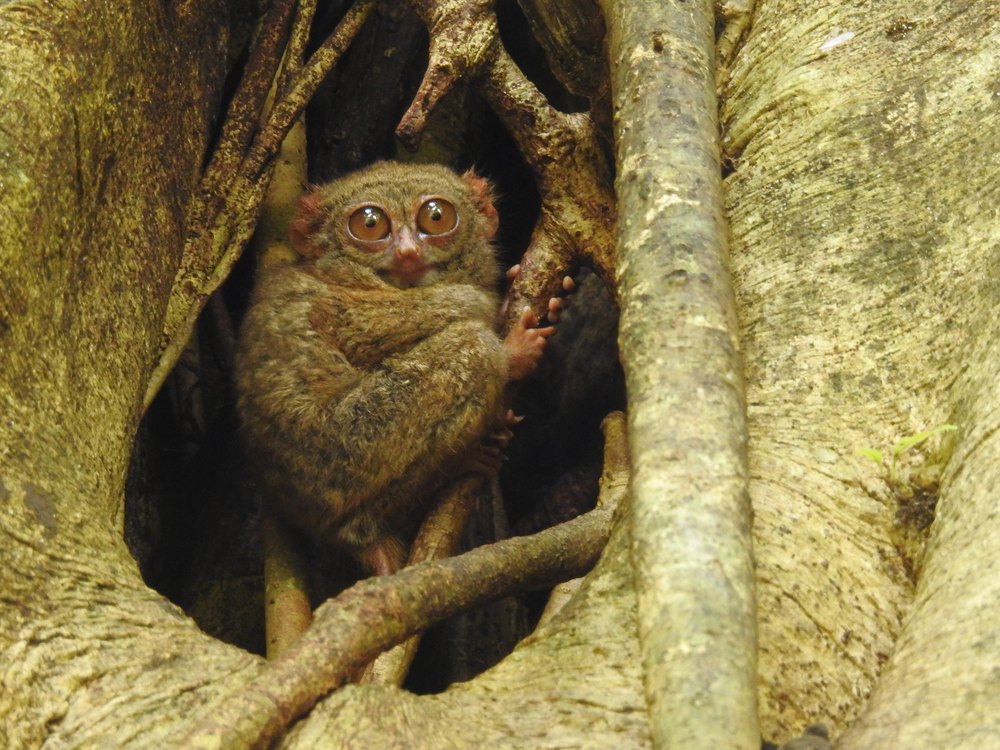
Tarsiers in general have round heads, remarkably large forward-facing eyes, large hairless ears that move easily and a short muzzle. Their velvety fur is buff, greyish brown or dark brown, much like dead leaves or bark, and their hindlimbs and fingers are long.[4]

Name
The English name “Gursky’s Spectral Tarsier” is the one the IUCN and the Mammal Diversity Database use.[1][5] The scientific name Tarsius spectrumgurskyae was published by Shekelle, Groves, Maryanto and Mittermeier in 2017.[3] Until 2010, most tarsiers of Sulawesi were called the Spectral Tarsier (Tarsius spectrum), and most field studies of this animal at Tangkoko were published under that name.[6][7]
In other languages
| Language | Name | Meaning |
|---|---|---|
| Minahasa local | tangkasi | — |
| North Sulawesi local | wusing | — |
| German | Gursky-Koboldmaki | Gursky’s tarsier |
| French | Tarsier de Gursky | Gursky’s tarsier |
| Italian | Tarsio spettro di Gursky | Gursky’s spectral tarsier |
| Spanish | Tarsero de Gursky | Gursky’s tarsier |
The local names are listed by the Mammal Diversity Database.[5]
Body
Senses and special features
At Tangkoko, recordings at the base of sleeping trees (studied as the Spectral Tarsier) found five call types: chirps, twitters, choruses, doubles and whistles.[7] Doubles and whistles are purely ultrasonic, meaning too high for the human ear, and chirps, twitters and choruses reach from audible sounds into the ultrasonic range.[7]
About 42% of the ultrasonic calls were given within one second before the animal moved, and calls were more frequent during travel than during resting, foraging or social time.[8] The author suggests, only as a preliminary idea, that these calls may help the tarsier navigate, so whether it uses echolocation (finding objects by the echoes of its own calls) remains an open question.[8]

Behavior
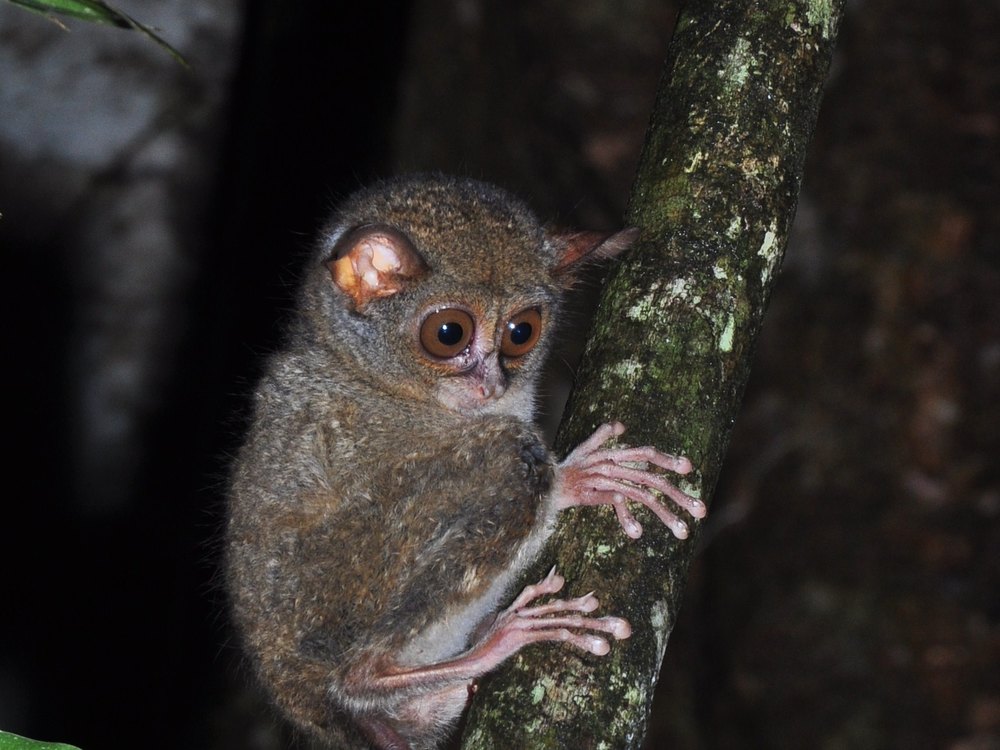
Gursky’s Spectral Tarsier is nocturnal and lives in trees, gripping a vertical trunk and jumping from it. At night its time is split between periods of inactivity and foraging, and a little before dawn the animals sing a territorial duet and return to their sleeping sites.[1]

Groups
The tarsier probably lives in small groups of 2 to 11 animals, monogamous or polygamous, and often shares its home range with more than one adult of the same sex.[1] At Tangkoko, 15 pairs studied in July and August 2018 held territories of 0.016 to 0.041 km² (1.6 to 4.1 ha).[2]
Care of young by group members other than the parents (allocare) is limited at Tangkoko. Nearly grown females gave most of it, through food sharing, carrying, grooming, play, alarm calling and babysitting. Males sometimes groomed and played with the young, and patrolled and defended the territory boundaries.[9]
Group members mob snakes. At Tangkoko in 2003 and 2004, 11 natural and 31 experimentally induced mobbing events, in which the group harasses a snake, drew an average of 5.7 animals, and adults and males were more likely to join.[10]
Duets and calls
A duet is a call sung together by a pair. At Tangkoko the pairs sing around dawn, and sometimes at night when neighbours meet at a territory edge. A phrase lasts 4 to 36 s and averages about 12 s in both sexes, and the duet carries up to 500 m.[2]
Sleeping sites
A group normally uses one main sleeping site and 2 to 3 alternatives, in dense vegetation or tree cavities.[1] At Tangkoko, fig trees (Ficus) are preferred, and the pairs return to a few trees again and again.[2]

Diet
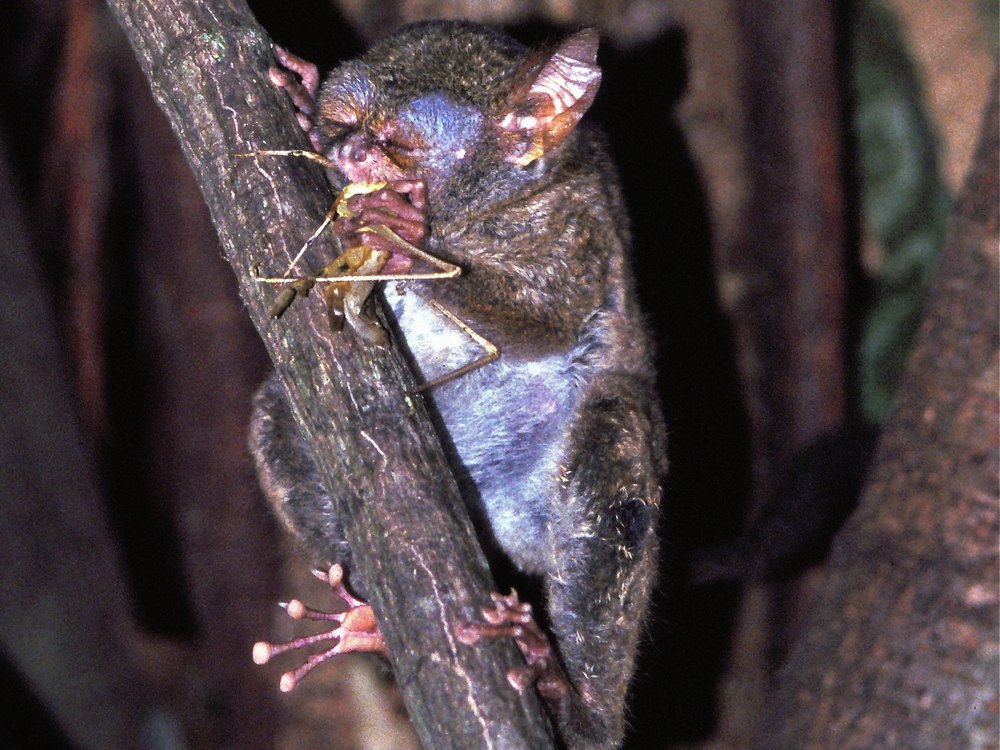
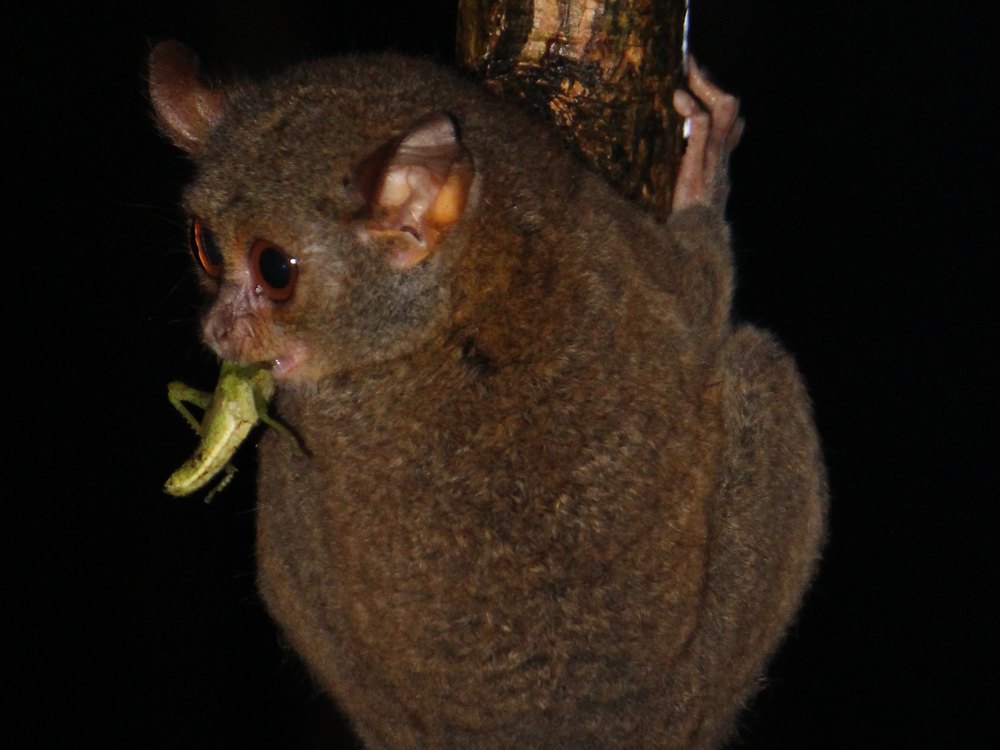
The diet is 100% live animal prey, mostly insects with some small vertebrates. The prey includes insects such as moths and crickets and small vertebrates such as frogs and lizards.[1] The tarsier may prefer some real crop pests, such as large grasshoppers.[1]


Life cycle
| Stage | Age / time | Notes |
|---|---|---|
| Infant | From birth | A wild newborn weighs about 20 to 33% of an adult’s weight, at Tangkoko.[9] |
| Juvenile | Before adulthood | Young are cared for by group members other than the parents, mostly nearly grown females.[9] |
| Adult | From maturity | The IUCN estimates a generation at 7.5 years.[1] |
Young tarsiers are not always safe from their own kind. At Tangkoko, a neighbouring male was seen to kill a young infant.[11]
Ecology
Role in the ecosystem
Gursky’s Spectral Tarsier lives entirely on live animal prey, mostly insects (see Diet).[1]
Predators
Over more than three decades of observations at Tangkoko, domestic cats were seen near tarsiers 169 times, more often and farther from the village as the years went on. Cats tried to catch a tarsier 19 times and succeeded 12 times. The tarsiers always gave alarm calls, sometimes mobbed the cat, and travelled more, moved higher and stayed closer together afterwards.[12] A snake preying on a wild tarsier has also been reported, in a study of the animal as the Spectral Tarsier.[13]
In 1999 field tests with two wild infants at Tangkoko, rubber snakes made the infants move about 1.8 m from where they had been placed, against 0.23 m on control nights, and bird-of-prey models made them move 0.05 m. The infants alarm-called to every model, and their mothers answered an appropriate alarm call about 88% of the time and a wrong one 19%.[14]
Habitat and range
Where it lives
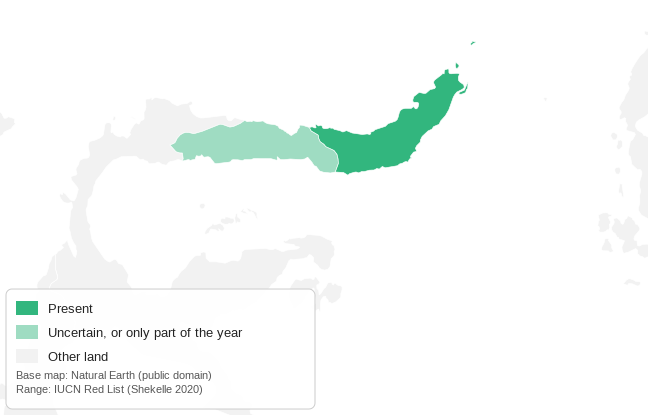
Gursky’s Spectral Tarsier lives on Sulawesi, Indonesia, from the northern tip of the northern peninsula to the Isthmus of Gorontalo, from sea level up to 1,100 m.[1] The Mammal Diversity Database places it in North Sulawesi province and in Gorontalo province east of the isthmus.[5]
Habitat
The tarsier occurs in primary, secondary and mangrove forests, forest gardens and other habitats, with different amounts of human disturbance, that offer enough shrubby cover. The IUCN rates lowland tropical moist forest and mangrove above the high-tide line as suitable and rural gardens and heavily degraded former forest as marginal.[1] It can survive small-scale agroforestry, selective logging and disturbed forest.[1]
At Batuputih in the Tangkoko reserve, tarsiers were found from 10 to 112 m above sea level. The animals slept in trees 1 to 17 m tall, usually tangled with lianas, with 2 to 6 animals in a tree. Sleeping trees stood about 1 ha apart.[15]
Population
In good habitat the density was estimated at 156 animals per km² (Gursky’s study at Tangkoko, 1997).[1] A count along one 2 km transect at Batuputih, in secondary forest, found 46 animals in 17 family groups and gave a density of 230 animals per km²; the authors multiplied this to an estimated 1,415 animals for the whole Batuputih area.[15]
Evolution
Tarsiers are haplorhine primates, the group that also holds monkeys and apes.[5] Dating studies of living tarsiers (not of this species alone) place the split between the Sulawesi lineage and the other tarsiers at about 22 million years ago in two studies (ranges 16.8 to 28.4 and 16.6 to 27.7).[16][17] An earlier study of one mitochondrial gene gave about 20 million years (range 10.6 to 32.1) for the oldest split among living tarsiers.[18]
The Sulawesi tarsiers form one group. Its first branch, the Pygmy Tarsier, split off about 9.9 million years ago (range 6.6 to 13.6), and most later splits among the other Sulawesi species fall between 0.1 and 1.55 million years ago.[17] The two main lineages of the other Sulawesi tarsiers divided about 2.3 million years ago (range 1.5 to 3.3) in one study and about 2.5 million years ago (range 1.6 to 3.5) in another.[17][16]
Forms and variants
The Mammal Diversity Database, GBIF and ITIS list no subspecies of Gursky’s Spectral Tarsier.[5][19][20]
Conservation
Status
The IUCN lists Gursky’s Spectral Tarsier as Vulnerable (criteria A2cde+3cde), assessed on 20 March 2020, with a decreasing population trend.[1] The listing rests on habitat loss alone: at least 30% of its habitat was converted in the past 20 years, about three generations. From 1990 to 2000 about 15.26% of the forest on the island was converted to agriculture, and at least a further 10% has been lost since.[1]
Threats
Habitat lossPesticidesPredationCollection for the pet trade[1]Habitat loss. The IUCN names illegal logging as the main threat.[1] The tarsier tolerates some forest conversion.[1]
Pesticides. Farm pesticides are named as a threat.[1]
Predation. Dogs and cats prey on the tarsier (see Ecology).[1]
Collection for the pet trade. Some animals enter the pet trade.[1]
Light at night. At Tangkoko, extra light at night, from street lights and sky glow, made tarsiers travel and forage more, leave sleeping sites earlier and return later, sleep lower in the trees and call less. The authors suggest this may make them easier for predators to find.[21]
Protection
Tarsiers are protected by national law and by international treaties, including CITES Appendix II. The tarsier lives in several conservation areas, including the Greater Tangkoko area, but the IUCN says management of the protected areas needs to improve.[1] No recovery plan or systematic monitoring is in place, and the IUCN asks for research on threats, population trends and habitat trends, and for public education about tarsiers.[1]
History and culture
Naming
The species was described in 2017 from Manado, North Sulawesi, with the holotype (the reference specimen) MZB 3269.[3][5] It is named for the primatologist Sharon Gursky, whose field studies of this tarsier at Tangkoko were published under the older name. The authors say the new name closes this gap between those papers and current taxonomy.[3]
Research and tourism
A 15-month field study in North Sulawesi, published in 1980 as a study of the wild Spectral Tarsier, made more than 300 sightings and found the animals monogamous and territorial.[22] A 1996 study of tourism at Tangkoko, which named the tarsier among the species watched, found that tourism was growing quickly, that the reserve earned too little to pay for its management, and that primate behaviour was being affected.[23]
In February 2021, a news report said authorities in North Sulawesi had rescued a white (leucistic) baby tarsier of about 6 months, found alone about a metre up a small tree in a fruit garden. A veterinarian of the provincial conservation agency cared for it, with release planned.[24]
Taxonomy
| Rank | Name |
|---|---|
| Kingdom | Animalia |
| Phylum | Chordata |
| Subphylum | Vertebrata |
| Superclass | Tetrapoda[27] |
| Class | Mammalia |
| Subclass | Theria[27] |
| Infraclass | Eutheria[27] |
| Order | Primates[1] |
| Suborder | Haplorhini (dry-nosed primates)[5] |
| Infraorder | Tarsiiformes[5] |
| Family | Tarsiidae (tarsiers)[5][1] |
| Genus | Tarsius[6] |
| Species | Tarsius spectrumgurskyae (Shekelle, Groves, Maryanto and Mittermeier, 2017)[1][5][19] |
Higher classification
Tarsiers form the family Tarsiidae, placed in the infraorder Tarsiiformes within the primates.[3] The genus Tarsius holds the tarsiers of Sulawesi and the islands around it. GBIF lists about a dozen living species in it, and the other tarsiers sit in two separate genera, Cephalopachus for the western tarsier and Carlito for the Philippine tarsier.[6][25] The closest relative of this species is Jatna’s Tarsier, Tarsius supriatnai, named in the same 2017 paper.[3] The two are said to have split about 300,000 years ago.[26]
From one species to many
Until 2010 the tarsiers of Sulawesi were generally called Tarsius spectrum, and most research at Tangkoko was published under that name.[3][6] The 2010 revision gave the name Tarsius tarsier to the tarsiers of Selayar Island and revived Tarsius fuscus for those of the Makassar area, so the northern animals had no valid name until 2017.[6] The 2017 authors separated Gursky’s Spectral Tarsier and Jatna’s Tarsier by their calls and by DNA.[26] Night-active animals often look alike, and Shekelle says the group may hold as many as 16 species.[26] Other Sulawesi species include Dian’s Tarsier (T. dentatus), Wallace’s Tarsier (T. wallacei), the Lariang Tarsier (T. lariang), the Makassar Tarsier (T. fuscus) and the Pygmy Tarsier (T. pumilus).[17]
Sources
- Shekelle, M. 2020. Tarsius spectrumgurskyae (Gursky’s Spectral Tarsier). The IUCN Red List of Threatened Species 2020: e.T162336422A162336580
- Clink, D.J., Tasirin, J.S. and Klinck, H. 2020. Vocal individuality and rhythm in male and female duet contributions of a nonhuman primate. Current Zoology 66: 173–186
- Shekelle, M., Groves, C. P., Maryanto, I. and Mittermeier, R. A. 2017. Two new tarsier species (Tarsiidae, Primates) and the biogeography of Sulawesi, Indonesia. Primate Conservation 31: 61–69
- Dewey, T. and Myers, P. Tarsiidae (tarsiers). Animal Diversity Web, University of Michigan Museum of Zoology
- Mammal Diversity Database, Tarsius spectrumgurskyae (taxon 1000924)
- Groves, C. and Shekelle, M. 2010. The Genera and Species of Tarsiidae. International Journal of Primatology 31: 1071–1082
- Gursky, S. 2015. Ultrasonic Vocalizations by the Spectral Tarsier, Tarsius spectrum. Folia Primatologica 86: 153–163
- Gursky, S. 2019. Echolocation in a Nocturnal Primate? Folia Primatologica 90: 379–391
- Gursky, S. 2000. Allocare in a Nocturnal Primate: Data on the Spectral Tarsier, Tarsius spectrum. Folia Primatologica 71: 39–54
- Gursky, S. 2006. Function of snake mobbing in spectral tarsiers. American Journal of Physical Anthropology 129: 601–608
- Gursky-Doyen, S. 2011. Infanticide by a male spectral tarsier (Tarsius spectrum). Primates 52: 385–389
- Gursky, S. 2025. Domestic cats and predation on a free-ranging primate, Gursky’s tarsier (Tarsius spectrumgurskyae). Folia Primatologica 96: 327–341
- Gursky, S. 2002. Predation on a Wild Spectral Tarsier (Tarsius spectrum) by a Snake. Folia Primatologica 73: 60–62
- Gursky, S. 2003. Predation Experiments on Infant Spectral Tarsiers (Tarsius spectrum). Folia Primatologica 74: 272–284
- Rizki and Abiduna 2020. Populasi dan karakteristik mikrohabitat tarsius (Tarsius spectrumgurskyae) di TWA Batuputih Sulawesi Utara. Bioma 5(2): 131–143 (in Indonesian)
- Driller, C. et al. 2015. Stop and Go – Waves of Tarsier Dispersal Mirror the Genesis of Sulawesi Island. PLOS ONE 10: e0141212
- Hagemann, L. et al. 2022. Small, odd and old: The mysterious Tarsius pumilus is the most basal Sulawesi tarsier. Biology Letters 18: 20210642
- Shekelle, M. et al. 2010. Molecular Phylogenetics and Chronometrics of Tarsiidae Based on 12S mtDNA Haplotypes: Evidence for Miocene Origins of Crown Tarsiers and Numerous Species within the Sulawesian Clade. International Journal of Primatology 31: 1083–1106
- GBIF Secretariat, Tarsius spectrumgurskyae Shekelle et al., 2017, GBIF Backbone Taxonomy (species 9717634)
- ITIS, Tarsius spectrumgurskyae
- Gursky, S. and Grow, N. 2024. The effect of artificial light at night on a nocturnal primate. Folia Primatologica 95: 177–190
- MacKinnon, J. and MacKinnon, K. 1980. The behavior of wild spectral tarsiers. International Journal of Primatology 1: 361–379
- Kinnaird, M. F. and O’Brien, T. G. 1996. Ecotourism in the Tangkoko DuaSudara Nature Reserve: opening Pandora’s box? Oryx 30(1): 65–73
- Mongabay, “Rescue of rare white tarsier raises fears of habitat loss, illegal pet trade” (February 2021)
- GBIF Secretariat, Tarsius Storr, 1780, GBIF Backbone Taxonomy (genus 2436483)
- Mongabay, “Two new species of tarsier, rumored to be inspiration for Yoda, announced on Star Wars Day” (May 2017)
- ITIS, Tarsius spectrumgurskyae, classification