The Western Honey Bee (Apis mellifera) is the social bee kept in hives for honey and for pollinating crops. Each colony has one queen, many workers and some drones. It is native to Europe, Africa and western Asia, and people have since carried it to the other continents.[1] The Asian Honey Bee and the giant honey bees are separate species. The IUCN has no global assessment, but its 2025 Europe assessment puts the wild colonies of the EU at Endangered.[2]
Quick facts
Description
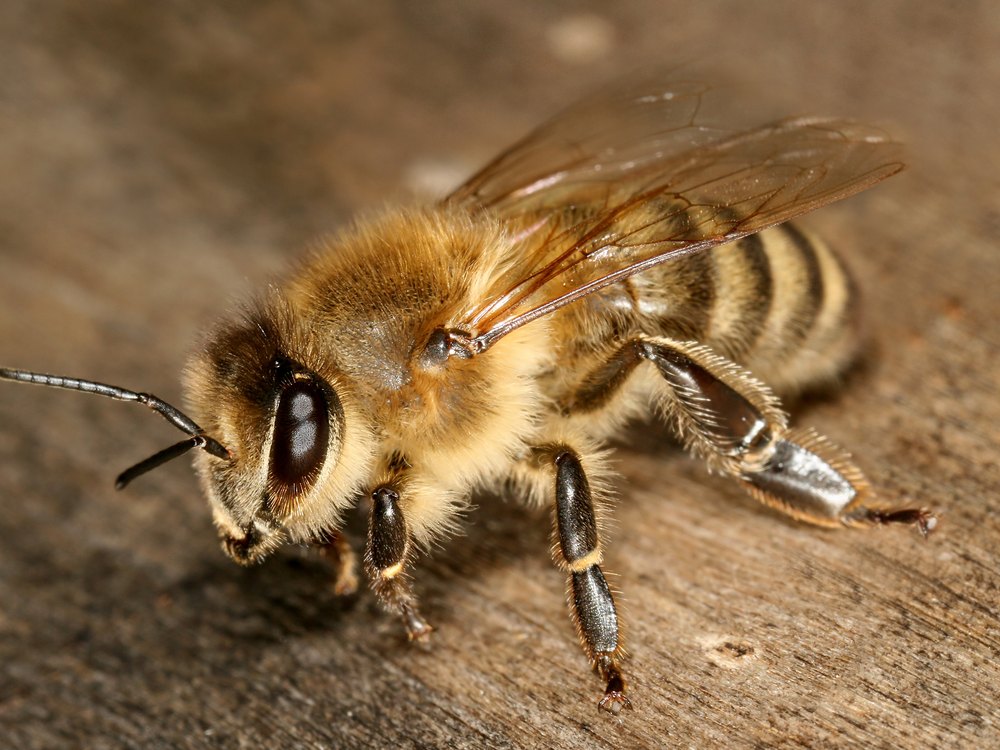
Animal Diversity Web describes Apis mellifera as generally red-brown with black bands and orange-yellow rings on the abdomen.[1] The legs are mostly dark brown or black.[1] Hair covers the thorax, with less on the abdomen.[1] Colour varies between subspecies: some have darker abdominal banding and others a mix of darker and lighter bands.[1]
The three castes differ in shape. Queens (fertile females) are larger than workers (sterile females), and drones (males) are a different size again; the figures are under Body.[1] Worker wings are longer than drone wings, even though the worker is the smaller bee.[1] Males have much larger eyes than females.[1]

Name
“Western Honey Bee” is the English name used by the IUCN Red List for Apis mellifera.[2] Databases also list it as the European Honey Bee.[4][5] The words “honey bee” on their own cover the whole genus Apis, not one species. The Asian Honey Bee (A. cerana, described by Fabricius in 1793), the giant honey bees and the dwarf honey bees are separate species.[6][7]
Carl Linnaeus described the species in 1758 in the tenth edition of Systema Naturae, under the name Apis mellifera.[5][6][8] In 1761 he published the name Apis mellifica in Fauna Suecica. It is a replacement name for the same bee, so it counts as a synonym, an extra name for the same species, and it is common in older books.[8]
In other languages
| Language | Name | Meaning |
|---|---|---|
| Danish local | Honningbi | — |
| Finnish local | tarhamehiläinen | garden bee |
| Scottish Gaelic local | seillean-meala | — |
| Gǀui (Botswana) local | ɟǐne | also honey |
| German | Westliche Honigbiene | Western honey bee |
| French | Abeille domestique | domestic bee |
| Spanish | Abeja de la miel | bee of the honey |
| Dutch | Honingbij | honey bee |
| Swedish | Honungsbi | honey bee |
| Russian | Медоносная пчела | honey-bearing bee |
| Japanese | セイヨウミツバチ | Western honey bee |
| Chinese | 西方蜜蜂 | Western honey bee |
French, Spanish, Dutch, Swedish and Russian names appear in the IUCN Red List text and in GBIF name lists; German, Japanese and Chinese names come from GBIF name lists, which draw on the Catalogue of Life and national checklists. The Danish, Finnish and Scottish Gaelic names are from national checklists, as listed by GBIF; the Gǀui name is from Tanaka and Sugawara 2010, via Tsammalex.
Body
Size
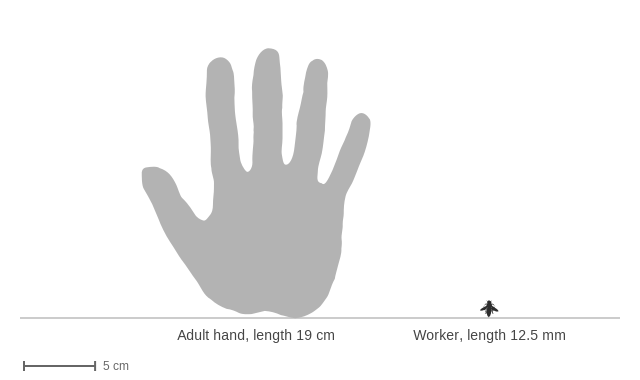
The three castes differ in size. A queen is 18 to 20 mm long, a worker 10 to 15 mm and a drone 15 to 17 mm at maturity, according to Animal Diversity Web.[1]
| Queen | Worker | Drone | |
|---|---|---|---|
| Length | 18–20 mm | 10–15 mm | 15–17 mm |
Head and senses
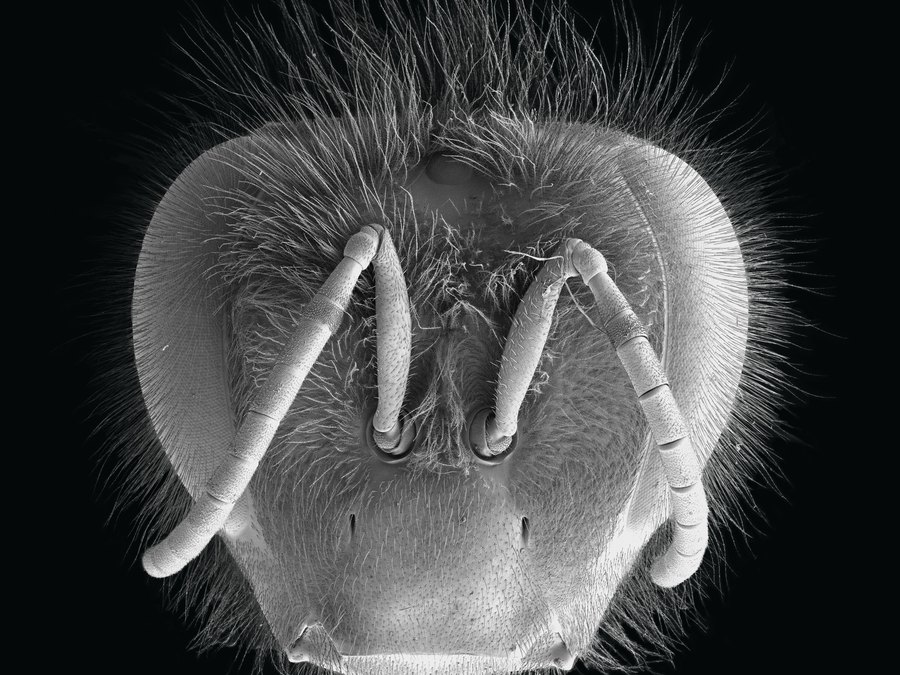
The workers' eyes see ultraviolet light, which people cannot see.[1] A study of the three castes found that worker photoreceptors are most sensitive at 350 nm (ultraviolet), 440 nm (blue) and 540 nm (green), and that workers have about 5,300 ommatidia, the units of a compound eye, against 4,600 in queens.[9] Bees also sense the polarised light of the sky, and in a tunnel experiment they signalled the direction of food in the waggle dance with it.[10] Hearing works through vibration. Each antenna holds a Johnston's organ, a cluster of about 300 to 320 sensory units that picks up vibrations from 265 to 350 Hz. In mature forager workers the antennae are tuned to 250 to 300 Hz, the same band as the sounds made during the waggle dance.[11]

Wings and flight
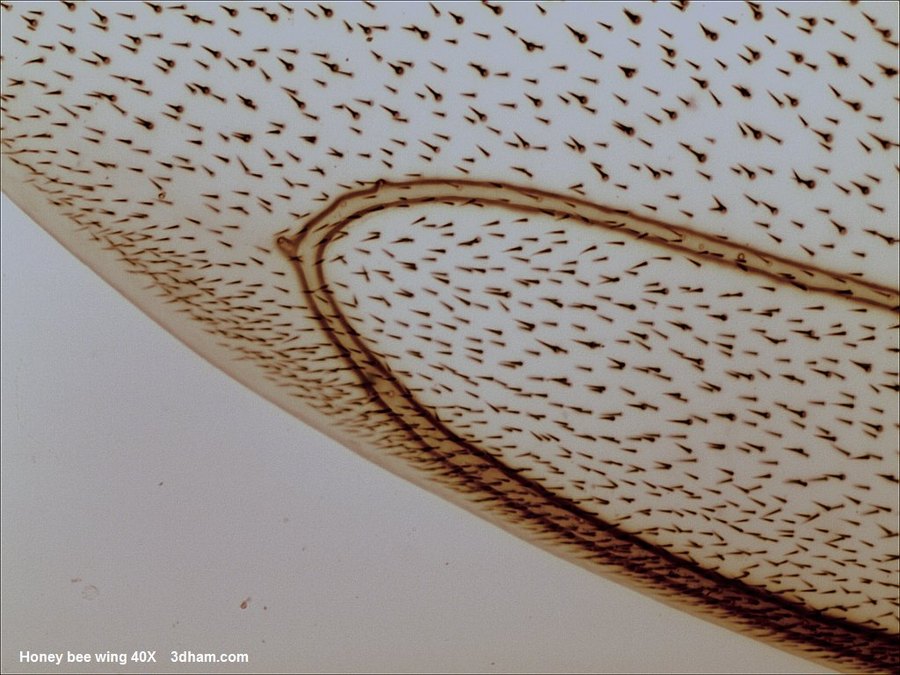
Hovering forager workers beat their wings at about 229.8 Hz, which produces the buzz.[12]

Pollen basket and sting
Honey bee venom contains proteins that can cause an allergy. Reactions range from local swelling to life-threatening anaphylaxis, and in rare cases death, and 12 of the venom proteins are registered as allergens.[13]


Alarm pheromone, a chemical signal, is released from a gland near the sting; its main component is isopentyl acetate, which triggers defensive and aggressive responses in the colony.[14]
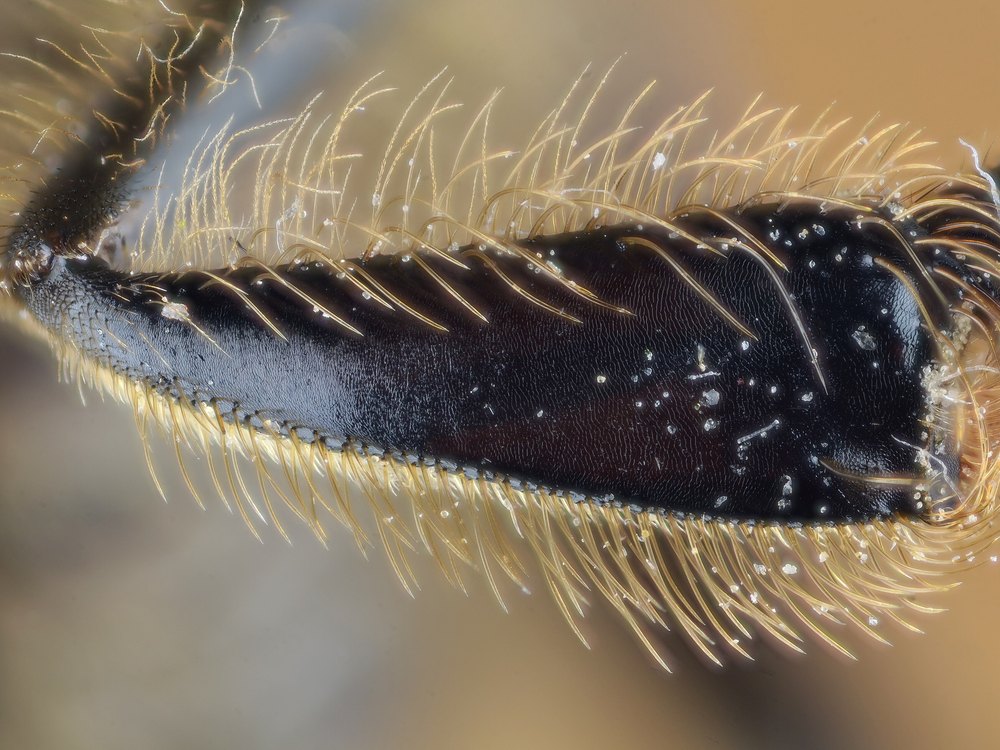
The pollen basket is a hairy hollow on the hind leg of a worker, which holds a ball of pollen carried to the hive.[1]
Wax and comb
Young workers secrete liquid wax from special glands in the abdomen, and it hardens into scales that are used to build the honeycomb, the wax cells that hold food and brood (the eggs, larvae and pupae).[15] In a measured comb of Italian bees (A. m. ligustica) the average worker cell was 5.50 mm wide and the average drone cell 6.63 mm.[16] Dry weight, measured in one study, averaged 42 mg for workers and 63.7 mg for drones.[17]
Behavior
Castes and work
A honey bee colony is a eusocial group, which means that only some of its members breed and the others work for the whole colony. It has three kinds of adult, called castes. The queen is the egg-laying female. A worker is a non-breeding female and does the work of the colony. A drone is a male, and his task is to mate with queens from other colonies. Colonies of the Western Honey Bee (Apis mellifera) can be managed, which means kept in hives, or free-living; the IUCN counts a group of free-living colonies as wild only when it sustains itself without swarms from managed ones.[2]
Foraging
Foraging workers are usually found within about 3 km of the hive, and they can fly 8 to 13 km for food or water.[1] Decoded dances of workers foraging on heather near Sheffield, UK, in August 1996 showed distances of up to about 14 km (Beekman and Ratnieks 2000).[18][19] The same city gave an average near 1 km in May 1997, so the distance depends on what is in flower nearby.[19] A prediction from body size alone had been about 2.5 km, far below what the dances showed.[19] In a study at three sites in Virginia, workers flew about 14% farther for nectar than for pollen.[20] Small developments covering about 1% of a foraging range roughly doubled the flight distance of foraging workers.[21]
Waggle dance
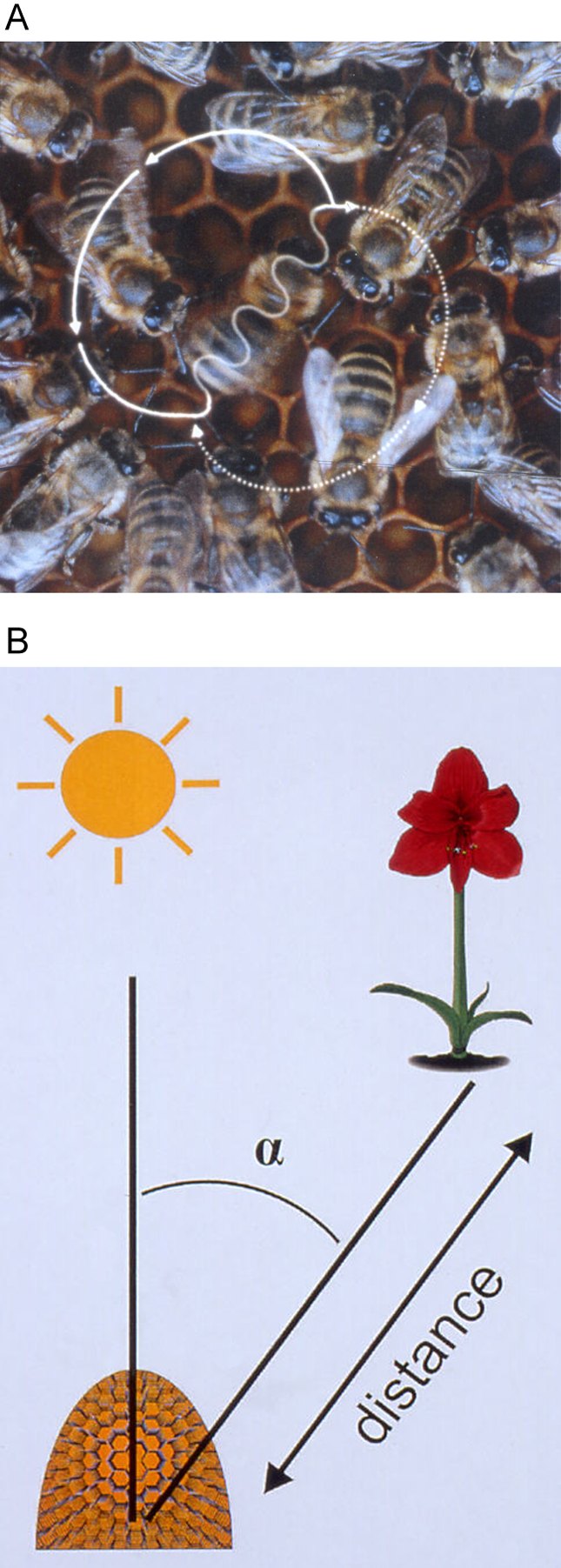
A forager that has found good food can tell nestmates about it by a waggle dance, a figure-of-eight dance on the comb (the wax cells of the nest). The longer the straight waggle run in the middle of the figure, the farther away the food is. Karl von Frisch described this dance language (see History and culture).[22] For food close to the hive, a worker dances a simpler round dance, circling without a straight waggle run.[1]
The dance does not work like a fixed ruler. Each forager has her own link between the length of the waggle run and the distance, and the slopes and starting points of these links differ significantly between bees. A bee that follows the dance can therefore misjudge the distance by up to 50% (Schürch and colleagues 2016).[3]

Swarming
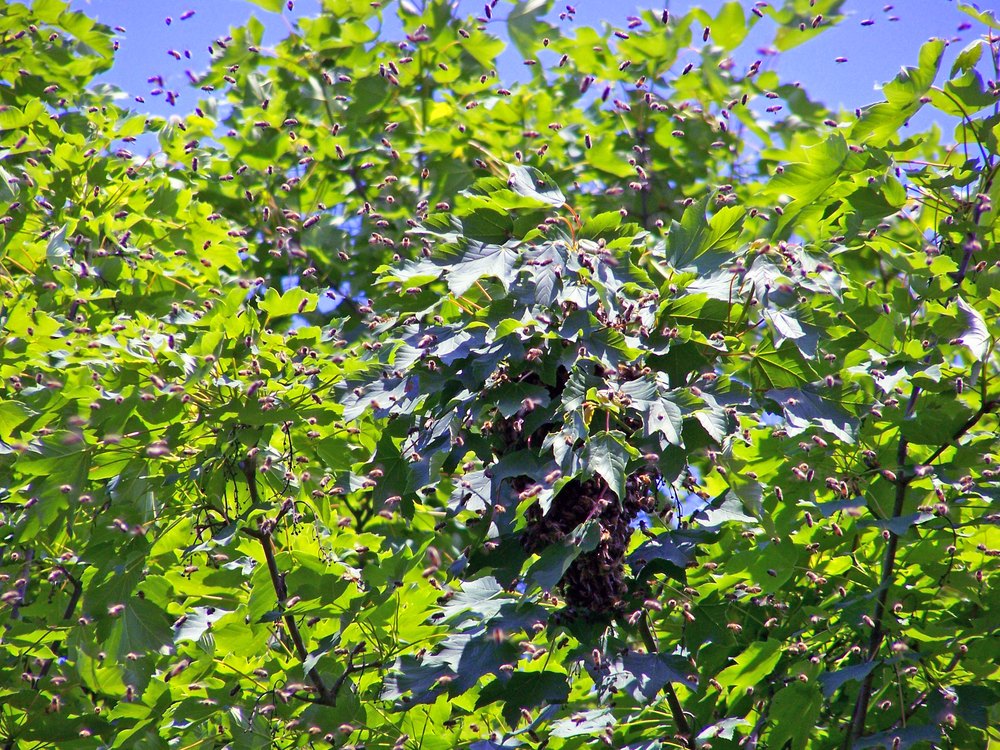
A colony reproduces by splitting in two. A swarm is a group of workers that leaves the hive with the old queen to found a new colony. The first, or prime, swarm leaves with the mated old queen; later swarms, called afterswarms or casts, leave with the first young virgin daughter queens.[2] In a study of colonies in Germany, a colony produced an average of about two swarms per year.[2] A swarm may carry up to half of the workers of the old colony.[1]

Defence
Workers defend the nest with their sting. Apart from allergic reactions (see Body), stings are dangerous to a mammal only in large numbers: the lethal dose is about 20 stings per kilogram of body weight.[1]
Diet
Honey bees feed on what flowers and the surroundings provide. Workers forage for nectar, pollen, honeydew, propolis and water.[2] Nectar is the sugary liquid of flowers and is the bees’ source of carbohydrate; pollen supplies protein; honey is nectar that the bees have stored in the nest.[1] Honeydew is the sugary liquid left on plants by sap-feeding insects, and propolis is a resin that bees collect from plants.[2] Water is collected for the colony as well.[2]
The food supply depends on the place. For how far workers travel for nectar and pollen, see Behavior.
Life cycle
| Stage | What it looks like / size |
|---|---|
| Egg | Laid by the queen in a wax cell; hatches after about 3 days, or 28 to 144 hours depending on temperature[1] |
| Larva | A grub that stays in its cell and is fed by nurse workers; lasts 4 to 5 days for a bee that will be a worker[1] |
| Pupa | The stage in which the larva turns into an adult; lasts about 12 days for a bee that will be a worker[1] |
| Adult worker | Leaves the cell 21 days after the egg is laid[1] |
A particularly fertile queen may lay as many as 1,000 eggs a day, and about 200,000 eggs in her lifetime.[49]
Stages
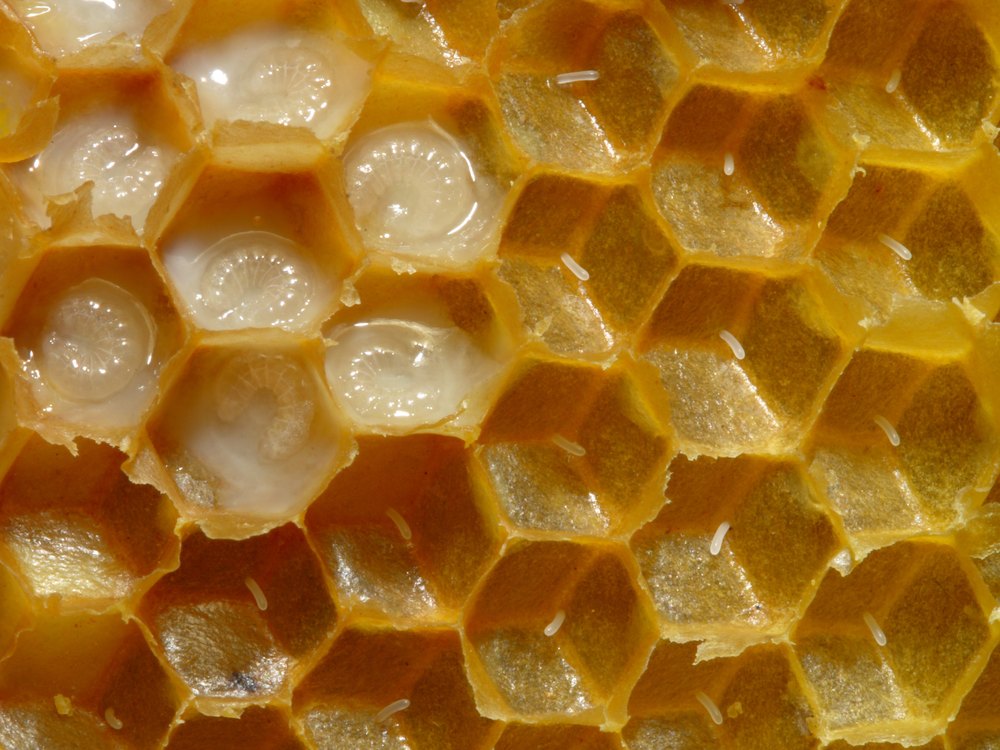
A honey bee passes through four stages: egg, larva (the feeding grub), pupa (the stage in which the body is rebuilt) and adult. For a worker, the most common bee in the colony, Animal Diversity Web gives about 3 days for the egg to hatch and 21 days from egg to adult.[1] The bees develop fastest at a hive temperature of 33 to 36 °C.[1]
The three castes (see Behavior) develop at different speeds. A queen larva lasts 6 days and the queen pupa 7 to 8 days, so a queen is an adult 16 days after the egg is laid. A drone larva lasts 6 to 7 days and the drone pupa 14 to 15 days, so a drone takes 24 days.[1] A queen is ready to mate at 15 to 17 days old.[1]

Queen and mating
A queen mates in the air, on nuptial (mating) flights in spring and summer. In southern Europe these start as early as March, and queens choose sunny days with little wind.[2] She flies a considerable distance to a drone congregation area, a place in the air where drones from many colonies gather.[2]
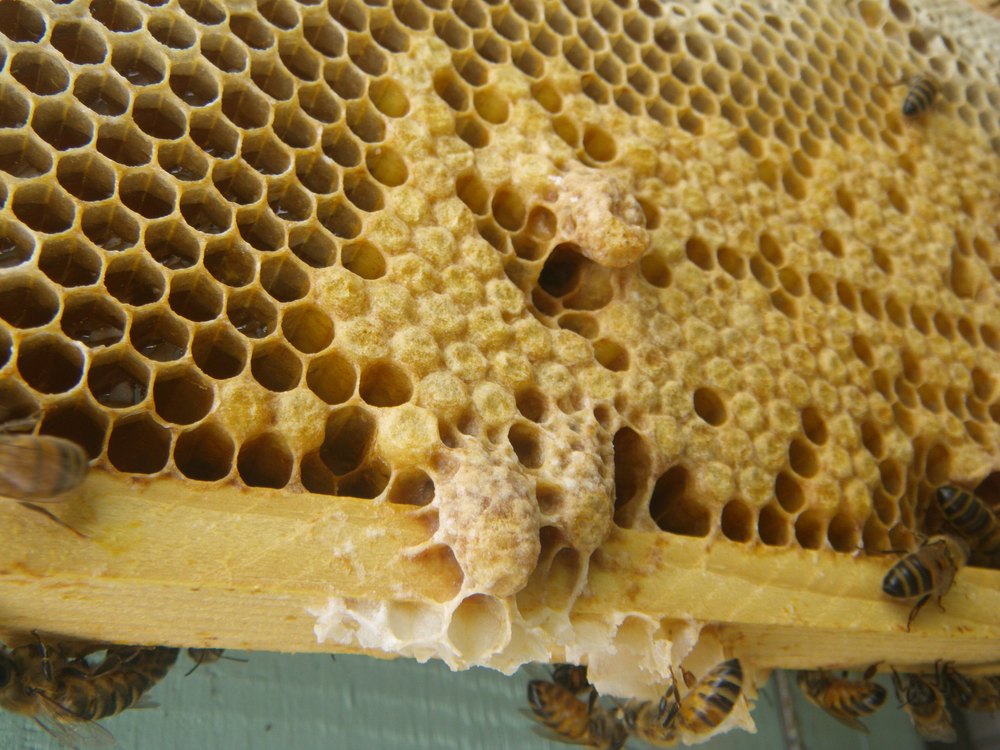

One queen mates with several drones, a habit called polyandry. IUCN records between 1 and 49 matings for a single queen.[2] A meta-analysis of managed colonies found an average of about 12 drones per queen.[23]
Colony year
A colony lives through the year as a changing group. In spring and summer the young queens fly out to mate, and swarms leave with a mated old queen.[2] See Behavior for how often a colony swarms.
Workers raised in autumn do not die within weeks. They live through the winter which carries the colony to the next spring.[1]

Lifespan
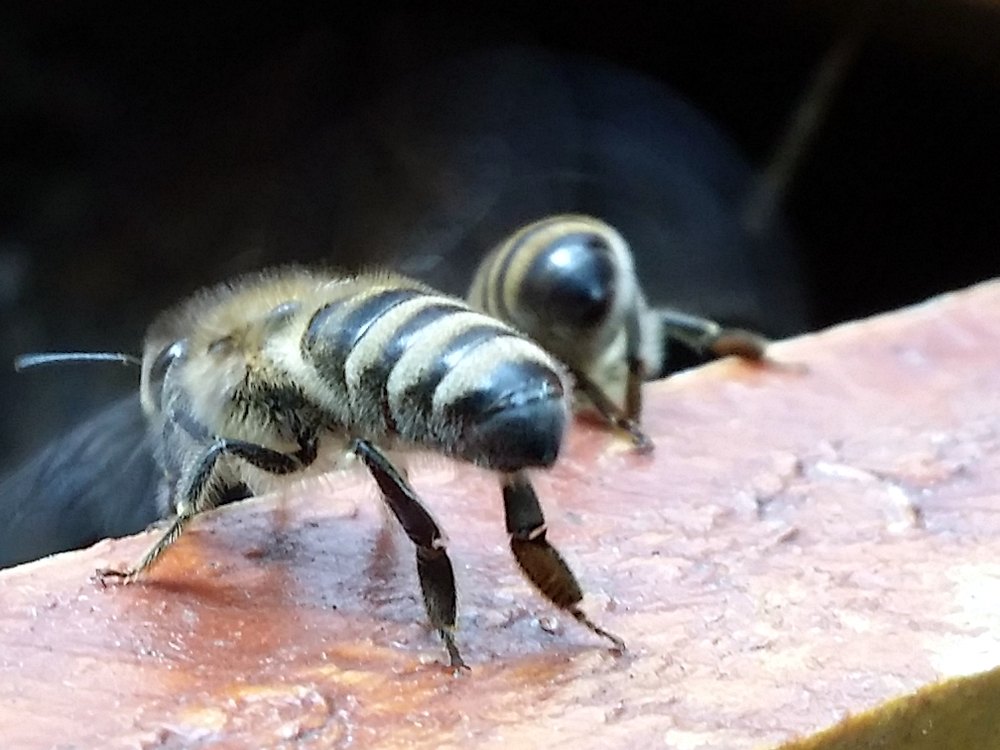
Lifespan depends on the caste and the season. Animal Diversity Web gives these figures.[1]
- Queen: commonly 2 to 3 years and some live to 5, mostly in managed colonies.[1]
- Worker: a few weeks in summer and up to 11 months when the worker overwinters.[1]
- Drone: 4 to 8 weeks.[1]
This is a colony generation, the average age of established wild colonies that survived at least one year in two self-sustaining wild populations outside Europe, and not the age of one bee.[2][24]
Ecology
Pollination
Of the 115 leading global food crops, 87 (about 75%) depend on animal pollination for fruit, vegetable or seed production, and these crops supply 35% of global food crop production by volume.[25] Across 41 crop systems on all continents except Antarctica, fruit set rose with visits by wild insects in every system, but with honey bee visits in only 14% of them; managed honey bees added to wild-insect pollination rather than replacing it.[26] Wild bees and other wild insects therefore pollinate crops too.
In natural habitats worldwide, Apis mellifera is the most frequent flower visitor, making an average of 13% of flower visits across 80 plant–pollinator networks (range 0 to 85%). In 33% of those networks it was never seen on flowers at all.[27]
Predators
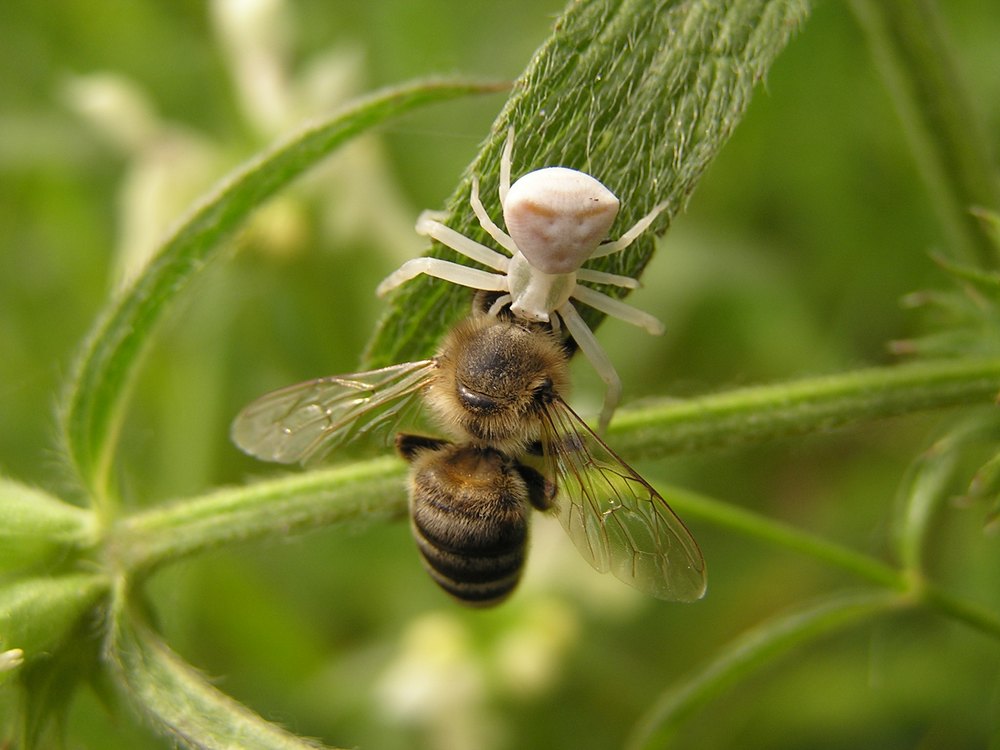
Animal Diversity Web lists beewolves (wasps that hunt bees), spiders, other wasps, bee-eaters, honeyguides, bears, honey badgers, skunks, toads, opossums, wax moths and small hive beetles among the enemies of honey bee colonies, including managed ones.[1] Skunks and bears are the mammals that most often raid kept hives, skunks by scratching at the entrance and eating bees at night, bears by breaking into hives and returning again and again.[28] Wax moth larvae eat beeswax combs in weak or dead colonies and in stored combs.[28]
In Europe, the Asian hornet Vespa velutina hunts foraging workers at hive entrances from the end of summer to winter (see Conservation).[2]

Parasites and disease
The most damaging parasite is Varroa destructor, a parasitic mite that feeds on the fat body of adult bees and of pupae.[28] It originally lived on the Asian Honey Bee (Apis cerana) and moved to the Western Honey Bee during the first half of the 20th century, probably when hives were taken to eastern Russia or the Far East. It reached Bulgaria in 1967, Germany in 1977 and the United States in 1987, and by 2009 was found almost everywhere except Australia.[29] The IUCN dates its arrival in Europe to the 1960s.[2] Untreated managed colonies in temperate climates may collapse three to four years after the first infestation.[29] Africanized bees in Brazil and an isolated Italian-bee (A. m. ligustica) population on Fernando de Noronha, untreated for more than 25 years, show long-term tolerance.[29]
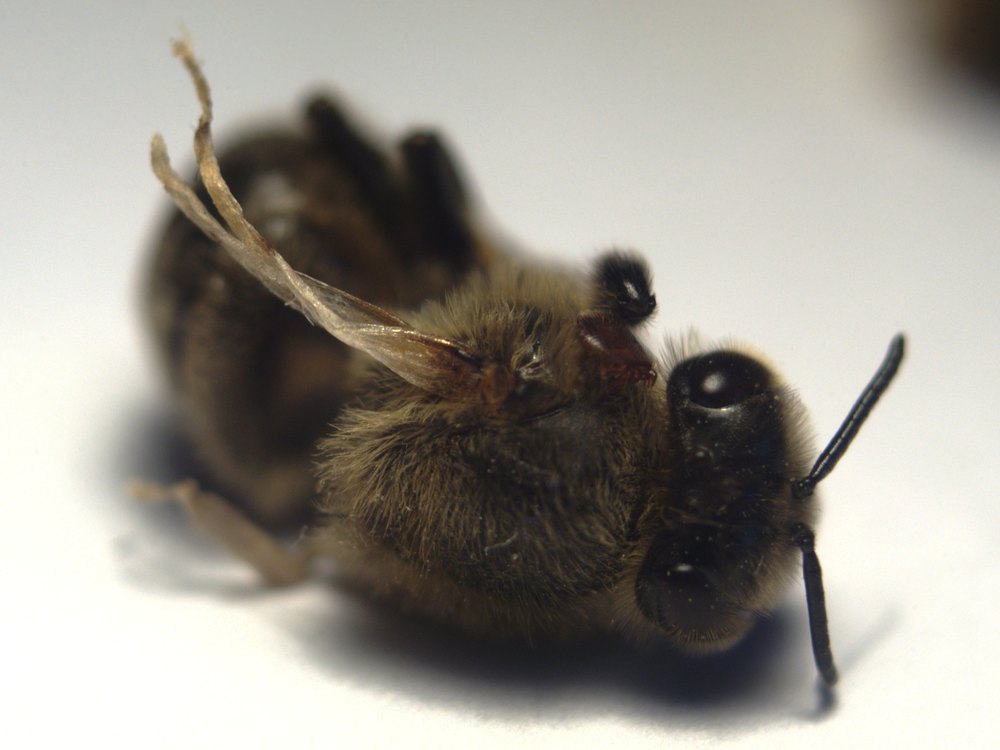
The mite also spreads deformed wing virus, which gives worker bees crumpled wings and a bloated, shortened abdomen; in some European areas up to 100% of colonies test positive, depending on the season. The virus is one of the key factors in the final collapse of mite-infested colonies.[30]
In the United States, managed colonies lost on average 29.3% over winter across 17 survey years, and about 40.2% in the winter of 2024 to 2025, the highest on record.[31] Commercial beekeepers there lost on average 62% of their managed colonies between June 2024 and March 2025.[32] Managed colonies are replaced by splitting hives. For wild colonies and the IUCN assessment, see Conservation.

Habitat and range
Habitat
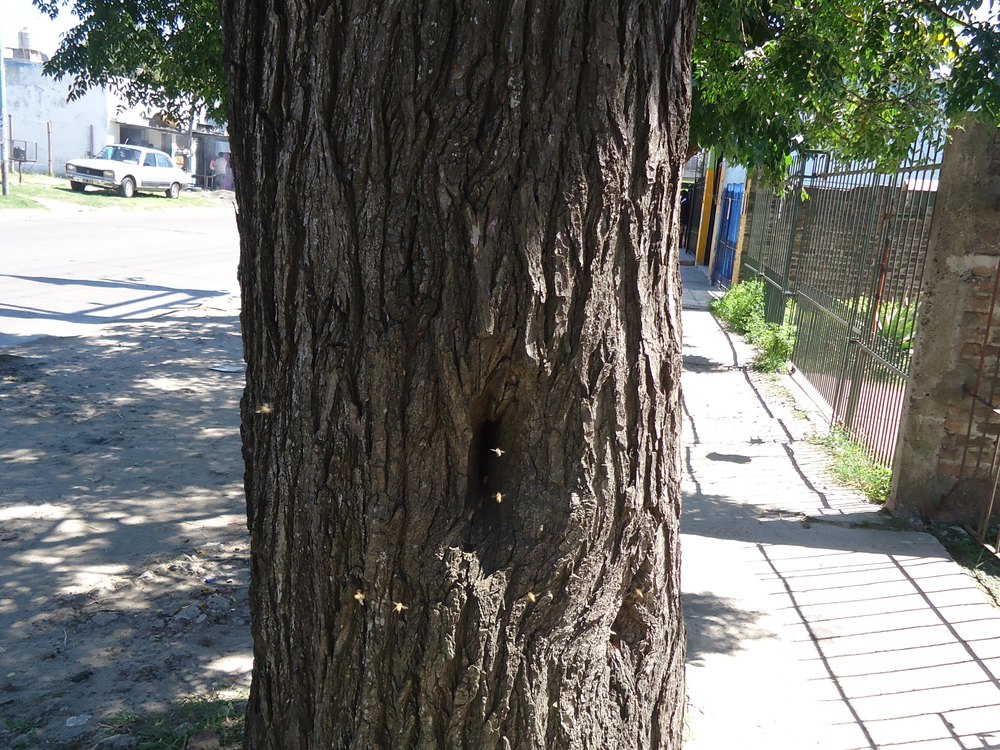
The Western Honey Bee nests in temperate forests, shrublands and grasslands, and even in artificial habitats, wherever it can find pollen, nectar, propolis, honeydew and water. Free-living colonies depend on suitable nest sites, such as tree cavities, and also use cavities in walls, building roofs and hollow electric power poles. Colony densities are high in some cities, among them Belgrade and Munich.[2] Honey bees find a richer foraging environment in open habitats than in managed forests, which lack pollen in late summer.[2][33]
A count of tree cavities in 106 European forest areas suggested that more than 80,000 wild colonies could be sustained in the forests of Europe.[34] In the Arnot Forest in New York State, a 2002 census found about as many wild colonies as one in 1978, even though Varroa was present.[35]

Range
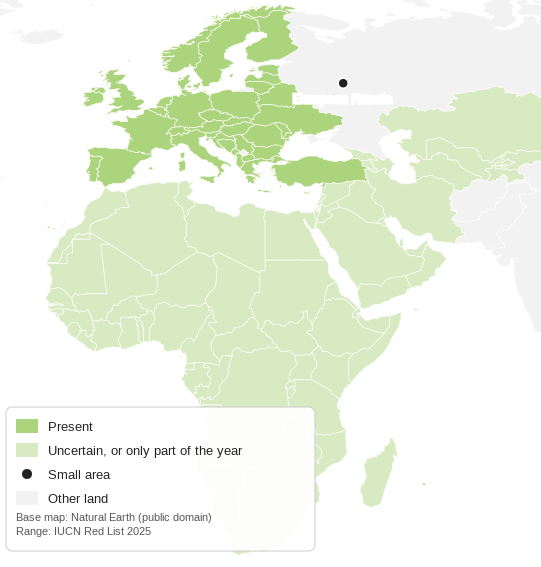
The Western Honey Bee is native to the whole of Europe except Iceland, the Faroe Islands, the Azores and northern Scandinavia, and also to Africa, the Middle East and Central and West Asia.[2] Kept colonies were later introduced to the non-native parts of Europe and are widespread there.[2] Humans have carried the species to East Asia, Australia and the Americas, and it is now kept worldwide.[1] Colonies reached Virginia from England in 1622,[36] and the African subspecies A. m. scutellata reached Brazil in 1956.[37]
Evolution
The genus Apis holds the honey bees. ITIS lists 8 species,[6] and a 2025 study counts at least 9, because it treats the Borneo mountain bee, A. nuluensis, as a species of its own.[7] Cridland and colleagues (2017) put the split between A. mellifera and the Asian Honey Bee, A. cerana, at roughly 6 to 25 million years ago, a range taken from earlier work.[38]
Where the Western Honey Bee itself began is still argued. Whitfield and colleagues (2006) used 1,136 variable DNA positions and concluded that Africa was the origin, with the M, C and O lineages arising from two to three expansions out of Africa.[39][38] A lineage here is a major genetic group of subspecies. Wallberg and colleagues (2014) studied 140 genomes from 14 populations and found that the data did not clearly favour one origin; an Asian origin was the most economical explanation, because the other honey bee species live in Asia.[40] Cridland and colleagues (2017) combined the data sets and found the Middle East or north-eastern Africa most likely, with the A and Y lineages branching off first.[38] The IUCN text reads the Chinese subspecies sinisxinyuan, which extends the M lineage to the far east, as further support for an Asian origin and against an African one.[2][41] Kotthoff and colleagues (2013) argued that the genus Apis arose in Europe, and that the ancestors of the Western Honey Bee moved from western Europe to Africa in the late Miocene and returned to Europe in the Holocene.[42]
Ruttner (1988) sorted the subspecies into four lineages: A (Africa), M (western and northern Europe), C (south-eastern Europe) and O (the Middle East and western Asia), and genome surveys support them. Later work added Y (southern Arabia), L (Egypt) and U (Madagascar).[2][40][38] The IUCN text points out that the high genetic diversity in the native range shows no sign of a domestication bottleneck, a sharp loss of variation when a wild species is first kept.[2][40]
The genome was published in 2006, from the DNA of drones of a single queen. It has 16 chromosomes in the haploid (single) set, a haploid size of about 262 million base pairs, and 10,157 genes in the official gene set. Compared with fruit flies and mosquitoes, the honey bee has fewer genes for immunity, detoxification and taste, but more for smell.[43]
Forms and variants
Subspecies
No single list of subspecies is agreed. Animal Diversity Web counts 26,[1] and a 2020 revision lists 33 taxa.[44] The IUCN text names ten European subspecies (mellifera, ligustica, carnica, iberiensis, macedonica, cecropia, siciliana, ruttneri, cypria and adami) and a Chinese one, sinisxinyuan.[2] They fall into the lineages explained under Evolution: mellifera in M, four of the European ones in C, and the island forms in A or O.[2] The Catalogue of Life lists every subspecies as a synonym of the species, and ITIS lists none.[4][6]
See all 34 named subspeciesHybrids
The African subspecies A. m. scutellata was brought to Brazil from South Africa in 1956 and crossed with bees of European descent to give a hybrid better suited to the tropics.[37] Several swarms escaped in 1957, and the hybrid swarms spread rapidly north through the American tropics, reaching the United States in 1990.[37] The result, the Africanized honey bee, is a hybrid population of African and European bees, not a subspecies, and commercial breeding lines are strains, not subspecies either.[37][45][43][2]
Castes
The adults of a colony come in three castes that look and live differently: the queen lays the eggs, workers do the work of the colony, and drones mate with queens. They are forms within one colony, not separate species or subspecies.[1]
Conservation
Status
The IUCN has not assessed the Western Honey Bee (Apis mellifera) for the whole world. Its Europe assessment, assessed on 17 July 2025, gives the species as Data Deficient across Europe, because there are too few data on the distribution, survival and trends of free-living colonies in that wider region.[2] The same assessment rates the wild populations of the European Union (EU27) as Endangered, under criterion A2abe, which rests on a population decline.[2][32]
The IUCN defines ‘wild’ here as self-sustaining groups of free-living colonies. ‘Self-sustaining’ means that the group can keep itself going for at least ten years through the reproduction of its own colonies, without depending on swarms arriving from managed colonies.[2] The time span is three generations, and one generation of a colony is 3.3 years on average.[2] The assessment found a similar level of threat in Switzerland and England, which are outside the EU.[2] It describes the wild, self-sustaining populations of Europe as now rare or locally extinct.[2] In Europe, managed colonies outnumber free-living ones, which makes it the region with the lowest density of free-living colonies in the world.[2]

Threats
Disease Habitat loss Pollution
Habitat loss. The IUCN names the loss of nest sites and food as one threat to wild colonies. Large trees with cavities are being lost, hollow trees are removed along avenues, and free-living colonies compete for cavities with other animals that raid their nests in winter. Pollen and nectar are in short supply, and winter survival is higher where more semi-natural habitat lies nearby.[2]
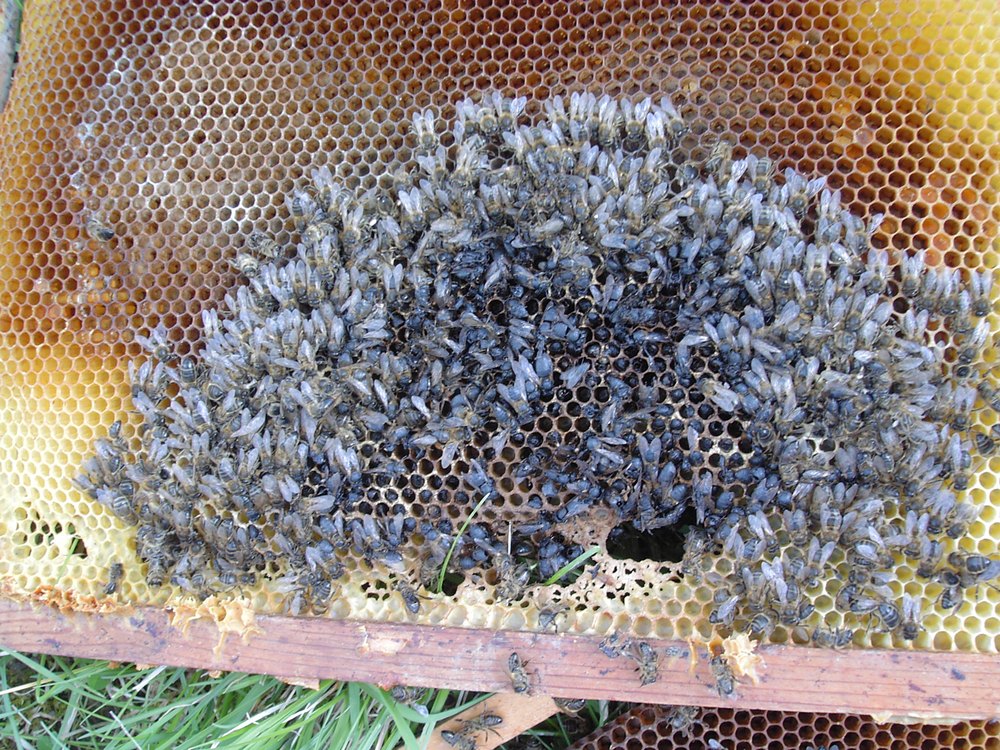
Parasites, pests and disease. The parasitic mite Varroa destructor is called the most likely cause of the loss of wild populations across Europe. It reached Europe in the 1960s, feeds on the fat body of the bee and carries deformed wing virus.[2] The gut parasite Nosema ceranae was first recorded in Europe in 2004.[2] The Asian hornet (Vespa velutina) has spread through western Europe, from southern Portugal to the Netherlands and into Great Britain, and hundreds of hornets hovering at a hive entrance can disrupt foraging and lead to starvation.[2] The small hive beetle (Aethina tumida) was first seen in Europe in 2014, in Calabria, Italy, and is now confined to a limited area there.[2] Tropilaelaps mercedesae, another parasitic mite, has recently been reported in managed colonies in Europe.[2]
Mixing with other subspecies. The trade in queens and the moving of hives between regions by beekeepers can bring in genes from other subspecies, and such mixing has been documented in A. m. mellifera even inside protected areas.[2]
How serious. The IUCN lists the scope and severity of all these threats as unknown.[2] For the losses of managed colonies, see Ecology.
Protection
The assessment follows the IUCN guidelines for species that have both managed and wild populations, and it treats only the free-living colonies as wild.[2] The Honey Bee Watch coalition works to locate, monitor, study and protect wild colonies across Europe.[2][32] Other monitoring schemes include FreeTheBees and the Swiss BeeMapping project.[2]
The IUCN lists three measures for wild colonies: conserving habitats rich in nesting cavities, controlling invasive predators and parasites, and promoting native and regional subspecies in beekeeping.[2] Conservation groups back the last of these, and an Italian declaration of 2018 (San Michele all’Adige) calls for the protection of local subspecies.[2] Importing queens of non-native subspecies is legally restricted in Serbia, Slovenia and the Canary Islands, and the restriction is under consideration in Ireland.[2]
History and culture
The first description
Carl Linnaeus described Apis mellifera in the 10th edition of Systema Naturae in 1758.[8] In 1761 he used the name Apis mellifica in Fauna Suecica, which the Moure catalogue treats as an unnecessary replacement name, so mellifera remains the valid name.[8]
Beekeeping
Beeswax found in the residues of Neolithic pottery from Europe, the Near East and North Africa shows that people used bee products from at least the 7th millennium BC.[46] The same study dates Old Kingdom Egyptian bee iconography to about 2400 BC.[46]


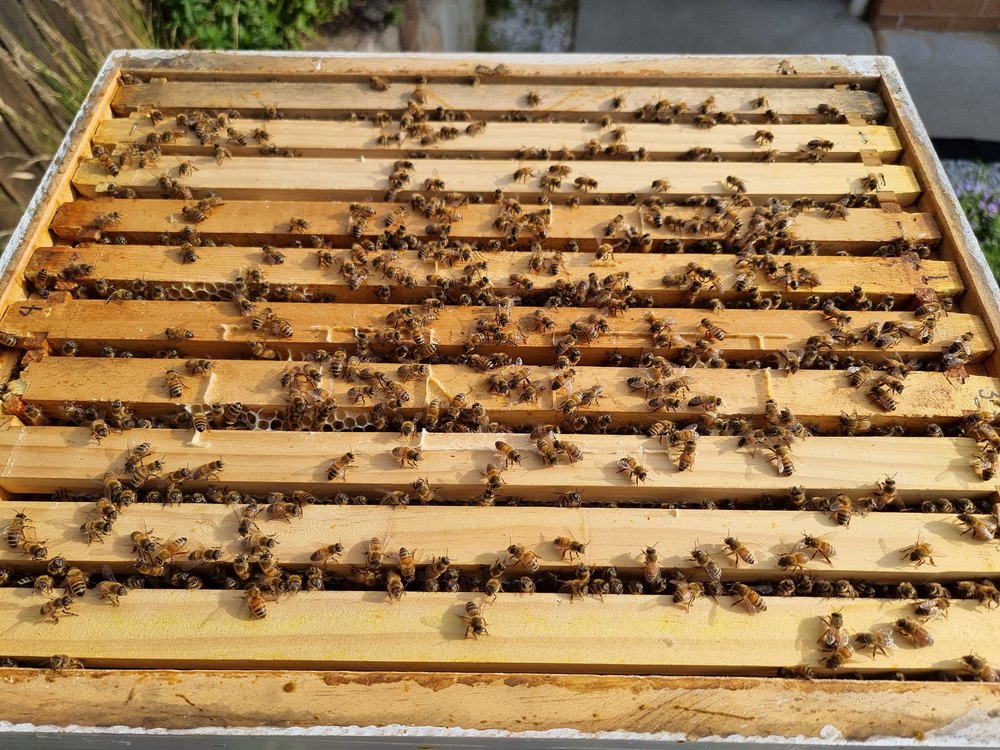

Lorenzo Langstroth of Philadelphia received US Patent No. 9,300 for a beehive on 5 October 1852.[47]
The trade in queens and the moving of hives between regions by beekeepers do mix gene pools, and this has produced hybridisation in A. m. mellifera.[2]
The dance language
Karl von Frisch shared the 1973 Nobel Prize in Physiology or Medicine with Konrad Lorenz and Nikolaas Tinbergen, one third each.[22] He is known above all for his research on the dance language of honey bees (see Behavior).[22]
Taxonomy
| Rank | Name |
|---|---|
| Kingdom | Animalia |
| Phylum | Arthropoda |
| Subphylum | Hexapoda |
| Class | Insecta |
| Subclass | Pterygota[51] |
| Infraclass | Neoptera[51] |
| Superorder | Holometabola[51] |
| Order | Hymenoptera |
| Suborder | Apocrita[51] |
| Infraorder | Aculeata[51] |
| Superfamily | Apoidea[51] |
| Family | Apidae |
| Subfamily | Apinae[51] |
| Tribe | Apini[51] |
| Genus | Apis |
| Species | Apis mellifera (Linnaeus, 1758)[5][6] |
Synonyms (10)
| Name |
|---|
| Apis mellifica (Linnaeus, 1761) |
| Apis gregaria (Geoffroy, 1762) |
| Apis adansonii (Latreille, 1804) |
| Apis fasciata (Latreille, 1804) |
| Apis caffra (Lepeletier, 1836) |
| Apis nigritarum (Lepeletier, 1836) |
| Apis daurica (Fischer von Waldheim, 1843) |
| Apis australis (Kiesenwetter, 1860) |
| Apis cerifera (Gerstäcker, 1862) |
| Apis siciliana (Dalla Torre, 1896) |
A selection of the oldest names. The GBIF backbone lists 13 species-level synonyms.[50]
Higher classification
Apis mellifera belongs to the family Apidae, which also holds the bumble bees (Bombus), in the order Hymenoptera, the order of bees, wasps and ants.[5][48] Its genus, Apis, holds the honey bees.[6][7] The Asian Honey Bee, Apis cerana Fabricius, 1793, sits in the same subgenus.[6][7]
Inside the genus
Takahashi and Takahashi (2025) sort the living honey bees into three subgenera: the dwarf bees (Micrapis, two species), the giant bees (Megapis, two species) and Apis in the narrow sense, which holds the Western Honey Bee, the Asian Honey Bee and three more species.[7] One of those three, Apis nuluensis of Borneo, is a species in their list but not in ITIS.[6][7] The links among A. cerana, A. nuluensis and A. nigrocincta are not settled, and A. nigrocincta is reported to be very close to A. cerana.[7] None of this changes the status of the Western Honey Bee itself.
Sources
- Animal Diversity Web, Apis mellifera
- Moro et al. 2025, Apis mellifera (Europe assessment), The IUCN Red List of Threatened Species 2025: e.T42463639A277757621 (assessed 17 July 2025)
- Schürch, Ratnieks, Samuelson and Couvillon 2016, “Dancing to her own beat: honey bee foragers communicate via individually calibrated waggle dances”, Journal of Experimental Biology (2016), article jeb.134874
- Catalogue of Life (ChecklistBank), Apis mellifera Linnaeus, 1758 and its subspecies records
- GBIF Backbone Taxonomy, Apis mellifera Linnaeus, 1758, key 1341976
- ITIS, Apis mellifera Linnaeus, 1758 (TSN 154396)
- Takahashi and Takahashi 2025, “A honey bee fossil (Hymenoptera, Apidae) from the Late Pliocene to Early Pleistocene Teragi Group, Hyogo Prefecture, Japan: bridging a gap in Apis evolutionary history”, ZooKeys 1255: 291–301
- Moure’s Bee Catalogue, Apis mellifera Linnaeus, 1758 and Apis mellifica Linnaeus, 1761 (type data)
- Durand et al. 2025, “A comprehensive characterization of opsin distribution across the visual system in the three castes of the honeybee”, iScience 28: 113105
- Evangelista et al. 2014, “Honeybee navigation: critically examining the role of the polarization compass”, Philosophical Transactions of the Royal Society B 369: 20130037
- Tsujiuchi, Sivan-Loukianova, Eberl et al. 2007, “Dynamic range compression in the honey bee auditory system toward waggle dance sounds”, PLoS ONE 2(2): e234
- Altshuler, Dickson, Vance et al. 2005, “Short-amplitude high-frequency wing strokes determine the aerodynamics of honeybee flight”, Proceedings of the National Academy of Sciences 102(50): 18213–18218
- Burzyńska and Piasecka-Kwiatkowska 2021, “A review of honeybee venom allergens and allergenicity”, International Journal of Molecular Sciences 22(16): 8371
- Andreu et al. 2025, “Identification of two odorant receptors tuned to alarm pheromone compounds in the honey bee Apis mellifera”, Communications Biology 9: 115
- Huanbutta et al. 2026, “Beeswax in pharmaceutical sciences: a comprehensive review of its chemical composition, functional applications, types, and formulation roles”, International Journal of Molecular Sciences 27: 3486
- Yang et al. 2021, “Evaluating and comparing the natural cell structure and dimensions of honey bee comb cells of Chinese bee, Apis cerana cerana, and Italian bee, Apis mellifera ligustica”, Journal of Insect Science 21(4): 1
- Zarić et al. 2025, “Sex-specific element accumulation in honey bees (Apis mellifera)”, Environmental Science and Pollution Research 32: 10348–10355
- Beekman and Ratnieks 2000, “Long-range foraging by the honey-bee, Apis mellifera L.”, Functional Ecology 14(4): 490–496
- Ratnieks and Shackleton 2015, “Does the waggle dance help honey bees to forage at greater distances than expected for their body size?”, Frontiers in Ecology and Evolution 3: 31
- Ohlinger, Schürch, Silliman et al. 2022, “Dance-communicated distances support nectar foraging as a supply-driven system”, Biology Letters 18(8): 20220155
- Ostrom, Couvillon, Ohlinger et al. 2025, “Concrete consequences: construction on prime honey bee habitat doubles foraging distances”, Biology Open 14(5): bio061807
- NobelPrize.org, The Nobel Prize in Physiology or Medicine 1973 (von Frisch, Lorenz and Tinbergen)
- Tarpy, Caren, Delaney et al. 2023, “Meta-analysis of genetic diversity and intercolony relatedness among reproductives in commercial honey bee populations”, Frontiers in Insect Science 3: 1112898
- Kohl and Rutschmann, “European wild honeybee populations are endangered”, preprint, doi 10.32942/X2SW5M
- Klein, Vaissière, Cane et al. 2007, “Importance of pollinators in changing landscapes for world crops”, Proceedings of the Royal Society B 274(1608): 303–313
- Garibaldi, Steffan-Dewenter, Winfree et al. 2013, “Wild pollinators enhance fruit set of crops regardless of honey bee abundance”, Science 339(6127): 1608–1611
- Hung, Kingston, Albrecht et al. 2018, “The worldwide importance of honey bees as pollinators in natural habitats”, Proceedings of the Royal Society B 285(1870): 20172140
- Penn State Extension / MAAREC, honey bee pests and predators Quick Reference Guide (2021)
- Rosenkranz, Aumeier and Ziegelmann 2010, “Biology and control of Varroa destructor”, Journal of Invertebrate Pathology 103(Suppl. 1): S96–S119
- Genersch and Aubert 2010, “Emerging and re-emerging viruses of the honey bee (Apis mellifera L.)”, Veterinary Research 41(6): 54
- Auburn University and Apiary Inspectors of America, 2024–2025 US beekeeping survey, technical abstract
- Honey Bee Watch, international press release on the IUCN Red List assessment of Apis mellifera, 11 October 2025
- Rutschmann, Kohl and Steffan-Dewenter 2023, “Foraging distances, habitat preferences and seasonal colony performance of honeybees in Central European forest landscapes”, Journal of Applied Ecology 60(6): 1056–1066
- Requier, Paillet, Laroche et al. 2020, “Contribution of European forests to safeguard wild honeybee populations”, Conservation Letters 13(2): e12693
- Seeley 2007, “Honey bees of the Arnot Forest: a population of feral colonies persisting with Varroa destructor in the northeastern United States”, Apidologie 38(1): 19–29
- Virginia Places, “Honeybees in Virginia”
- Rangel et al. 2016, “Africanization of a feral honey bee (Apis mellifera) population in South Texas: does a decade make a difference?”, Ecology and Evolution 6: 2158–2169
- Cridland, Tsutsui and Ramírez 2017, “The complex demographic history and evolutionary origin of the western honey bee, Apis mellifera”, Genome Biology and Evolution 9(2): 457–472
- Whitfield, Behura, Berlocher et al. 2006, “Thrice out of Africa: ancient and recent expansions of the honey bee, Apis mellifera”, Science 314(5799): 642–645
- Wallberg, Han, Wellhagen et al. 2014, “A worldwide survey of genome sequence variation provides insight into the evolutionary history of the honeybee Apis mellifera”, Nature Genetics 46(10): 1081–1088
- Chen, Liu, Pan et al. 2016, “Genomic analyses reveal demographic history and temperate adaptation of the newly discovered honey bee subspecies Apis mellifera sinisxinyuan n. ssp.”, Molecular Biology and Evolution 33(5): 1337–1348
- Kotthoff, Wappler and Engel 2013, “Greater past disparity and diversity hints at ancient migrations of European honey bee lineages into Africa and Asia”, Journal of Biogeography 40(10): 1832–1838
- Honeybee Genome Sequencing Consortium 2006, “Insights into social insects from the genome of the honeybee Apis mellifera”, Nature 443(7114): 931–949
- Ilyasov, Lee, Takahashi, Kwon and Nikolenko 2020, “A revision of subspecies structure of western honey bee Apis mellifera”, Saudi Journal of Biological Sciences 27(12): 3615–3621
- Harpur et al. 2020, “Defense response in Brazilian honey bees (Apis mellifera scutellata × spp.) is underpinned by complex patterns of admixture”, Genome Biology and Evolution 12: 1367–1377
- Roffet-Salque, Regert, Evershed et al. 2015, “Widespread exploitation of the honeybee by early Neolithic farmers”, Nature 527(7577): 226–230
- Langstroth, L. L., “Beehive”, US Patent No. 9,300, 5 October 1852, Google Patents
- GBIF Backbone Taxonomy, Bombus Latreille, 1802, key 1340278 (family Apidae)
- Animal Diversity Web. Apis mellifera (Western honey bee). University of Michigan Museum of Zoology
- GBIF backbone, Apis mellifera, synonyms
- ITIS, Apis mellifera, classification