Apis mellifera macedonica is the Macedonian honey bee, a subspecies of the Balkans.[1][2]
Names and classification
Ruttner named it Apis mellifera macedonica in 1988 (p. 249), as a subspecies from the start. No type was designated.[2] Engel treats rodopica Petrov, 1991, as a synonym.[2] Ilyasov and colleagues keep rodopica as a separate subspecies, and say the two cannot be told apart by morphometry or allozymes, but can be by mitochondrial DNA.[3] It belongs to lineage C.[1][3]
Range
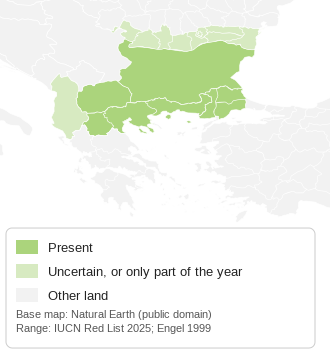
The IUCN gives the range as Bulgaria, Greece and Turkiye.[1] Engel says it reaches north to southern Romania and south to northern Greece, where it meets cecropia. It meets carnica in the Carpathian Mountains and in the former Yugoslavia, and anatoliaca in the European part of Turkey.[2] Ilyasov and colleagues give Bulgaria, Greece, North Macedonia and Ukraine.[3]
Classification evidence
In 2020 a complete mitochondrial genome was still missing for macedonica, as for cecropia.[4]
Status
Accepted: it is one of the ten subspecies of Apis mellifera that the IUCN’s 2025 assessment for Europe (Moro et al.) recognises.[1]
BeeBreed.eu says the subspecies is endangered by hybridisation and replacement.[5]
Sources
- Moro et al. 2025, Apis mellifera (Europe assessment), The IUCN Red List of Threatened Species 2025: e.T42463639A277757621 (assessed 17 July 2025)
- Engel 1999, “The taxonomy of recent and fossil honey bees (Hymenoptera: Apidae; Apis)”, Journal of Hymenoptera Research 8(2): 165–196
- Ilyasov, Lee, Takahashi, Kwon and Nikolenko 2020, “A revision of subspecies structure of western honey bee Apis mellifera”, Saudi Journal of Biological Sciences 27(12): 3615–3621
- Tihelka, Cai, Pisani and Donoghue 2020, “Mitochondrial genomes illuminate the evolutionary history of the Western honey bee (Apis mellifera)”, Scientific Reports 10: 14515
- BeeBreed.eu, Institute for Bee Research, pages on the subspecies