Apis mellifera siciliana is the Sicilian bee, a dark honey bee found on the island of Sicily.[1][2][3]
Names and classification
The IUCN and Engel give the author as Grassi, 1881, and say Engel reinstated the name in 1999.[1][2] Manino and Longo argue that Grassi’s paper gave no name or status, and that the name dates from Dalla Torre, 1896.[3] Ruttner and later authors used sicula Montagano, 1911, which Engel rejects because it does not follow priority, and Manino and Longo because Rossi had already used sicula in 1792 for a mason bee.[2][3] The lineage has two answers: the IUCN gives lineage A, and Ilyasov and colleagues give C.[1][4] Franck and colleagues found only African (A) mitochondrial types in Sicily, but microsatellites with a south-eastern European (C) signal, and called its origin hybrid.[5]
Description
It has been known since the 19th century as clearly different from the bees of mainland Italy in the uniformly dark colour of its body.[3] In a study of 16 colonies of the University of Palermo apiary, its wings were significantly smaller than those of mainland ligustica, and its tongue base was distinctly shorter. The dark areas on the tergites were larger, in line with the impression of a darker bee.[6] Body size was quite similar.[6]
Behaviour
Sinacori and colleagues, quoting Ruttner, say it makes very many swarm cells and does not swarm until virgin queens have hatched. It does not fly in the hottest part of the day, when the oriental hornet Vespa orientalis is most active.[6]
Range
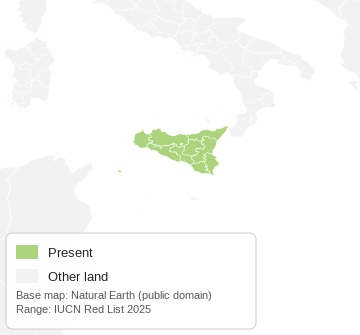
Engel says it occurs on the island of Sicily.[2] The IUCN also gives Sicily.[1]
Classification evidence
In the Palermo study, 253 of 260 bees were assigned to the right group when compared with ligustica.[6] Thirteen of 16 colonies carried an African mitochondrial type.[6] Whole-genome sequencing of six Sicilian bees found no introgression from the other breeds compared, and the highest number of private variants (2,287) among the groups.[7] The mitochondrial genome is close to those of sahariensis, intermissa and ruttneri.[8]
History
A herd book for ligustica and the Sicilian bee was created in Italy in 1997.[7] The honey of the Sicilian black honey bee is a Slow Food Presidium.[9]
Status
Accepted: it is one of the ten subspecies of Apis mellifera that the IUCN’s 2025 assessment for Europe (Moro et al.) recognises.[1]
Sinacori and colleagues wrote in 1998 that it was threatened by the import of ligustica from the mainland, which began in the last century.[6] A 2021 study says its identity must be protected from hybridisation linked to nomadic beekeeping and trade.[7]
Sources
- Moro et al. 2025, Apis mellifera (Europe assessment), The IUCN Red List of Threatened Species 2025: e.T42463639A277757621 (assessed 17 July 2025)
- Engel 1999, “The taxonomy of recent and fossil honey bees (Hymenoptera: Apidae; Apis)”, Journal of Hymenoptera Research 8(2): 165–196
- Manino and Longo 2010, “The black Sicilian honey bee: a nomenclatural clarification”
- Ilyasov, Lee, Takahashi, Kwon and Nikolenko 2020, “A revision of subspecies structure of western honey bee Apis mellifera”, Saudi Journal of Biological Sciences 27(12): 3615–3621
- Franck, Garnery, Celebrano, Solignac and Cornuet 2000, “Hybrid origins of honeybees from Italy (Apis mellifera ligustica) and Sicily (A. m. sicula)”, Molecular Ecology 9: 907–921
- Sinacori, Rinderer, Lancaster and Sheppard 1998, on the honey bees of Palermo, Apidologie 29(6)
- Minozzi et al. 2021, Animals 11(5): 1311
- Henriques et al. 2022, Mitochondrial DNA Part B
- Biundo et al. 2024, Food Research International