Macaca fascicularis aurea, the Burmese long-tailed macaque, lives in Myanmar and parts of Thailand, west of the mountains on the Myanmar–Thailand border. It differs from other long-tailed macaques in the way the hairs in front of its ears point backward.[1][2]
Names and classification
The name Macacus aureus was published by I. Geoffroy Saint-Hilaire in 1831, with a plate, for animals he called “Le Macaque Roux Doré”, the golden-red macaque.[1][3] It rests on four specimens, from “Bengale”, Pegu in Burma, Sumatra and Java, with no holotype named.[1] Rode designated the Bengale specimen as lectotype in 1938. It was probably a captive bought in Calcutta, so its origin is unknown, and Pocock restricted the type locality to Pegu, Burma, in 1939.[1] It is also called the Burmese Long-tailed Macaque.[4]
Description
The back is buffy to medium brown, with pale hair bands that are pale yellow to golden and only rarely reddish. The crown is usually brighter than the back, occasionally with a faint blackish wash.[1] The hairs in front of the ear point backward and partly cover the ears.[1] Geoffroy’s plate already shows this, although Geoffroy gave the golden-red colour of the four specimens as the main sign of the new species, a character Fooden’s description of the subspecies does not use.[1] The tail is 76 to 104 percent of the head and body length in 12 adults.[1] A study of Thai animals found the tail shorter than in the common long-tailed macaque.[5]
Range
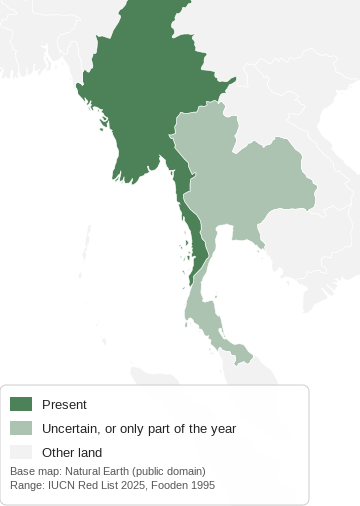
Fooden gives its range as southernmost Bangladesh, south-western and southern Burma (including Preparis Island), the islands of the Mergui Archipelago, and a small area of west-central Thailand. Most of it lies west of the mountain chains on the Myanmar–Thailand border.[1] IUCN gives it as mainland and island Myanmar, some southern parts of central Thailand and north-western parts of southern Thailand.[6] Two zones next to it hold animals of both crest types, sometimes at one locality: central and eastern Indochina, and the eastern and southern Isthmus of Kra.[1]
Classification evidence
GBIF and the IUCN Red List accept aurea as a subspecies, and Fooden does too, on the backward-pointing crest of hair.[3][6][1] The Mammal Diversity Database lists no subspecies of M. fascicularis.[7] IUCN says that Groves (2001) and Fooden (1995) divided the species into ten subspecies, and that it tentatively set aside the tenth, philippinensis, following Smith et al. (2014).[6]
In the Isthmus of Kra contact zone Fooden sees a meeting of two subspecies. In central and eastern Indochina it may instead be a meeting between the Long-tailed Macaque and the Rhesus Macaque.[1] DNA studies give a more complex picture. In a study of Thai animals, mitochondrial DNA separated aurea from a group holding the Rhesus Macaque and the common long-tailed macaque, while Y-chromosome DNA gave three groups, one of them aurea.[5] A second study found that the Y chromosome groups aurea with the long-tailed macaques but its mitochondrial genome groups it with the Rhesus Macaque’s relatives. The authors suggest an ancestral aurea hybridised with a population of that group between about 2.5 and 0.95 million years ago.[2] None of these sources treats aurea as a separate species.[8][6][7]
History
In 1910 Elliot described Pithecus vitiis from the Mergui Archipelago. Pocock listed it as a synonym of aurea in 1939.[1]
A well-studied population
Burmese long-tailed macaques on Piak Nam Yai Island, in Laem Son National Park, Thailand, are among the few wild animals known to use stone tools. They pound shelled sea animals from the shore, and they use two styles of hammering.[9]
Status
IUCN lists M. f. aurea as Vulnerable, in an assessment by Gumert and colleagues in 2022.[6][10]
Sources
- Fooden 1995, Systematic review of Southeast Asian longtail macaques, Fieldiana Zoology n.s. 81: 1–206
- Matsudaira et al. 2018, Journal of Heredity 109: 360–371
- GBIF Backbone Taxonomy, accepted subspecies of Macaca fascicularis
- Primate Info Net, long-tailed macaque fact sheet (Wisconsin National Primate Research Center)
- Bunlungsup et al. 2015, American Journal of Primatology 78: 441–455 (mitochondrial and Y-chromosome DNA of Burmese and common long-tailed macaques)
- Hansen et al. 2025, IUCN Red List assessment of Macaca fascicularis
- Mammal Diversity Database, Macaca fascicularis
- GBIF Backbone Taxonomy, Macaca fascicularis (Raffles, 1821)
- Haslam et al. 2013, PLoS ONE 8: e72872
- Gumert, Ahmed, Hansen & Ang 2022, Macaca fascicularis ssp. aurea. The IUCN Red List of Threatened Species 2022: e.T39770A199563861