The Long-tailed Macaque (Macaca fascicularis) is a medium-sized monkey of South and Southeast Asia, with a tail about as long as its body. It lives in large mixed groups in forest, mangrove and along coasts, and eats mostly fruit.[1][2] The IUCN rates the species Endangered.[3]
Quick facts
Description
The Long-tailed Macaque (Macaca fascicularis) is a slender monkey with a tail about as long as its head and body together.[3] The fur looks mottled or speckled up close, because each hair has bands of different colours. Shades run through yellowish, golden brown, reddish brown, brown, whitish and blackish, and they differ between individuals and between populations. Across the subspecies the overall colour ranges from almost black to light brown or grey.[3]
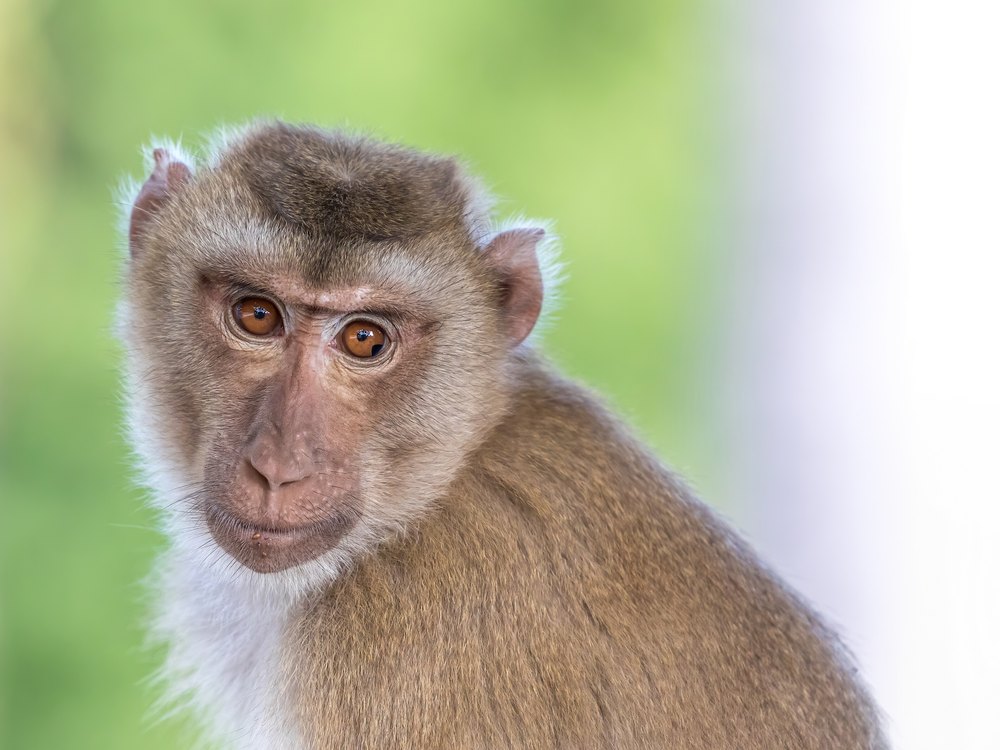

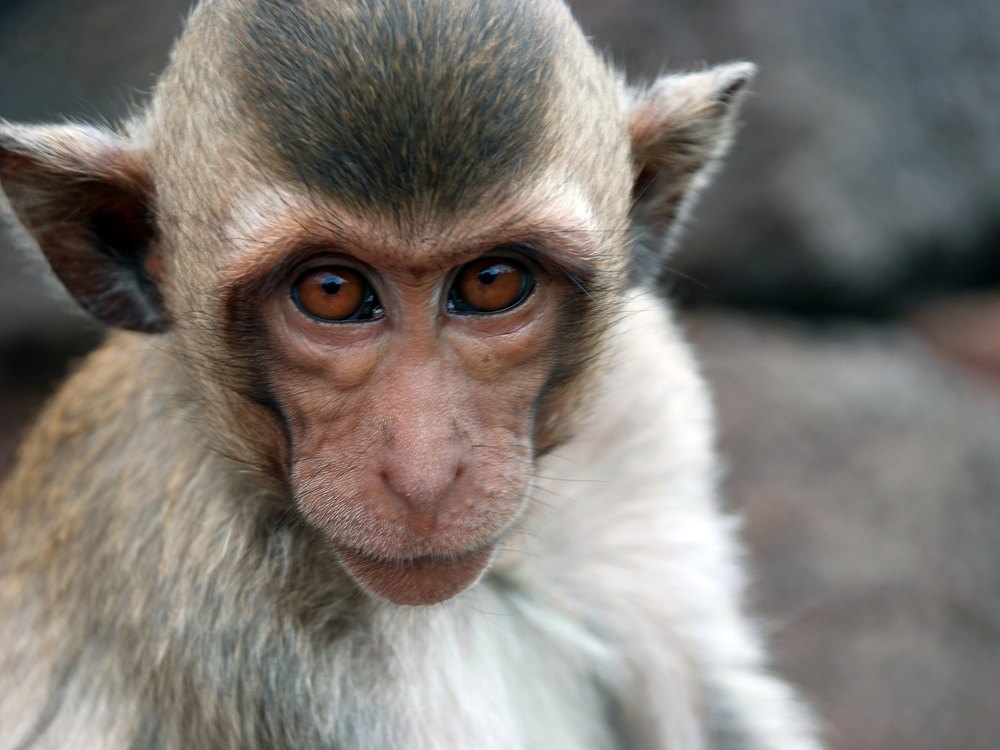

The face is lightly haired. Around the snout and eyes the hair is short and sparse, and the eyelids are often white. A crown of hair is bordered by white or black, and white spots often show on the skin in front of the ears. Skin colour varies from white and pink to black and brown, and the face tans easily in strong sun.[3] Adults are usually bearded: older females have the fullest beard, while in males it is more like whiskers. A crest of hair on each cheek usually runs vertically along the face, but in some subspecies it runs horizontally across the middle of the cheek.[3]
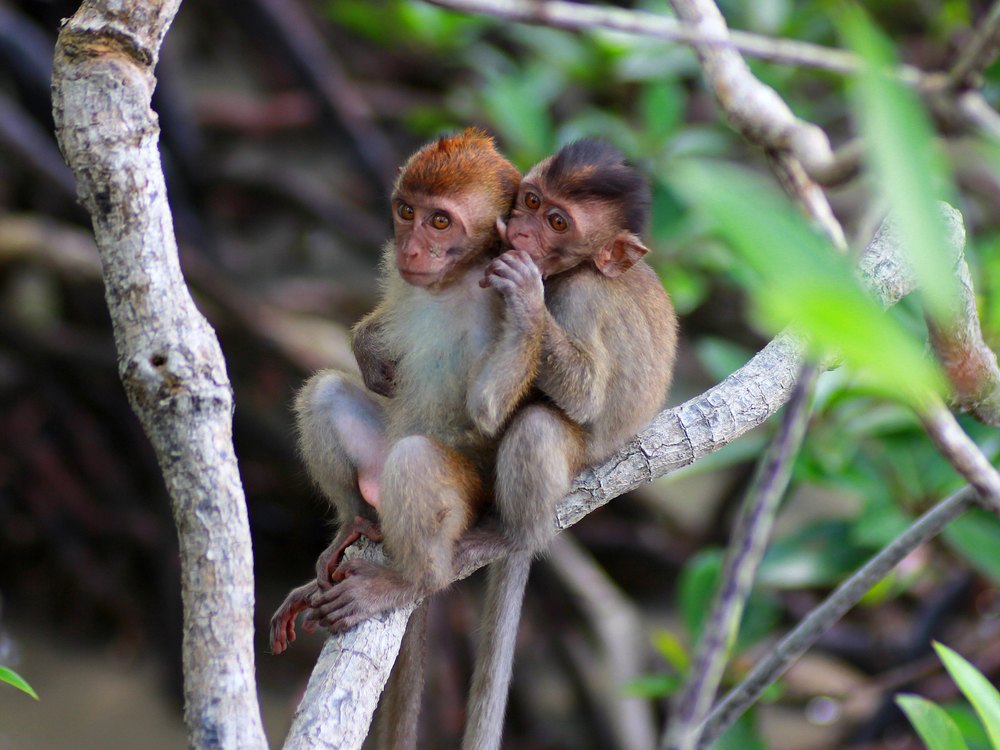
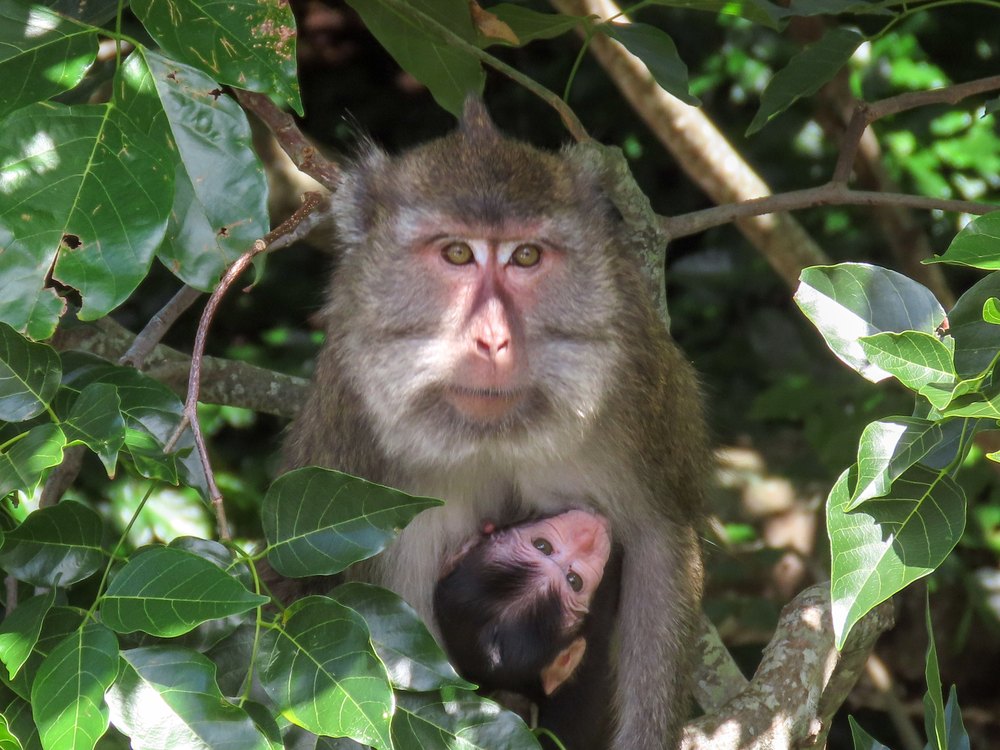
Newborns are dark brown to blackish and have bare, pinkish faces. The change to adult colour starts at 2 to 3 months and is finished at about 15 months, before the first permanent molars come through.[1] At puberty a female develops a swelling of skin between the tail root and the anus.[1]
Name
The scientific name is Macaca fascicularis. In English the species has three common names. IUCN calls it the Long-tailed Macaque. Mammal databases also use Crab-eating Macaque, and laboratories use Cynomolgus Macaque or “cynomolgus monkey”.[3][5]
In other languages
| Language | Name | Meaning |
|---|---|---|
| Indonesian local | monyet ekor panjang | “monkey tail long”, the long-tailed monkey |
| Malay local | kera | the general Malay word for a monkey or macaque; Raffles wrote “Kra of the Malays” in 1821 |
| Javanese local | kethek | a general word for monkey, not specific to this species |
| Thai local | ลิงแสม (ling saem); ลิงหางยาว (ling hang yao) | the second name means “long-tailed monkey” |
| Khmer local | ស្វាក្ដាម (sva kdam) | “crab monkey” |
| Vietnamese local | khỉ đuôi dài | “monkey tail long”, the long-tailed monkey |
| Lao local | ລິງຫາງຍາວ (ling hang yao) | “long-tailed monkey” |
| Burmese local | မျောက်တံငါ (myauk ta-nga) | — |
| Tagalog local | matsing | — |
| Bengali | kakravuk banor; lomba leji banor | “crab-eating monkey”; “long-tailed monkey” (southern Bangladesh) |
| Chinese | 长尾猕猴 (chángwěi míhóu) | “long-tailed macaque” |
| Japanese | カニクイザル (kanikuizaru) | “crab-eating monkey” |
| German | Langschwanzmakak; Krabbenesser | “long-tailed macaque”; “crab eater” |
| French | macaque crabier | “crab macaque” |
| Spanish | macaco cangrejero | “crab macaque” |
| Russian | макак-крабоед (makak-krabojed) | “crab-eating macaque” |
Names come from IUCN and from national checklists and the Catalogue of Life through GBIF.[3][5][6]
Meaning of the name
“Long-tailed” describes the tail, which is about as long as the head and body combined.[3] “Crab-eating” comes from the habit of foraging on shores for crabs and other shellfish (see Diet). The name carries the same idea in French, German, Khmer and Japanese.[5]
“Cynomolgus” was first the name of a different monkey. IUCN lists Simia cynomolgus Schreber, 1775 as a synonym of this species.[3] The word survives as the laboratory name.
The word “macaque” was first used for this monkey by Buffon in 1766, for an imported animal of unknown origin.[7] In his 1821 description Raffles gave the Malay name as “Kra” and noted that it closely resembles the cry of the animal.[6]
Body
Size
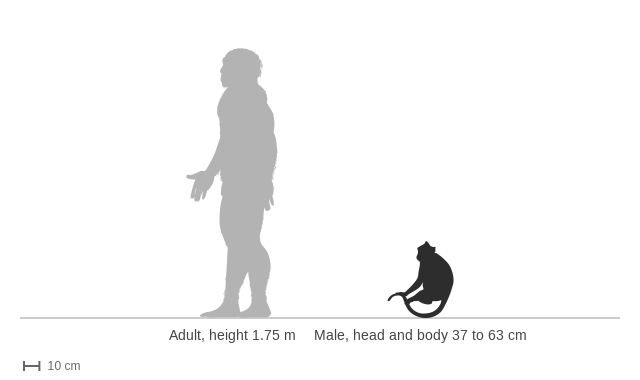
The Long-tailed Macaque (Macaca fascicularis) is the smallest species of its species group. Males measure 37 to 63 cm from head to body end and females 31.5 to 54.5 cm. The tail is 36 to 71.5 cm long in males and 31.5 to 62.8 cm in females, so it is about as long as the head and body together.[1][3] Males weigh 3.4 to 12 kg and females 2.4 to 5.4 kg. These ranges cover the whole species and do not separate wild from captive animals, and 12 kg is an extreme figure.[1] Other references give narrower weights: 3 to 7 kg in total, with males averaging 4.8 to 7 kg and females 3 to 4 kg.[2] Primate Info Net gives 4.7 to 8.3 kg for males and 2.5 to 5.7 kg for females.[8]
On average, the head and body of a male is 13 percent longer than that of a female.[1] Subspecies differ in the head and body length of adult males and in how long the tail is compared with the body.[1] In a captive group, female newborns averaged 318.2 g (563 infants) and male newborns 347.5 g (600 infants).[1]
The ranges cover the whole species, wild and captive animals together.
| Female | Male | |
|---|---|---|
| Weight | 2.4–5.4 kg | 3.4–12 kg |
| Length (head and body) | 31.5–54.5 cm | 37–63 cm |
Senses and special features
The eyes face forward, which gives the macaque binocular vision, and the nose is flat with narrow nostrils set close together. It has 32 teeth, with shovel-shaped front teeth, long canines and ridged back molars.[2]
The Long-tailed Macaque is an excellent swimmer and seems to enter the water for pleasure.[1] It also forages on the ground near coasts and rivers: in Sumatra 25 percent of encounters with groups were on the ground, and in East Kalimantan 26.5 percent. Inland it is mostly a tree dweller (see Behavior).[1]
Macaques store food in cheek pouches while foraging and carry it away to eat. This is described for macaques in general, not for this species alone.[8]
Behavior
Groups and social life
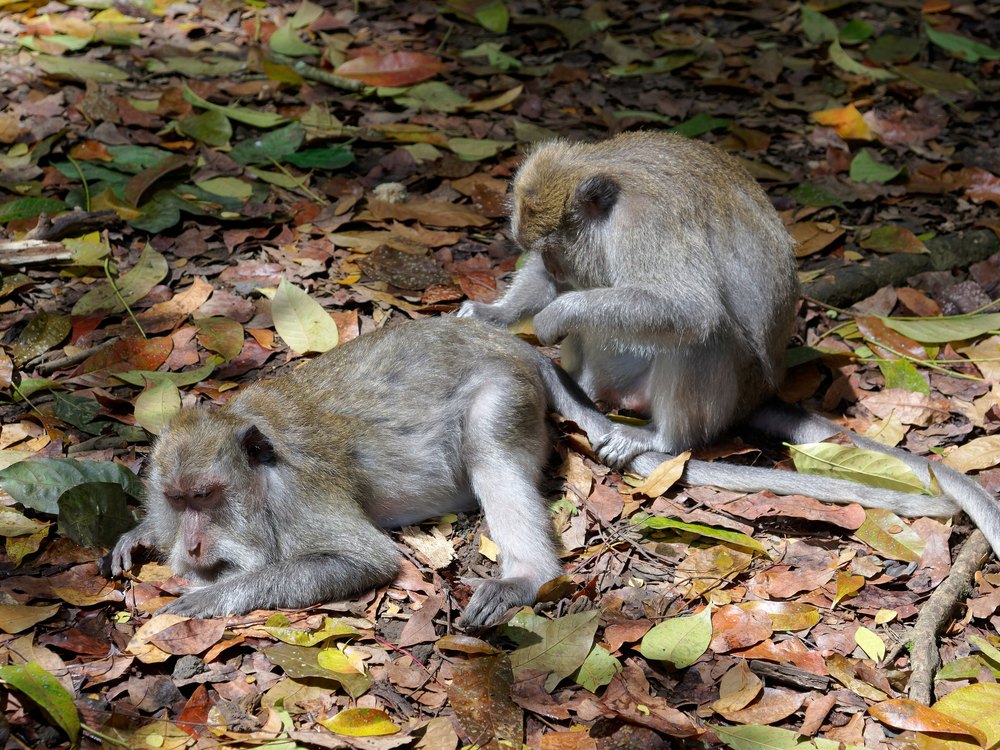
The Long-tailed Macaque (Macaca fascicularis) lives in troops, which are groups of related and unrelated animals that stay together and move through the forest as a unit. Troops that are not fed by people hold 5 to 100 animals and include several adult males and several adult females. A large troop may split into smaller foraging parties during the day.[1] Other counts are lower: 6 to 58 animals in one review, and about 30 on average in another.[2][8] In a study in Sumatra, a troop averaged 5.7 adult males and 9.9 adult females.[2]
Females stay in the troop where they were born, so a troop is built around lines of related females. Males leave. Young males usually go between the ages of 4 and 6 years, around sexual maturity.[2][8] After leaving, a male joins a new troop as a subadult and starts to mate at 5 to 6 years.[1]
Females are ranked, both between the family lines and within them. Males also form a ranking. In one account the male order follows age, size and fighting skill, and high-ranking females mature earlier and raise more surviving young.[1][2] When a new male takes over a troop, he may kill infants. Adult-male infanticide may be an important cause of infant death, and killing an infant brings its mother back into breeding condition sooner.[1][8]
A troop uses a home range of 12.5 ha to more than 300 ha. Neighbouring ranges overlap only slightly. A troop moves about 325 to 1,900 m a day on average.[1] Animal Diversity Web gives an average home range of 125 ha.[2]

Activity and movement
The Long-tailed Macaque is active by day.[1][2] Inland, it spends nearly all its time in trees: 98 percent of observations in Peninsular Malaysia and about 97 percent in East Kalimantan, mostly in the lower and middle levels of the forest. It sleeps in tall, fairly bare trees near rivers.[1] Along coasts and rivers it also feeds on the ground, in 25 percent of encounters in Sumatra and 26.5 percent in East Kalimantan.[1]
Voice
Calls fall into two kinds. Harsh calls include the "kra" call, alarm calls made of three to five chirp-like pulses, and barks. Clear calls include coos, screams and friendly calls between troop members.[8] Animals also signal with posture, touch and possibly smell.[2]
Tool use
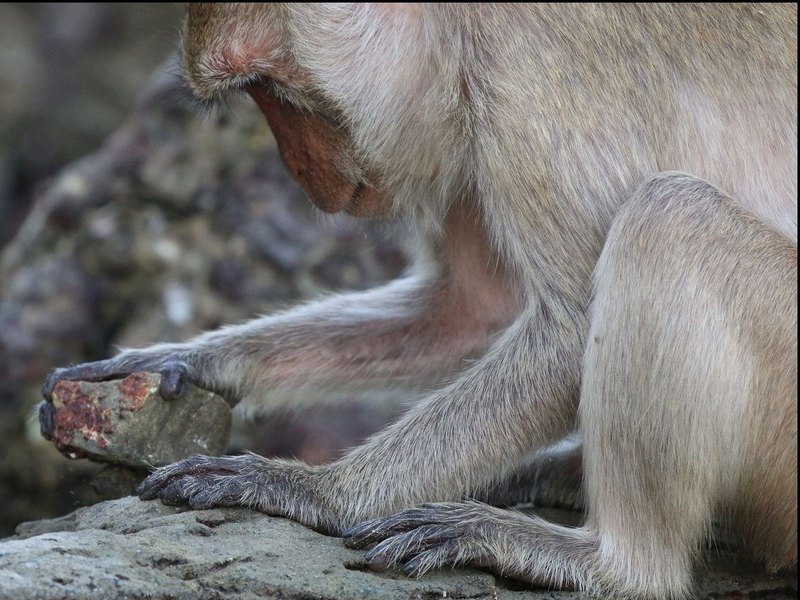
Some wild Long-tailed Macaques use stones as tools, which only a limited number of wild animals do. The studies below come from islands off the coast of Thailand.
On Piak Nam Yai Island in Laem Son National Park, Burmese Long-tailed Macaques (the subspecies aurea) pound shelled sea animals from the tidal zone. A study of 60 wild stone tools from the island described two styles: axe hammering, used on oysters, and pound hammering, used on food that is not attached to a surface.[9] A later study recorded 638 tool-use bouts by 90 individuals on two islands in the park. It sorted the hammering into three classes (face, point and edge) and 17 action patterns.[10] Two neighbouring groups used stones of different sizes on the same kind of shellfish, so each group has its own habit.[11]
On Yao Noi Island, in Ao Phang Nga National Park, wild macaques crack oil palm nuts with stone hammers. Before this was reported, only West African chimpanzees and modern humans were known to crack this nut with stone hammers.[4] Old stone tools left by earlier generations are described in History and culture.

Diet
What it eats
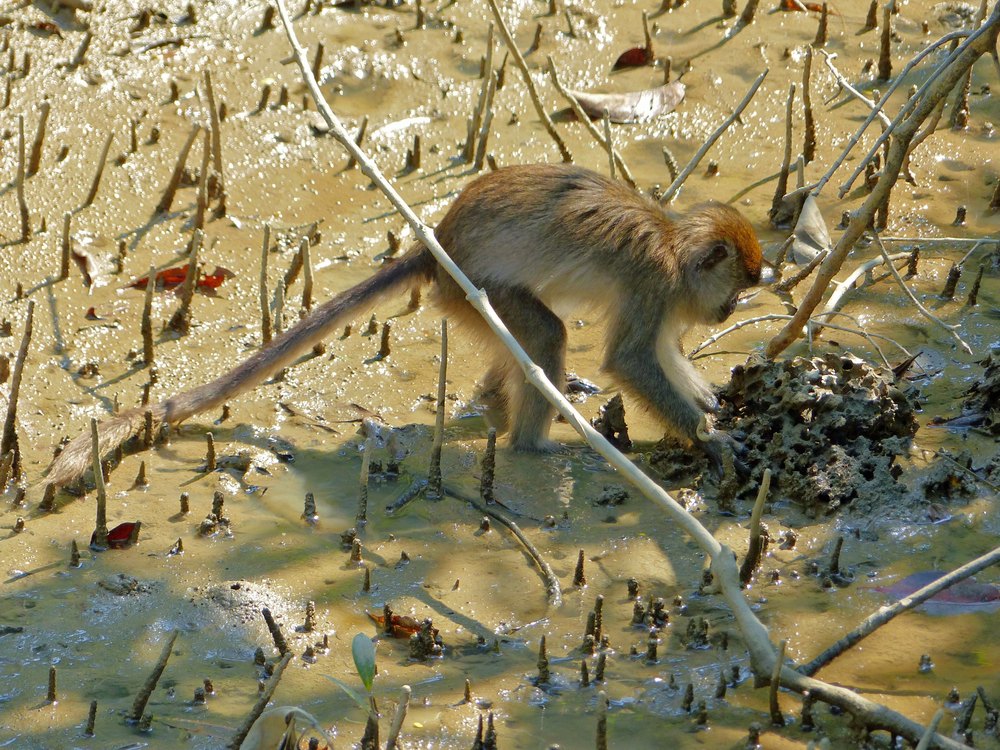
The Long-tailed Macaque eats whatever is available. It is mainly a fruit eater, but also takes leaves and other plant parts, insects inland, crustaceans, bivalves and snails near water, and small vertebrates such as fish.[1] Fruit made up 66.7 percent of the diet in Kalimantan and 82 percent in Sumatra, in two studies cited by Primate Info Net.[8] Animal Diversity Web reports that 96 percent of feeding time is spent on fruit.[2] It also eats clay.[2]
Foraging on the shore
Crabs are only a small part of the diet.[8] In mangroves the macaque also eats frogs, shrimp and octopus.[8] On the seashore it picks up rocks and carries them to open oysters.[1] For how it uses stones on shellfish and nuts, see Behavior.

Crops and food from people
Where forest meets farms, the macaque raids crops. Rice and corn are taken in many places, and young dry rice, cassava leaves, rubber fruit and taro are also listed.[1][2] It scavenges and begs in towns. Where tourists feed the monkeys, food from people can make up as much as 22 percent of the diet.[8] Conflict with farmers and townspeople is growing, and the answers include culling in Peninsular Malaysia, trapping quotas in Indonesia and sterilisation in Singapore (see Conservation).[1]
Life cycle
| Stage | Age / time | Notes |
|---|---|---|
| Infant | Birth to about 15 months | Weighs about 320 to 350 g at birth; in a captive group, 563 female infants averaged 318 g and 600 male infants 348 g[1] |
| Juvenile | About 15 months to about 4 years | Nursed for 9 to 22 months in captivity, about 15 months on average[1] |
| Subadult | About 4 to 6 years | Males leave the troop they were born in and start to mate (see Behavior)[1][2] |
| Adult | From about 4 years (females) | A female has her first young at about 4 years[1] |
Birth and growth
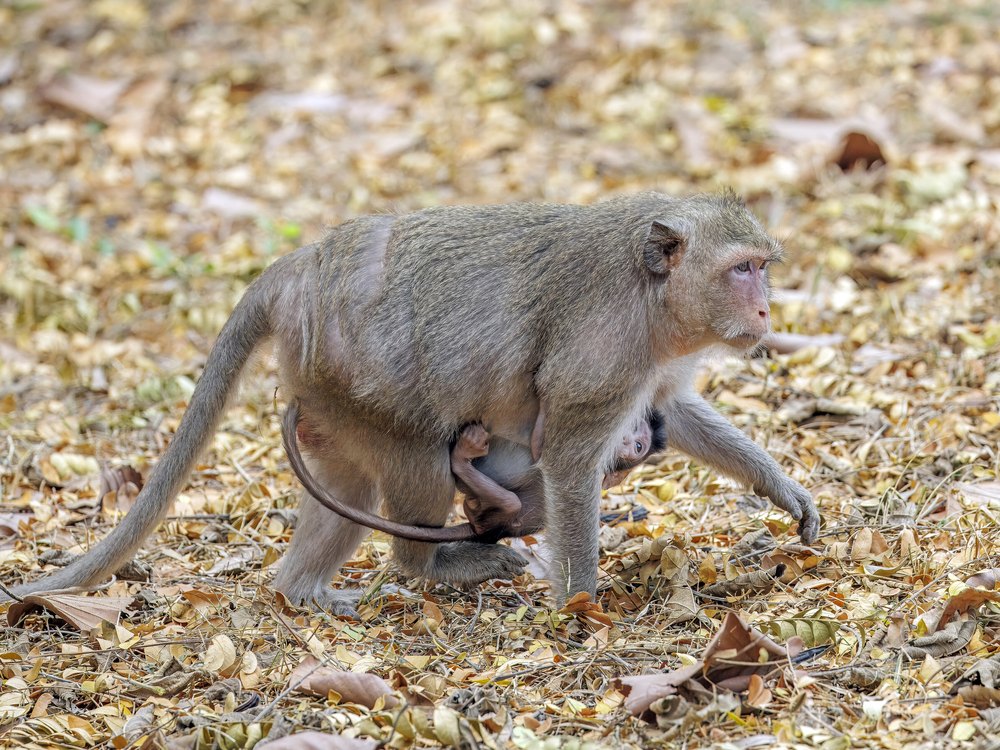
A female is pregnant for 160 to 168 days and has one young at a time.[1] The Long-tailed Macaque (Macaca fascicularis) gives birth in seasonal peaks. The timing differs between places and years and seems to follow the fruiting of forest trees.[1] A newborn weighs about 320 to 350 g.[1]
Young are nursed for 9 to 22 months in captivity, with an average of about 15 months.[1] Females stay in the troop they were born in. Males leave their birth troop when they are young adults (see Behavior).[8]

Breeding
A female is probably able to breed at about 3 to 5 years and has her first young at about 4 years.[1] Males begin to mate at 5 to 6 years, after they have left their birth troop (see Behavior).[1][2]
In northern Sumatra, a four-year study of wild macaques found an average of 0.58 births per adult female each year, with high and low years alternating. Captive females can breed every year.[1] A female in a non-provisioned troop (one that does not live on food given by people) has about 8 to 9 young between the ages of about 4 and 20.[1] Animal Diversity Web gives an average gap between births of 390 days, probably for high-ranking females.[2]
Lifespan
The longest known captive Long-tailed Macaque lived 37 years.[1] The average generation, from one breeding female to her daughter, is 10 years.[3]
Ecology
Predators
The Long-tailed Macaque (Macaca fascicularis) is prey for several animals. Primate Info Net lists pythons, monitor lizards, birds of prey, large cats and, in some areas, feral dogs.[8] Where cats hunt them, the pressure can be strong enough to shape the size and social structure of a troop.[8] In places with people, domestic dogs are an important predator.[8] A 2026 record from Singapore describes a reticulated python coiled around an adult female and her infant.[8] People hunt the macaque too: it is eaten for subsistence in Myanmar and in the Eastern Plains of Cambodia (see Conservation).[3]
Seed dispersal
Cheek pouches let the macaque carry food away from the tree where it found it.[8] Studies of wild macaques in Singapore report that they swallow only small seeds, rarely break larger ones, and can keep fruit in the pouches and spit out the seeds one at a time. Fruit has been seen in pouches almost 100 m from the nearest tree, although the authors could not say whether this makes the macaque an effective seed spreader.[8] Studies of seed networks in Asia describe macaques as major primate seed dispersers, a role that earlier work overlooked.[8]
On Mauritius, where the macaque was brought by people, the picture is different. It eats the seeds of native plants, and a 2022 study suggests it may mostly spread invasive plants.[12][13]
Parasites and disease
The Long-tailed Macaque is a natural host of Plasmodium knowlesi, a malaria parasite that also infects people. The pig-tailed macaque and the banded langur carry it as well. Mosquitoes of the Anopheles leucosphyrus group pass it on, and most human cases are reported from Malaysian Borneo.[14] A genetic study of the parasite in Malaysian Borneo found two clusters, one linked to long-tailed macaques and one to pig-tailed macaques.[14]
Macaques in general carry the B virus (macacine herpesvirus 1). It rarely infects people, but human infections can be severe. The virus passes on through bites and scratches, and through contact of the eyes, nose or mouth with infected fluids.[15] A CDC report describes a monkey bite in a Thai park as an example of this risk.[15]
A study of wild macaques in Thailand between 2018 and 2022 found tuberculosis bacteria in several populations, more often in Rhesus Macaques than in common Long-tailed Macaques. The authors found no link between prevalence and contact with people, but they consider spread in both directions a concern.[16] The macaque can also pass on simian foamy virus to people who feed or handle it.[8]
Pet macaques that are confiscated and released without proper procedure can bring disease and parasites into wild groups.[3] In the Ubud Monkey Forest on Bali, where the groups are fed and given veterinary care, a clinic study recorded injuries and deaths that were mostly from natural causes.[17]
Habitat and range
Habitat
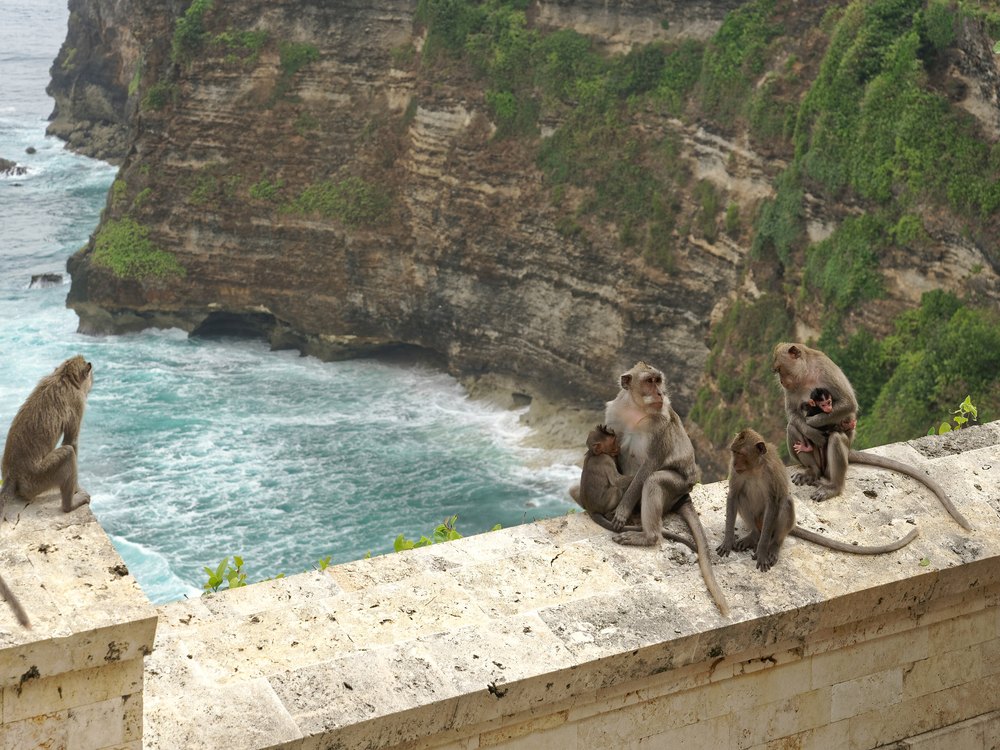
The Long-tailed Macaque is a generalist that makes use of many kinds of land. It lives in dry and moist lowland forest, moist mountain forest, mangroves, swamp forest and marshes, and it is most often found along rivers.[3] Its range overlaps 17,233 km² of the world’s mangrove forest, about 21 percent of the total, and in Thailand it is sometimes called the mangrove monkey.[3] It also lives in the changed landscapes that people create: temples, roadsides, farmland, villages and towns. It cannot live in cities alone and depends on forest edges.[3]
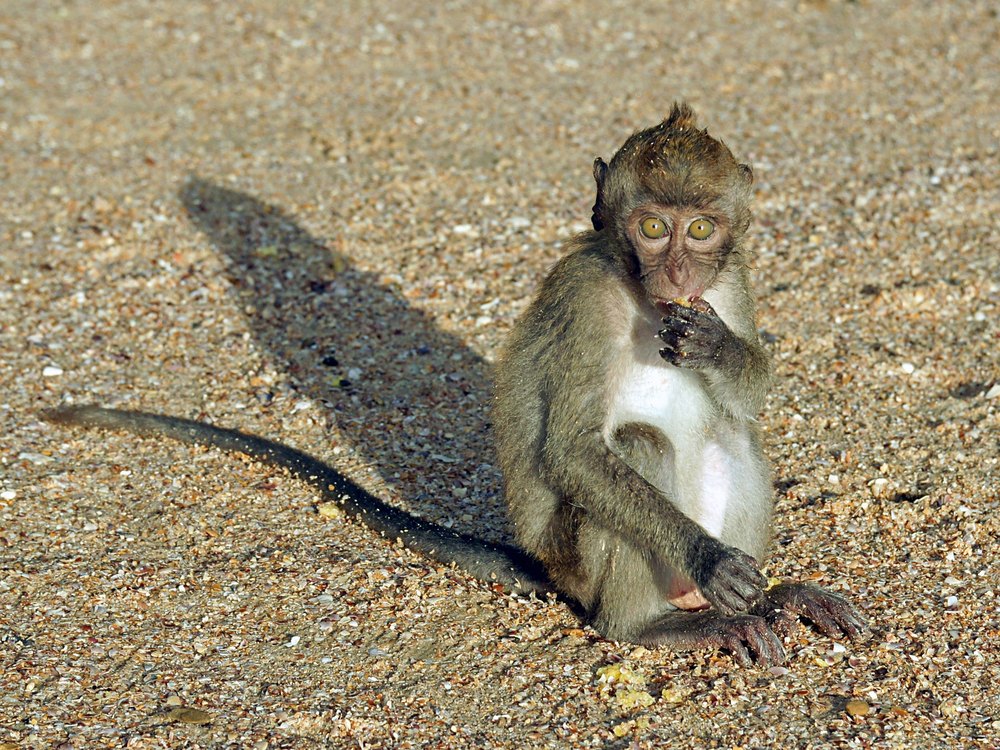

Elevation runs from sea level up to 2,250 m.[3] Densities differ widely. Groups that are not fed by people reach about 55 animals per km².[3]

Range
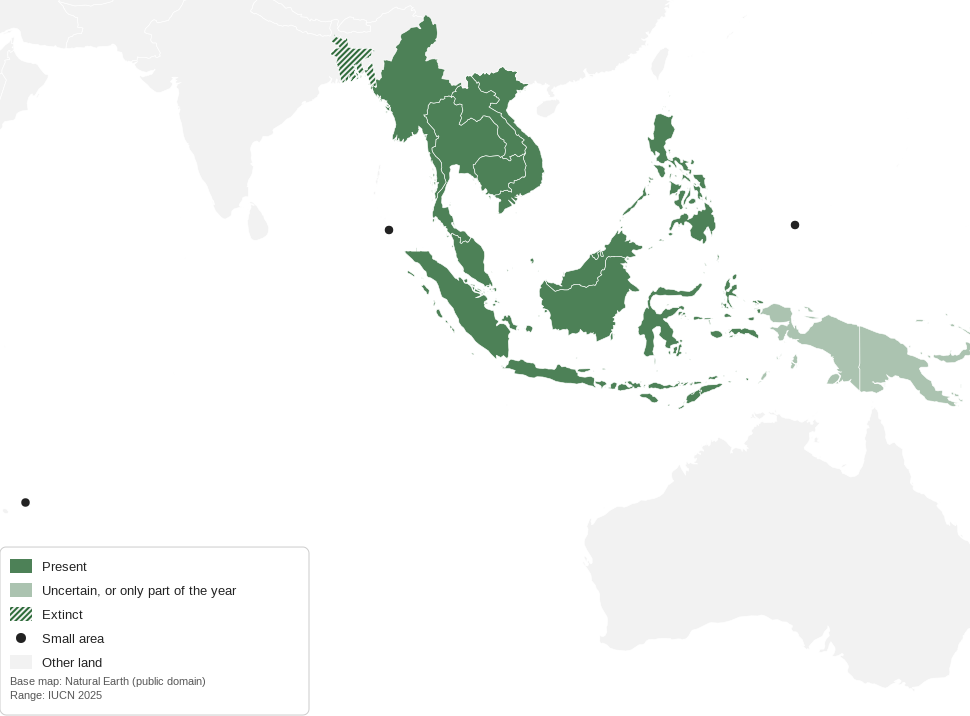
The macaque is native to 12 countries: Brunei, Cambodia, India (the Nicobar Islands only), Indonesia, Laos, Malaysia, Myanmar, the Philippines, Singapore, Thailand, Timor-Leste and Viet Nam.[3] On the mainland it runs from northern coastal Rakhine in Myanmar south through the coastal lowlands, east through Thailand, across most of Cambodia, to the south-east tip of Laos and southern Viet Nam. From there it continues down the Thai-Malay peninsula, across the Indonesian islands including Borneo, and through the Philippines, with many small islands too. The range is patchy, not continuous.[3] Bangladesh once held the macaque, but it is now considered extinct there; mangrove loss is named as a cause.[3] The macaque does not migrate.[3]
The subspecies live in different parts of this range (see Forms and variants).
Introduced populations
People have carried the macaque to other places, where it now breeds in the wild. Mauritius holds the largest introduced population. The Dutch brought it there around 1602, probably as pets, and genetic evidence points to Javanese ancestry.[13] It also lives on Palau (Angaur Island) and in Papua New Guinea; in West Papua, Indonesia, the population is under control with the aim of removing it.[3] Tinjil Island in Indonesia is used as a breeding island.[8] The IUCN also lists populations in Hong Kong, now gone, and on Kabaena Island off Sulawesi.[3]
Evolution
The genus Macaca
Fossils show that the macaque genus, Macaca, arose in Africa about 7 million years ago and spread into Asia about 5.5 million years ago.[18] A study of macaque mitochondrial DNA (the small ring of DNA passed down from the mother) found that the macaques began to diversify about 7.0 to 6.7 million years ago, and that they then spread through Asia in steps.[19]
In the mitochondrial tree of Yao and colleagues, the African Barbary Macaque split from the Asian macaques 6.83 million years ago (95 percent range 6.02 to 7.84 million). The lineage of the Long-tailed Macaque, Macaca fascicularis, parted from the lineage of the Rhesus and Stump-tailed Macaques 3.85 million years ago (3.28 to 4.49 million).[18] A second study gives 3.2 to 4.6 million years ago for the same split.[20] The two studies overlap at every point of the tree. Both are built on mitochondrial DNA alone, and the Roos study notes that gene flow between ancient macaque lineages makes some groups look mixed in such trees.[19]
Within the species
Inside the species, two main mitochondrial lineages split about 1.88 million years ago (1.60 to 2.20 million). One covers the mainland and northern Sumatra, and began to branch about 1.03 million years ago. The other covers the islands and southern Sumatra.[18] The other study gives 1.1 to 2.2 million years for the splits within the species.[20] The figures differ because the studies use different markers and different dating points.
The oldest fossils of the species come from Java. The Long-tailed Macaque has lived on the Sunda Shelf, the shallow shelf joining Sumatra, Borneo, Java and the Malay Peninsula, since about 1 million years ago, and the earliest macaque fossils there are 0.8 to 1.0 million years old. The Trinil site in central Java holds the macaque bones from this time, in the same collection as Homo erectus. Some of these finds are single teeth that may have been named wrongly.[7] Later fossils and subfossils come from West Malaysia, Sumatra, Borneo and Java.[7]
The macaque bones in caves on Timor (about 4,500 years old) and Flores (about 3,500 years old) are thought to come from animals that people brought there.[7] Fooden proposed six stages for the spread of the species, from the first move onto the Sunda Shelf over a million years ago to the arrival on the eastern Lesser Sunda islands about 4,500 years ago. These stages are his hypotheses, not measured dates.[7]
How the macaques reached the Philippines is disputed. The mitochondrial study dates the split of the Philippine lineages from the Borneo stock to 0.06 to 0.43 million years ago. Other authors argue that people carried the monkeys there about 4,000 to 3,500 years ago, and a third view is that they arrived by themselves in two waves.[18]
Forms and variants
Subspecies
Checklists disagree on how many subspecies the Long-tailed Macaque has. The IUCN and GBIF accept nine.[3][21] Fooden's 1995 review of 2,049 museum specimens, and a 2001 list by Groves, give ten, adding the Philippine subspecies (philippinensis). The IUCN sets that subspecies aside, because a 2014 study questioned it.[3][7] The Mammal Diversity Database lists no subspecies at all.[22]
The subspecies differ mainly in the colour of the back and crown, the direction of the hair on the cheeks, and the length of the tail.[7] Animals of the mainland and the large islands are buffy to medium brown, and about 5 percent of the nominate subspecies (fascicularis, which covers most of the range) are dark brown, enough to be mistaken for an island subspecies.[7] The Burmese subspecies (aurea) lives in Myanmar and parts of Thailand, and its cheek hair sweeps back over the ears.[3][7] Where it meets the nominate subspecies, in central and eastern Indochina and on the Isthmus of Kra, monkeys with either kind of cheek hair turn up, sometimes at the same place.[7] The Philippine subspecies is dark brown with golden to reddish hair tips, and a zone of mixed animals lies between it and the nominate subspecies on Mindanao and southern Negros.[7]
The other subspecies are small populations on single islands or island groups. Fooden linked the most distinct of them, on the Nicobar, Simeulue, Lasia and Maratua islands, to isolation by deep water.[7] Four are Critically Endangered (Simeulue, Karimunjawa, Lasia and Maratua), and Fooden knew the Lasia subspecies from only two museum specimens.[3][7]
Genes add a twist for the Burmese subspecies. Its Y chromosome groups with the long-tailed macaques, but its mitochondrial DNA, which is passed on by the mother, groups with a different group of macaques. The authors explain this by an ancient hybridisation, proposed to have happened 2.5 to 0.95 million years ago.[23] An earlier study also set its mitochondrial DNA apart and found a shorter tail than in the other long-tailed macaques it sampled.[24]
See all 10 subspeciesHybrids
The Long-tailed Macaque hybridises with other macaques where their ranges meet. In the north of its range it regularly interbreeds with the Rhesus Macaque, and it also hybridises with the Southern Pig-tailed Macaque. Hybrids occur between subspecies as well.[3] Fooden found that the Rhesus Macaque replaces the Long-tailed Macaque in the northern Indochinese Peninsula, and he inferred that two short-tailed monkeys at Bukit Nanas in the Malay Peninsula, recorded in 1966, were hybrids with the pig-tailed macaque.[7] In a 2015 genetic study, monkeys that looked like hybrids all carried the mitochondrial DNA of the Long-tailed Macaque.[24]
Conservation
Status
The Long-tailed Macaque is listed as Endangered on the IUCN Red List (criteria A2cd+3cd+4cd, assessed on 28 October 2024 and published in 2025). The assessors infer a decline of 50 to 70 percent over the past three generations (30 years) and suspect the same over the next 30, driven by habitat loss and exploitation.[3] The species was Endangered in 2022, Vulnerable in 2020 and 2021, Least Concern in 2008, and Lower Risk (near threatened) in 1996 and 2000.[3] It is in Appendix II of CITES, so trade needs permits and wild off-take is limited by quotas.[3]
The change is not the same everywhere. Where monkeys are fed and protected, as at temples, numbers have risen (see History and culture). The assessors treat such cases as exceptions tied to feeding. Some studies challenge the decline, and the assessment notes that one claim of an increase was disputed in 2025 for errors in its data.[3]
Threats
Habitat lossHuntingKilling in conflict with peopleCollection for the pet tradeIllegal trade[3]Habitat loss. Mangroves lost 20 to 35 percent of their extent worldwide since 1980, and nearly 80 percent of the human-driven loss in 2000 to 2016 took place in Indonesia, Myanmar, Malaysia, the Philippines, Thailand and Viet Nam. Between 2002 and 2022 tree cover fell by 52 percent in Cambodia, 18 percent in Indonesia and 21 percent in Viet Nam.[3] The macaque cannot live in cities alone and depends on forest edges. Mangrove loss is named as a cause of its disappearance from Bangladesh (see Habitat and range).[3]
Hunting. The IUCN threat table lists hunting for use as affecting the whole population, with rapid declines. People hunt the macaque for food in Myanmar and in the Eastern Plains of Cambodia, and animals are taken from the wild for research and the pet trade.[3]
Killing in conflict with people. Control of the macaque as a pest is also listed as affecting the whole population, with rapid declines. In Peninsular Malaysia 493,823 animals were reported to have been affected by culling, a figure the IUCN takes from a news report. The assessors say culling has caused local declines and extinctions.[3]
Collection for the pet trade. In Indonesia no macaques are bred for sale as pets, so the assessors believe all are taken from the wild. In Viet Nam keeping them as pets is common although they are protected, and confiscated animals are often released without proper procedure, which may spread disease and parasites. In 179 surveys of 13 markets in Java and Bali between 2016 and 2020, 1,620 macaques were recorded, making it the most common wild-caught mammal on sale there. The IUCN cites an estimate that 10,000 to 20,000 are taken each year to meet pet demand on the two islands.[3]
Illegal trade. Wild-caught macaques are brought into breeding facilities in Cambodia, Lao PDR and Viet Nam and sold as captive-born.[3]
Trade
The Long-tailed Macaque is the most highly traded primate in the world and is in heavy demand for medical and drug-safety research.[3][25] Between 2010 and 2019, 163,780 live animals were traded legally from seven countries: Indonesia, the Philippines, Cambodia, Lao PDR, Thailand, Myanmar and Viet Nam. The total is larger when China and Mauritius are counted.[3] The species makes up about 90 percent of the legal primate trade monitored by CITES, and the trade is described as worth billions of dollars.[3] TRAFFIC reports that 95.6 percent of world exports of live macaques in that decade came from eight countries (Cambodia, China, Indonesia, Laos, Mauritius, the Philippines, Thailand and Viet Nam) and that the United States took the largest share of imports, 58 percent of those declared between 2012 and 2022.[25]
About 90 percent of the recorded trade is declared captive-bred. The IUCN points out that this figure does not show wild animals added to breeding stock.[3] TRAFFIC's 2023 report notes a November 2022 United States indictment of eight people over alleged laundering of wild-caught macaques as captive-bred.[25] Demand comes mainly from the United States, Japan, China, the European Union and, more recently, Canada. China sharply cut its exports in 2019, and the countries where the macaque lives took over as suppliers. Only Indonesia and China have supplied a non-detriment finding, the CITES report that exports do not harm the wild population.[3]
Protection and conservation actions
The macaque lives in at least one protected area, and conservation sites have been identified across its whole range, but most of the animals live outside protected areas.[3] Its legal status varies by country. Cambodia, the Philippines and Myanmar normally protect it. In Viet Nam it falls under Appendix 2B of Decree 84/2021/ND-CP, in Malaysia under the Wildlife Conservation Act 2010, and in India under Schedule I. Indonesia does not protect it but allows harvest only by quota, which has been at or near zero for a decade. In Thailand it has normal protection without a specific listing, and in Lao PDR it is a management species.[3]
The IUCN records no recovery plan and no systematic monitoring. The actions it asks for are site protection, management of harvest and trade, ranger training, better laws, alternative livelihoods, control of prices and the use of other medical models in place of macaques. It also asks for research on taxonomy, numbers, ecology and trade.[3]
History and culture
First description
The English colonial official Stamford Raffles described the species in 1821 as Simia fascicularis, in a catalogue of animals collected on Sumatra for the East India Company. The type locality is Bengkulu on Sumatra, and he noted that it was frequent in the forests of Sumatra and the Malay islands.[6][22] The holotype, the specimen on which the name rests, is lost.[22] Raffles also recorded the Malay name "Kra" (see Name).[6]
Research animals and the cloned monkeys
The Long-tailed Macaque is heavily used in medical and drug-safety research, and the trade that supplies it is described under Conservation.[3]
In January 2018 scientists at the Institute of Neuroscience of the Chinese Academy of Sciences in Shanghai announced two cloned Long-tailed Macaques, Zhong Zhong and Hua Hua. They were the first primates cloned by somatic cell nuclear transfer, the method that produced Dolly the sheep, and they were about seven and eight weeks old when the news was announced on 24 January 2018.[26][27][28] The team used cell nuclei from a fetus. Their paper in Cell reports that 6 pregnancies from 21 surrogate mothers produced two healthy babies. A second set of clones made from adult cells did not survive for long.[26]
Temples and festivals
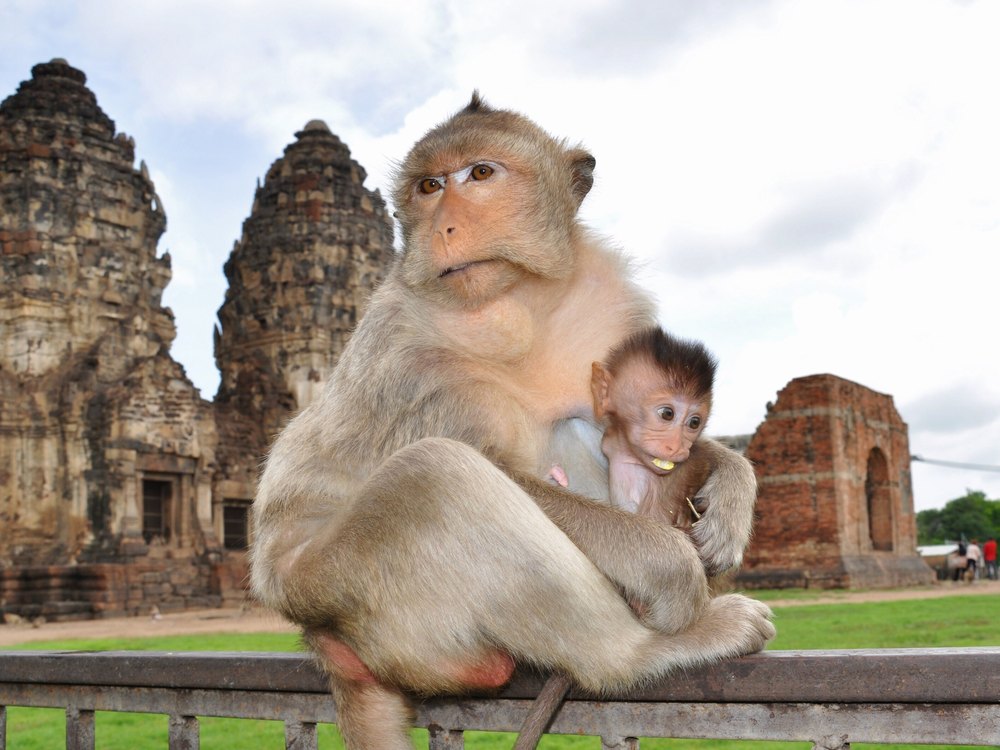
In Thailand, groups that live at temples are regularly fed by monks, and their numbers grew 5 to 10 times between 1992 and 2008.[3] The Indonesian island of Bali has a similar story. At the Ubud Monkey Forest the macaques live around three Hindu temples. They are fed and given veterinary care, and a study of six groups recorded 275 injuries and deaths from 2015 to 2018, most of them from natural causes.[17]


Stone tools and archaeology
On the islands of Thailand's coast, macaques use stones to crack open shellfish, crabs and nuts (see Behavior). In 2016 a team excavated beneath a boulder in a marine national park on Piak Nam Yai Island and found ten tools in the oldest layer, 65 cm down. It was the first archaeological evidence of tool use by an Old World monkey. Radiocarbon dates of oyster shell in the same layer showed that the tools were between 10 and 50 years old.[29]
A later study of neighbouring groups showed that the stones they leave behind differ from group to group. The difference in tool choice and reuse cannot be explained by food or stone supply alone, which suggests habits that are learned within a group.[11]
Conflict with people
Where the macaque raids crops or gardens or is seen as a pest, people remove it. Control measures include culling and sterilisation (numbers in Conservation, Threats).[3]
The pet trade is another pressure (see Conservation, Threats). Macaque skulls are also sold to tourists in shops in Bali.[3]
Taxonomy
| Rank | Name |
|---|---|
| Kingdom | Animalia |
| Phylum | Chordata |
| Subphylum | Vertebrata |
| Class | Mammalia |
| Order | Primates |
| Family | Cercopithecidae (Old World monkeys)[21] |
| Genus | Macaca[21] |
| Species | Macaca fascicularis (Raffles, 1821)[3][21][22] |
Synonyms (3)
| Name |
|---|
| Macaco fascicularis (Raffles, 1821) |
| Simia fascicularis (Raffles, 1821) |
| Semnpithecus kra (Lesson, 1830) |
From the GBIF backbone.[5]
Synonyms and type locality
The original combination was Simia fascicularis, from Sumatra. The type locality was later narrowed to the neighbourhood of Bencoolen (now Bengkulu), and the type specimen is lost.[6][7][22] The species was later moved to the genus Macaca.[21] An older name, Simia aygula, was shown in 1983 to be a senior synonym of the species. The International Commission on Zoological Nomenclature suppressed it in 1986, so fascicularis stays the valid name.[7] The Mammal Diversity Database lists 155 names and synonyms.[22]
Higher classification
The Long-tailed Macaque belongs to the Old World monkeys, the family Cercopithecidae, in the order Primates.[21] Macaca is the only macaque genus. Its species are sorted into species groups, and the count of species differs by study: 22 species in seven groups in the study of Yao and colleagues, which follows Zinner et al. 2013, and 23 species in Roos and colleagues (2019).[18][19]
Relationships
Authors disagree on which macaques form the species group of the Long-tailed Macaque. Fooden (1976) put it with the Rhesus, Taiwan and Japanese Macaques. Groves (2001) put it with the Stump-tailed Macaque. Zinner and colleagues (2013) made it a group of its own.[18] The mitochondrial tree and the nuclear and Y-chromosome data do not agree everywhere, and the relationships inside these groups are partly unresolved.[18][19]
The checklists also differ on the subspecies: IUCN and GBIF list nine, Fooden and Groves list ten, and the Mammal Diversity Database lists none (see Forms and variants).[3][7][21][22]
Sources
- Mittermeier, Rylands & Wilson (eds) 2013, Handbook of the Mammals of the World vol. 3, Macaca fascicularis (species account 19)
- Animal Diversity Web, Macaca fascicularis
- Hansen et al. 2025, IUCN Red List assessment of Macaca fascicularis
- Proffitt et al. 2018, Royal Society Open Science 5: 171904
- GBIF vernacular names, Macaca fascicularis (national checklists and the Catalogue of Life)
- Raffles 1821, Descriptive catalogue of a zoological collection made in Sumatra, Transactions of the Linnean Society of London 13: 239–274
- Fooden 1995, Systematic review of Southeast Asian longtail macaques, Fieldiana Zoology n.s. 81: 1–206
- Primate Info Net, long-tailed macaque fact sheet (Wisconsin National Primate Research Center)
- Haslam et al. 2013, PLoS ONE 8: e72872
- Stone-tool use by long-tailed macaques in Laem Son National Park, PLoS ONE 2015, e0124733
- Luncz et al. 2019, eLife 8: e46961
- Reinegger et al. 2022, International Journal of Primatology
- The Conversation 2022, the macaque monkeys of Mauritius
- Emerging Infectious Diseases 26(8), Plasmodium knowlesi paper
- CDC, Morbidity and Mortality Weekly Report 69, macacine herpesvirus 1 (B virus)
- Emerging Infectious Diseases 29(3), tuberculosis in wild macaques in Thailand, 2018–2022
- Loudon et al. 2024, Animals 14: 117
- Yao et al. 2017, Molecular Phylogenetics and Evolution 116: 227–238
- Roos et al. 2019, Journal of Human Evolution 133: 114–132
- Liedigk et al. 2014, BMC Evolutionary Biology 14: 176
- GBIF Backbone Taxonomy, Macaca fascicularis (Raffles, 1821)
- Mammal Diversity Database, Macaca fascicularis
- Matsudaira et al. 2018, Journal of Heredity 109: 360–371
- Bunlungsup et al. 2015, American Journal of Primatology 78: 441–455 (mitochondrial and Y-chromosome DNA of Burmese and common long-tailed macaques)
- TRAFFIC 2023, Corruption risks in the supply of non-human primates for clinical testing
- Liu et al. 2018, Cell 172: 881–887
- Chinese Academy of Sciences, news item on the cloned macaques, January 2018
- NPR, 24 January 2018, Chinese scientists clone monkeys
- Haslam et al. 2016, Journal of Human Evolution 96: 134–144