Macaca fascicularis karimondjawae is the Long-tailed Macaque of Karimunjawa and Kemujan, two small islands in the Java Sea, 60 km north of central Java in Indonesia.[1][2] The IUCN Red List lists it as Critically Endangered.[2]
Names and classification
Sody named it Macaca irus karimondjawae in 1949.[1] The holotype, an adult male, was collected on Karimunjawa on 28 November 1930; the original description gave the month wrongly.[1] The type series also holds animals collected on Karimunjawa in 1926 and one skull from Kemujan.[1] Fooden counted it among ten subspecies in 1995, and the IUCN Red List 2025 and GBIF list it among nine. The Mammal Diversity Database lists no subspecies of the species.[1][2][3][4] It is also called the Kemujan Long-tailed Macaque.[5]
Description
The back is dark greyish brown, and each hair carries pale yellowish rings. The crown often has a blackish wash.[1] In the adults measured the tail was 101 to 112 percent of the head-and-body length (3 animals).[1] It is the darkest of the island subspecies that live on shallow seas.[1]
Range
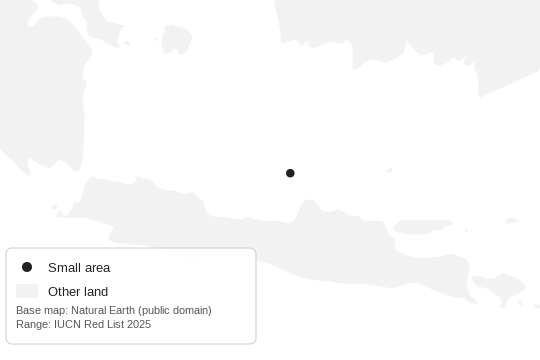
It lives on Karimunjawa and, presumably, on nearby Kemujan; the animals known from Kemujan are one skull.[1] The IUCN lists both islands as its range.[2]
Classification evidence
The only basis for the name is colour. The back of the Karimunjawa monkeys is darker than that of nearly all fascicularis, and the two overlap only a little in the amount of dark colour. About 5 percent of the fascicularis specimens Fooden examined are dark brown too, and without a place label they could be mistaken for this subspecies or for philippinensis.[1] Fooden suggested that the Karimunjawa monkeys were cut off from Java, when the sea rose after the last ice age, somewhat earlier than most other island groups on shallow seas.[1]
Status
The IUCN Red List 2025 lists karimondjawae as Critically Endangered, citing the 2022 assessment by Kristiawan, Hansen, Ang and Gumert.[2]
Sources
- Fooden 1995, Systematic review of Southeast Asian longtail macaques, Fieldiana Zoology n.s. 81: 1–206
- Hansen et al. 2025, IUCN Red List assessment of Macaca fascicularis
- GBIF Backbone Taxonomy, Macaca fascicularis (Raffles, 1821)
- Mammal Diversity Database, Macaca fascicularis
- Primate Info Net, long-tailed macaque fact sheet (Wisconsin National Primate Research Center)