Macaca fascicularis philippinensis is the name for the dark-brown Long-tailed Macaques of the western, northern and eastern Philippines.[1] Fooden (1995) and Groves (2001) list it as a tenth subspecies. The IUCN set it aside in 2025, saying it has come under dispute.[1][2]
Names and classification
Isidore Geoffroy named it Macacus philippinensis in 1843. The name rests on a single albino adult male, mounted as a skin, that A. Chenest bought alive in Manila and believed came from Luzon. The animal went to the Paris menagerie on 6 August 1841 and died on 29 August 1842.[1] Fooden listed it as one of ten subspecies, and the IUCN says Groves (2001) did the same.[1][2] GBIF lists nine subspecies and not this one, and the Mammal Diversity Database lists no subspecies of the species.[3][4] It is also called the Philippine Long-tailed Macaque.[5]
Description
The back is dark brown, and each hair carries pale golden to reddish rings. The crown is brighter than the back, and the hair in front of the ear points forward along the cheek.[1] The tail is 101 to 138 percent of the head-and-body length in 14 adults. Thirteen adult males measured 410 to 530 mm from head to rump.[1] The pale rings on the hairs are golden to reddish, which in Fooden’s key separates it from the Karimunjawa subspecies, whose rings are pale yellow.[1]
Range
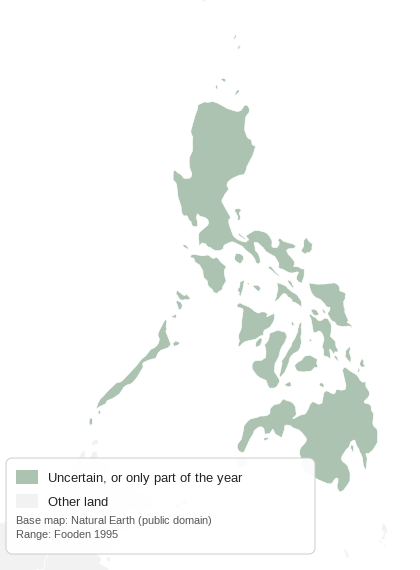
Fooden gave the range as the western, northern and eastern islands of the Philippines, among them Balabac, Palawan, Culion, Mindoro, Luzon, Samar and Leyte, and probably other islands north of about 10°N.[1] The southern islands hold paler macaques that Fooden placed in fascicularis. In eastern and central Mindanao and southern Negros, between the two ranges, he found mixed populations of dark and pale animals and called the area a contact zone. He once placed north-eastern Mindanao in the range of philippinensis on the evidence of two skins, but one of them proved to be a juvenile skin mismatched with a skull, which weakens the case.[1]
Classification evidence
Fooden based the subspecies on colour: the dark-brown back of the macaques in the western, northern and eastern Philippines. He suggested that their ancestors reached the islands about 160,000 years ago and became darker and redder after being cut off, and that the paler southern macaques came later from Borneo through the Sulu Archipelago, perhaps in the last ice age. The mixed populations of Mindanao and Negros could then come from interbreeding between the two arrivals.[1] The IUCN calls this the most eastern subspecies and says it “has come under dispute” (Smith et al. 2014, a genetic comparison of two alleged subspecies of Philippine cynomolgus macaques). It has therefore been tentatively removed from the Red List assessment and is included with fascicularis.[2] A 2017 study of whole mitochondrial genomes dated the split of the Philippine lineages from Bornean stock to about 60,000 to 430,000 years ago. It cites two other ideas: that people introduced the macaques about 4,000 to 3,500 years ago (Fooden 2006; Heaney et al. 2016), and that they arrived naturally in two waves (Smith et al. 2014).[6]
Status
The IUCN does not assess it separately. Its macaques count within fascicularis, which the 2025 assessment lists as Endangered.[2]
Sources
- Fooden 1995, Systematic review of Southeast Asian longtail macaques, Fieldiana Zoology n.s. 81: 1–206
- Hansen et al. 2025, IUCN Red List assessment of Macaca fascicularis
- GBIF Backbone Taxonomy, Macaca fascicularis (Raffles, 1821)
- Mammal Diversity Database, Macaca fascicularis
- Primate Info Net, long-tailed macaque fact sheet (Wisconsin National Primate Research Center)
- Yao et al. 2017, Molecular Phylogenetics and Evolution 116: 227–238