Macaca fascicularis umbrosa is the Long-tailed Macaque of the Nicobar Islands, India, where it lives on Great Nicobar, Little Nicobar and Katchall.[1][2] The IUCN Red List lists it as Vulnerable.[1]
Names and classification
Miller named it Macacus umbrosus in 1902 from monkeys collected in the Nicobars by W. L. Abbott in 1901. The holotype is an adult male from Little Nicobar, and the type series also includes animals from Great Nicobar and Katchall.[2] Earlier writers listed the Nicobar monkeys under the name cynomolgus (Cantor 1846; Blyth 1846).[2] The IUCN Red List 2025 and GBIF list umbrosa among nine subspecies, and Fooden listed it in 1995. The Mammal Diversity Database lists no subspecies of the species.[1][3][2][4] It is also called the Nicobar Long-tailed Macaque.[5]
Description
The back is blackish, and each hair carries pale yellowish rings. The crown is yellowish brown, and the thighs and shanks are pale brownish grey. The hair below the ears is pale brownish grey and short, 2 to 4 cm, so it shows less than the long pale patch of the Maratua subspecies.[2] The tail is 115 to 116 percent of the head-and-body length in three adults, and the head and body of three adult males measured 475 to 525 mm.[2] The hair in front of the ear points forward in five of eight specimens and sweeps back over the ear in three.[2]
Range
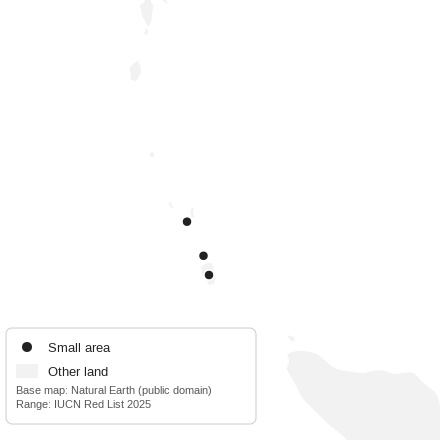
Long-tailed Macaques live on three islands of the Nicobar group: Great Nicobar, Little Nicobar and Katchall. A report from 1903 found no monkeys on the Nicobar islands north of Katchall.[2] The IUCN lists the same three islands as its range, and India has no other population of the species.[1] Macaques do not live on the Andaman Islands.[2]
Classification evidence
It is one of four blackish macaque populations on islands in deep water. The others are those of Simeulue and Lasia, Maratua and the Philippines.[2] Fooden thought the ancestors crossed the sea by themselves, because the Nicobars have never been joined to another land mass and have very few land mammals, and he suggested the crossing happened about 160,000 years ago. He proposed that the island population then darkened and grew a larger skull.[2] Since macaques are absent from the Andamans, he thought they came from Sumatra, the Malay Peninsula or the Isthmus of Kra, not from Myanmar.[2] Three of the eight specimens have the backward-pointing hair of the Burmese subspecies, aurea, and Fooden gave three possible explanations, including a past range of aurea that reached Sumatra, or a change that arose on the islands.[2]
Status
The IUCN Red List 2025 lists umbrosa as Vulnerable, citing the 2022 assessment by Ramakrishna, Mishra, Mazumder and Pal.[1]
Sources
- Hansen et al. 2025, IUCN Red List assessment of Macaca fascicularis
- Fooden 1995, Systematic review of Southeast Asian longtail macaques, Fieldiana Zoology n.s. 81: 1–206
- GBIF Backbone Taxonomy, Macaca fascicularis (Raffles, 1821)
- Mammal Diversity Database, Macaca fascicularis
- Primate Info Net, long-tailed macaque fact sheet (Wisconsin National Primate Research Center)