The Malabar Rose (Pachliopta pandiyana) is a black and white swallowtail butterfly with a red body. It lives only in the Western Ghats of southern India.[1][2] Its caterpillars feed on a small plant of the pipevine family, and for most of the 20th century the butterfly was treated as a race of the Ceylon Rose of Sri Lanka.[3][4][5]
Quick facts
Description
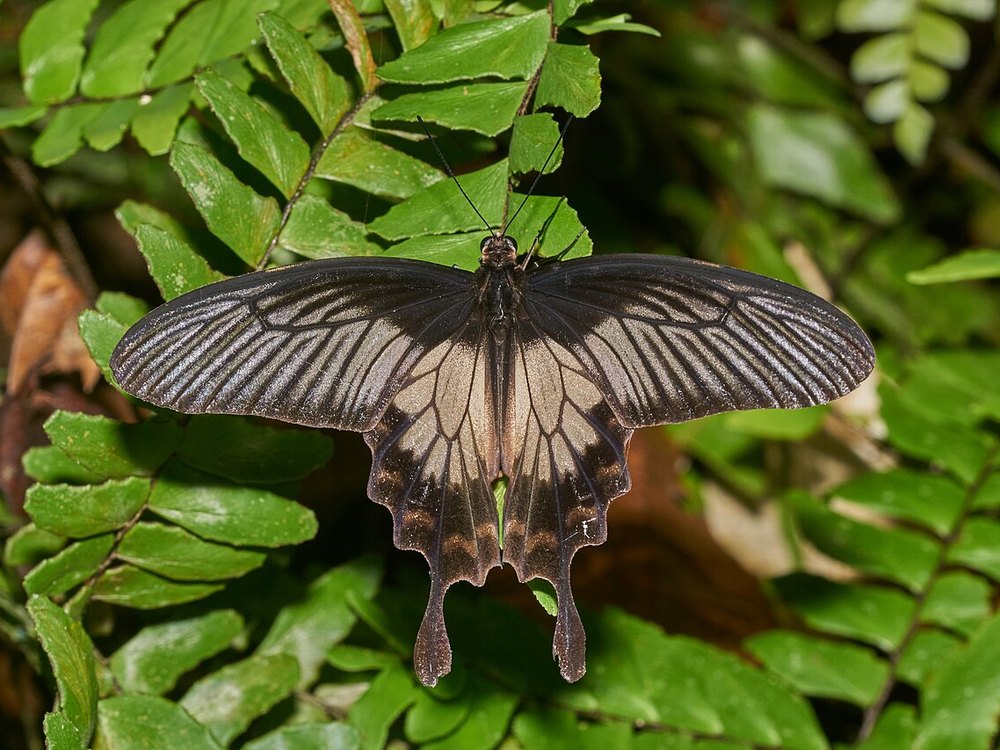
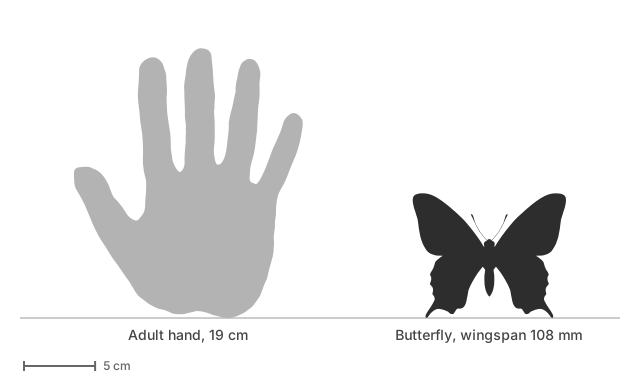
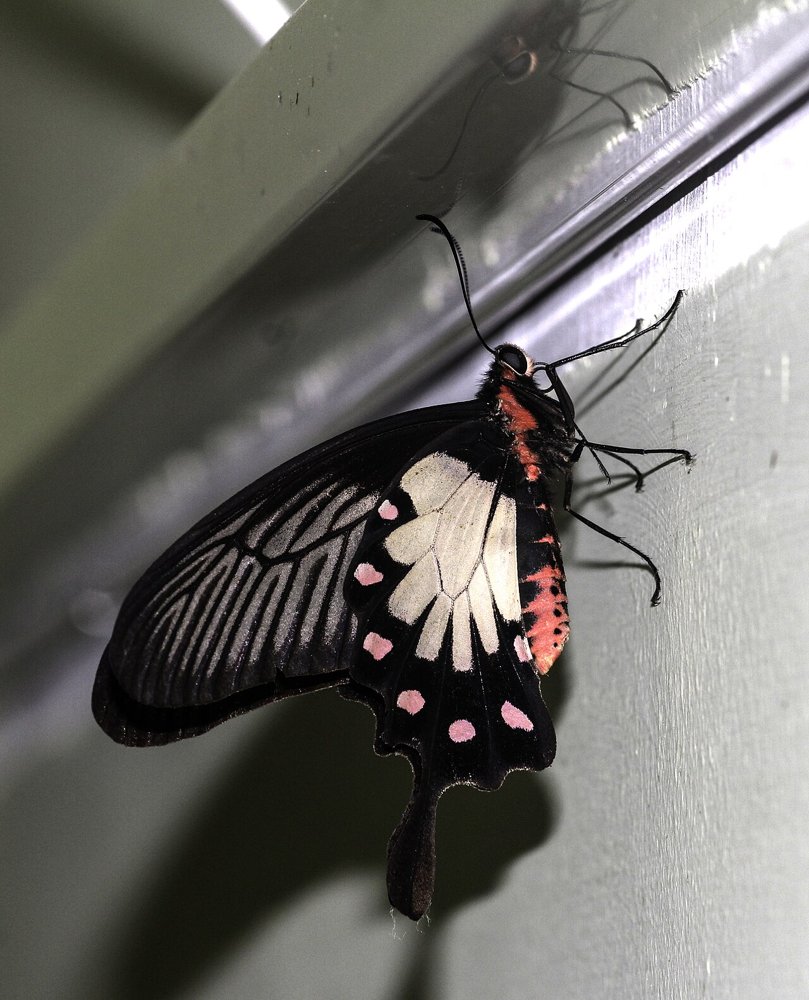
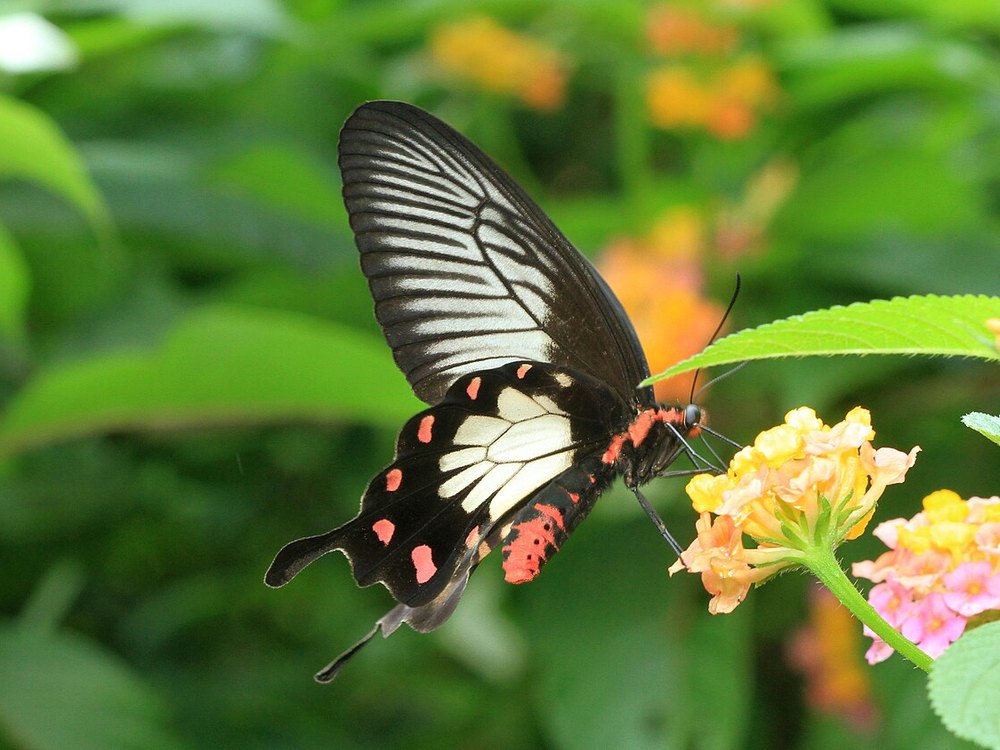
The Malabar Rose is a large butterfly with a wingspan of 100–130 mm.[8][5] The forewings are black with white streaks between the veins. The hindwings carry a broad whitish patch in the middle, with reddish crescents along the outer edge, and, like the other roses, the butterfly has crimson markings on its body.[9][4] The female’s forewing is more rounded than the male’s.[9]
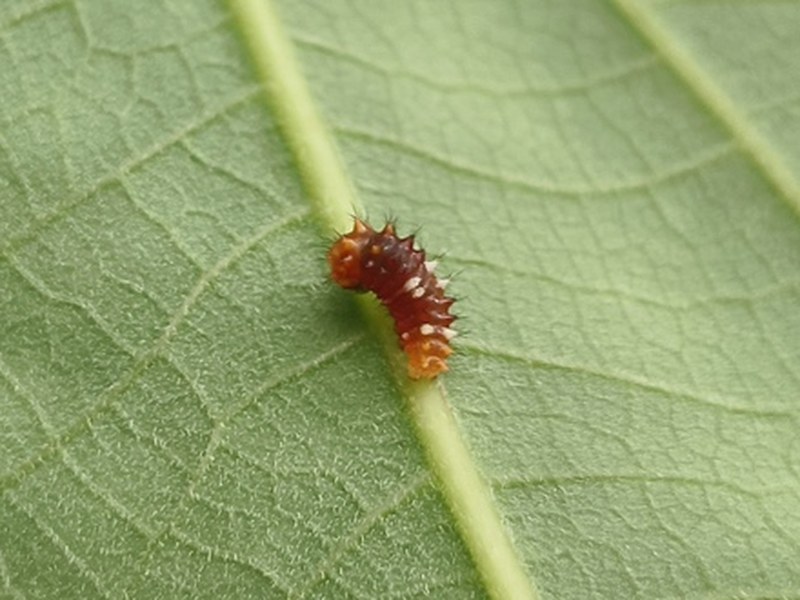
Early in the morning the butterfly hovers in front of flowers, fanning its wings, and later it flies low through the forest.[5] The caterpillar is dark velvety brown with orange-tipped spines and a white band, and it turns into a light brown chrysalis that hangs from a dead twig.[10][5]

Name
The Malabar Rose was named Papilio Pandiyana by Frederic Moore in 1881, from a specimen collected in Travancore, now part of Kerala, by a collector named Bourdillon.[9] Moore gave no reason for the name, and a link to the Pandya dynasty of the Tamil country is plausible but not documented. The English name “Malabar Rose” was in use by 1932.[8] It has also been placed in the genera Atrophaneura, Menelaides and Polydorus, and some lists, including CITES, still use Atrophaneura pandiyana.[11][5][12]
Body
Early authors give the wingspan as 102–114 mm in typical specimens, and 100–130 mm overall.[4][5] In the original description, the male's forewing is narrow, with smoky pale areas between black streaks, and the hindwing has a broad whitish central patch.[9] In the male, the first white spot on the hindwing is very large, and in the female it is small, divided in two, or missing.[4]
Size ranges

Behavior
The Malabar Rose appears early in the morning at flowers, hovering in front of them with a fanning motion of its wings.[5] It flies low inside wet evergreen forest.[5] An old account calls it local, but common in the hills of Travancore, and most common in April–May and September–October.[5] Modern records exist in every month, with most from July to September, though the records mainly show when and where people take photographs.[2]
Diet
| Stage | Food | Notes |
|---|---|---|
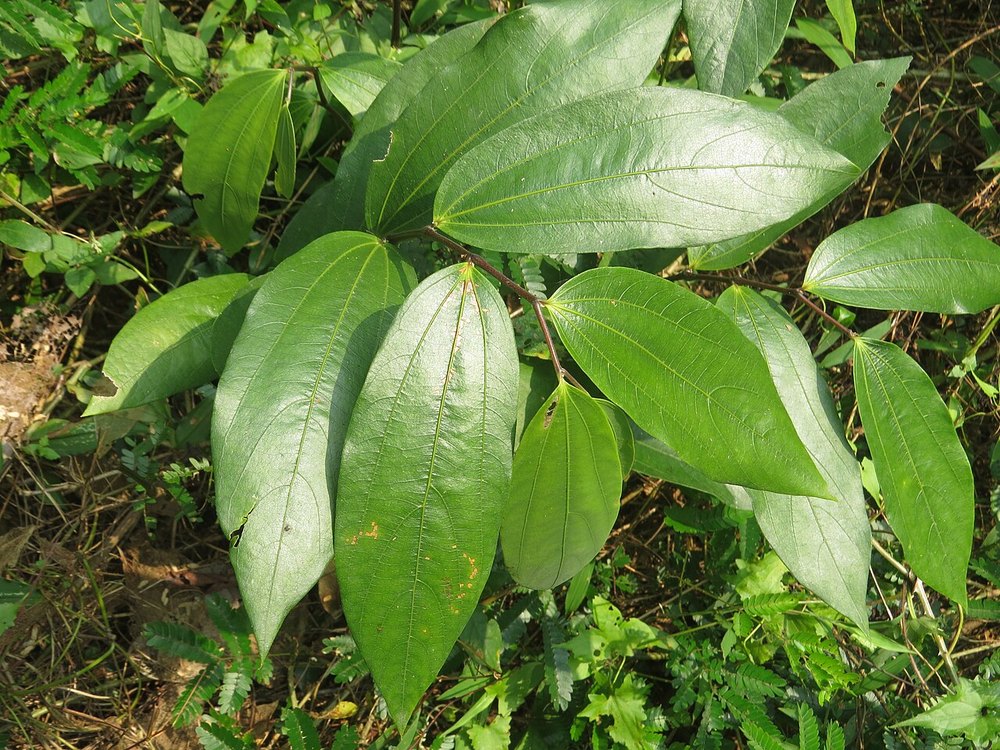
| Larva (caterpillar) | Thottea siliquosa | A small plant of the pipevine family. It is the only host listed in a checklist of Western Ghats butterflies.[3] Older records also name Bragantia wallichii.[5] |
| Butterfly | Flower nectar | It feeds at flowers in the early morning.[5] |

.jpg)
Life cycle
| Stage | Time | Notes |
|---|---|---|
| Egg | 4–5 days | Brick red, round and 1–2 mm wide. Laid singly on the underside of young leaves, or on tender shoots.[10] |
| Larva (caterpillar) | About 21 days | Five instars, growing from about 5 mm to about 45 mm.[10][13] |
| Pupa (chrysalis) | About 10–15 days | Light brown, hanging head up from a dry twig on a silk girdle.[10][13][5] |
| Butterfly | 6–10 days in captivity | Males about 6 days and females about 10 in one laboratory study; the wild lifespan is not known.[13] |
The caterpillar looks very like that of the Common Rose, which has the same shape, so wild caterpillars are hard to tell apart.[5] The full-grown caterpillar is about 42–47 mm long, with a white band on the third segment.[10][5] The number of broods in a year has not been established.
Ecology
Roses and other butterflies of their tribe take in poisonous aristolochic acid from the pipevine-family plants their caterpillars eat. This makes both the caterpillars and the adults taste bad to predators, and the bright colours act as a warning.[14][15] It has been shown for other roses and has not been measured in the Malabar Rose itself. Some swallowtails mimic the roses to gain the same protection: the females of the Common Mormon, for example, copy the Common Rose.[16]
Habitat and range
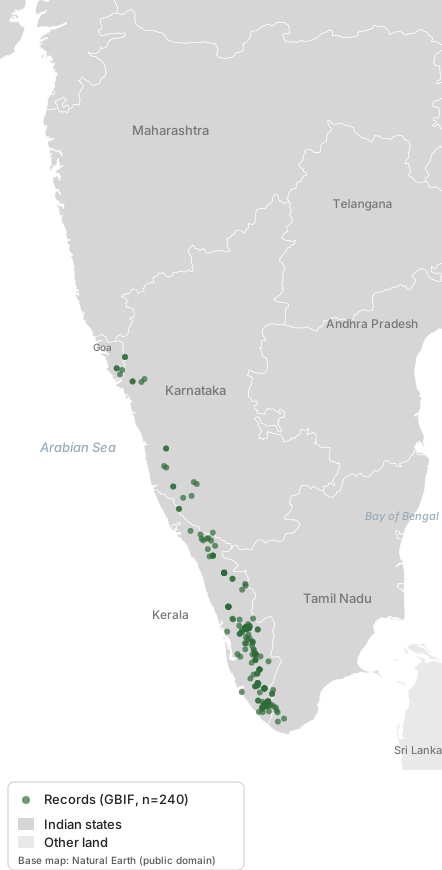
The Malabar Rose is found only in the Western Ghats.[1] An early account records it from the hills of Travancore, the Nilgiris and North Kanara, at about 300–900 m (1,000–3,000 ft).[5] About 86% of the modern records with coordinates are in Kerala, and a few are in Karnataka, Tamil Nadu and Goa.[2] It lives in wet evergreen forest, and the females lay eggs near streams in and beside the forest.[5]
Evolution
The swallowtail family is about 55 million years old in one recent estimate, and older in others, ranging from 55 to 85 million years.[14][17] The oldest known fossil swallowtails, from the Green River rocks of Colorado, are about 48.5 to 53.5 million years old.[14] The tribe that contains the roses, the Troidini, feeds only on pipevine-family plants.[14][18] Where the tribe began is disputed: one study favours the broken-up southern continents, while another finds that the American members arose in North America.[19][20] No dated family tree includes the Malabar Rose itself. One hypothesis, based on body structure, says it and the Ceylon Rose returned to India and Sri Lanka from Southeast Asia.[18]
Conservation
The Malabar Rose is listed as Least Concern on the IUCN Red List.[2] It is also on Appendix II of CITES, which controls trade. The listing was added in 2002 because the butterfly resembles the Ceylon Rose, and it is not an assessment of the Malabar Rose itself.[6][7][12]
History and culture
Moore described the butterfly in 1881 and later illustrated it in his Lepidoptera Indica.[9][5] In the books of Bingham, Evans and Talbot it appears as a southern Indian race of the Ceylon Rose, and it was raised to a full species in 1961 and again in 1983, according to the CITES proposal of 2002.[4][8][5][6] No Indian state has chosen it as its butterfly. Kerala’s is the Malabar Banded Peacock.[21]
Taxonomy
| Rank | Name |
|---|---|
| Kingdom | Animalia |
| Phylum | Arthropoda |
| Class | Insecta |
| Order | Lepidoptera |
| Family | Papilionidae (swallowtails)[2] |
| Tribe | Troidini[2] |
| Genus | Pachliopta |
| Species | Pachliopta pandiyana (Moore, 1881)[2] |
No subspecies are recognised.[2] Its closest relative is probably the Ceylon Rose, Pachliopta jophon, with which it was long united.[18][5] The original specimen came from Travancore, and one list gives Trevandrum as the type locality.[9][11]
Sources
- Anto, Binoy & Anto 2021, Journal of Basic and Applied Zoology 82: 22
- GBIF, Pachliopta pandiyana (records, classification and IUCN category)
- Nitin et al. 2018, Journal of Threatened Taxa 10(4): 11495–11550 (larval host plants)
- Bingham 1907, Fauna of British India, Butterflies, vol. 2, pp. 22–23
- Talbot 1939, Fauna of British India, Butterflies, vol. 1, pp. 81–83
- CITES CoP12 Proposal 12.40, 2002 (archived copy)
- CITES CoP12, adopted amendments to the Appendices, 2002 (archived copy)
- Evans 1932, The Identification of Indian Butterflies, 2nd ed.
- Moore 1881, Transactions of the Entomological Society of London, p. 313 (the original description)
- Revathy & Mathew 2015, International Journal of Zoological Research 11(5): 177–187
- Funet (Savela), Atrophaneura page
- CITES Appendices valid from 21 May 2023 (archived copy)
- Rajeswari & Jeyabalan 2017, International Journal of Advanced Research in Biological Sciences 4(2): 1–11
- Allio et al. 2021, Nature Communications 12: 354
- Komata et al. 2026, DNA Research
- Nishikawa et al. 2013, Scientific Reports 3: 3184
- Condamine et al. 2018, Systematic Entomology 43: 460–480
- Hancock 2007, Australian Entomologist 34: 33–42
- Braby, Trueman & Eastwood 2005, Invertebrate Systematics 19: 113
- Condamine et al. 2012, BMC Evolutionary Biology 12: 82
- Indian Foundation for Butterflies, state and national butterflies (archived copy)
- Open Tree of Life, synthetic tree and taxonomy
- Photographs: Praveenp (adult) and Vinayaraj (caterpillar and chrysalis), via Wikimedia Commons, CC BY-SA 4.0; credited in the captions