The Masai Giraffe (Giraffa tippelskirchi) is a giraffe of Africa. It lives in Kenya and Tanzania, and a separate population lives in the Luangwa Valley of Zambia.[1][2] Its coat has dark-brown patches with jagged, leaf-like edges.[3] The IUCN Red List assessed the Masai Giraffe as Endangered in 2019 (as a subspecies).[1][2] Whether it is a species or a subspecies depends on the authority. This page treats it as a species, as the IUCN Giraffe and Okapi Specialist Group did in August 2025 (see Taxonomy).[4][5]
Quick facts
Description
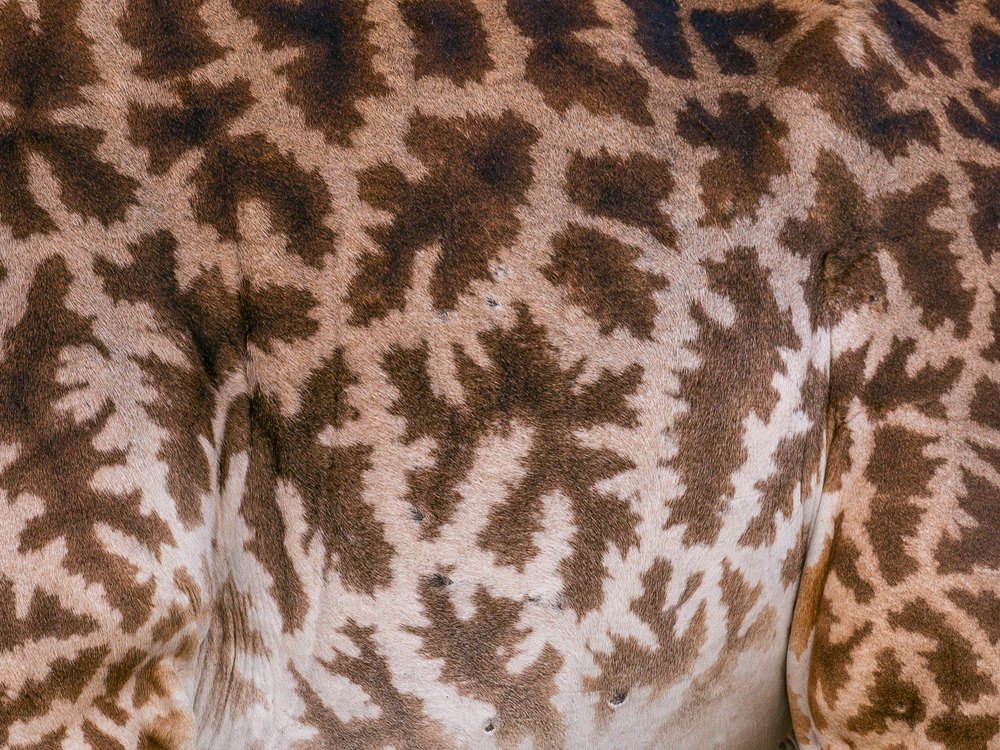
The Masai Giraffe is darker than the other giraffes. Its large dark-brown patches have jagged edges and a leaf-like shape, and they are outlined in a creamy-brown tone that runs down the lower legs.[3] The first description of 1898 also noted the jagged edges. Matschie wrote that the dark-brown spots on the Berlin skins had edges heavily jagged by short white cross-lines, but still sharply bordered, and that the legs were spotted down almost to the hooves.[7] The IUCN task force says coat pattern has not yet been systematically evaluated, and it did not use pattern to decide which giraffes are species.[4]
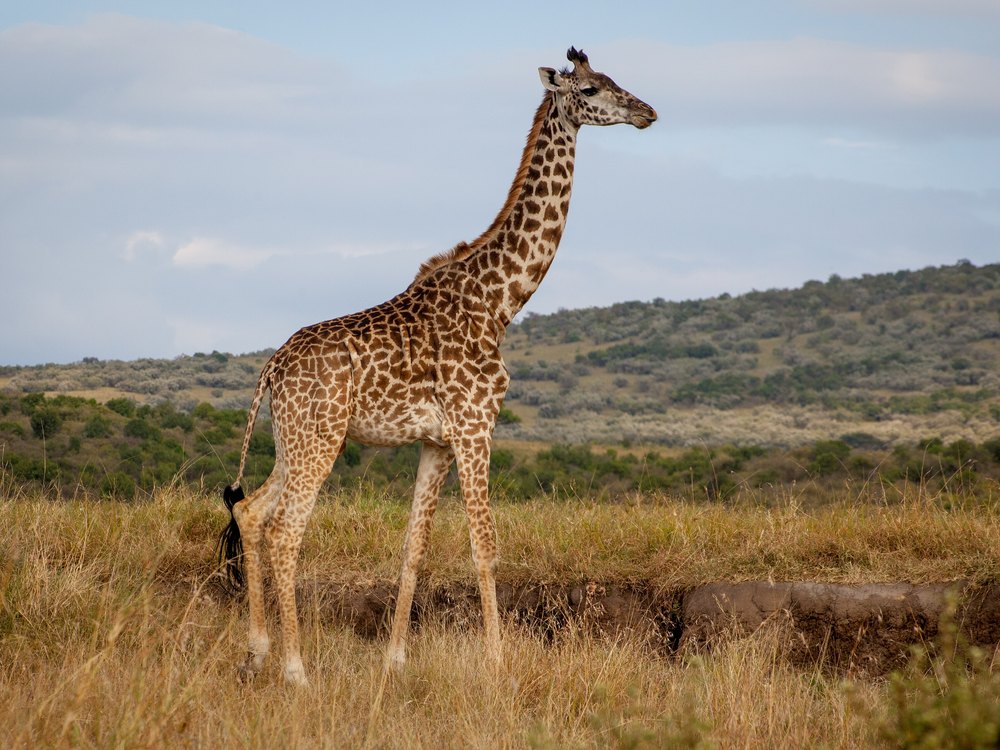
The pattern does not change as a giraffe ages. Researchers in Tarangire identify individuals by their spots for this reason. The skin underneath is uniformly dark grey.[8] Some spot traits are inherited. Larger, rounder spots were linked to better survival of young animals, with differences of 0.04 to 0.07 in first-season survival among groups.[8]
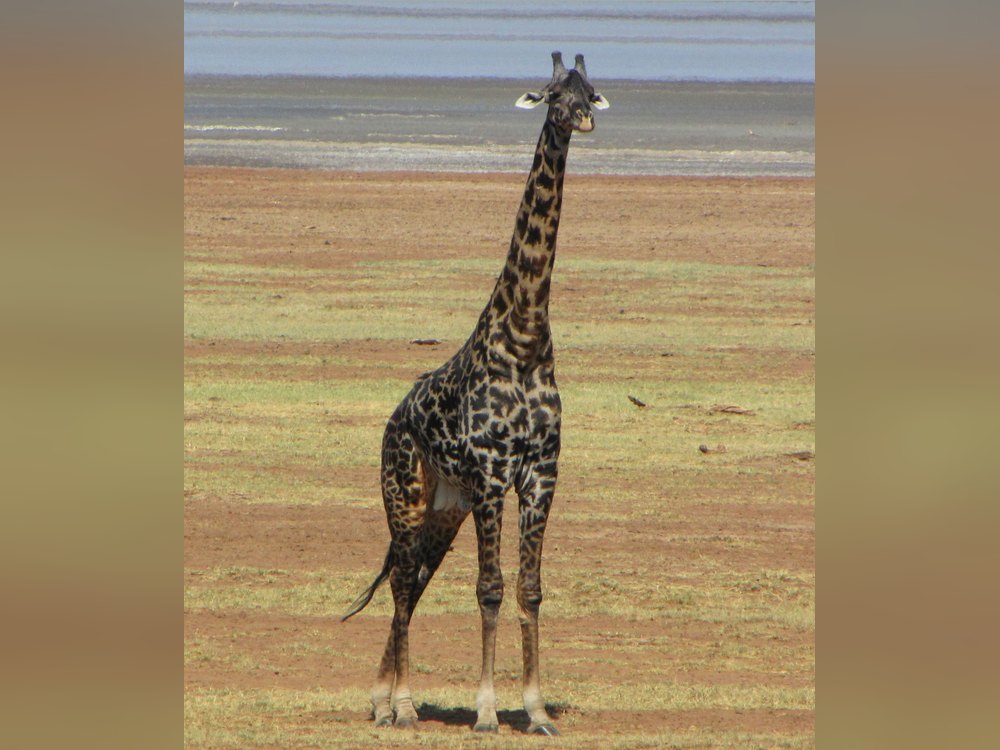
Males are said to darken with age, but the only measured study is on the Luangwa population in Zambia. It followed 36 males over 33 years. The change in colour took 1.8 years on average, and males reached full coal-black blotching at an average age of 9.4 years.[9] No measurement of this kind was found for the Masai Giraffe elsewhere. Calves are described as “reddish and fluffy” in a field manuscript from the Masai Mara.[10]
Ossicones
Ossicones are skin-covered bony knobs on the head. For giraffes in general, Wikipedia (citing Dagg 2014, Estes and Prothero 2003) says that females and young have thinner ossicones with tufts of hair, that the tops of adult males’ ossicones are bald and knobbed, and that older males also build up bumps of calcium on the skull.[11] Wikipedia’s Masai Giraffe page adds that bulls usually have an extra bump between the eyes.[12] Field workers use the look of the ossicones to judge the age of Masai Giraffes.[10] No measured ossicone sizes for the Masai Giraffe were found.
Name
Paul Matschie named Giraffa tippelskirchi in 1898, in a talk to the Society of Friends of Natural Science in Berlin on 19 July of that year. He described it as a variety (Abart) of the giraffe, not as a species.[7] Species rank is a later treatment, and it is still disputed (see Taxonomy).[5][4]
The epithet honours Herr von Tippelskirch. Matschie wrote that he shot the specimen, a younger female, on the steppe not far from Lake Eyasi in what is now northern Tanzania, and gave its skin to the Berlin museum.[7][5] The text gives no first name for him, and no biography was found.
The English name is “Masai Giraffe”. “Maasai Giraffe” is a common variant spelling.[5] No source read explains who first used the English name or why. An older English name, Kilimanjaro Giraffe, goes with the subspecies named by Lydekker in 1904. The Mammal Diversity Database also lists Rhodesian Giraffe and Thornicroft Giraffe, which belong to the Zambian form (see Forms and variants).[4][5]
The English word “giraffe” comes from Arabic zarafa, by way of Italian and French. Its deeper origin is disputed.[13] An older English name, “camelopard”, comes from the Greek words for camel and leopard, after the animal’s shape and spotted coat.[13][14]
In other languages
| Language | Name | Meaning |
|---|---|---|
| French | Girafe Massaï | Masai giraffe |
| Spanish | Jirafa masai | Masai giraffe |
| Swahili | twiga | Giraffe (the general word, not specific to this species) |
The French and Spanish names are printed in a document of the Convention on Migratory Species.[1] The Swahili word is from a Giraffe Conservation Foundation report for Tanzania.[15] Names that rest on one weak source are left out.
Body
Size
No measured standing heights of wild adult Masai Giraffes were found. The Tanzania national giraffe action plan, citing Dagg (2014), says males are about 5.2 m tall on average and females about 4.3 m. Shoulder height is 2.4 to 3.5 m for males and 2.1 to 3.0 m for females, and adult size is reached at 5 to 7 years.[16] The plan is written for giraffes in general, but Tanzania has only the Masai Giraffe.[15] Animal Diversity Web gives up to 5.7 m for males, to the horns, and 3.3 m at the shoulder.[17] The 5.2 m in the size drawing below is the plan’s typical male height.
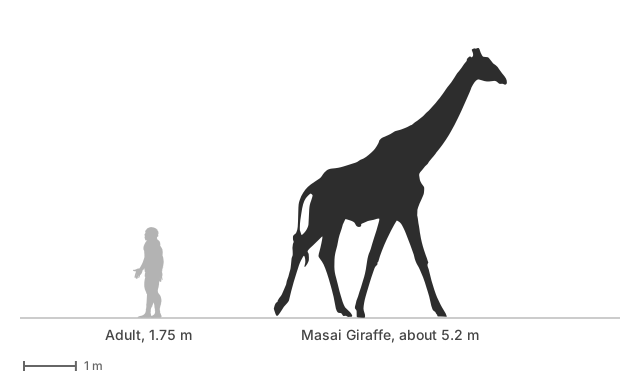
Guinness World Records lists a Masai bull named George, at Chester Zoo in the United Kingdom, as the tallest giraffe ever, at 5.8 m. It arrived from Kenya on 8 January 1959 and died on 22 July 1969. The record does not say how the height was measured, so it is not a typical size.[18]
Weight
The Tanzania action plan, citing Dagg (2014), gives about 1,200 kg for males and about 800 kg for females.[16] Animal Diversity Web gives up to 1,930 kg for bulls and up to 1,180 kg for cows.[17] Wild adult giraffes are rarely weighed, and no measured weights for the Masai Giraffe were found. A group studying Masai Giraffes from photographs says males are 30% to 40% bigger than females overall.[6]
Newborn size
Values for giraffes in general conflict. The Giraffe Conservation Foundation gives a calf about 1.8 m tall and around 65 kg at birth.[19] Animal Diversity Web gives 50 to 55 kg.[17] A zoo factsheet gives about 100 kg for wild giraffes, with a shoulder height of 1.5 to 1.8 m.[20] No birth measurements for the Masai Giraffe were found.
Neck and proportions
The neck is about 2.4 m long at most, according to Animal Diversity Web, for giraffes in general.[17] A study of Masai Giraffes measured from photographs of captive and wild adults. Females have proportionally longer necks and trunks. Males have longer forelegs and wider necks, with greater apparent mass. The proportions are the same in newborns and become clearly different at about 3 years of age. Males grow faster in their first year. In that study, captive males more often had the proportions of females.[6] The study could not measure absolute height without a reference length.[6]
Heart
The Giraffe Conservation Foundation says that a giraffe’s heart weighs 11 kg and pushes blood up about 2 m.[21] This is for giraffes in general. No heart or blood-pressure measurements for the Masai Giraffe were found.
Behavior
Groups
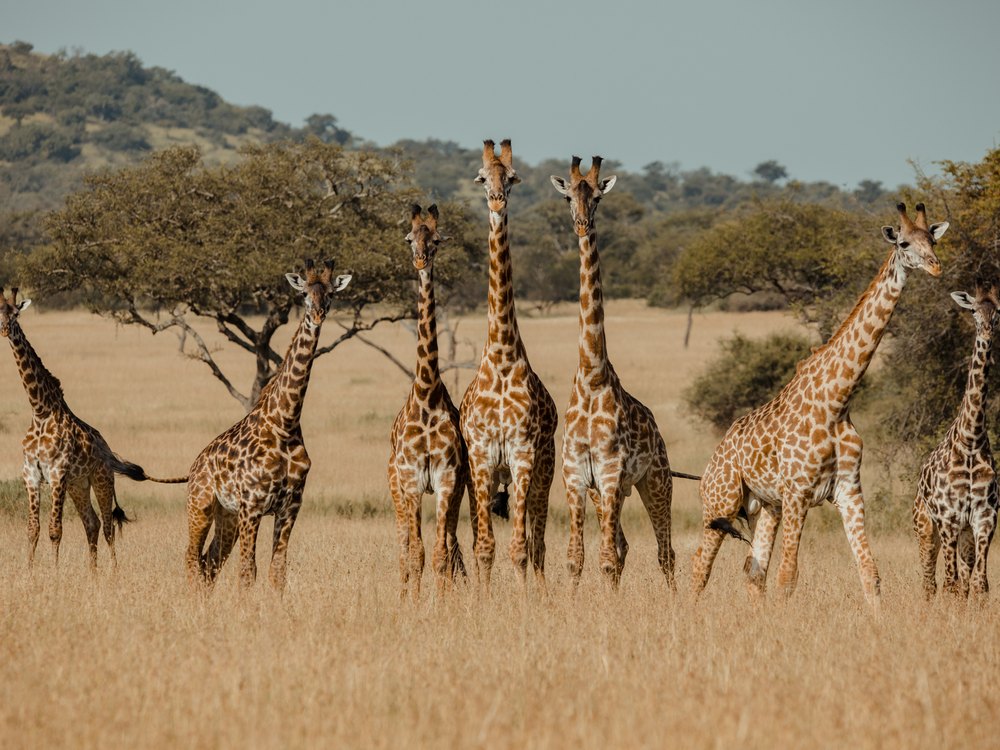
Masai Giraffes in the Tarangire ecosystem live in groups whose members change often, but the long-term ties between females are stable. A study of 1,139 adult females seen in 2,137 groups from 2012 to 2016 found 14 communities. Ten of them had enough members to count, and they averaged 51 females each (range 28 to 70). A female was seen on average with about 3 other adult females (3.027, standard deviation 1.259). A group in that study meant giraffes more than 500 m from the nearest member of any other group.[22]
Males are more solitary. They show weaker preferences for company, wander widely to find females in estrus, and form no lasting bonds with females.[22] Females that were seen with more other females survived better, up to about three others, and then the effect levelled off. Survival also improved farther from towns. The study counted only females seen at least six times, which the authors say probably makes survival look higher than it is.[22] In the Luangwa population, calves of the same age cohort form stronger bonds, and mothers and adult daughters associate more than unrelated females.[23]
Home range
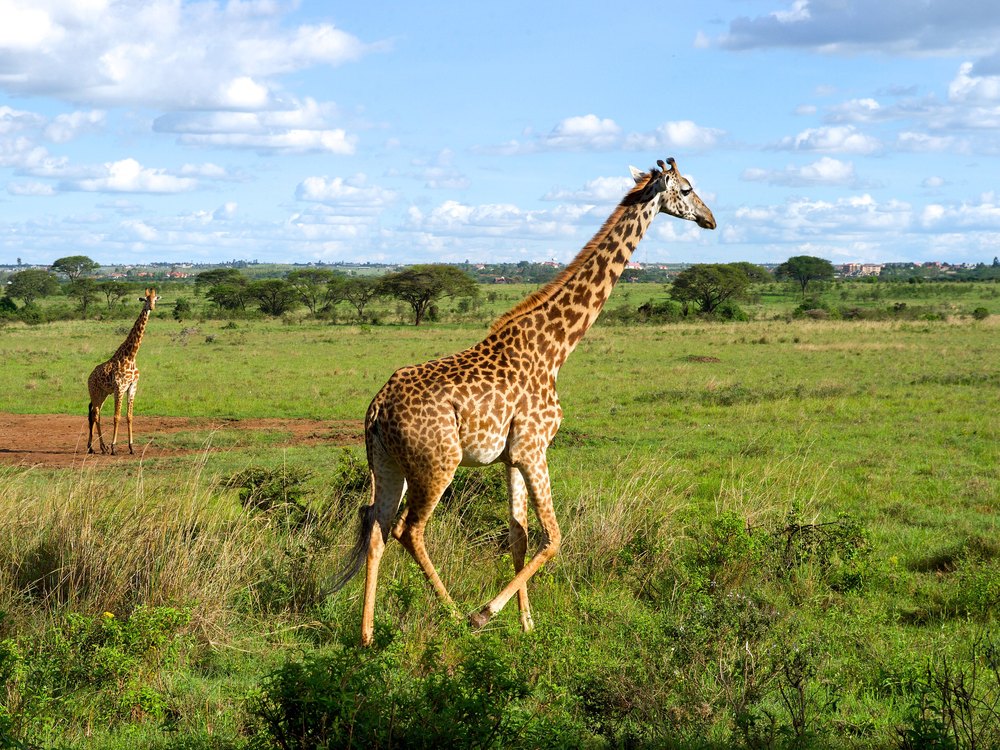
In the Tarangire–Manyara region, 132 Masai Giraffes tracked over 6 years had home ranges (95% kernel) of 114.6 km² for females (109 animals) and 157.2 km² for males (23 animals). Adult female ranges were larger near densely populated towns. Across Africa, mean annual rainfall explained 74% of the variation in giraffe home ranges.[24]
Necking and fights
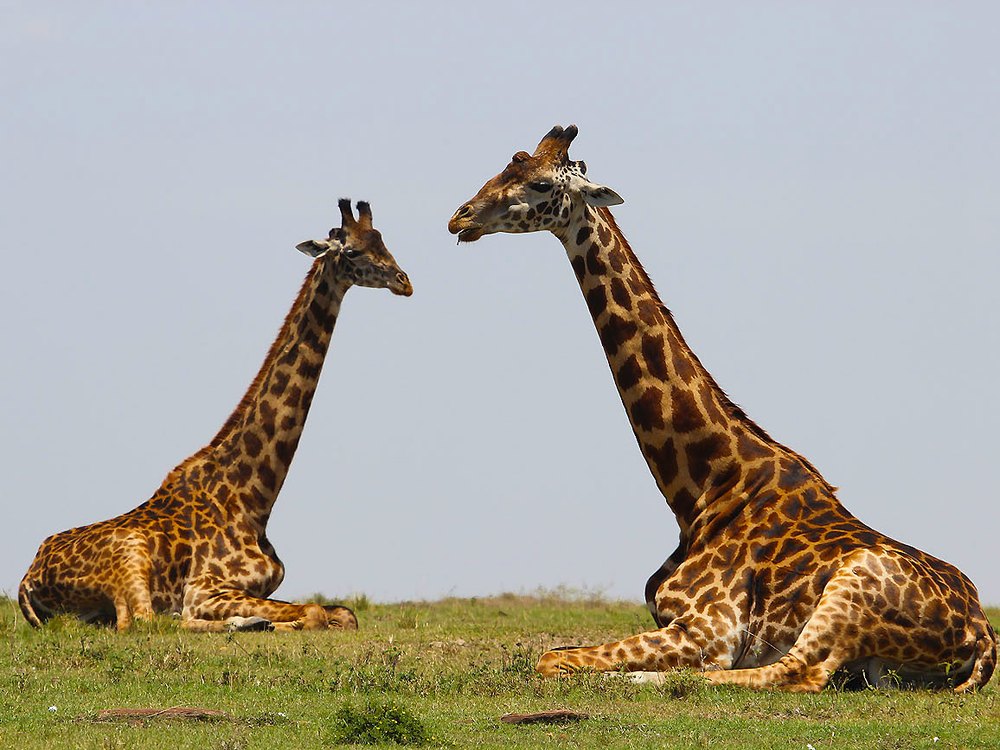
For giraffes in general, Wikipedia says that bulls fight by swinging the neck and clubbing with the ossicones, and that a duel can last more than half an hour (citing Williams 2010 and Kingdon 1988).[11][12] The study of Masai Giraffe proportions found wider, heavier necks in males, which fits fighting. It also found proportionally longer necks in females, which the authors say does not fit the older idea that the neck evolved only for male contests. They favour a mixed explanation (see Evolution).[6]
Sleep and rest
No sleep study of wild Masai Giraffes was found. In a zoo, 8 giraffes filmed for 152 nights slept for 4.6 hours in total on average (not counting the juvenile). The main sleep period ran from 20:00 to 07:00, and most lying sleep episodes were shorter than 11 minutes. The subspecies of the zoo giraffes is not stated.[25] In the wild, accelerometers on 3 young adult Angolan giraffes in Namibia, a different giraffe, recorded lying sleep-like posture for 8.6 ± 7.9 minutes a night in total. The device could not tell lying from standing, and posture is not proof of sleep.[26] The two studies used different methods, so their numbers cannot be compared directly.
Voice
Giraffes are not silent. In zoos in Berlin, Vienna and Copenhagen, 947 hours or more of audio recordings captured 65 humming sounds, all at night. The mean frequency was 92.01 ± 25.78 Hz, and the hums lasted 0.41 to 4.17 seconds. None was infrasound.[27] The animals were captive Rothschild’s and reticulated giraffes. No recordings of Masai Giraffes in the wild were found.[27]
Diet
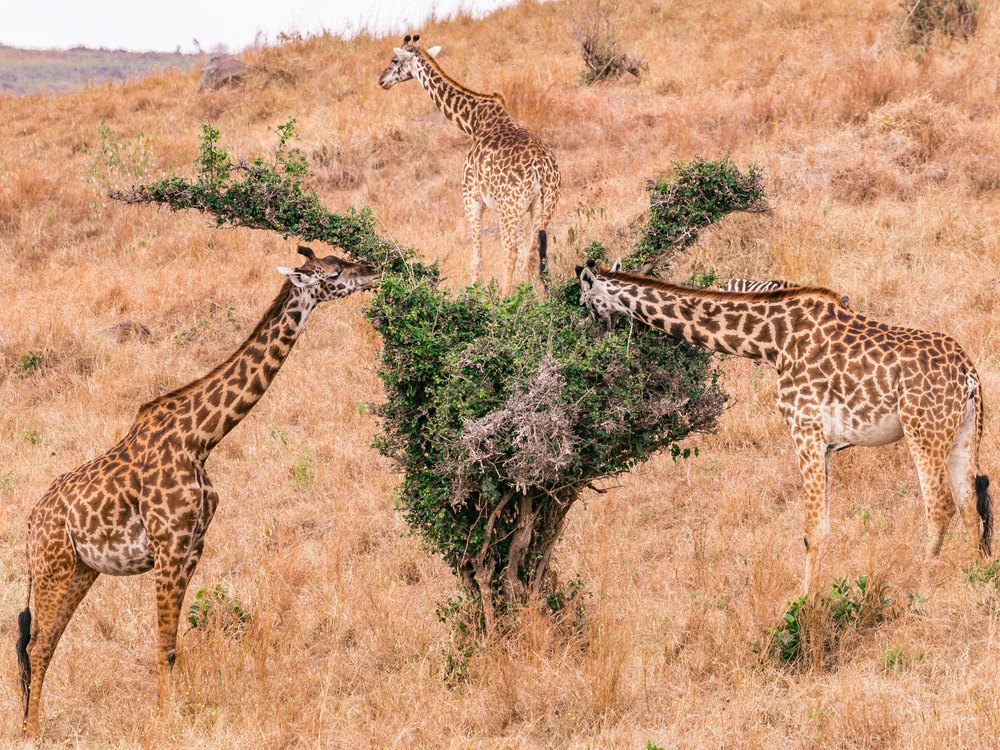
The Masai Giraffe is a herbivore. It browses the leaves, stems, flowers and fruits of trees and shrubs, and it commonly lives in areas with Vachellia and Senegalia acacias.[16] It is a selective browser. In the Serengeti, giraffes moved between habitats along the drainage slopes with the seasons. They favoured minor food species and fresh, protein-rich shoots, and they ate the dominant species roughly in line with how common they were. Breeding females chose high-energy food in the dry season. The giraffes avoided certain defensive plant chemicals, and they foraged longer when food was scarce in the dry season, while cutting back on tiring activity in the hottest hours.[28]
In Tarangire, Masai Giraffes preferred some woody plants, including Vachellia species, and avoided others, at both local and landscape scales. They consistently preferred the shrub Dichrostachys cinerea, which livestock managers often treat as an invading bush.[29] A Serengeti study reported that adult males ate 1.6% and adult females 2.1% of their live weight a day. This comes from a one-line summary of the paper, and the paper itself was not read.[30]
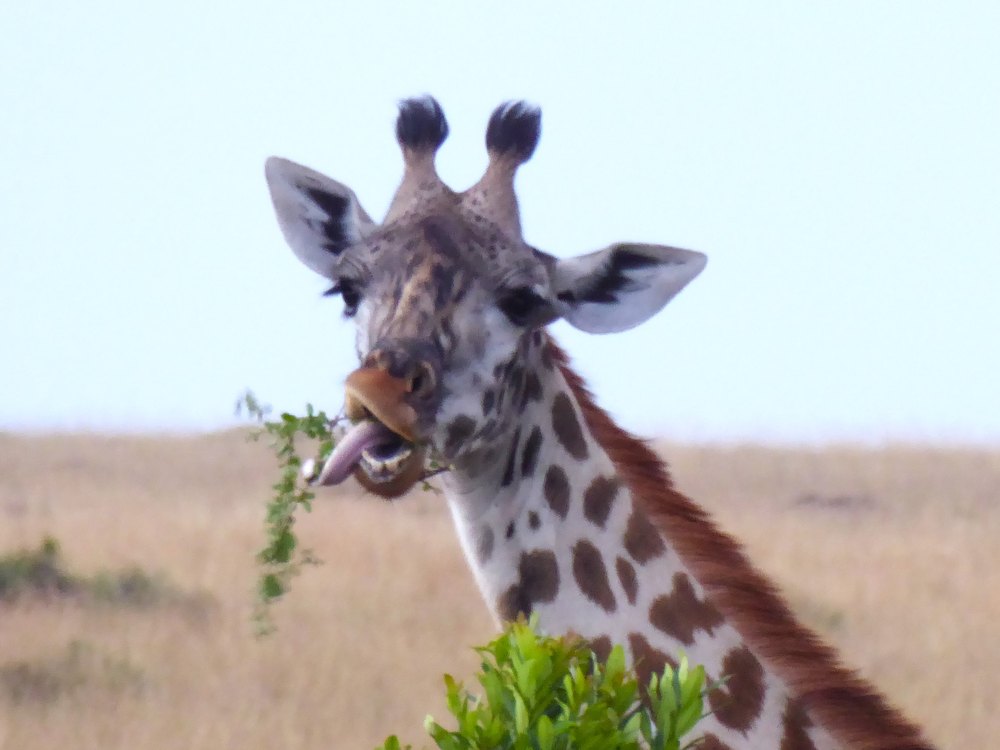
Tongue
The tongue is 45 to 50 cm long.[21] It is long, muscular and prehensile, and giraffes use it to strip leaves from thorny branches.[12] No measured stripping technique for the Masai Giraffe was found.
Water
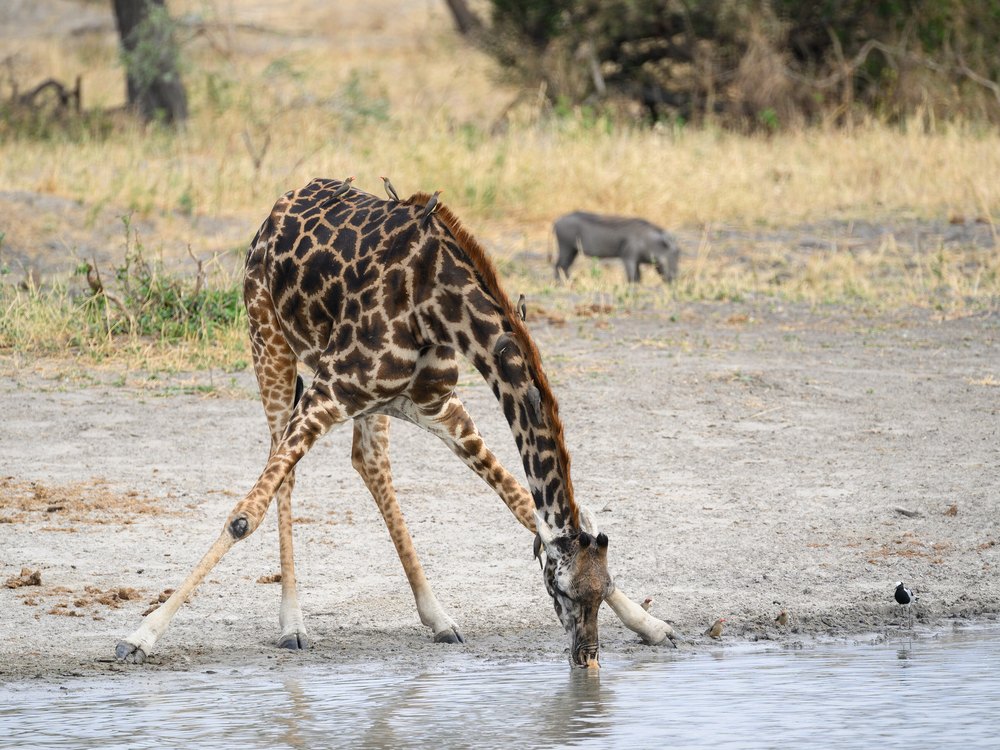
Giraffes drink only rarely, according to the Giraffe Conservation Foundation, and they get much of their water from the plants they eat.[21][17] To drink they spread the forelegs or bend the knees (Wikipedia, citing Estes, for giraffes in general).[11] No drinking study for the Masai Giraffe was found.
Life cycle
| Stage | Time | Notes |
|---|---|---|
| Calf | Birth to about 1 year | One calf at a time. It hides in the first weeks, and it is weaned at about 9 months[19][31] |
| Juvenile | About 1 to 3 years | Independent at about 14 months. The body proportions of the sexes begin to differ at about 3 years[31][6] |
| Adult | From about 3–4 years (females) or 6 years (males) in field surveys | Females breed from about 4 to 6 years and have a calf about every 620 days[31][20][32] |
Field studies call every animal between about 1 year and adulthood a subadult: 1 to 3 years for females and 1 to 6 years for males in Tarangire. The Juvenile stage above is a simplification. Ages are approximate.[31][8]
Pregnancy and birth
Pregnancy lasts about 15 months, according to the Tanzania action plan. Other values for giraffes in general are 453 to 464 days (Giraffe Conservation Foundation), 446 to 457 days on average (Dagg 2014, as quoted by a zoo factsheet) and 457 days (Animal Diversity Web and AnAge).[16][19][20][17][33] Gestation has not been measured for the Masai Giraffe on its own. There is one calf per birth.[33]
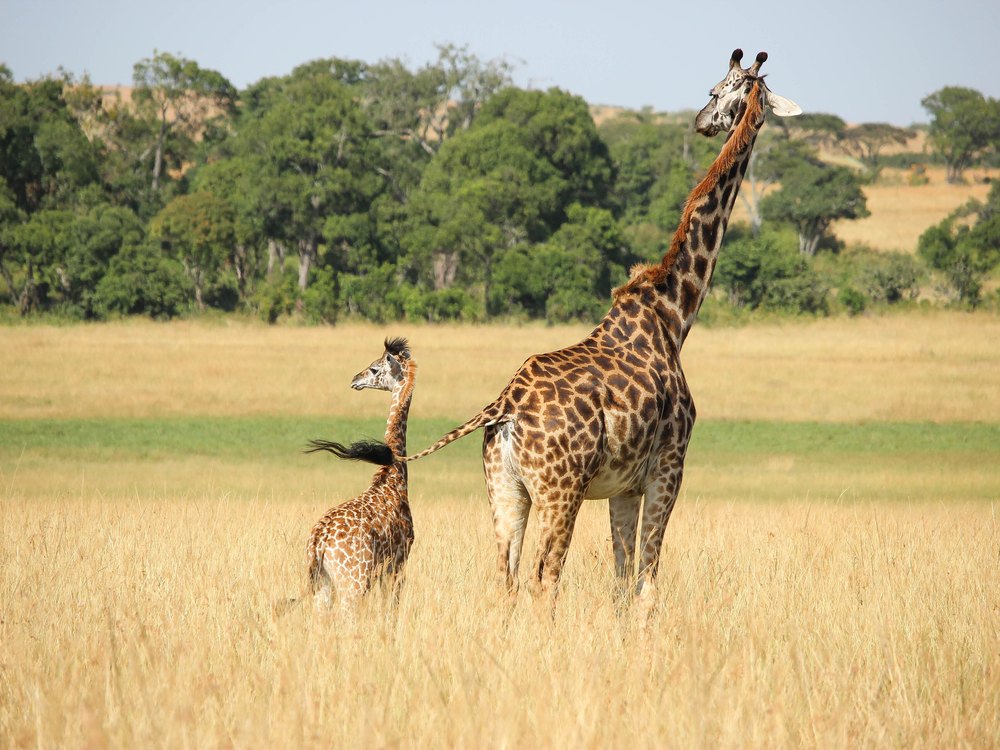
There is no fixed breeding season. In Tarangire, Masai Giraffes gave birth in any month, with a possible small peak linked to rainfall.[31] Females in Luangwa also bred all year.[32] For giraffes in general, the Giraffe Conservation Foundation says the mother gives birth standing, so the calf falls about 2 m, and that it stands within an hour.[19]
Calf
For giraffes in general, a calf spends the first days to weeks hidden in tall grass or cover while the mother feeds, and she returns to nurse it.[19] Calves lie motionless while the mother is often 10 to 25 m away (Toon and Toon 2004, as quoted by a zoo factsheet).[20] Wikipedia, citing Langman 1977, says calves spend most of the first one to three weeks hiding.[11] Within a few weeks the calf joins a group of other calves.[19]
In the Tarangire paper on Masai Giraffes, weaning typically comes at 9 months and independence at 14 months.[31] For giraffes in general, the Giraffe Conservation Foundation says calves nurse for 9 to 12 months and start to sample leaves at about 4 months. Young males leave around 15 months to join male groups, and females usually stay with their mother’s herd.[19] A zoo factsheet gives weaning at 6 to 17 months, most often 9 to 12.[20]
Researchers who score photographs use age classes. In Tarangire, a newborn calf is 0 to 3 months old and an older calf 4 to 11 months. A subadult is 1 to 3 years (females) or 1 to 6 years (males), and an adult is over 3 years (females) or over 6 years (males).[31][8] Another Tarangire study counts adult females as those over 4 years.[22] In the Masai Mara, a manuscript uses 0 to 3 months, over 3 to 12 months, over 1 to 5 years and over 5 years.[10] These are scoring classes for photographs, not biological milestones.
Survival of calves and adults
In the Tarangire region, the share of calves surviving to 1 year was 0.588 ± 0.054 across five sites in 2012 to 2014. Adult female survival was 0.847 ± 0.016 a year and adult male survival 0.841 ± 0.045. The animals had 0.22 calves per adult female per year. Adult female survival differed among sites and was higher where anti-poaching effort was higher, but calf survival did not differ significantly. These numbers come from a dissertation chapter.[34] When migratory wildebeest and zebra herds were absent, calf survival was 11% lower and apparent reproduction 37% lower than when the herds were present.[31]
In the Siria Plateau of the Masai Mara, where lions are few, a manuscript reports yearly survival of 0.85 for animals of all ages and sexes from 2014 to 2022. Calves made up about 23.6 ± 6.7% of animals counted (8 counts). The authors say this is higher than the 30 to 70% calf survival reported for protected areas in Tanzania.[10] In the Luangwa population, about half of the calves died before 1 year.[32] The Giraffe Conservation Foundation says that in the Serengeti more than 20% of calves die in the first month and about half do not reach six months, but it names no study for this.[19][35]
Growing up and breeding
Tarangire females had a calf on average every 620 ± 49 days.[31] In Luangwa the interval was about 678 days.[32] A zoo factsheet gives 19 to 22 months.[20] In the Serengeti in the 1970s, calving intervals were shorter and first conceptions earlier than in Nairobi National Park.[36]
Ages at maturity for giraffes in general vary a lot. For females, AnAge gives about 3.5 years, Animal Diversity Web 3 to 4 years with breeding at least a year later, and a zoo factsheet 4 to 5 years.[33][17][20] In Luangwa, females had their first calf at about 6.4 years.[32] For males the values run from about 4 to 10 years: AnAge gives about 4.5 years, Animal Diversity Web 4 to 5 with breeding from about 7, and a zoo factsheet about 9 to 10 (range 8 to 11).[33][17][20] Luangwa males reached full black colour at about 9.4 years.[9] No age at first mating was measured for the Masai Giraffe.
Lifespan
The measured figures come from the Luangwa population in Zambia, from more than 40 years of follow-up. The longest-lived females reached about 28 years. The maximum lifespan of males was about 75% of that of females, and adult males and females had similar average life expectancy, but males had shorter breeding lives.[37] A separate study of 36 males gave an average of about 16 years and a maximum of about 22, against about 28 for females. The male figures come from records of deaths and disappearances, so they can include males that left the area.[9] No measured maximum age was found for the Serengeti or Tarangire.
Round figures for the wild lifespan of giraffes are often quoted. The Giraffe Conservation Foundation says they were estimates without supporting data.[35] For giraffes in general, AnAge lists up to 39.5 years for a wild-born animal that died in captivity.[33]
Ecology
Lions and other predators
Lions are the main predator of giraffes. In the Serengeti, 13% of 702 individually known Masai Giraffes older than one year carried lion claw marks, mostly on the hindquarters and flanks. No calf had claw marks, which suggests that calves seldom survive an attack. Females were marked more often than males, and the share differed between areas.[38] In Ruaha National Park, giraffes were the largest prey group of the lions in one study, at 27% of kills (171 of 641).[39]
Predation is tied to other grazers. In Tarangire, calf survival fell when migratory wildebeest and zebra herds were away (see Life cycle).[31]
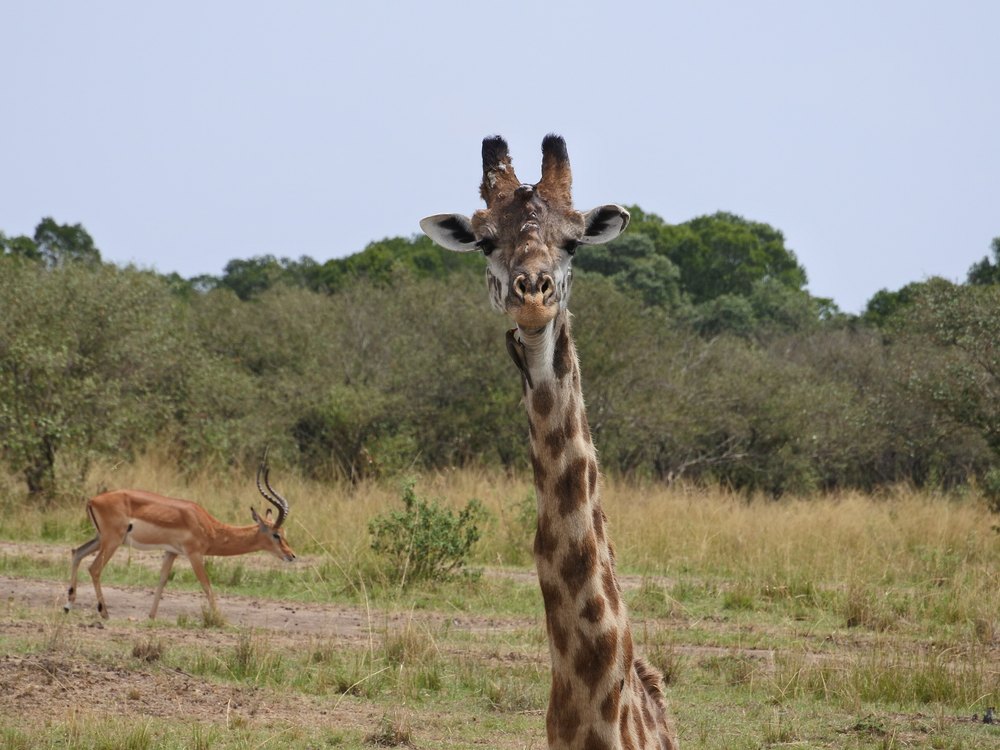
Oxpeckers
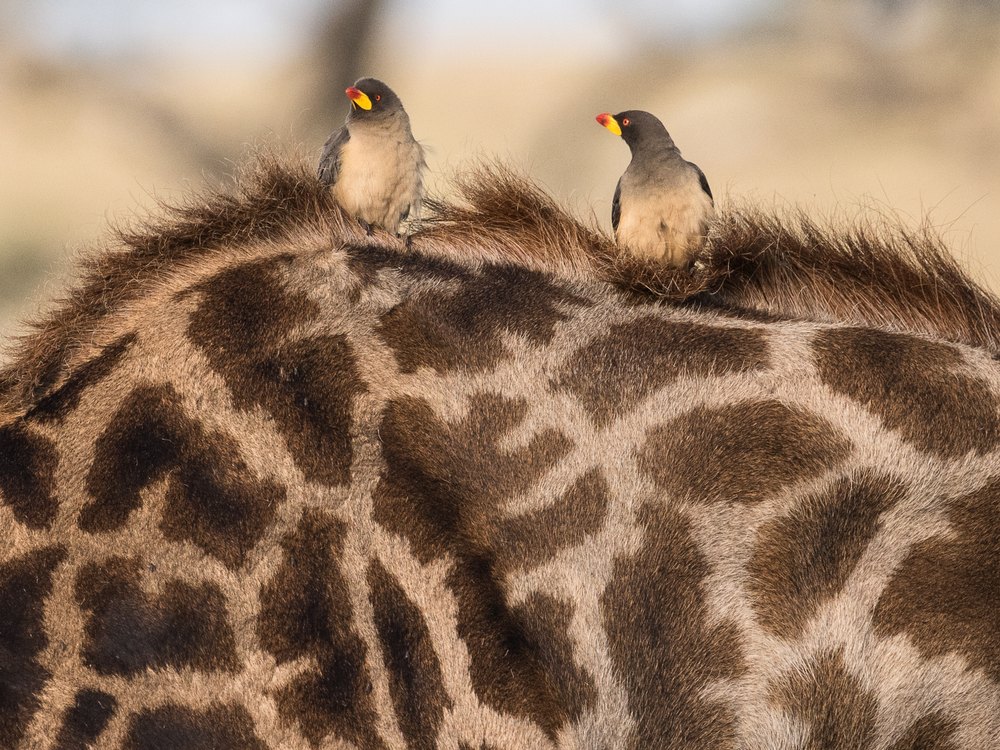
Camera traps in the Serengeti caught yellow-billed oxpeckers roosting overnight on giraffes, mostly in the groin, where it is warm and sheltered and ticks are common. The work was published as “Giraffe Bed and Breakfast”. A project blog describes it without counts, and the paper itself was not read.[40]
Giraffe skin disease
Giraffe skin disease causes grey-brown crusted sores, mostly on the forelegs, of adult and subadult giraffes. It was first noted in Ruaha National Park in 2000. Prevalence there is 80 to 85%.[41] In a 2019 sample from Tarangire–Manyara, 58 of 84 giraffes (69%) had it, including 57 of 72 adults (79%) and none of 4 calves.[41] The cause is unknown. A spiral worm has been suggested, and fungi or bacteria may be secondary. Fungal threads were found in all five biopsies, but the authors say the primary cause is unconfirmed.[41] No effect on survival was proven in Tarangire (Bond et al. 2016, as reported by the Giraffe Conservation Foundation).[15] A 2025 study in Ruaha found that sores on the limbs slow walking speed.[42]
Other diseases
An anthrax outbreak in the Luangwa Valley in 1987 killed more than 4,000 hippos and a number of giraffes.[43] For giraffes in general, rinderpest killed many in the 60 years after 1890, and numbers recovered after the disease was eradicated.[15]
Acacias and ants
On the Athi-Kapiti Plains in Kenya, the whistling thorn acacia Acacia drepanolobium carries ants that defend it. Giraffe calves fed for shorter periods on trees with more aggressive Crematogaster ants, and older giraffes were less sensitive. The ants gather on the shoot tips, which are the parts giraffes prefer. The paper is known only from a summary of its abstract.[44] In the Serengeti, the spread of an unpalatable tree, Vachellia robusta, reduced the palatable food.[45][46] No Masai-specific data on seed dispersal or on competition with other browsers were found.
Habitat and range
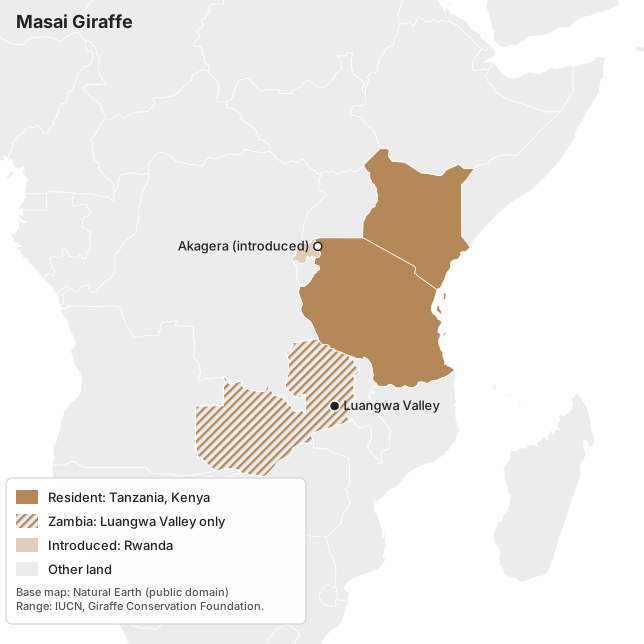
Tanzania is home to the Masai Giraffe only. It lives in the north and centre of the country and does not occur south of the Rufiji River.[15] In Kenya it lives in the south, along the border with Tanzania, and its northernmost population is around Naivasha and Hell’s Gate. Kenya also has two other kinds of giraffe, the reticulated and Nubian.[1][2][48] In Zambia only the Luangwa Valley is in its range.[1][2][43] Giraffes in Akagera National Park, Rwanda, do not occur there naturally. Kenya gave animals to the park, and they have bred there.[47][1] A 2019 mapping study found that the range was 4.7% (20,816 km²) smaller than on the 2016 IUCN map, with Tanzania’s range larger than earlier reported and Kenya’s smaller.[49]


Habitat
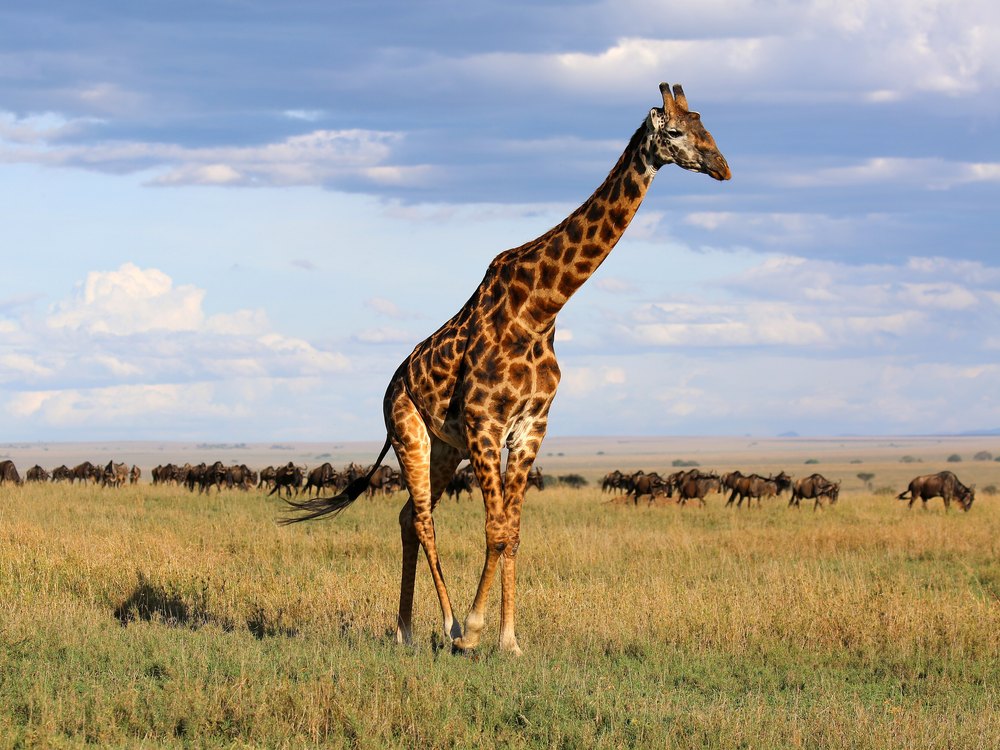
In Tanzania the Masai Giraffe lives mainly in scrubland, open grassland and woodland. It browses trees such as Combretum, Commiphora, Vachellia and Terminalia.[46] For giraffes in general, the Tanzania action plan says they avoid dense forest and areas with lions and hyenas.[16] In Tarangire, where giraffes live is tied less to water than to seasonal access to preferred food, such as Vachellia drepanolobium in the long rains.[50] In Kenya, community rangelands, group ranches and conservancies hold 70% of the giraffes. No elevation range was found.[48]
Where to find it
In Tanzania, the Serengeti ecosystem has about 12,000 giraffes (2016), 42% of the national total.[2] Others live in Ngorongoro, Tarangire–Manyara (3,904 ± 507 by an aerial survey in 2016), Ruaha–Rungwa (3,525 ± 980 in 2015), Selous–Mikumi (3,183 in 2015), Katavi–Rukwa, Mkomazi, Saadani and Arusha National Park.[15] In Kenya they live in the Masai Mara and its conservancies, Amboseli, Nairobi National Park, the Tsavo area and the Nakuru–Naivasha area. They have died out in the Shimba Hills.[48] In Zambia they live in South Luangwa National Park, Luambe National Park and nearby management areas and ranches.[43]
Numbers
The Giraffe Conservation Foundation’s State of Giraffe 2025 counts the species, including the Luangwa population, at 43,926 animals (range 42,874–55,269), by country as below.[2] It calls the trend stable, at −3% over 5 years, but −39% over 30 years. It also says Tanzania’s estimates rest on data almost 10 years old and that stability there is presumed.[2]
| Country | Status | Estimate, 2025 (range) |
|---|---|---|
| Tanzania | Native | 28,820 (27,994–31,676) |
| Kenya | Native | 14,179 (14,090–22,508) |
| Zambia, Luangwa Valley | Native | 764 (654–895) |
| Rwanda, Akagera National Park | Introduced from Kenya | 163 (136–190) |
Older counts used other methods and cannot be added to these. Aerial surveys in Kenya found about 32,000 giraffes in 1977 and 17,330 in 1999. A Kenyan recovery plan gives about 15,158 Masai Giraffes in 2023, with a later check giving about 14,122.[48] In the Greater Masai Mara, aerial counts reached 2,607 in 2017, and photographic mark-recapture in 2019 to 2021 gave about 3,290.[48] In Tanzania, one analysis put the numbers at about 31,000 in 1986 and 22,000 in 2013.[15] In the Serengeti, density fell from 1.5–2.6 giraffes per km² in the 1970s to 0.3–0.4.[45] Numbers in Luangwa were about 300 in 1958 and 556 on average in 2013.[43]
Evolution
The Masai Giraffe belongs to the giraffe family, Giraffidae. The only other living member is the okapi, Okapia johnstoni.[4] The okapi is the giraffe’s closest relative. A genome study dated the split of the two lines at 11.5 million years ago, less than an earlier mitochondrial estimate of 16 million.[51] Another study gives about 15.2 million years.[52] The family itself is about 19 to 16 million years old in the fossil record. The earliest member, Canthumeryx, is known from Libya and Kenya. What unites the family is ossicones, a two-lobed canine tooth and large size, not neck length.[53]
Moderate neck lengthening was already present in Canthumeryx and its possible ancestor, so it came before the family. The okapi and some other relatives later shortened their necks again. One research group proposes that the neck then lengthened in stages, first towards the head and then towards the tail, which produced the very long neck of Giraffa. This is a model from a single group, not a measured sequence.[53] Why the neck became long is debated. The study of Masai Giraffe proportions favours a mixed explanation: the neck and legs first grew long in competition for food and under the demands of pregnancy and nursing, and fighting between males later added neck mass.[6]
Palaeotragus and Samotherium lived about 7 to 7.5 million years ago in Europe and Asia. They are relatives of the giraffe line, not its direct ancestors.[53] Bohlinia is often named as a close ancestor of Giraffa, but this is debated, and its ossicones are notably different.[53][54] The oldest named Giraffa fossils are from the Siwaliks of Pakistan. Three bones from the early Late Miocene there are about 8.1 million years old (an ossicone), 8.9 million (a foot bone) and 9.4 million (an ankle bone).[54] No fossil is assigned to the Masai Giraffe line itself.
When the living giraffes split
The age of the living giraffe lineages depends on the kind of DNA. Whole-genome data from 50 giraffes put the split of the four lineages at 230 to 370 thousand years ago.[55] Mitochondrial DNA gives older ages. The northern and southern groups split about 2.0 million years ago (95% range 1.4–2.8), and the Masai giraffe split from the South African giraffe about 0.6 million years ago (0.4–0.9). Divergence within the Masai giraffe is about 0.4 million years (0.2–0.7).[56] Those authors warn that their dates may be too old. Another study calibrated the root of the genus at about 1 million years.[52] The gap between the two kinds of date is not explained.
In Tanzania, Masai Giraffes west and east of the Gregory Rift Valley have two mitochondrial groups that split about 289 thousand years ago, or about 665 thousand with another calibration. The authors propose treating them as two management units. They are not named taxa.[57] Genomes from Kenya show very little recent mixing between the Masai, reticulated and Nubian giraffes.[58] A re-analysis of older data found that mitochondrial DNA moved from the Masai giraffe into south-eastern giraffes about 420 thousand years ago, on its dating.[52]
Forms and variants
The IUCN task force and the Catalogue of Life recognise two subspecies: the nominate G. t. tippelskirchi of Kenya and Tanzania, and G. t. thornicrofti, the Luangwa or Thornicroft’s giraffe of eastern Zambia.[4][59] The Luangwa population lives more than 400 km south of the nearest nominate population.[4] Its mitochondrial DNA falls inside a western Masai group.[57]
Authorities treat the Luangwa giraffe in different ways. Groves and Grubb (2011) treated it as a species, G. thornicrofti, but the IUCN task force found no support for that rank. The task force counts it within the Masai species.[4] Fennessy and colleagues (2016) suggested folding it into the Masai giraffe.[60] Coimbra and colleagues (2021) say it should be recognised as a distinct subspecies, but note that animals from the areas between are missing from their samples.[4][55] The Mammal Diversity Database does not list subspecies and shows the name as a synonym within the species.[5] The IUCN Red List assessed it separately in 2018, as the subspecies G. c. thornicrofti, as Vulnerable.[1] No date for its separation from the other Masai giraffes was found.
The 2025 count was 764 animals (range 654–895), and a 2023 survey extended the known range 120 km southward.[2] Several life-history numbers on this page, such as lifespan and age at first calf, come from this Luangwa population and are labelled as such.
Conservation
The IUCN Red List assessed the Masai Giraffe as Endangered in 2019. It was the first time it was assessed on its own, and the assessment was for the subspecies Giraffa camelopardalis tippelskirchi, which excludes the Luangwa population.[1][2][61] A species-level assessment was planned for 2025 to 2026.[1] The Giraffe Conservation Foundation recommends in its 2025 report that the Masai Giraffe, as a single species, be moved to Vulnerable. This is the foundation’s recommendation, not an IUCN decision.[2]
Threats
Illegal hunting. In Tanzania, giraffes are killed for meat, hide, bones and tail hair, with guns, dogs and wire snares, some of them hung in tree canopies in the Serengeti. Some people believe that giraffe bone marrow or brain cures HIV/AIDS. It is not clear that giraffes are preferred as bushmeat. Rentsch and colleagues (2015) estimated that poaching caused a 2 to 10% yearly decline in the Serengeti population, and an earlier study estimated 98 giraffes killed illegally each year around Katavi–Rukwa, from 82 hunter interviews.[15] In the Serengeti, lower adult survival was linked to illegal hunting, and lower numbers of young to poorer food as palatable trees were replaced by unpalatable ones.[45] A 2025 study found that adult and subadult survival differed among four Serengeti subpopulations, and that the two next to the park boundary declined over 48 years.[62]
Habitat loss. Charcoal burning, logging, farming, fences, growing towns and livestock all take habitat. In Kenya, a railway about 133 km long crosses Tsavo, and giraffes rarely use its crossing structures. Pastoral settlement was found to lower the birth rate in the Mara.[15][48] Effects of drought are not simple: Mara numbers fell by more than 50% by 2003, which was blamed on less rain and higher temperatures, but the 2020 to 2022 drought did not hit giraffes severely.[48]
Trade and law
At the CITES conference in Geneva in August 2019, the Wildlife Conservation Society reported that on 22 August the committee voted 106 to 21, with 7 abstentions, to list the giraffe in Appendix II. The proposal came from six African countries, including Kenya.[63] Appendix II allows regulated trade, not a ban. The listing is for giraffes as one species, and the Giraffe Conservation Foundation says it needs to be reassessed under the four-species view.[63][48]
Tanzania protects giraffes under the Wildlife Conservation Act No. 5 of 2009, which prohibits killing, wounding, capturing and hunting.[15] Kenya protects all three giraffe kinds under the Wildlife Conservation and Management Act of 2013. For killing an endangered or threatened species the penalty is a fine of not less than 20 million shillings, life imprisonment, or both.[48] The Luangwa giraffes have lived in protected habitat since 1938.[43]
Action
Tanzania launched a National Giraffe Conservation Action Plan for 2020 to 2024, only the third African country to have an official giraffe strategy. Kenya has recovery and action plans for 2018 to 2022 and 2023 to 2027.[15][48] In Tarangire, adult female survival varied with the intensity of anti-poaching patrols.[15] The Wild Nature Institute follows more than 6,000 individual Masai Giraffes by their spot patterns in Tarangire and the Serengeti–Ngorongoro area. It calls this the biggest giraffe study in the world.[50]
History and culture
National animal of Tanzania
The Giraffe Conservation Foundation says the giraffe is the national animal of Tanzania, where only the Masai Giraffe lives. It adds that the constitution does not mention the giraffe, though it is used a great deal in Tanzanian symbols.[15] Giraffes were the watermark on Tanzanian banknotes from independence in 1961 to the 2011 series. In 1997 the Bank of Tanzania issued a “Giraffe banknote series”, with a giraffe on the front of the 500, 1,000, 5,000 and 10,000 notes. Brand names use the Swahili word twiga, for example Twiga Brew and Twiga Cement.[15]
Giraffes in history
The following items are about giraffes in general. None of these animals is shown to have been a Masai Giraffe. Ptolemy II showed a giraffe in a procession at the Ptolemaieia festival in Alexandria, which began in 279 BC. Encyclopaedia Romana says the first giraffe seen in Europe was shown in Rome in 46 BC, brought from Alexandria by Julius Caesar, and it quotes Dio and Pliny.[14] In 1414 a giraffe reached the Chinese court in the Ming dynasty, and the Chinese took it for the mythical qilin.[64]
A record bull
The Guinness record for the tallest giraffe is held by George, a Masai bull at Chester Zoo, listed at 5.8 m. The height has no stated method (see Body).[18]
Taxonomy
| Rank | Name |
|---|---|
| Kingdom | Animalia[59] |
| Phylum | Chordata[59] |
| Class | Mammalia[59] |
| Order | Artiodactyla[5][59] |
| Family | Giraffidae[5][59] |
| Genus | Giraffa Brisson, 1762[59][4] |
| Species | Giraffa tippelskirchi Matschie, 1898[5][65][59] |
This page treats the Masai Giraffe as a species, as the IUCN Giraffe and Okapi Specialist Group (August 2025), the Mammal Diversity Database, ITIS and the Catalogue of Life do.[4][5][65][59] The IUCN Red List assessments of 2016 to 2019, and Grubb (2005), treated it as the subspecies Giraffa camelopardalis tippelskirchi.[4][1] The number of giraffe species is still debated: one, three or four species in different papers.
| Authority | Treatment of the Masai Giraffe |
|---|---|
| IUCN SSC Giraffe and Okapi Specialist Group, August 2025 | Species, with two subspecies. Four giraffe species in all: northern, reticulated, Masai and southern[4][66] |
| Mammal Diversity Database | Species, including the Luangwa form[5] |
| ITIS | Valid species[65] |
| Catalogue of Life, release 26.10 | Accepted species, with two accepted subspecies[59] |
| CMS COP15 document, 2025 | Follows the IUCN task force: four species and seven subspecies[1] |
| Fennessy et al. 2016; Winter et al. 2018; Coimbra et al. 2021 | Four species, with the Masai giraffe as one[60][67][55] |
| Petzold and Hassanin 2020 | Three species: northern (including reticulated), southern and Masai[52] |
| Groves and Grubb 2011 | Eight giraffe species, with Masai and Luangwa as separate species (as summarised by the IUCN task force)[4] |
| Grubb 2005 (Mammal Species of the World) | One species, Giraffa camelopardalis, with six subspecies, one of them tippelskirchi (as quoted by the IUCN task force)[4] |
| IUCN Red List, 2016 to 2019 | A subspecies, G. c. tippelskirchi, of a single giraffe species[4][1] |
| Bercovitch et al. 2017 | Giraffes were then classified as one species with nine subspecies, and the authors argue that the differing views come from different data, methods and rules[68] |
The species was described in Sitzungs-Berichte der Gesellschaft Naturforschender Freunde zu Berlin 1898: 75–81. Its type locality is near Lake Eyasi in north-west Tanzania, and the type is a lectotype in the Berlin museum.[5][7] The Mammal Diversity Database lists these other names as synonyms: Giraffa schillingsi Matschie, 1898 (Matschie’s second name of that year, from the Kilimanjaro–Taveta area), Giraffa camelopardalis tippelskirchi Lydekker, 1904, Giraffa camelopardalis thornicrofti Lydekker, 1911, Giraffa capensis tippelskirchi Schwarz, 1920, and Giraffa thornicrofti Groves and Grubb, 2011.[5][7]
The IUCN task force scored the Masai giraffe as distinct on genetics, with phenotype and biogeography each supporting it. It names the Nile and Lake Victoria, the Tana River and the Zambezi and Luangwa rivers as barriers.[4] The task force says it will keep reviewing new evidence.[4]
Sources
- CMS COP15 document UNEP/CMS/COP15/Doc.31.3.5, “Concerted action for the Masai giraffe, northern giraffe, reticulated giraffe and southern giraffe” (2025)
- Giraffe Conservation Foundation, State of Giraffe 2025 (Marneweck et al., eds) (doi 10.5281/zenodo.15688798)
- Giraffe Conservation Foundation, Masai giraffe species page
- IUCN SSC Giraffe and Okapi Specialist Group, Giraffe Taxonomy Task Force 2025 (August), “An Evaluation of the Taxonomic Status of Giraffe (Giraffa spp.)” (full text)
- Mammal Diversity Database, Giraffa tippelskirchi (taxon 1006342)
- Cavener et al. 2024, Mammalian Biology 104: 513 (sexual dimorphism in body proportions of Masai giraffes; abstract and a Penn State news item)
- Matschie 1898, Sitzungs-Berichte der Gesellschaft Naturforschender Freunde zu Berlin, session of 19 July 1898, pp. 75–81 (scan, Internet Archive, German; the giraffe passage is on pp. 76–79)
- Lee, Cavener & Bond 2018, PeerJ, “Seeing spots” (spot patterns of Masai giraffes; most of the text)
- Berry & Bercovitch 2012, Journal of Zoology (darkening coat colour of male Thornicroft’s giraffes; abstract)
- Becker et al., “High survival and percentages of giraffe calves signal areas in need of protection” (Siria Plateau, Masai Mara; a manuscript on the EcoEvoRxiv preprint server, not peer reviewed as far as could be told)
- Wikipedia, Giraffe (secondary; used only where named in the text)
- Wikipedia, Masai giraffe (secondary; used only where named in the text)
- Language Log, “The giraffe, a supposedly composite creature with a complicated nomenclature” (blog; it cites Etymonline and the OED)
- Encyclopaedia Romana, University of Chicago, “Giraffe” (secondary; gives Pliny and Dio)
- Giraffe Conservation Foundation, Country profile, United Republic of Tanzania (August 2020)
- Tanzania National Giraffe Conservation Action Plan 2020–2024 (GCF, TAWIRI and partners) (background section; written for giraffes in general)
- Animal Diversity Web, Giraffa camelopardalis (Maisano 2006) (secondary; written for giraffes in general)
- Guinness World Records, Tallest giraffe ever (does not say how the height was measured)
- Giraffe Conservation Foundation, Baby giraffe: your questions, answered (giraffes in general; no references on the page)
- San Diego Zoo Global library, giraffe reproduction factsheet (zoo factsheet; giraffes in general)
- Giraffe Conservation Foundation, Facts about giraffe (giraffes in general)
- Bond, Lee, Farine, Ozgul & König 2021, Proceedings of the Royal Society B 288: 20202770 (sociability and survival of adult female giraffes, Tarangire)
- Bercovitch & Berry 2013, Journal of Zoology (social ties of Thornicroft’s giraffe; abstract)
- Knüsel et al. 2019, Animal Behaviour 149 (correlates of home range sizes of giraffes; abstract)
- Tobler & Schwierin 1996, Journal of Sleep Research (behavioural sleep of giraffes in a zoo; abstract)
- Burger et al. 2023, Frontiers in Mammal Science (accelerometry and sleep in three wild Angolan giraffes in Namibia)
- Baotić, Sicks & Stoeger 2015, BMC Research Notes (nocturnal humming of captive giraffes)
- Pellew 1984, Journal of Zoology (the feeding ecology of the giraffe in the Serengeti; abstract)
- Levi, Lee, Bond & Treydte 2022, Journal of Mammalogy 103: 737–744 (forage selection by Masai giraffes at several spatial scales; abstract)
- Pellew 1984, “Food consumption and energy budgets of the giraffe”, Journal of Applied Ecology, one-line summary on the Chicago Zoological Society (czaw.org) resource page (the paper itself was not read)
- Lee, Kissui, Kiwango & Bond 2016, Ecology and Evolution 6: 8402 (migratory herds and the survival of giraffe calves, Tarangire; most of the text)
- Bercovitch & Berry 2010, African Journal of Ecology (reproductive life history of Thornicroft’s giraffe in Zambia; abstract)
- AnAge, Giraffa camelopardalis (giraffes in general)
- Lee, dissertation chapter 1, “Spatial variation in giraffe adult survival, calf survival, and reproduction” (Tarangire region; a dissertation chapter, not the journal text)
- Giraffe Conservation Foundation, How long do giraffe live? (no study cited on the page)
- Pellew 1983, African Journal of Ecology (the giraffe and its food resource in the Serengeti, II; abstract)
- Bercovitch & Berry 2017, African Journal of Ecology (life expectancy and maximum longevity of female Thornicroft’s giraffe; abstract)
- Strauss & Packer 2013, Journal of Zoology 289 (claw marks and lion predation on giraffes in the Serengeti; abstract)
- Muneza et al. 2022, Journal of Zoology 316: 49–60 (lions and giraffes in Ruaha National Park; record only)
- Snapshot Serengeti blog, “The giraffe and the oxpecker”, 15 March 2018 (blog; the paper it describes was not read)
- Kiula et al. 2021, Veterinary Quarterly 41: 242–249 (giraffe skin disease in Tanzania)
- Dunham et al. 2025, Ecology and Evolution (skin disease and walking speed of Masai giraffes in Ruaha; abstract seen in a Europe PMC search record)
- Giraffe Conservation Foundation, Country profile, Republic of Zambia (February 2022)
- Madden & Young 1992, Oecologia 91: 235–238 (ants as a defence of Acacia drepanolobium against giraffe browsing; abstract seen through a search summary)
- Strauss, Kilewo, Rentsch & Packer 2015, Population Ecology 57: 505–516 (food supply and poaching limit giraffe abundance in the Serengeti; abstract)
- Giraffe Conservation Foundation, Tanzania’s giraffe poster (2022)
- Giraffe Conservation Foundation, Country profile, Rwanda (the file is named 2016; the counts it cites are from 2012)
- Giraffe Conservation Foundation, Country profile, Republic of Kenya (November 2025)
- O’Connor et al. 2019, Mammal Review 49: 285–299 (giraffe range maps; abstract)
- Wild Nature Institute, Masai Giraffe Project (the project’s own summary)
- Agaba et al. 2016, Nature Communications 7: 11519 (giraffe genome sequence)
- Petzold & Hassanin 2020, PLoS ONE 15: e0217956 (species delimitation in Giraffa; abstract and text)
- Danowitz et al. 2015, Royal Society Open Science 2: 150393 (fossil evidence and stages of elongation of the neck)
- Danowitz et al. 2017, PLoS ONE 12: e0185139 (the earliest ossicone and post-cranial record of Giraffa)
- Coimbra et al. 2021, Current Biology 31: 2929–2938 (whole-genome analysis; abstract, node dates from later papers)
- Bock et al. 2014, BMC Evolutionary Biology 14: 219 (mitochondrial sequences of 161 giraffes)
- Lohay et al. 2023, Ecology and Evolution 13: e10160 (Masai giraffes separated by the Gregory Rift Valley in Tanzania)
- Coimbra et al. 2023, BMC Biology 21: 216 (limited hybridization among three giraffe species in Kenya)
- Catalogue of Life, monthly release 26.10 (14 October 2026), Giraffa tippelskirchi
- Fennessy et al. 2016, Current Biology 26: 2543–2549 (“Multi-locus analyses reveal four giraffe species instead of one”; abstract)
- National Geographic, “Masai giraffes declared endangered”, 12 July 2019 (news)
- Bond, Behr et al. 2025, Journal of Wildlife Management 89: e70037 (demographic drivers in the Serengeti ecosystem; abstract)
- Wildlife Conservation Society, “Good News for Giraffes at CITES CoP18”, 22 August 2019 (news release; the CITES pages themselves could not be read)
- Science News, “The giraffes that sailed to medieval China”
- ITIS, Giraffa tippelskirchi (TSN 1012247)
- IUCN press release, Windhoek, 21 August 2025, on the four giraffe species
- Winter, Fennessy & Janke 2018, Ecology and Evolution 8: 10156–10165 (limited introgression supports four species; abstract)
- Bercovitch et al. 2017, Current Biology 27: R136–R137 (“How many species of giraffe are there?”; opening paragraph only)