The Nile Crocodile (Crocodylus niloticus) is a large freshwater crocodile of Africa and Madagascar. It lives in rivers, lakes, dams, swamps and estuaries.[1][2] The female digs a nest in a sandy bank, and the temperature of the nest decides whether the eggs hatch as males or females.[3][4] Older books count the West African crocodile as part of this species. It is now treated as a separate species, so many old figures mix two animals.[2][5][6] The IUCN rates the Nile Crocodile Least Concern.[2]
Quick facts
Description
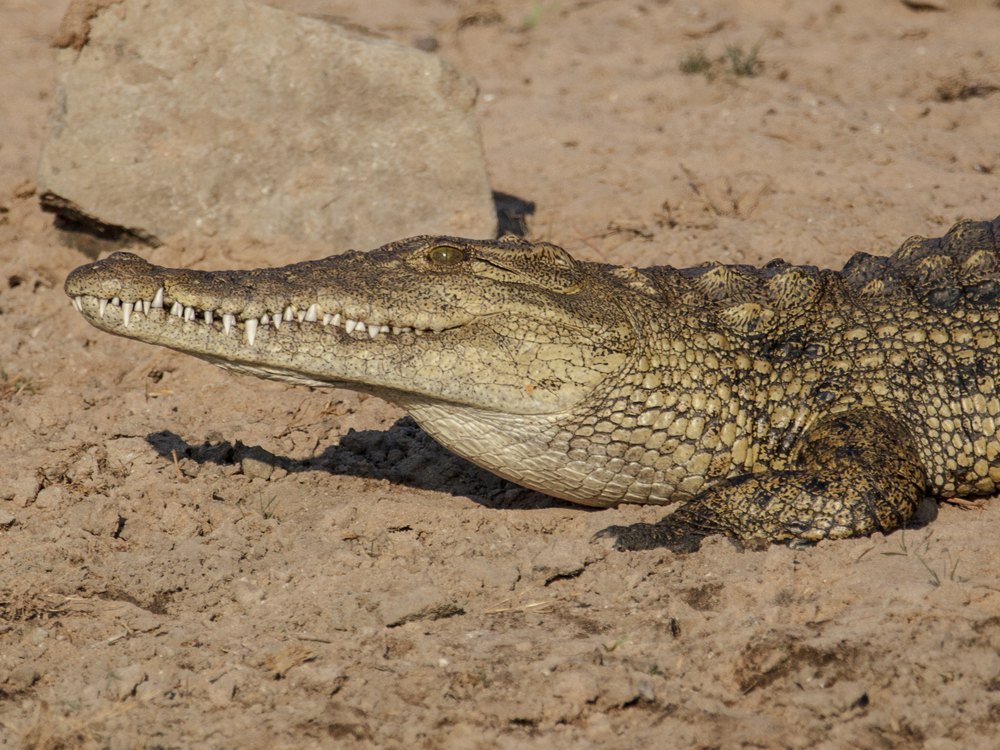
The Nile Crocodile is the crocodile of eastern and southern Africa, the Nile valley and Madagascar.[7] It is a large animal, and the sexes differ in size: males grow larger than females.[3] Young crocodiles eat insects and other small animals from the water, while large adults eat mostly vertebrates.[3] The female lays her eggs in a hole in a sandy bank, and the temperature of the nest decides the sex of the young.[3][4]


Skin and senses
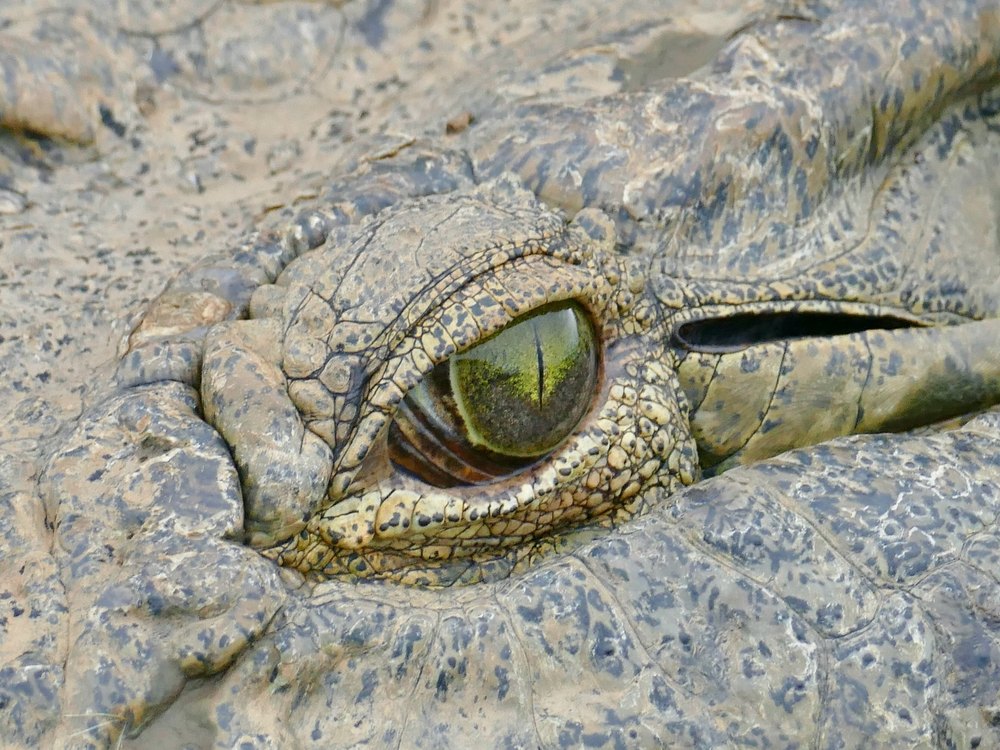
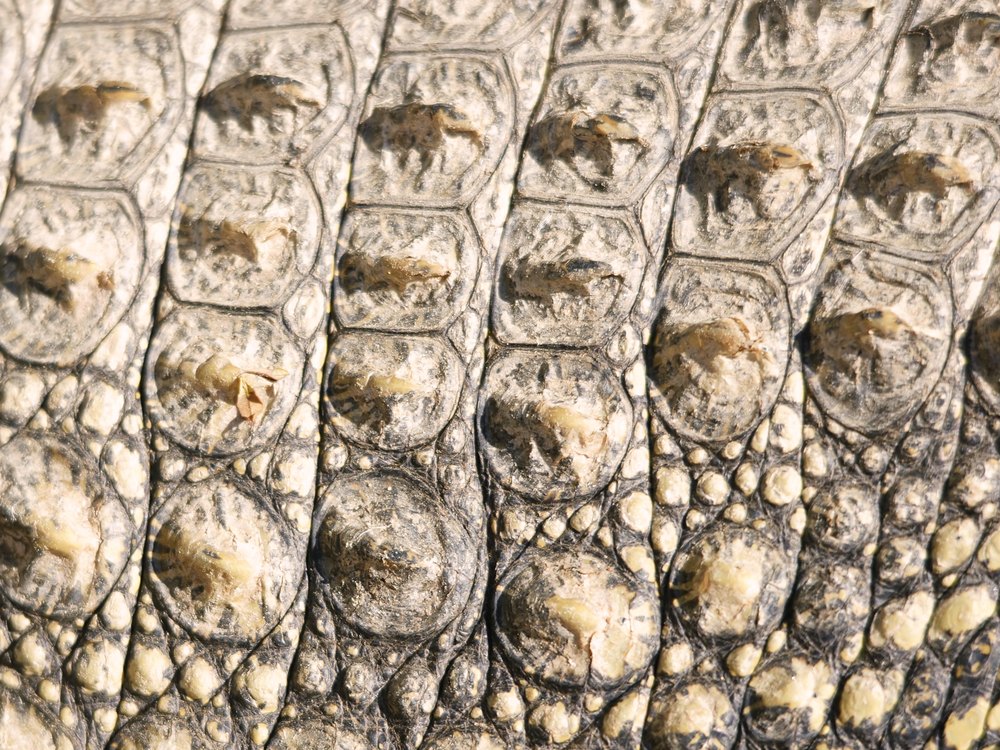
Crocodylians have a highly armoured but very sensitive skin. Small sense organs, called integumentary sensory organs, sit on the scales of the head and body in the true crocodiles and gharials. They are absent from the body scales of alligators and caimans.[8] In a study of young Nile Crocodiles and spectacled caimans, each organ responded to touch, to warmth and cold, and to changes in acidity, but not to a very salty solution. The eggs came from a crocodile farm in France, and the recordings were made on captive juveniles.[8] Earlier work cited in that paper suggests the system has high resolution and may be more sensitive than a primate fingertip.[8]


Salt water
The Nile Crocodile lives in fresh water but copes with salt for a time. At Lake St Lucia in South Africa it survives water that is periodically very salty, and after a short period of acclimation it survives in sea water. A sudden move into sea water causes dehydration, weight loss and possibly death.[9] The species has been recorded in estuaries and even in hypersaline water.[1]
Name
The scientific name Crocodylus niloticus was published by Laurenti in 1768, on page 53 of his Specimen medicum.[5] Niloticus is Latin for “of the Nile”: the species was named after the type locality in Egypt, along the Nile. Laurenti gave the place as “India and Egypt”, and a later paper restricted it to Egypt. The specimen that carries the name is lost.[5] The genus name comes from Greek krokodeilos, a kind of lizard, and/or Latin crocodilus, a crocodile.[5] Herodotus wrote that the Egyptians called these animals champsai, and that the Ionians named them crocodiles after the lizards on their stone walls.[10]
In other languages
| Language | Name | Notes |
|---|---|---|
| isiZulu and Ndebele local | ngwenya | — |
| Kinyarwanda local | ingona | — |
| Malagasy local | voay | — |
| German | Nilkrokodil | Nile crocodile (literal)[5] |
| Swahili | mamba; ngwenya | —[2] |
| Shona | garwe | —[2] |
| Tswana | kwena | —[2] |
| Arabic | temsah | written in Latin letters in the list[2] |
The isiZulu, Ndebele, Kinyarwanda and Malagasy names are from the “Common names” list of the IUCN Crocodile Specialist Group action plan.
Body
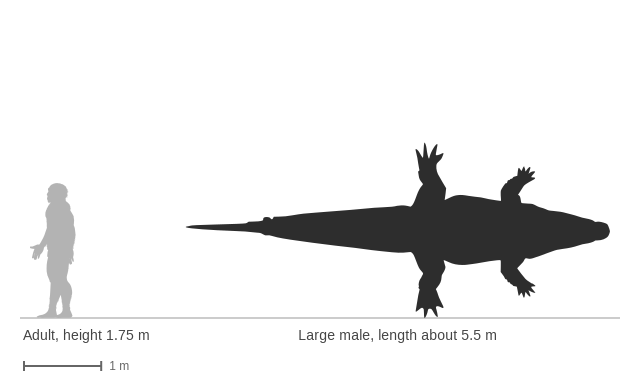
Males are larger than females. The IUCN Crocodile Specialist Group says males reach lengths of up to 6 m in exceptional cases.[3] That is a general figure for the species, not a measured animal. Range-finder and photo measurements at Lake Chamo in Ethiopia found some crocodiles over 5.5 m.[11] The largest skulls known are kept at the Arba Minch Crocodile Ranch in Ethiopia. They come from Lake Chamo crocodiles that drowned in fishing nets, and the biggest has a head 68.6 cm long and 40.4 cm wide.[11] Very large crocodiles grow more slowly in length and become bulkier, so the old rule that body length is seven times head length fails above about 4 m.[11]
| Longest (males) | up to about 6 m |
| Mature females | 1.8–3.0 m |
Size at maturity
The size at which a crocodile starts to breed depends on the population. The CSG gives a range of 1.8 to 3.0 m for females.[3]
| Place | Smallest mature or breeding animals |
|---|---|
| Lake Turkana, Kenya | Males 2.12 m; females as small as 1.8 m[12] |
| Lake Victoria | Breeding females from 2.19 m[12] |
| Luangwa Valley, Zambia | Smallest mature female 2.31 m[12] |
| Two sites in Zambia | Smallest mature males 3.33 m and 3.09 m[12] |
| Lake Ngezi, Zimbabwe | Smallest breeding female 2.65 m[12] |
| A seasonal river, Zimbabwe | Females 2.62–2.87 m; males 2.70–2.95 m[13][12] |
| Kruger National Park, South Africa | Breeding females from 2.1 m up to 4.1 m[12] |
The same studies give the age at maturity as about 13 to 25 years for females and about 11 to 23 years for males, depending on food, temperature, crowding and habitat.[12] The AnAge database gives about 19 years for females.[14]
Growth
Growth varies with food and temperature. In the Okavango Delta, a field researcher expects a crocodile 10 years old to be about 2 m long.[15] Growth rings in bone are not a simple age count. In a study of captive two-year-olds, the bones had more growth marks than the animals had years.[16] Stones in the stomach make up a larger share of body mass in larger crocodiles.[17]
Behavior
Courtship and basking
On a seasonal river in Zimbabwe, courtship and mating ran from late June to mid August. These are the coldest months of the dry season, when the crocodiles were crowded into pools. The animals shared one basking ground and one courtship and mating area. Young adult males courted in groups, and the larger males took turns using the arena at different times from each other. After mating, the crocodiles came ashore to bask and sleep.[18] Breeding hierarchies were described at Lake Turkana in Kenya.[3]

Movement and home range
At Ndumo Game Reserve in South Africa, 50 crocodiles from 202 to 472 cm long were followed for 18 months by mark and resight, radio and satellite tracking. Home range size was related to body length. Sub-adults of 1.5 to 2.5 m had small, local ranges, and adults over 2.5 m had the largest. Larger crocodiles moved farther and more often. Ranges overlapped widely in the dry season, which suggests that any territorial behavior does not create separate ranges.[19] The reserve is a winter refuge and a spring breeding site for an estimated 846 crocodiles. Some animals leave for the Rio Maputo from November and return in May, as the floodplain water recedes.[19]
Gaping
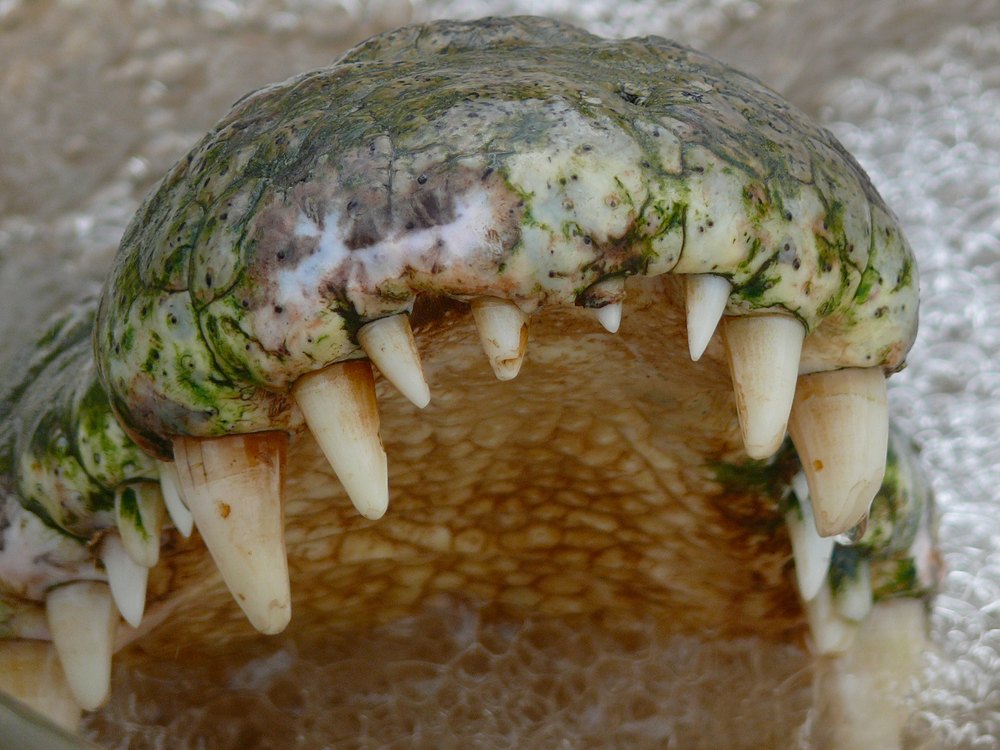
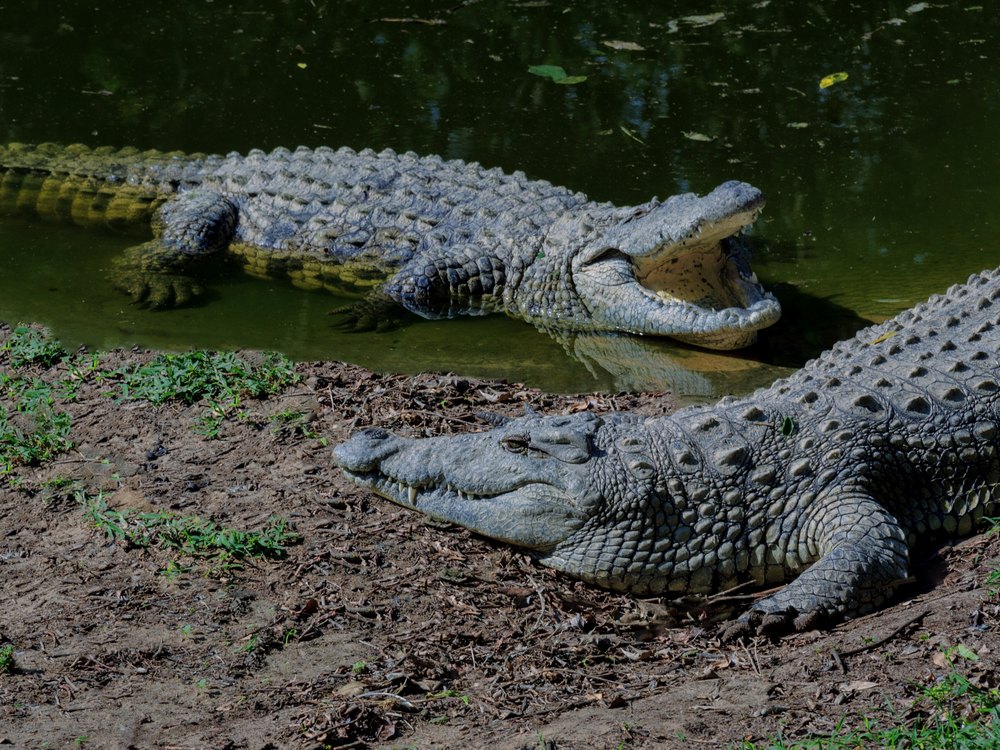
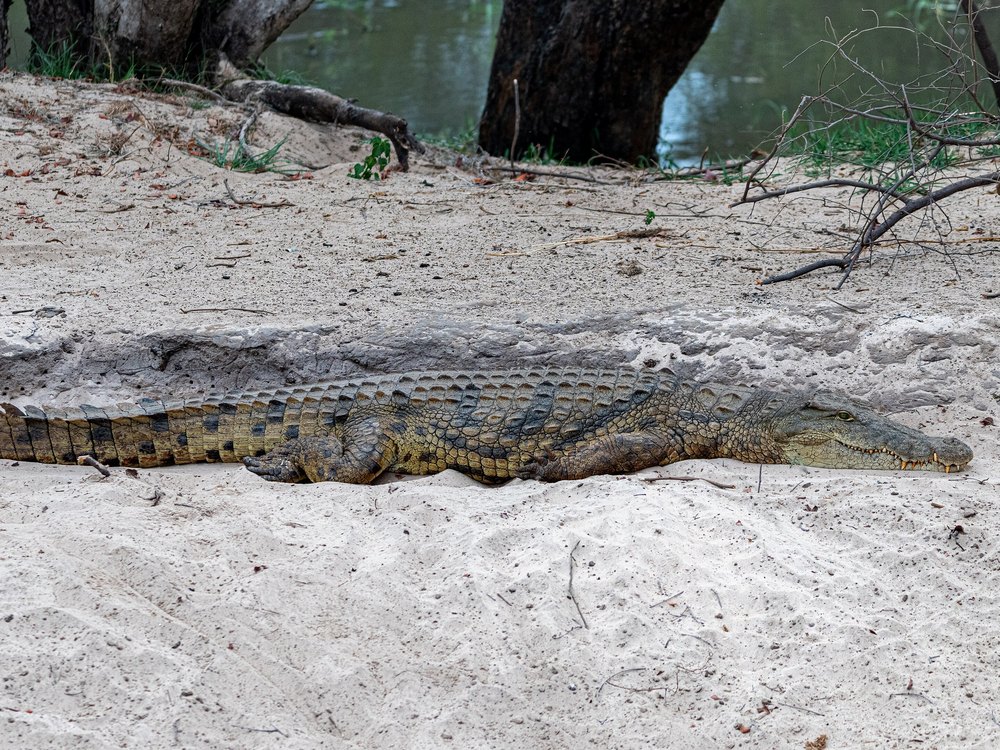
Nile Crocodiles often rest on the bank with the mouth open. It is often thought to help cool the head. A 2015 thesis from Pongolapoort Dam in KwaZulu-Natal suggests, as a preliminary finding, that it may also be a communicative posture, and it looked at position relative to the water, body length, how long and how wide the mouth was open, and the number and position of neighbours. The purpose is still debated.[20]
Voice
Young Nile Crocodiles call from the egg and after hatching. In a set of 60 Nile Crocodiles from 26 to 118 cm long, aged from one week to two years, the average frequency of the calls fell from 2.5 kHz in animals of 20–40 cm to 2.1 kHz in animals of 80–100 cm. The highest pitch reached 969 Hz in the smallest group, with an average near 640 Hz, but only 529 Hz in animals of 80–120 cm, with an average near 440 Hz.[15] Distress calls of the young attract the mother, and in the wild, mothers in the Okavango approached a loudspeaker more for the calls of smaller juveniles.[15]
Adults make other signals. A review of crocodylian sounds lists the head slap, the bellow, bubbles and a hiss for the Nile Crocodile. The head slap is a loud, percussive crack made by raising the head and snapping it down on the water surface. It is made mostly by adult males, and across crocodylians it is linked to courtship, aggression, advertisement and territory.[21]
Diet
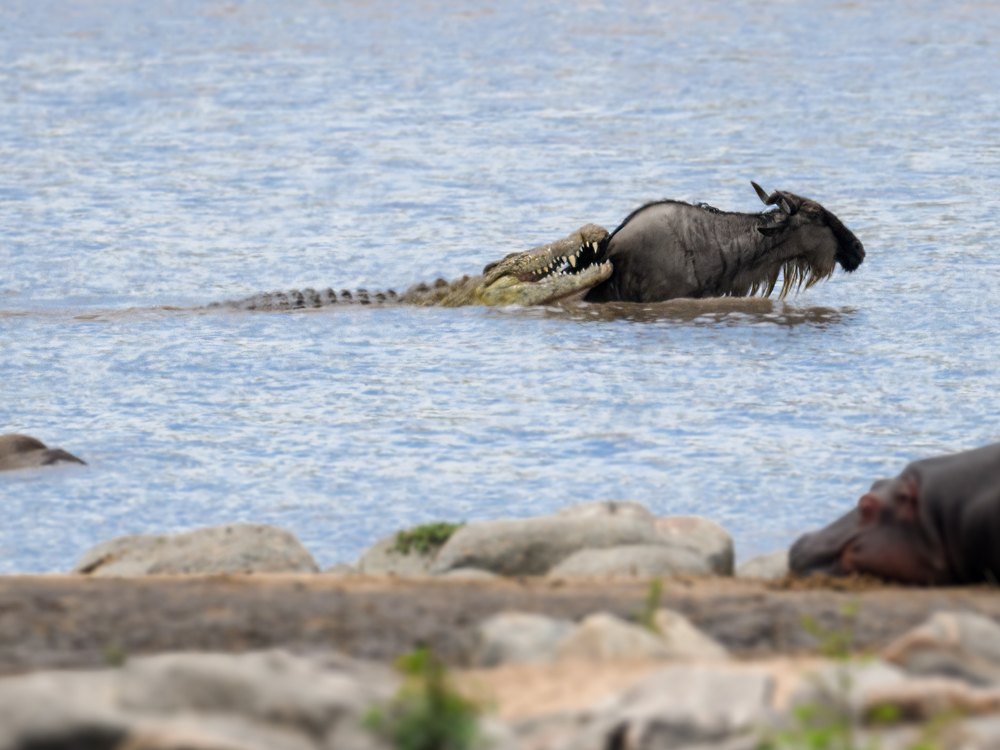
The diet changes as the crocodile grows, from insects and small water animals when young to mostly vertebrate prey among larger crocodiles.[3] In the Okavango Delta, researchers rinsed out the stomach contents of 286 young crocodiles over two years to see what they had eaten. The animals measured 17 to 166 cm from the nose to the vent, the opening at the base of the tail. Yearlings ate mainly aquatic insects and arachnids. Juveniles ate a wider range, including crustaceans, amphibians and fish, and sub-adults ate mainly fish.[17]

| Size or stage | Main food | Notes |
|---|---|---|
| Yearlings | Aquatic insects and arachnids | Fed all year in the Okavango Delta[17] |
| Juveniles | Crustaceans, amphibians, fish | More often had empty stomachs in winter[17] |
| Sub-adults | Mainly fish | More often had empty stomachs in winter[17] |
| Large adults | Mostly vertebrates | [3] |

How much they eat
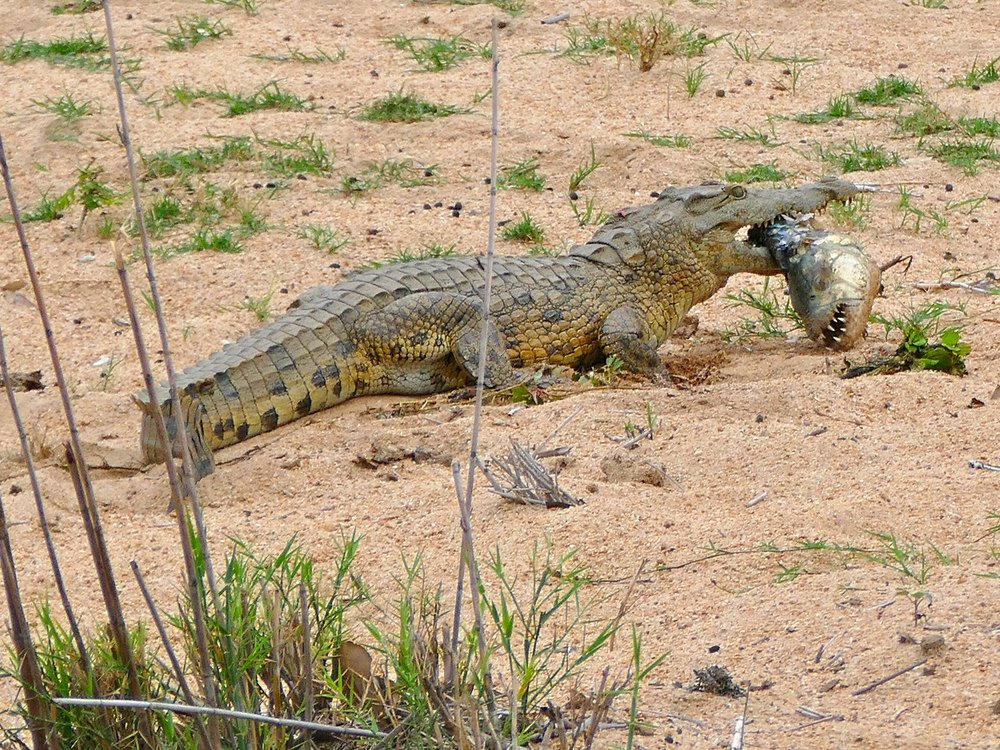
Wild yearlings in the Okavango Delta took in about 0.48% of their body mass a day, and juveniles about 0.23%. In captive crocodiles, the amount eaten until full fell from about 11.3% to 6.5% of body mass as the animals grew from 0.7 to 20 kg. The stomachs held seven species of roundworm.[17]
Carrion
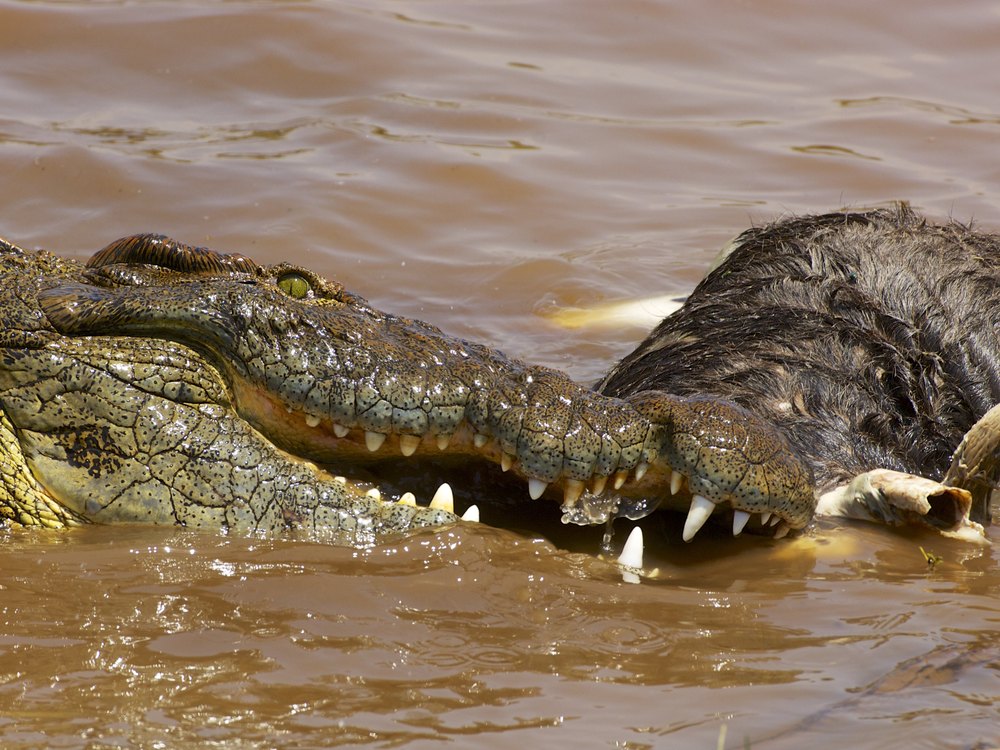
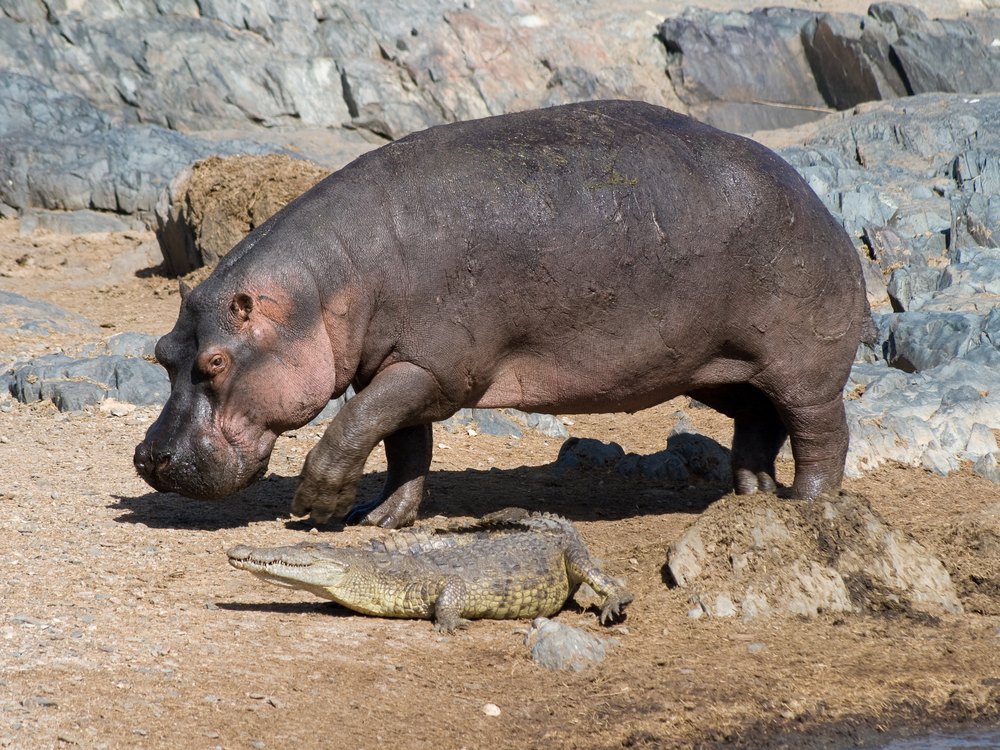
Nile Crocodiles also feed on dead animals. At the Cuando River in Angola, 15 to 20 adults were seen feeding on a hippo carcass in a side channel.[1]

Life cycle
| Stage | Age / time | Notes |
|---|---|---|
| Egg | About 75–95 days | Buried in a hole nest in a sandy bank; 35–50 eggs is typical. It takes 85 days at 34 °C and 110 days at 28 °C[3][4] |
| Hatchling | First days to about 8 weeks | Calls from the egg; the mother opens the nest, may carry the young to water in her mouth, and guards them for 6–8 weeks[22][15][3] |
| Juvenile | Until about 1.2 m long; years not measured | Eats insects, then crustaceans, frogs and fish; sub-adults eat mostly fish. At about 1.2 m the young disperse[3][17] |
| Adult | Females mature at about 13–25 years, males at about 11–23 | Females breed from 1.8–3.0 m, depending on the population[3][12] |
Nesting and eggs
The CSG says nesting is done in holes dug in sandy banks during the annual dry season. Females lay 35 to 50 eggs, though this varies a lot between populations, and incubation takes 75 to 95 days.[3] On a seasonal river in Zimbabwe, females ovulated in the second half of August, nested on sand ridges in the dry river bed from early September to early October, and the eggs hatched in December. Some females did not breed every year.[13] At Lake St Lucia, only a small share of the mature females nests in a given year.[9] At St Lucia all nests were close to freshwater streams or seepage areas. At Pongolapoort Dam, all 38 nests were on alluvial soil near common reed, an average of 13.5 m from the water and at most 32 m.[1]
In a six-year study in the Olifants River in Kruger National Park, researchers found 165 nests, opened 20 and measured 795 eggs. Larger females laid larger eggs. In a dry year, only the larger females, over 3 m, nested, and breeding females ranged from 2.1 to 4.1 m.[12] The average clutch was 36.8 eggs in 1997 and 42.7 in 1998. Eggs averaged 75.8 mm long, 49.4 mm wide and 113.7 g in 1997, and 78.5 mm, 52.3 mm and 122.7 g in 1998. The average depth to the first egg was 250 mm in 1997 and 360 mm in 1998.[12] Clutch size differs between places, and the Kruger paper compares them:[12]
| Place | Average clutch |
|---|---|
| Olifants River, Kruger | 39 eggs |
| Uganda | 49 eggs |
| Lake Ngezi, Zimbabwe | 54 eggs |
| Umfolozi, South Africa | 47 eggs |
| Lake St Lucia, South Africa | 45 eggs |
The same nest site can be used for many years by different females. Adult Nile Crocodiles do not feed their young.[12]
Nest temperature and sex
In laboratory experiments with eggs from Lake Ngezi in Zimbabwe, the sex of the young depended on the temperature of incubation. At 31 °C and below only females were produced. The threshold for males lay between 31 and 34 °C and seemed to vary between clutches. Incubation took 110 days at 28 °C and 85 days at 34 °C. Hatchlings from 34 °C were shorter than those from 28 or 31 °C, but by three months they had outgrown them.[4] The average temperature of wild nests there was always below 31 °C, the temperature in a nest could swing by up to 10 °C in a day, and hatching success was poor. Females were the majority in all size classes and among embryos.[4]
The turning points differ between populations. At Lake St Lucia the lower and upper pivotal temperatures were 31.7 and 34.5 °C, so the pattern is female, then male, then female as the nest gets warmer.[9] On the Okavango River in Botswana they were 31.4 and 33.4 °C. Eggs at a constant 30.0 and 30.5 °C all gave females, 71% were female at 31.0 °C, and most were male at 31.5 to 33.0 °C. Wild nests there were mostly female-biased.[23] The general picture is that nests cooler than about 31 °C or hotter than about 34 °C give only females.[4][9][23]
Mother and young
In captive animals, the male and female form a pair, and the male defends the nesting area. The female rarely leaves the nest until the sounds of the hatching young stimulate her to open it. She carries unhatched eggs and live young in her mouth to the water and sets up a nursery, where the young are defended for several weeks.[22] The CSG says females open the nest and guard the young for 6 to 8 weeks after hatching, and the juveniles then enter a dispersal phase at about 1.2 m.[3] Another study says mothers abandon their young after a few weeks, and a mother may chase juveniles away.[15] A satellite-tagged female at St Lucia guarded her hatchlings for 20 days, 94 m from the nest.[1] Five females were seen freeing hatchlings from nests, and one made 13 trips between the nest and the water in 32.5 hours.[24] The smallest animals in the call study, one week old, were 26 cm long.[15]
Lifespan
The AnAge database gives a maximum of 56 years in captivity, citing Weigl 2014, and notes an indirect estimate of up to 60 years from another study.[14] The lifespan in the wild has not been measured, and bone growth marks do not give a simple age.[16]
Ecology


Eggs and young
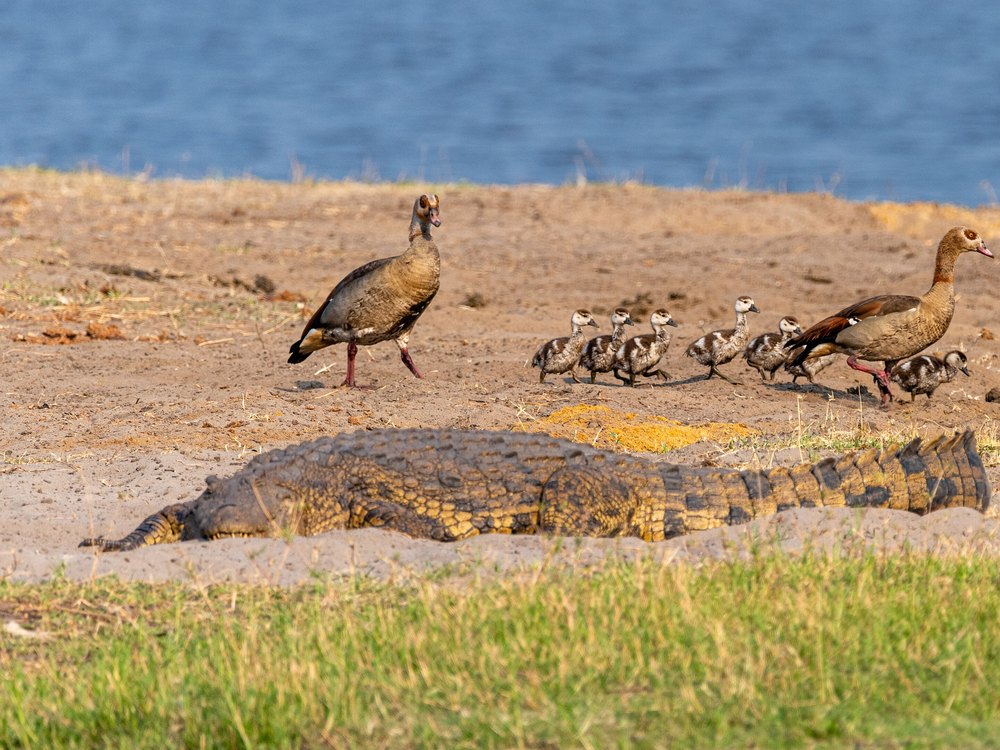
At Lake St Lucia, camera traps watched nests for four years. Of 19 monitored nests, 37% were raided by predators, and water monitors (Varanus niloticus) and marsh mongooses were the main egg predators. All females returned to their nests after the first raid, and on average returned three times between raids before they gave up the nest.[24] A female that is disturbed and leaves the nest may give diurnal egg predators such as the water monitor a chance.[1] At Lake Turkana, humans were almost certainly the most important egg predator.[1] Floods also destroy nests: at Pongolapoort Dam, all nests flooded in January 2010.[1]
A keystone species?
Researchers have argued that the Nile Crocodile is a keystone species for river ecosystems, and that its loss from the Olifants River in South Africa harmed the river.[1] The argument comes from one river.
Carcasses in the Mara River
Each year the migrating wildebeest of the Serengeti drown in large numbers while crossing the Mara River. Mass drownings of more than 100 animals took place in at least 13 of 15 years. On average 6,250 carcasses and 1,100 tonnes of biomass enter the river each year. Half of the dry mass of a carcass is bone, which takes 7 years to decompose, while soft tissue decomposes in 2 to 10 weeks. The carcasses make up 34–50% of the assimilated diet of fish when they are present, and 7–24% by way of the film of microbes on the bones.[25]
Parasites and disease
Of 32 crocodiles from Kruger National Park and nearby, 97% carried tongue worms, which are pentastomes, with an average of 23.4 per animal (range 0 to 81). Six species were found, and the animals pick them up through fish that act as intermediate hosts.[26] Necropsies in Kruger also found coccidian parasites, capillarid and filaroid roundworms, and flukes.[27] A roundworm called Trichinella zimbabwensis, which lives in muscle, was first taken from a naturally infected Nile Crocodile and is the main Trichinella species in southern Africa.[28]
Between 2008 and 2012, at least 216 crocodiles died in the Olifants River Gorge in Kruger. Necropsy of 56 affected animals showed hard yellow-brown nodules in the fat, and the disease is called pansteatitis, or yellow fat disease. No cause has been proven.[27] Blue-green algae blooms have been linked to outbreaks, and at Loskop Dam the deaths were linked to the intake of rancid fish after fish die-offs. Affected crocodiles moved less and most likely died of exposure, starvation and perhaps drowning.[1]
Pollutants
Blood lead was elevated in crocodiles in KwaZulu-Natal. The highest concentration, 960 µg/dL at the St Lucia Estuary, is the most elevated blood lead recorded in a free-ranging vertebrate, and the likely source is lead fishing sinkers swallowed as stomach stones. Fat of crocodiles from iSimangaliso contained DDT and related compounds at some of the highest levels ever recorded in crocodilian tissue.[1]
Near fishing camps
A 2025 study in Lake Nasser, Egypt, found that Nile Crocodiles were close to fishermen’s camps.[29]
Habitat and range
Habitat
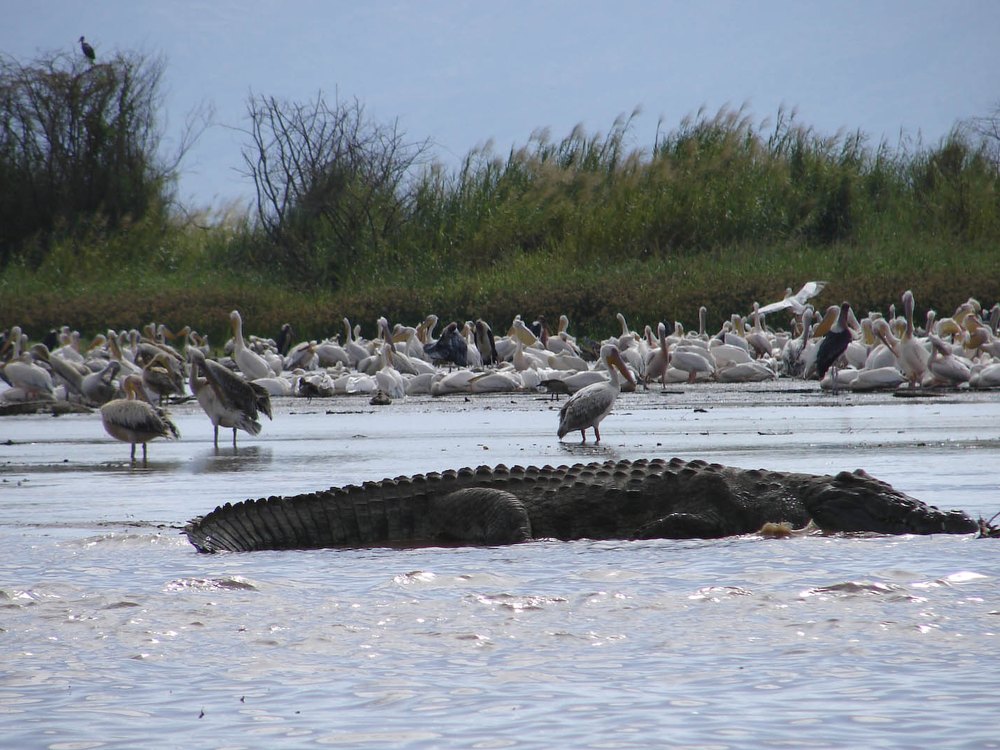
Nile Crocodiles live in many kinds of water: lakes, rivers, dams, freshwater swamps and estuaries, even hypersaline water.[1] The Red List lists inland wetlands, artificial water bodies, and marine coastal, intertidal and shallow sea zones, and calls the species congregatory and dispersive but not migratory.[2] Lake St Lucia holds the largest estuarine population in Africa and the most southern viable breeding population, and wild crocodiles reach the Tugela River.[1] Young crocodiles move at about 1.2 m from vegetated areas to more open shoreline.[1] Nests are dug on open sandy banks, and many nests are close to fresh water.[1]


Range
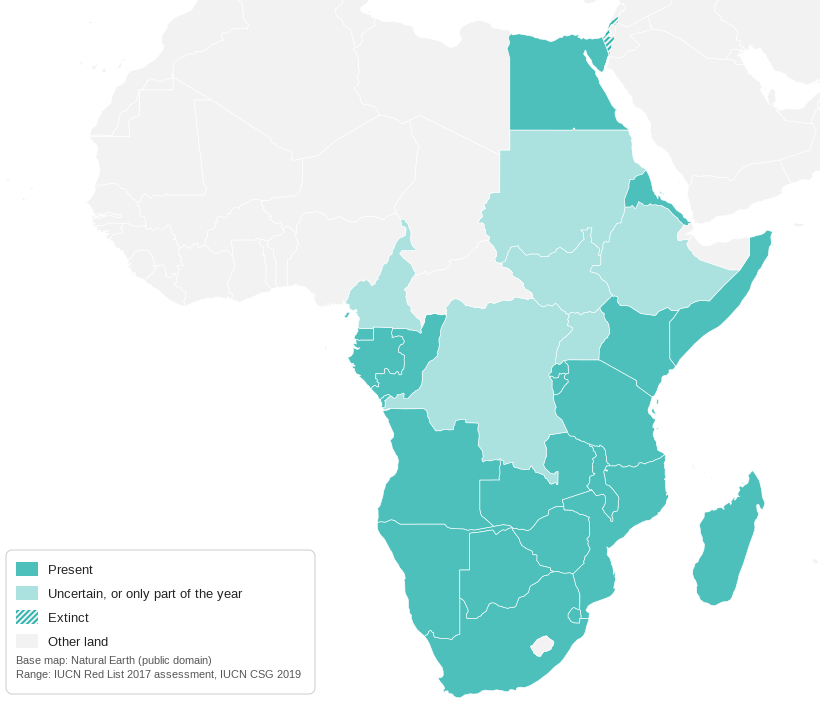
The Nile Crocodile in the narrow sense lives mostly in the eastern half of Africa from South Africa north to Egypt, and in Madagascar. It once also lived east to Israel.[7] The Red List and the CSG list 26 countries: Angola, Botswana, Burundi, Cameroon, the Republic of the Congo, the Democratic Republic of the Congo, Egypt, Equatorial Guinea, Eritrea, Eswatini, Ethiopia, Gabon, Kenya, Madagascar, Malawi, Mozambique, Namibia, Rwanda, Somalia, South Africa, South Sudan, Sudan, Tanzania, Uganda, Zambia and Zimbabwe.[2][1] Both give only the countries of the narrow species, with no West African country.[2][1] All animals sampled in southern Africa, from the Okavango, the lower Kunene, the lower Shire, the Limpopo and KwaZulu-Natal, belonged to the Nile Crocodile lineage.[30]
The West African crocodile lives from Senegal and Mauritania in the west to Uganda and the Democratic Republic of the Congo.[7] The two species overlapped in the Nile drainage for nearly two millennia, but today little overlap seems to remain. Both lineages occur in Uganda, with the West African crocodile in the Kidepo Valley. Five samples from the Awash River in Ethiopia all belonged to the West African species, while the Rift Valley lakes such as Chamo are treated as Nile Crocodile. Museum specimens show both lineages in the upper Nile in Sudan until the 1920s, and the West African crocodile has since vanished from the Nile.[1] The Red List says the lines in Ethiopia are still being worked out, and its country list and its taxonomic notes disagree for parts of Central Africa.[2] The West African crocodile also lives, or may live, in Ethiopia, Uganda, Sudan, South Sudan, the Democratic Republic of the Congo and Cameroon.
Lost and uncertain range
The Nile Crocodile is gone from Israel, and from the Comoros, though reports about the Comoros differ.[1][5] In Egypt it was widespread in the Nile and the Delta until the late 18th century and by the mid-19th century was mostly limited to the river south of Aswan. Today it lives in Lake Nasser and the Nile south of Aswan.[1] It was once found in Algeria.[1] Gabon once regarded it as extinct after hunting from the 1960s to the 1980s, and populations are recovering in protected coastal areas.[1] It has been absent from the Eastern Cape of South Africa since 1903. Six juveniles were released in 1977 at the Kobole River, at least two survived, and successful nesting was confirmed in December 2013.[1] Records from the Seychelles are considered to belong to the saltwater crocodile.[5]
A few Nile Crocodiles have been found in Florida. Four non-native animals were collected between 2000 and 2014, and two of them were confirmed by DNA to be Nile Crocodiles, most closely related to animals from South Africa. No breeding has been reported, and the likely source is the pet trade.[7]
Evolution
The Nile Crocodile belongs to Crocodylus, the true crocodiles. Studies disagree about how old the genus is and where it began. A tip-dated analysis puts the last common ancestor of the living species at about 16.3 million years ago, with a 95% range of 12.5 to 20.5 million. Its authors say their timetrees hint at an African origin, but they call the position of extinct Crocodylus unstable and the ranges broad.[31] A species tree from 2011 instead says the true crocodiles came from an ancestor in the tropical Indo-Pacific in the Late Miocene and then spread quickly around the world.[32] A review of chromosome studies gives an Indo-Pacific origin about 9 to 16 million years ago, a spread into Africa 8 to 12 million years ago, and a crossing to the New World 4 to 8 million years ago, although the dates come from other work.[33]
Closest relatives
The Nile Crocodile is closer to the crocodiles of the Americas than to the West African crocodile. A 2011 DNA study found that the Asian and Australian species form one group, and that Nile Crocodiles from the east group with the four American species, to the exclusion of those from the west, which are now the West African crocodile. The Open Tree of Life synthetic tree has the same shape.[34][35] The pairs of species inside the American and Indo-Pacific groups in the tree on this page come from that synthetic tree alone.[35] The West African crocodile is therefore not the Nile Crocodile’s sister species.[34] The same study says the fossil record of Crocodylus goes back only to the Late Miocene, and that the earliest fossils assigned to the Nile Crocodile and to American Crocodylus are Pliocene. With the DNA trees, this implies a fairly recent crossing from Africa to the Americas, a voyage of hundreds of miles at sea.[34]
Fossils
Fossils as old as the Miocene have been referred to the Nile Crocodile, but it is doubtful whether they are the same species or even belong to Crocodylus. Miocene African fossils include Crocodylus checchiai from Libya and Crocodylus gariepensis from Namibia. Some younger material, such as a Pleistocene form from Uganda, fits the living species better.[36] Fragments from the Pliocene and Pleistocene may not be safely assigned to the species.[36] At Olduvai Gorge in Tanzania, the extinct Crocodylus anthropophagus, from about 1.84 million years ago, was the largest predator encountered by our ancestors there. Its authors say many fossils once called Nile-like belong to an African group tied to the dwarf crocodiles, which is why the Nile Crocodile’s look hid a diverse fossil fauna.[36] The Nile Crocodile is not a living fossil: the true crocodiles are not unchanged survivors, and treating crocodiles as evolutionarily static has hidden diversity.[32][36]
Forms and variants
Old subspecies
The Reptile Database, ITIS and the Catalogue of Life list five subspecies: niloticus, africanus, chamses, cowiei and pauciscutatus. The Reptile Database gives them ranges, such as africanus in Tanzania, Rwanda and Burundi, cowiei from Mozambique and Botswana south to South Africa, and pauciscutatus in Somalia, Ethiopia and Kenya.[5][37][38] The IUCN Red List and the CSG use no subspecies.[2][6] Genetic work found two lineages across Africa, now treated as two species (the Nile Crocodile and the West African Crocodile), not five subspecies.[39] The Nile Crocodile’s differences are gradational and show mostly in scale patterns.[36]
Madagascar
The crocodiles of Madagascar are the same species. The Red List and the CSG list the island as native, and the CSG says the species is widely spread over the country.[2][1] A name for the island form, madagascariensis, is not recognised by recent authors.[5] A molecular clock estimate suggests that the Nile Crocodile reached Madagascar about 2,000 to 3,000 years ago, while the earliest dated Nile Crocodile material from the island is a juvenile about 1.1 m long from Anjohibe Cave, 310 to 460 years old.[31][40] An earlier DNA study placed the East African and Madagascan animals together.[5]
The Nile Crocodile should not be confused with the extinct Malagasy horned crocodile, Voay robustus. Its lineage split from Crocodylus about 24.9 million years ago (95% range 18.8 to 32.1), far from the Nile Crocodile.[31] The Red List gives “voay” as the Malagasy name of the living Nile Crocodile, the same word as the extinct genus.[2][31]
Conservation
The IUCN Red List rates the Nile Crocodile Least Concern. The assessment was made on 30 April 2017 and published in 2019, by Isberg, Combrink, Lippai and Balaguera-Reina. It gives 50,000–70,000 mature individuals and a stable trend, and says the population is not severely fragmented. A Least Concern listing has no criteria letters.[2] The Red List says 40–70% of the population is in protected areas, and records a recovery plan, a monitoring scheme and a harvest management plan.[2]
As listed in 2019, CITES puts the Nile Crocodile in Appendix I in most places and in Appendix II for ranched or quota populations. Appendix I covers Angola, Burundi, Cameroon, the Republic of the Congo, the Democratic Republic of the Congo, Equatorial Guinea, Eritrea, Gabon, Rwanda, Somalia, Sudan, South Sudan and Eswatini. Appendix II covers Egypt, with a zero quota for wild animals traded commercially, Tanzania, with an annual export quota of no more than 1,600 wild specimens including hunting trophies as well as ranched animals, Namibia and Ethiopia, with export quotas of 25 and 5 in 2018, and ranching programs in Botswana, Ethiopia, Kenya, Madagascar, Malawi, Mozambique, Namibia, South Africa, Uganda, Zambia and Zimbabwe.[1]
Population
Hunting in the 1940s to 1960s, and in some countries to the 1970s, caused dramatic declines. Protection and CITES then led to recovery in many places, but since the 1990s many populations have fallen, mostly from human causes.[1] A population model in the CSG account gives a potential increase of 8% a year, and says the true rate probably lies between 3% and 13%.[1] Survey data are adequate for South Africa and generally poor elsewhere, especially in Central Africa, and there are no recent surveys for many historically large populations, such as Lake Turkana.[1] Counts use different methods and are not estimates of the whole species.[1]
| Place | Count | Notes |
|---|---|---|
| Kruger National Park, South Africa | 3,326 | Counted from a helicopter in 2017; the third highest count since helicopter surveys began in 1982 |
| Lake Nasser, Egypt | 386 seen; about 2,581 estimated | Night spotlight surveys of 1,087 km of shore, July to December 2008 and June 2009; the estimate covers the whole lake, all sizes (95% CI 2,239–2,987) |
| Lake Kariba, Zimbabwe | 10,020 (1985); 5,400–9,600 (2016) | Total estimates; the 2016 range is after correction factors |
| Okavango panhandle, Botswana | 2,570 ± 151 (2002); 1,931 (2016) | The 2016 survey was 8% above 2008 |
| Liwonde National Park, Malawi | 676 over 1 m long | On 38 km, 17.8 per km; helicopter, 14 August 2016; one of the highest densities recorded in Africa |
| Lake St Lucia, South Africa | 356 (1972); 975 (1993); 617 (2017); 517 (2019) | Aerial counts |
| Kunene River, Namibia | 806 (95% CI 674–1,015) | Helicopter surveys of 352 km in 2012 |
In Madagascar, densities are low everywhere, at 0.408 crocodiles per km in a 2008 spotlight count, and nesting fell by 45% in 12 nesting areas over seven years from 1996 to 2003.[1]
Threats
Habitat lossPollutionIllegal killingNest destructionFishing gearUnregulated hunting[1][2]Habitat loss. Habitat is lost to afforestation, mining, farming and dams, and dams and water releases can flood nests. Invasive plants take over nesting sites.[1]
Fishing gear and snares. Crocodiles die in gill nets and fish traps, and are caught on snares and baited hooks, or killed with poisoned carcasses.[1]
Illegal killing and hunting. Some are killed for body parts used in traditional medicine, and in Central Africa there is a commercial bushmeat trade.[1]
Nest destruction. Nesting females are killed and nests are destroyed. Cattle, fishermen and tourist boats disturb nesting females at Lake Nasser.[1]
Pollution. Blue-green algae blooms and the disease pansteatitis are covered under Ecology.[1]
Crocodiles and people
The CSG says that conflict with people might be the most significant impediment to the species.[1] The conflict is lethal in both directions. Attack records include 388 attacks in Madagascar from 1892 to 2015, 98 attacks in Zambia from 2000 to 2009 of which 62.2% were fatal, and 214 attacks on people in South Africa from 1949 to 2016. In Namibia, 489 attacks were recorded in Caprivi and Kavango from 1993 to 2005, and 4.8% of them were on people.[1] To reduce conflict, the CSG suggests barriers at water collection points, footbridges and jetties, boreholes, education, not leaving fish remains by the river and using larger boats. Relocation needs a natural barrier, because Nile Crocodiles are confirmed to find their way home.[1]
Trade and ranching
Hunting for skins was heavy in the 20th century. In Botswana up to 80,000 were killed under quotas from 1957 to 1969, Ethiopia exported more than 47,000 skins from 1965 to 1972, and heavy skin hunting in Gabon ended in the 1980s.[1] Today the main source of skins is ranching and captive breeding, led by Zimbabwe: an average of 201,000 Nile Crocodile skins were exported globally per year from 2006 to 2015. In 2015, 251,596 skins were produced and traded internationally, 46% from Zimbabwe, 24% from South Africa and 17% from Zambia. No Central African country has a sustainable management program.[1] In Zimbabwe, 64,004 wild eggs from 1,617 nests were harvested in 2016, 73.7% of them from Lake Kariba.[1]
Actions
Conservation work includes the CITES sustainable-use programs, the restocking of Lake St Lucia and Ndumo with captive-reared crocodiles (486 young, 5 to 18 months old, were released at St Lucia from 1967 to 1976), surveys in protected areas, a nesting sanctuary in the Okavango, the Wadi Allaqi protected area in Egypt, Madagascar’s crocodile management unit and a Namibian management plan from 2014.[1] The CSG’s priorities include surveys in Central and East Africa, management plans, work on conflict, contaminants, protected nesting areas and finding out how far the Nile Crocodile and the West African crocodile share the same waters.[1]
History and culture
Ancient Egypt
Herodotus wrote that some Egyptians held crocodiles sacred and others treated them as enemies. Around Thebes and Lake Moiris they were held most sacred, and the people there kept one tame crocodile with ornaments in its ears and on its forefeet, fed it, and embalmed and buried it in a sacred chest after death. At Elephantine, people did not hold them sacred and ate them.[10] The crocodile god Sobek is known from the Old Kingdom Pyramid Texts. The Faiyum was a cult centre, and crocodiles were raised there as living forms of the god and were mummified.[41]
DNA from museum specimens, which included mummified crocodiles from temples at Thebes and the Grottes de Samoun, was compared with living crocodiles. The mummy haplotypes matched the lineage now called the West African crocodile, and the study concluded that both African lineages lived in the Nile in the past.[39] So a crocodile mummy from Egypt cannot be assumed to be a Nile Crocodile in the narrow sense.
The plover story
Herodotus described a bird that picks meat from between a crocodile’s teeth, and the tale was later tied to the Egyptian plover. Whether his bird was a plover is doubtful, and the cleaning has never been documented in a photograph or video; the well-known pictures are reconstructions.[42]
Hunting and farming
After the Second World War, Nile Crocodiles were hunted in large numbers in Africa. Farming gained momentum in the 1960s and 1970s as wild populations fell. CITES was adopted in 1975, and sustainable-use programs, including Nile Crocodile programs in Zimbabwe, developed in the late 1970s and 1980s. Mozambique exported 268,000 hatchlings to Zimbabwe and South Africa over seven years.[43]
Attacks on people
For the years 2010 to 2020, the CSG lists 696 fatal and 309 non-fatal reported Nile Crocodile attacks, 1,005 in all, from 20 countries.[44] The CSG says the trend is erratic, which probably shows patchy reporting. Incidents in remote rural areas may go unreported, fatal attacks are more likely to be reported than non-fatal ones, and some reports are not crocodile attacks or happened after death, when a crocodile scavenged on a drowned person. Only reported, verified attacks are counted, so the real totals are unknown.[44] In Uganda, a database held 69 Nile Crocodile cases, of which 63 were fatal, and an official estimated about 30 deaths a year. In Korogwe District in Tanzania, 51 people were killed from 1990 to 1994, about 5 per 100,000 a year. The author says the data understate the problem, and that the share of deaths in the database, 90%, against about 65% in the medical literature, suggests that fatal cases are over-reported.[45]
Taxonomy
| Rank | Name |
|---|---|
| Kingdom | Animalia |
| Phylum | Chordata |
| Subphylum | Vertebrata |
| Superclass | Tetrapoda[48] |
| Class | Reptilia |
| Order | Crocodylia[5][2] |
| Family | Crocodylidae (crocodiles)[5][6] |
| Genus | Crocodylus Laurenti, 1768[37] |
| Species | Crocodylus niloticus (Laurenti, 1768)[5][37][38][46][2] |
Synonyms (9)
| Name |
|---|
| Crocodilus vulgaris (Cuvier, 1807) |
| Crocodilus chamses (Bory de Saint Vincent, 1824) |
| Crocodilus complanatus (Geoffroy, 1827) |
| Crocodilus lacunosus (Geoffroy, 1827) |
| Crocodilus marginatus (Geoffroy, 1827) |
| Crocodilus madagascariensis (Grandidier, 1872) |
| Crocodylus madagascariensis (Grandidier, 1872) |
| Alligator cowiei (Smith in Hewitt, 1937) |
| Crocodylus worthingtoni (Deraniyagala) |
From the GBIF backbone.[46]
The Reptile Database, the Red List, the Catalogue of Life and GBIF write the order as Crocodylia, and ITIS and the CSG write Crocodilia.[5][2][38][46][37][6] This page uses Crocodylia.
One species or two
In 2011, a study of DNA from across Africa, from museum specimens and from mummified crocodiles, found a cryptic lineage inside the Nile Crocodile. It matches an earlier description, Crocodylus suchus Geoffroy Saint-Hilaire, 1807, the West African crocodile, and the authors write that it is declining or gone from much of its range.[39] The authorities now treat the West African crocodile as a species of its own.[5][6][37][38][46][2]
The Red List text says the African Nile Crocodile is now recognised as two distinct species, and that the West African populations are likely depleted and less numerous.[2] The Reptile Database kept a distribution list for niloticus that still names many West African countries, so older lists and books count both as one species.[5][47] Many figures and photographs of “Nile Crocodiles” in older sources therefore mix the two. In US captive collections, about 95% of sampled “Nile Crocodiles” were the West African species.[7]
Sources
- Combrink, Lippai & Fergusson 2019, Nile Crocodile Crocodylus niloticus, in Manolis & Stevenson (eds), Crocodiles. Status Survey and Conservation Action Plan, 4th ed., IUCN SSC Crocodile Specialist Group
- Isberg, Combrink, Lippai & Balaguera-Reina 2019, IUCN Red List assessment of Crocodylus niloticus
- Fergusson 2010, Nile Crocodile, in Crocodiles: Status Survey and Conservation Action Plan, IUCN SSC Crocodile Specialist Group
- Hutton 1987, “Incubation temperatures, sex ratios and sex determination in a population of Nile crocodiles”, Journal of Zoology 211: 143–155
- The Reptile Database, Crocodylus niloticus
- IUCN SSC Crocodile Specialist Group, Classification of Living Crocodilians
- Rochford et al. 2016, molecular analyses confirming the introduction of Nile Crocodiles in southern Florida, Herpetological Conservation and Biology 11(1): 80–89
- Di-Poi & Milinkovitch 2013, “Crocodylians evolved scattered multi-sensory micro-organs”, EvoDevo 4: 19
- Leslie & Spotila, “The ecology and physiology of the Nile crocodile in Lake St. Lucia”, doctoral thesis, Drexel University
- Herodotus, Histories 2.69, Macaulay translation
- Whitaker & Whitaker, “Who’s got the biggest?”, adapted from CSG Newsletter 27(4): 26–30
- Swanepoel, Ferguson & Perrin 2000, nesting ecology of the Nile crocodile in the Olifants River, Kruger National Park, Koedoe 43(2)
- Kofron 1990, “The reproductive cycle of the Nile crocodile”, Journal of Zoology 221
- AnAge database, Crocodylus niloticus
- Chabert et al. 2015, “Size does matter: crocodile mothers react more to the voice of smaller offspring”, Scientific Reports 5: 15547
- Chinsamy & Pereyra 2025, stochastic growth marks in Crocodylus niloticus, Scientific Reports 16: 1811
- Wallace 2006, MSc thesis, Stellenbosch University, feeding ecology of yearling, juvenile and sub-adult Nile crocodiles, Okavango Delta
- Kofron 1991, “Courtship and mating of the Nile crocodile”, Amphibia-Reptilia
- Calverley & Downs 2015, home range and movement of Nile crocodiles in Ndumo Game Reserve, Koedoe 57(1): a1234
- Summers 2015, MSc thesis, University of KwaZulu-Natal, Nile crocodiles at Pongolapoort Dam
- “Roars, Rumbles and Resonance”, review of crocodylian acoustic signals, Ecology and Evolution 2026
- Pooley 1977, “Nest opening response of the Nile crocodile”, Journal of Zoology 182
- Maciejewski 2006, MSc thesis, Stellenbosch University, temperature-dependent sex determination in the Nile crocodile, Okavango River, Botswana
- Combrink, Warner & Downs 2016, “Nest predation and maternal care in the Nile crocodile at Lake St Lucia, South Africa”, Behavioural Processes 133: 31–36
- Subalusky et al. 2017, “Annual mass drownings of the Serengeti wildebeest migration influence nutrient cycling and storage in the Mara River”, PNAS
- Junker et al. 2016, pentastome assemblages of the Nile crocodile in the Kruger National Park, Folia Parasitologica
- Lane et al. 2013, pansteatitis associated with large-scale Nile crocodile mortality in Kruger National Park, Journal of Zoo and Wildlife Medicine
- La Grange & Mukaratirwa 2020, experimental infection of tigerfish and sharptooth catfish with Trichinella zimbabwensis, Onderstepoort Journal of Veterinary Research 87(1)
- Ezat et al. 2025, “Nile Crocodiles in Lake Nasser, Egypt, are found close to fishermen’s camps”, Ecology and Evolution
- van Asch et al. 2019, phylogeography of Nile crocodile populations at the fringes of the southern African distribution, PLoS ONE
- Hekkala et al. 2021, paleogenomics of the extinct Malagasy “horned” crocodile Voay robustus, Communications Biology
- Oaks 2011, species tree of the crocodylians, Evolution 65: 3285–3297
- Srikulnath, Thapana & Muangmai 2015, chromosome changes in Crocodylus, Genomics & Informatics 13: 102–111
- Meredith, Hekkala, Amato & Gatesy 2011, phylogeny of Crocodylus, Molecular Phylogenetics and Evolution
- Open Tree of Life synthetic tree opentree16.1, induced subtree of 18 crocodylian species
- Brochu, Njau, Blumenschine & Densmore 2010, PLoS ONE 5: e9333
- ITIS, Crocodylus niloticus (TSN 202200)
- Catalogue of Life (release 2026-10-14), Crocodylus niloticus
- Hekkala et al. 2011, “An ancient icon reveals new mysteries: mummy DNA resurrects a cryptic species within the Nile crocodile”, Molecular Ecology 20: 4199–4215
- Mathews & Samonds 2016, juvenile subfossil crocodylian from Anjohibe Cave, Madagascar, PeerJ 4: e2296
- Wikipedia, Sobek
- Wikipedia, Egyptian plover
- IUCN SSC Crocodile Specialist Group, Farming and the Crocodile Industry
- IUCN SSC Crocodile Specialist Group, Crocodilian Attacks
- Abu-Zidan 2015, editorial, African Health Sciences 15(2): i–iv
- GBIF backbone, Crocodylus niloticus
- The Reptile Database, Crocodylus suchus
- ITIS, Crocodylus niloticus, classification