The Sable (Martes zibellina) is a marten of the northern Asian forests with long, silky fur.[1] It lives from the Ural Mountains across Siberia to the Pacific, and on the Japanese island of Hokkaido.[2] The IUCN lists it as Least Concern, with a Russian population of 2.0 to 2.2 million.[2]
Quick facts
Description
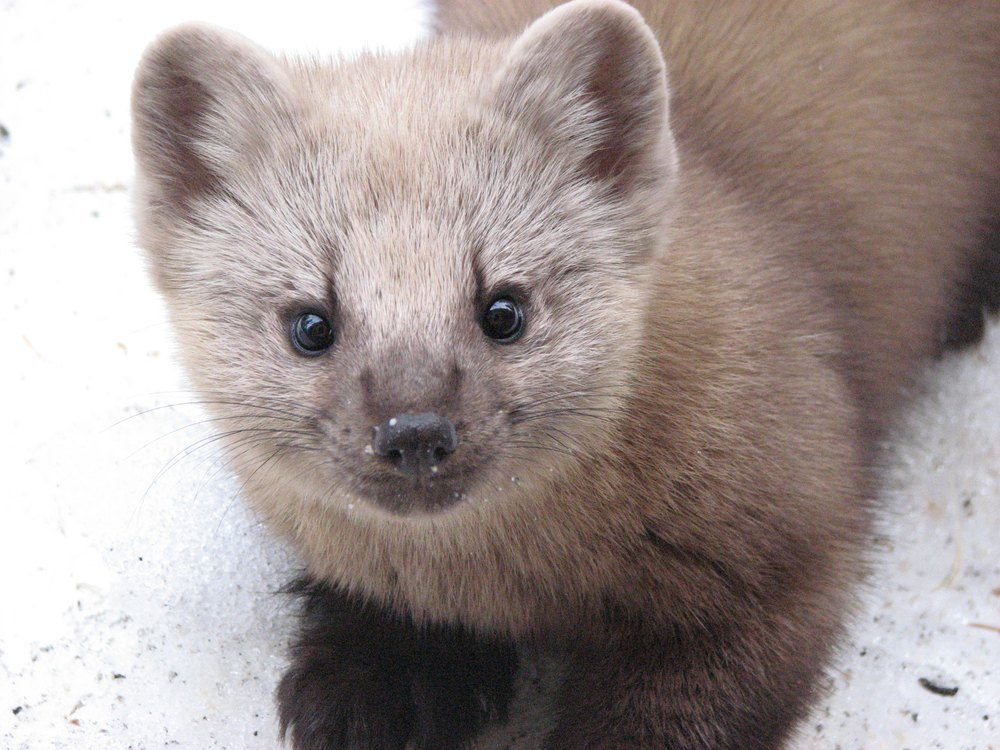
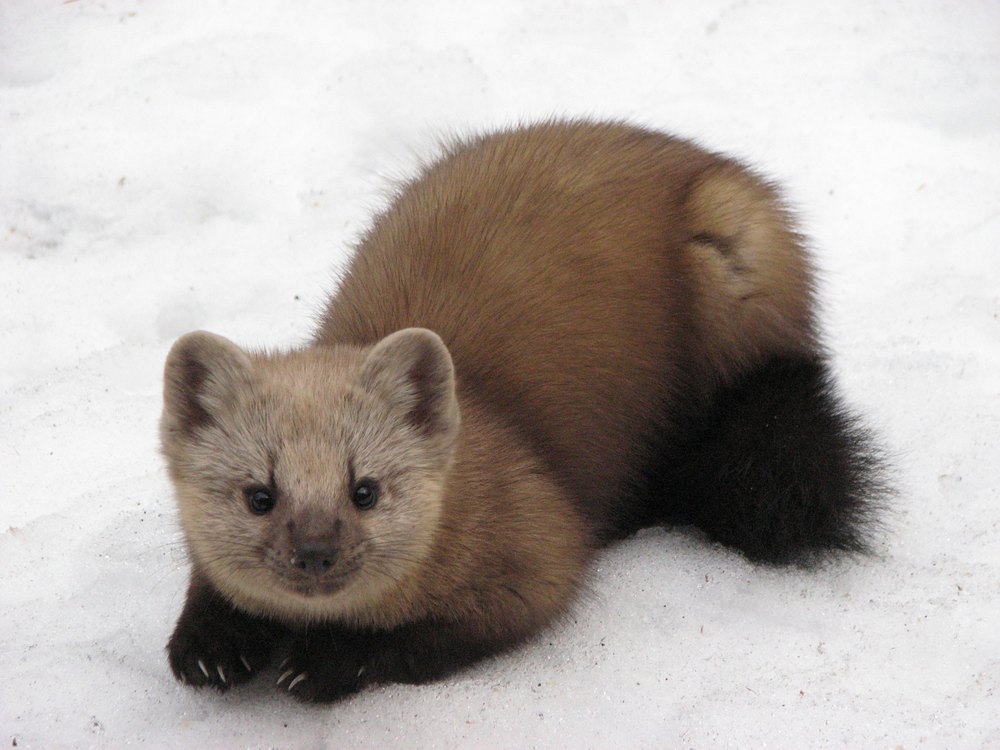
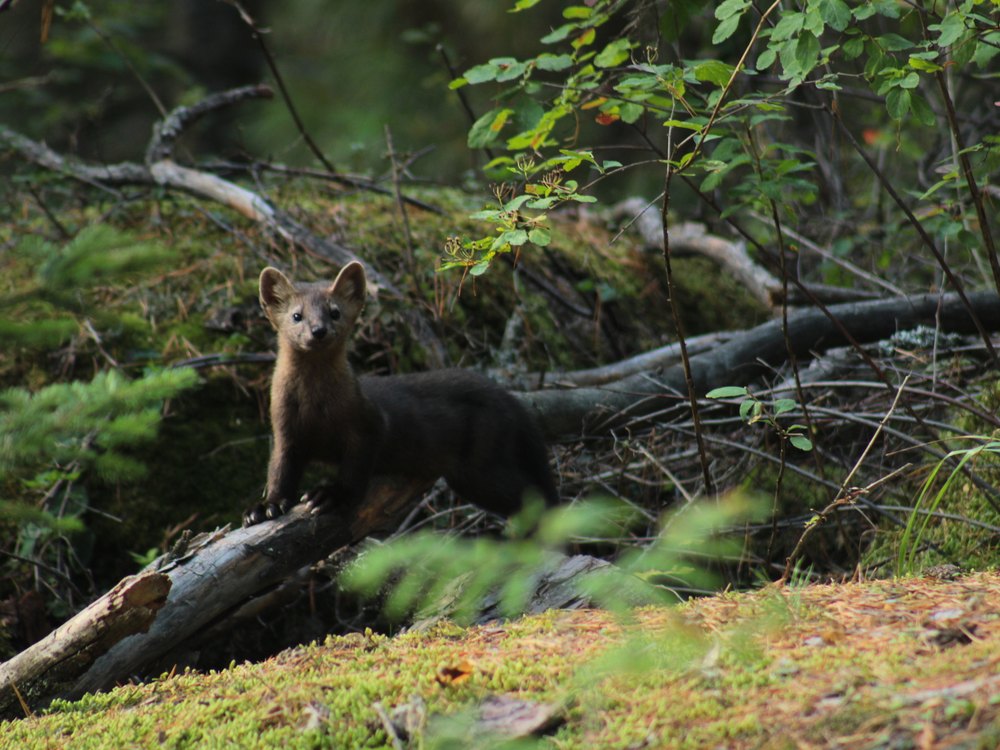
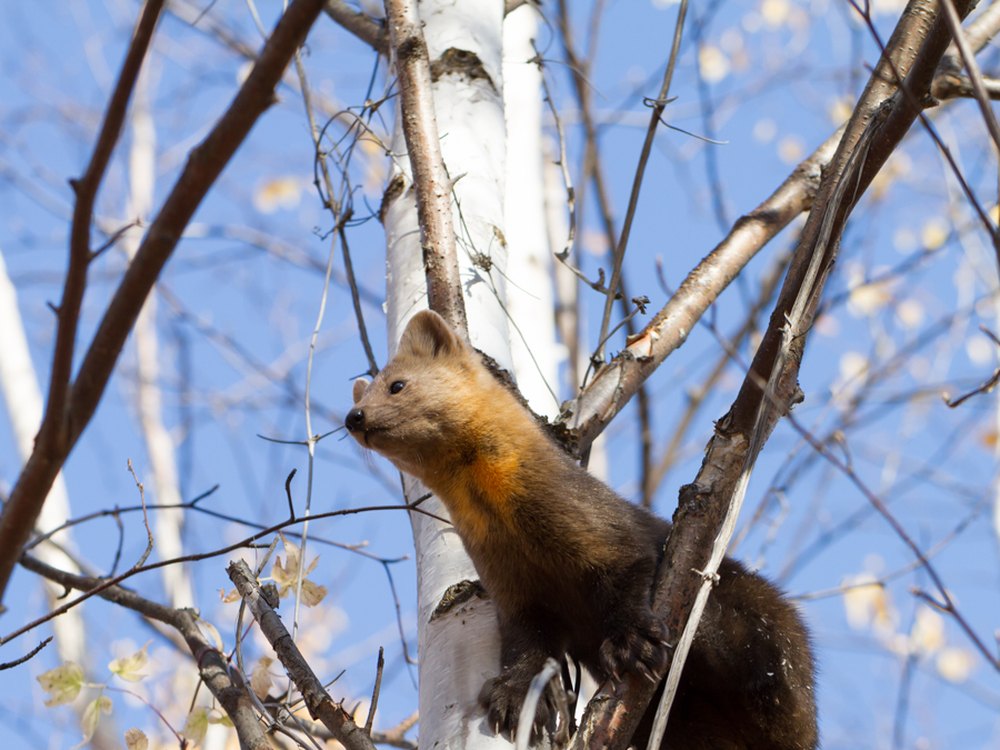
The Sable has long, silky fur that ranges from pale greyish brown to dark brown, almost black.[1] The head is paler than the body, and a pale throat patch can be grey, white or yellowish, or reduced to almost nothing.[1] Compared with the pine marten and its other close relatives, the sable has a shorter tail and darker, more lustrous fur.[2]
Name
The scientific name Martes zibellina goes back to Linnaeus, who described the species in 1758 as Mustela zibellina; the genus Martes was named by Pinel in 1792.[4]
In other languages
| Language | Name | Meaning |
|---|---|---|
| Kazakh local | бұлғын (bḯlgḯn) | — |
| Bashkir local | кеш (kesh) | — |
| Komi local | низь (niz’) | — |
| Russian | соболь (sobol′) | Sable |
| Japanese | クロテン (kuroten) | Sable |
| Chinese | 紫豂 (zǐ diāo) | Sable |
| Korean | 검은담비 | Sable |
| Mongolian | Булга (bulga) | Sable |
| German | Zobel | Sable |
| French | Zibeline, Martre zibeline | Sable |
| Spanish | Marta cibelina | Sable marten |
| Italian | Zibellino | Sable |
| Polish | Soból | Sable |
The names come from the vernacular-name records of the GBIF database, which draw on national checklists and the IUCN.[4] The Kazakh name is from the checklist of the mammals of Central Asia; the Bashkir and Komi names are from the Catalogue of Life, both as listed by GBIF.
Body
Size
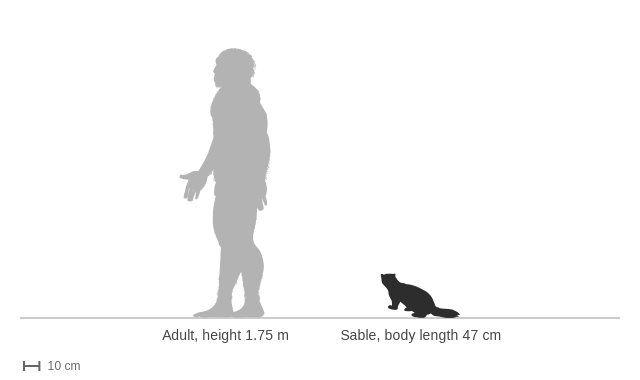
Adult sables weigh about 0.7 to 1.8 kg: males 0.8 to 1.8 kg and females 0.7 to 1.56 kg.[1] The Animal Diversity Web gives 0.88 to 1.8 kg for males.[5] Head and body length is 38 to 56 cm in males and 35 to 51 cm in females, with a tail of 12 to 19 cm in males and 11.5 to 17.2 cm in females.[1] Males are a little larger than females.[1] Wild animals can be lighter: hunted adults and young together in north-western Yakutia averaged 722 g in the winters 2005 to 2008.[6]
Size varies by region, and the smallest sables live in the Ussuri and Amur forests of the Russian Far East and on Hokkaido.[2]
| Female | Male | |
|---|---|---|
| Weight (adult) | 0.7–1.8 kg | |
| Length (head and body) | 35–51 cm | 38–56 cm |
Fur and colour
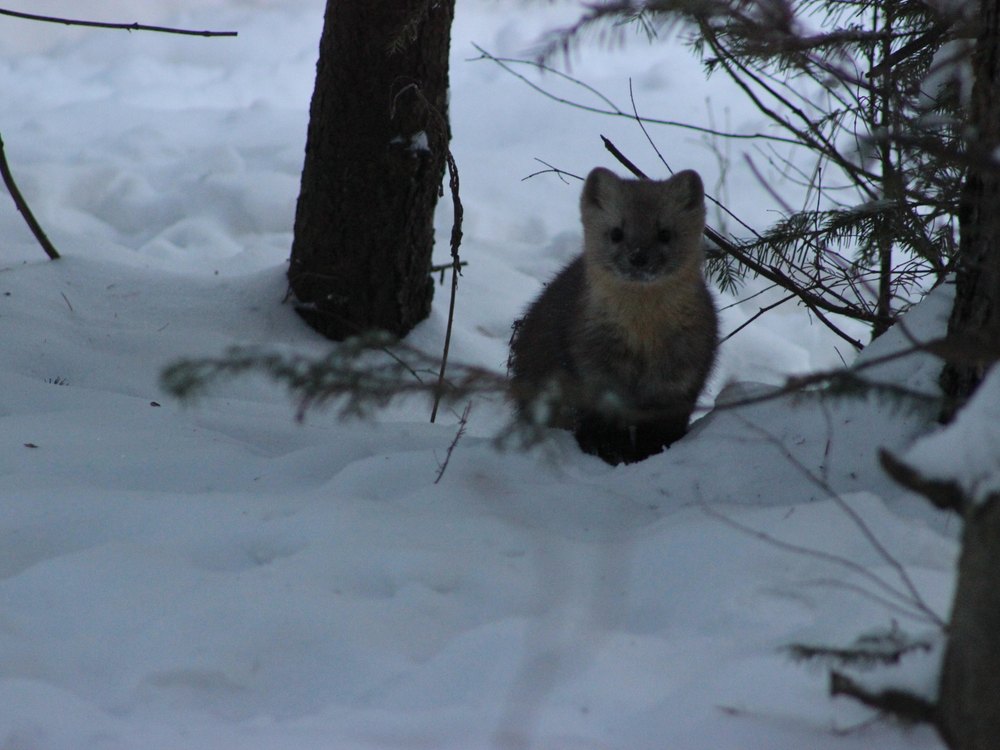
The winter coat is longer and denser than the short summer coat.[1] Colour varies by region: the darkest fur occurs around Lake Baikal, in Yakutia and in the Amur basin, and the lightest in the Trans-Urals.[2] In north-western Yakutia the native animals are larger and lighter than the introduced ones.[6]
Senses and special features
The Animal Diversity Web says the sable finds prey by sound and scent.[5]
Behavior
Home range
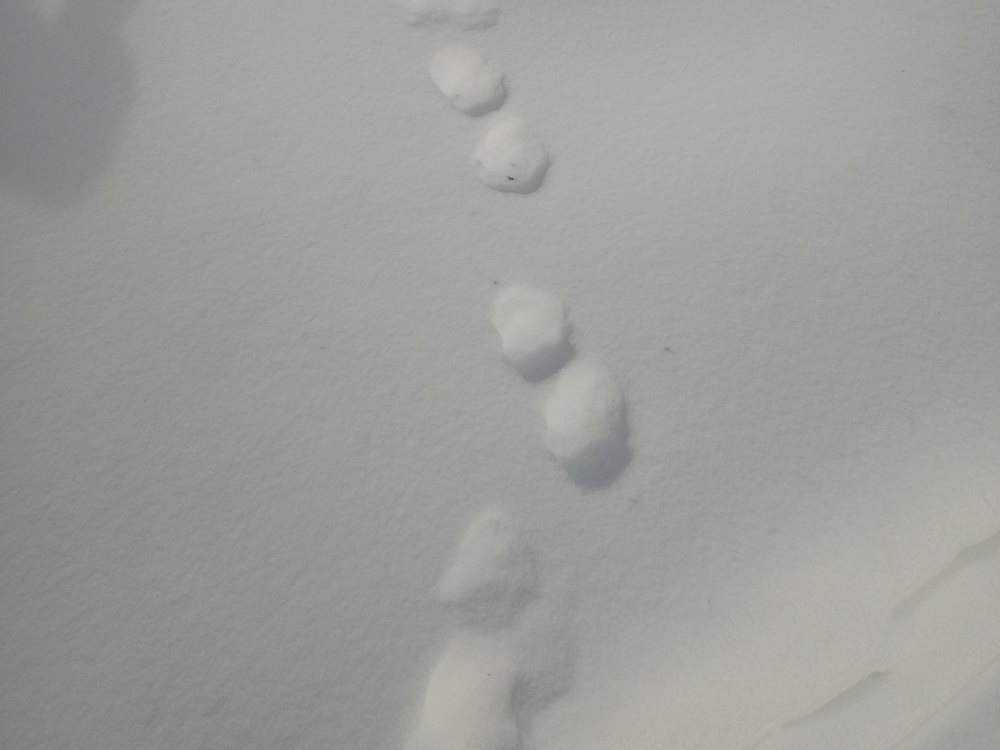
In forest, a sable’s home range is 4 to 30 km², and adults hold ranges 2 to 3 times larger than the young.[2] On average, males move 7.3 to 10.6 km a day and females 6.5 to 12.0 km. Most tagged sables went no farther than 30 km from the place where they were tagged, and young animals tend to move towards floodplains.[2]
Ranges are much smaller on Hokkaido. In a mixed forest there, six radio-tracked Japanese sables (M. z. brachyura) held ranges of 0.50 to 1.78 km² (average 1.12 km²). Range size did not follow weight or age, and the ranges overlapped so much that even the core areas were not exclusive. Some animals of both sexes roamed widely and held no home range at all.[7]
The Hokkaido sables rested in dense mixed forest with fallen debris, which gives cover from red foxes and wind, and searched for food in old forest rich in voles and mice.[7]
Solitary life
Outside the breeding season the sable lives alone.[1] It lives mainly on the lower, ground level of the forest, unlike the pine marten, which climbs more.[2]
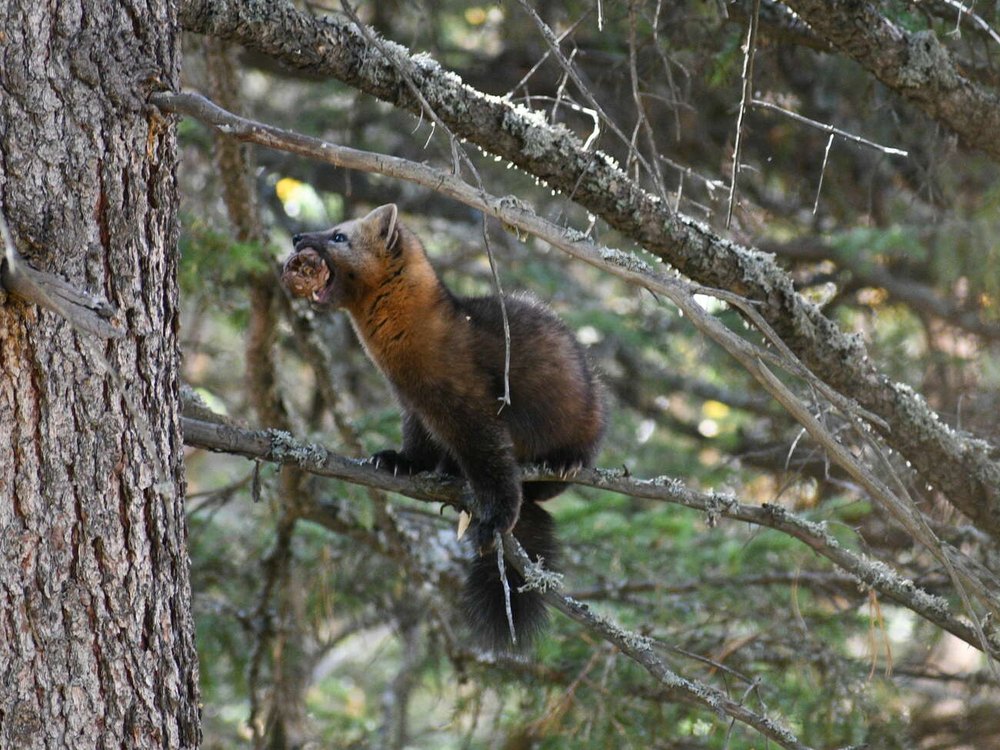
Activity changes with the season. Radio-collared sables were mostly active at night in spring and winter and by day in summer and autumn.[1]
Diet
What it eats
The Sable is an omnivorous predator that eats mostly small mammals.[2] In winter samples (stomachs and droppings) from the Sayan and Ural mountains, 64 to 80% contained mammals, 6 to 12% birds, 33 to 77% pine nuts and 4 to 33% berries. The shares overlap, because one sample can hold several foods. Larger prey includes pikas, squirrels, muskrats, marmots, hares and musk deer, and fish are not rare in the diet.[2]
In north-western Yakutia, stomachs of hunted sables held mostly voles: the root vole in 50.2% of them, and the northern and grey red-backed voles in 43.7% each. Birds were in 1.6% and bog bilberry in 15.5%.[6]
Seasons
On Hokkaido the diet depends on the season. In eastern Hokkaido, a study of 193 droppings and 20 stomachs found mammals the most common food all year: voles in 56.5%, the Siberian chipmunk in 19.3% and wood mice in 14.6%.[8] Insects were found mainly in summer (48.8%, against 9.3% in other seasons). Plant material, mainly fruit, was found in 45.7% in autumn and 68.4% in winter, but only 5.1% in spring and 1.3% in summer.[8] Birds, reptiles, amphibians, fish and crustaceans were also eaten.[8]
Life cycle
| Stage | Age / time | Notes |
|---|---|---|
| Newborn | Born 25 March to 3 May | Pregnancy lasts 245 to 298 days; litters hold 1 to 7 young, 2.5 to 3.5 on average[2] |
| Young | Under 1 year | In the Urals, 19.9% of underyearlings survive the year[2] |
| Adult | 2 years and older | In Yakutia, 57.9% of 2-year-old females bred[6] |
Breeding
Sables mate from June to August.[1] On fur farms in Finland, about 85% of matings took place in July.[9] The pregnancy is long because of delayed implantation: the fertilised egg stays unattached for 7.5 to 8.0 months (the diapause), and the embryo then develops for only 30 to 35 days. Births fall between 25 March and 3 May.[2]
Farmed females in Finland were pregnant for 268 days on average.[9]
Young
Of the sables in the Urals, 62.7% were juveniles, and in the Western Sayan 75.6%. Survival is 19.9% for underyearlings and 44.0% for yearlings in the Urals, and 33.0% and 59.6% in the Western Sayan. Animals aged 2 to 9 years survive at 75.9 to 79.4% a year in the Urals.[2] The IUCN notes that hunters take young animals more often, so these shares are probably too high.[2] Males make up 54.5% of the population.[2]
In Yakutia, 2.9% of one-year-old females bred, 57.9% at age 2 and 100% at ages 5 to 7.[6]
Ecology
Besides natural deaths and zoonoses (diseases passed from animals to people), the IUCN lists eight mammal species and eight bird species as enemies of the Sable, and describes its competitors as omnivorous and carnivorous predators.[2] Up to 34 helminth (parasitic worm) species, 19 flea species and three gamasid mite species are described as sable parasites.[2]
The sable is a predator of small mammals, mostly rodents (see Diet). In north-west Yakutia its numbers rise and fall in cycles of 2 to 5 years and of 9 to 12 years, and the short cycles follow the numbers of voles.[6]
Habitat and range
Where it lives
The Sable lives in Eurasia, mainly in mountain and lowland conifer forests of Siberia, from the European north-east (the western foothills of the Urals) to the Pacific Ocean, including Kamchatka, Sakhalin and Hokkaido.[2] In Russia it occurs across 7 million km².[2]
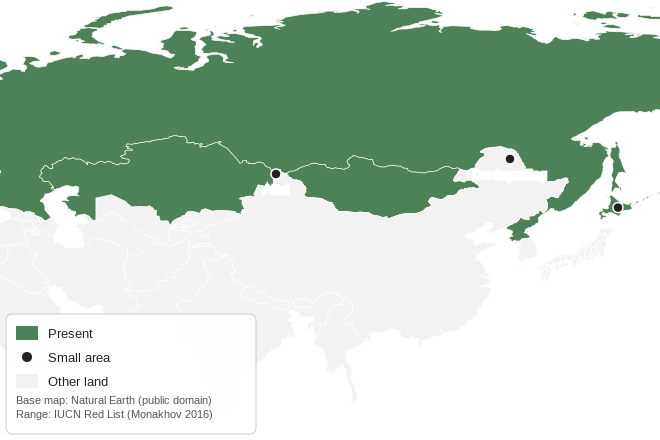
In north-west China it now lives in a small area of the southern Altai Mountains in Xinjiang, and in the north-east in the Daxinganling and Xiaoxinganling Mountains of Heilongjiang and Inner Mongolia.[2] In Mongolia it lives in the north-western Mongol Altai, the mountains around Lake Hovsgol and the Hentii Mountains.[2] In Kazakhstan it lives in the south-west Altai Mountains of Eastern province, in the basins of the Uba and Buhtarma rivers.[2] In North Korea it occurs around the Changbaishan (Paektu) Mountains and southward into North Hamgyong province, but not in South Korea, although some authors have shown the whole Korean peninsula as its range.[2] In Japan it occurs only on Hokkaido.[2]
In the 2010s the sable occupied all suitable habitats and territories that it had not colonised before.[2] In Yakutia, after sables from the Vitim area were released there from 1948 to 1961, the southern border of the northern form moved from about 61° N to 65° N, and sables reached near-tundra forests beyond 71° N.[6]
Habitat
The sable lives in dense coniferous forest (taiga, the northern conifer forest) and in deciduous forest, on plains and in mountains.[2] The IUCN rates both boreal and temperate forest as suitable and of major importance.[2] The sable has been seen near large cities in areas with developed industry.[2]
The altitude it uses depends on where forest grows. It lives at 20 to 200 m above sea level in the Ob Basin, 200 to 650 m in the Ural Mountains, 350 to 1,100 m in the Altai Mountains, 900 to 2,100 m in the Sayan Mountains and 600 to 1,600 m in the Barguzin and Cherskii ridges. In the Verkhoyansk Ridge it reaches 2,100 to 2,200 m.[2]
Hokkaido
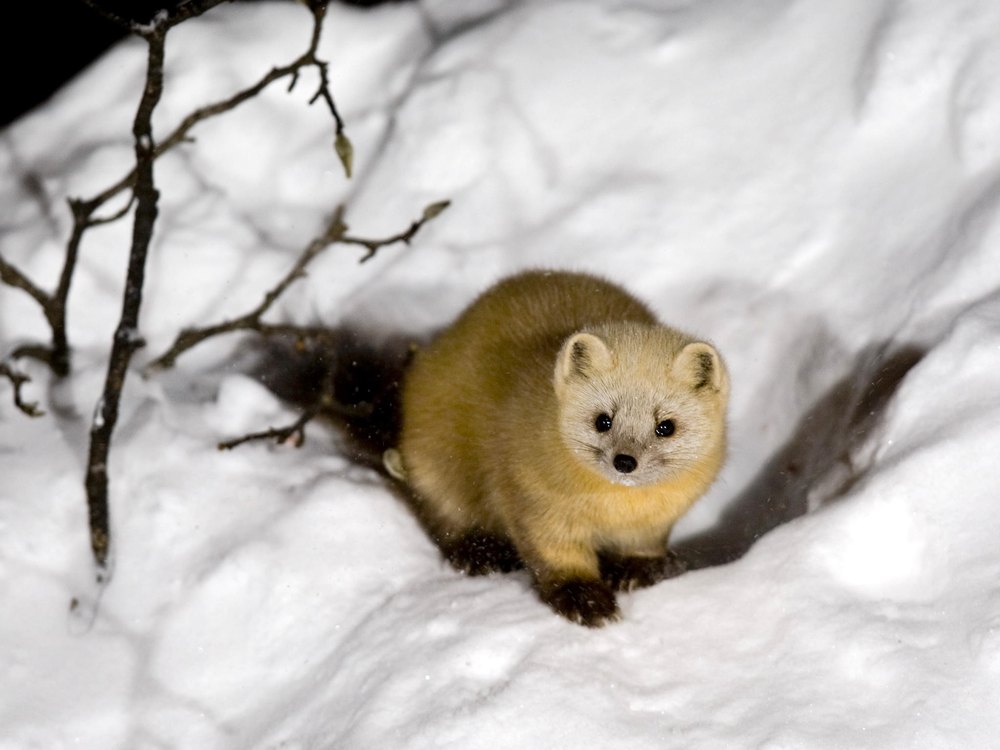
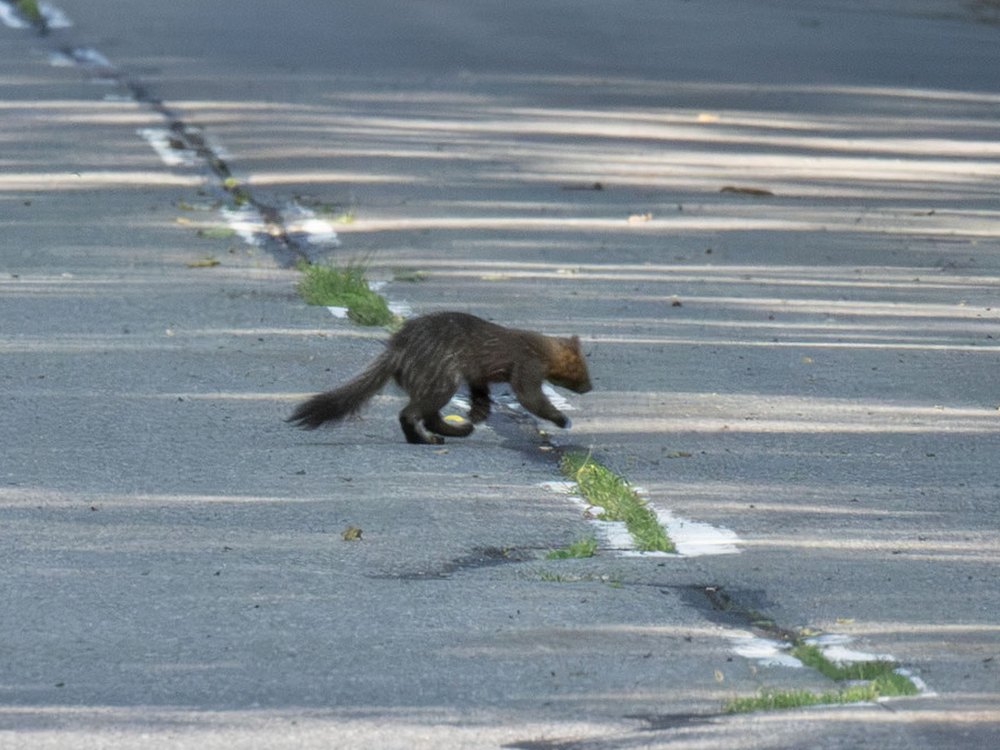
On Hokkaido the native sable (the Japanese sable, M. z. brachyura) was reported in 2000 to be widely distributed in the eastern, northern and central parts of the island.[10][11]


Evolution
The Sable belongs to the martens, a genus of slender forest hunters (see Taxonomy). Published dates for the split of the two lineages disagree. One mitochondrial gene gives about 0.54 million years ago (Ma), with a range of 0.27 to 0.80.[12] Whole mitochondrial genomes give 0.68 Ma (0.54 to 0.84), and several earlier studies about 1.1 Ma (about 0.6 to 1.6), as quoted in a 2026 genome study.[3] That study itself gives 1.52 Ma (1.05 to 2.06) from a fossil-calibrated whole-genome tree.[3] The 2026 genome study warns that mitochondrial trees are unreliable for these two species, because the sable’s mitochondrial DNA (the DNA passed on by the mother) has spread into pine martens (see Forms and variants).[3]
The stone marten split from the sable and pine marten lineage about 2.83 Ma (2.11 to 3.66) in the same genome study.[3] Within the sable, the most recent common ancestor of all sampled mitochondrial lineages lived about 0.22 Ma (0.12 to 0.34).[12] The sable’s effective population size, an estimate of how many animals breed, peaked at about 2.5, 0.5 and 0.1 Ma.[3]
Forms and variants
Subspecies
Checklists disagree on how many subspecies the Sable has. Catalogue of Life and ITIS accept none and list the names only as synonyms.[13][14] GBIF accepts 17.[4] The Handbook of the Mammals of the World says 30 have been proposed and that a revision is needed,[1] and the IUCN says up to 34 subspecies and variations have been proposed by different authors.[2] A genetic study of 279 sables found three main mitochondrial lineages on the mainland, and they do not match the named subspecies. Some 20,000 sables were also moved around between 1901 and the 1980s, which blurs any older pattern.[12]
The best-known form is the Japanese sable (Martes zibellina brachyura, Temminck, 1844) of Hokkaido. GBIF accepts it, Catalogue of Life and ITIS treat it as a synonym of the species.[4][13][14] All Hokkaido sables carry one island mitochondrial lineage, shared with Sakhalin and the southern Kurils, which the authors date to about 0.04 to 0.09 Ma.[12] Its genetic variety is low.[12] One gene for coat colour, Mc1r, has two versions on Hokkaido: one also found in Russian sables and one found only on the island.[15]
See all 17 named subspeciesHybrids
Where the ranges of the Sable and the pine marten meet, the two species interbreed. The hybrids, called kidas, are fertile, and whole-genome data show hybrids of many kinds. Sable mitochondrial DNA has replaced the native DNA in most pine martens.[3]
Conservation
The sable is listed as Least Concern on the IUCN Red List (version 3.1, published in 2016, assessed on 3 March 2015), and the population trend is increasing.[2] The reason given is a large population of over two million animals spread widely across Eurasia; numbers are not at risk in most of the range, despite declines in some countries that together make up only a small part of it.[2] The Russian population is estimated at 2.0 to 2.2 million animals, and the Russian harvest reached 700,000 to 750,000 animals in the 2011/2012 season.[2]
Threats
HuntingHabitat loss[2]Hunting. The IUCN names winter hunting as the main factor reducing numbers, but in Russia the hunt follows scientifically based quotas, so it is not seen as a threat to the species there.[2] Selective capture and shooting of young animals is the IUCN’s explanation for the very high share of juveniles found in hunted populations.[2] The IUCN rates hunting, logging and fire as affecting less than half of the population, with negligible declines.[2] In Mongolia, fur hunting is given as the cause of the sable’s decline.[16]
Habitat loss. Some habitat is lost through clear-felling of forests, the building of roads and other links, and new mines and oil and gas fields.[2]
Protection
In Russia the sable is protected in state nature reserves, national parks and game reserves; 41 state nature reserves with a total area of 164,960 km² are the main protected areas.[2] Outside protected areas the harvest is limited by regional quotas and to the period from 15 October to 29 February.[2] Mass reintroductions in the 1940s to 1960s involved about 19,000 animals (see History and culture).[2]
In China hunting is forbidden across the whole 215,678 km² area that holds the species, and it is in the first category of protection; eight national reserves totalling 8,122 km² hold it.[2] Mongolia classes the sable as Vulnerable, and North Korea as Endangered.[2][16]
In Japan, the sable of Hokkaido has been protected since 1920 and is now listed as Near Threatened.[2] A 2008 Japanese museum bulletin gives 1923 as the year capture became prohibited, and says the ban still applied.[11] The Japanese marten (Martes melampus), a different species from Honshu, was introduced to Hokkaido in the 1940s, and in 2010 a study of maternal DNA found no hybridisation between it and the sable on the island.[10] Records from 2000 to 2014 show the marten widely distributed in the south-west and the sable in the rest of Hokkaido, with the Ishikari Lowland, which is mostly non-forested or poorly forested, between them; the authors suggest the marten expanded by pushing out the sable.[17]
History and culture
Fur trade
One essay on the sable and the Barguzin reserve calls demand for sable fur and over-hunting in western Russia the main reason for Russia’s expansion east of the Ural Mountains in the 17th century.[18] The same essay gives the annual catch as 145,000 sables in the 1740s and 42,000 by the 1790s, and notes that other sources give a much higher figure for the 1740s.[18] In Yakutia, uncontrolled hunting in the 17th and 18th centuries left the sable in the north-west only in remote, isolated areas by the 19th century.[6]
Reserves and reintroduction
The Barguzin Nature Reserve, on the north-east shore of Lake Baikal, was founded in 1916 to protect and restore the Barguzin sable.[18] According to the same essay, the reserve staff brought the sable back in less than 20 years and helped it spread beyond the Barguzin Mountains through breeding and re-settlement.[18] In Yakutia hunting was prohibited in 1930 to 1933, 1936 to 1941 and 1946 to 1950, and numbers recovered from the 1940s.[6] The native sable of south-west Yakutia had been almost exterminated; Vitim sables (M. z. princeps) were released there from 1948 to 1961 and interbred with the north-west population along the Vilyuy River.[6] Russia-wide totals are in Conservation.
Hokkaido
A Japanese museum bulletin says that heavy fur hunting in the Meiji era (1868 to 1912) sharply reduced the sable on Hokkaido.[11] A 20th-century fur-hunting bottleneck is one possible reason for the Hokkaido sable’s low genetic diversity.[10] Protection is described in Conservation.
Taxonomy
| Rank | Name |
|---|---|
| Kingdom | Animalia |
| Phylum | Chordata |
| Subphylum | Vertebrata |
| Superclass | Tetrapoda[23] |
| Class | Mammalia |
| Subclass | Theria[23] |
| Infraclass | Eutheria[23] |
| Order | Carnivora |
| Suborder | Caniformia[23] |
| Family | Mustelidae (weasels and relatives)[4] |
| Subfamily | Guloninae[4] |
| Genus | Martes Pinel, 1792[4] |
| Species | Martes zibellina (Linnaeus, 1758)[4][13][14] |
Higher classification
The Sable is a carnivore of the order Carnivora, in the weasel family Mustelidae and the subfamily Guloninae.[4][19] This subfamily also holds the wolverine and the fisher.[21] GBIF and Catalogue of Life list eight species in Martes, including the pine marten, the stone marten, the Japanese marten and the American marten.[4][13] The pine marten is the Sable’s closest relative.[3] In shape, the Sable is most like the pine marten, the American marten and the Japanese marten, but it has a shorter tail and darker, silkier fur.[2]
Where the line between species is thin
The Sable’s neighbours have caused two disputes. The first is the Japanese marten. Heptner and colleagues (1967) held that it is a subspecies of the Sable, but recent genetic studies support two separate species.[2] The second is the pine marten, which interbreeds with the Sable (see Forms and variants).[3] On Hokkaido, a mitochondrial study found no sign that the Sable has mixed with the Japanese marten, but its authors said that other kinds of DNA marker are still needed to be sure.[10]
Sources
- Larivière, S. and Jennings, A. P. 2009. Family Mustelidae. In: Wilson, D. E. and Mittermeier, R. A. (eds), Handbook of the Mammals of the World, vol. 1. Lynx Edicions, Barcelona (entry for Martes zibellina)
- Monakhov, V. G. 2016. Martes zibellina (Sable). The IUCN Red List of Threatened Species 2016: e.T41652A45213477
- Tomarovsky, A.A. et al. 2026. Genomics of Sable (Martes zibellina) × Pine Marten (Martes martes) Hybridization. Genome Biology and Evolution 18: evag018
- GBIF Secretariat, Martes zibellina (Linnaeus, 1758), GBIF Backbone Taxonomy (species 5218826)
- Animal Diversity Web, Martes zibellina (sable)
- Zakharov, E. and Safronov, V. 2017. Ecology of sable of North-Western Yakutian native population. Russian Journal of Theriology 16: 74–85
- Miyoshi, K. and Higashi, S. 2004. Home range and habitat use by the sable Martes zibellina brachyura in a Japanese cool-temperate mixed forest. Ecological Research 20: 95–101
- Murakami, T. 2003. Food habits of the Japanese sable Martes zibellina brachyura in eastern Hokkaido, Japan. Mammal Study 28: 129–134
- Korhohen, H., Niemelä, P. and Siirilä, P. 2001. Temperament and reproductive performance in farmed sable. Agricultural and Food Science 10: 91–98
- Inoue, T. et al. 2010. Mitochondrial DNA Control Region Variations in the Sable Martes zibellina of Hokkaido Island and the Eurasian Continent, Compared with the Japanese MartenM. melampus. Mammal Study 35: 145–155
- Murakami, T. 2008. Bulletin of the Shiretoko Museum 29: 31–39 (in Japanese)
- Kinoshita, G. et al. 2015. Colonization history of the sable Martes zibellina (Mammalia, Carnivora) on the marginal peninsula and islands of northeastern Eurasia. Journal of Mammalogy 96: 172–184
- Catalogue of Life, Martes zibellina (Linnaeus, 1758) (ChecklistBank, taxon 3Y9W9)
- ITIS, Martes zibellina (Linnaeus, 1758) (TSN 621945)
- Ishida, K. et al. 2013. Evolutionary history of the sable (Martes zibellina brachyura) on Hokkaido inferred from mitochondrial Cytb and nuclear Mc1r and Tcf25 gene sequences. Acta Theriologica 58: 13–24
- Clark, E. L. et al. (eds) 2006. Mongolian Red List of Mammals: Martes zibellina. Regional Red List Series 2, Zoological Society of London
- Hirakawa, H. et al. 2015. Honyurui Kagaku (Mammalian Science) 55(2): 155–166
- Agarkova, E. 2009. Preserving the Symbol of Siberia, Moving On: Sobol’ and the Barguzinsky Zapovednik (Part I). ICWA Letters EA-13
- Mammal Diversity Database, Martes zibellina (taxon 1005824)
- Li, B. et al. 2014. Mitochondrial genomes reveal the pattern and timing of marten (Martes), wolverine (Gulo), and fisher (Pekania) diversification. Molecular Phylogenetics and Evolution 80: 156–164
- Koepfli, K.P. et al. 2008. Multigene phylogeny of the Mustelidae: Resolving relationships, tempo and biogeographic history of a mammalian adaptive radiation. BMC Biology 6: 10
- Sato, J.J. et al. 2012. Evolutionary and biogeographic history of weasel-like carnivorans (Musteloidea). Molecular Phylogenetics and Evolution 63: 745–757
- ITIS, Martes zibellina, classification