The Sea Lamprey (Petromyzon marinus) is a jawless, eel-shaped fish.[1] Its larva lives for years buried in stream mud, filtering food from the water.[2][3] The adult clamps onto other fish with a round sucker mouth and feeds on their blood and flesh.[3][4] It spawns once and dies.[5][6] Native to the North Atlantic, it is an invader in the Great Lakes of North America.[3][4]
Quick facts
Description
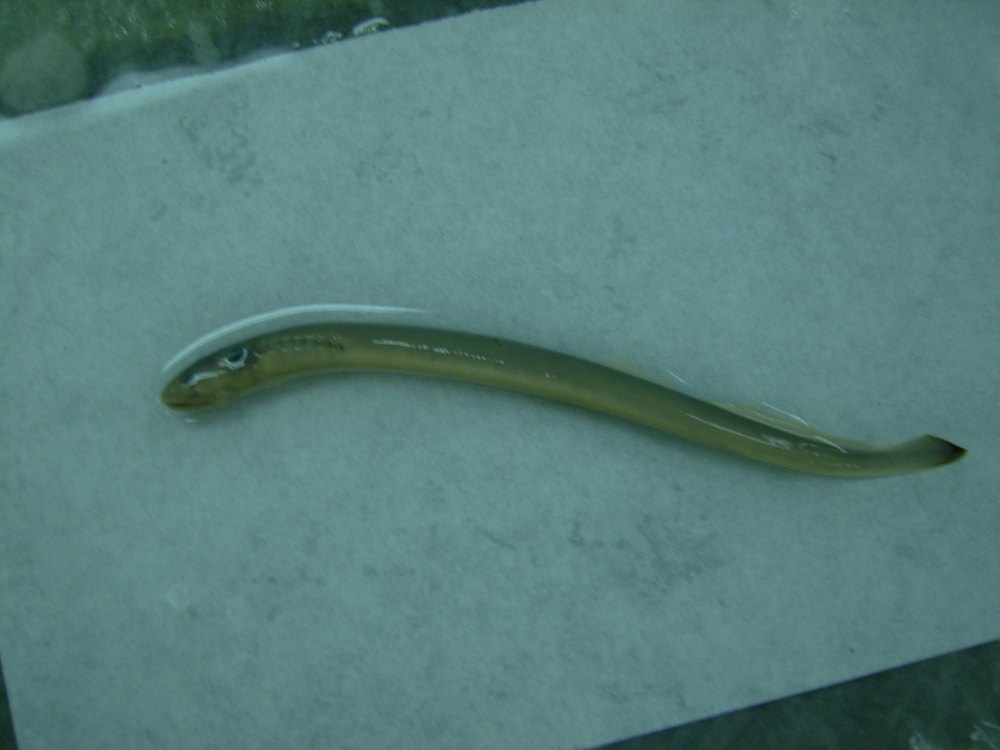
The Sea Lamprey is a long, cylindrical fish with smooth, scaleless skin. It looks like an eel but is not related to one.[4][5][6] The adult is brownish with dark marbling on the back and a lighter belly, and its tail fin is shaped like a spade.[6][1] It has two dorsal fins, no paired fins, and seven gill openings behind the eye on each side.[5][6]
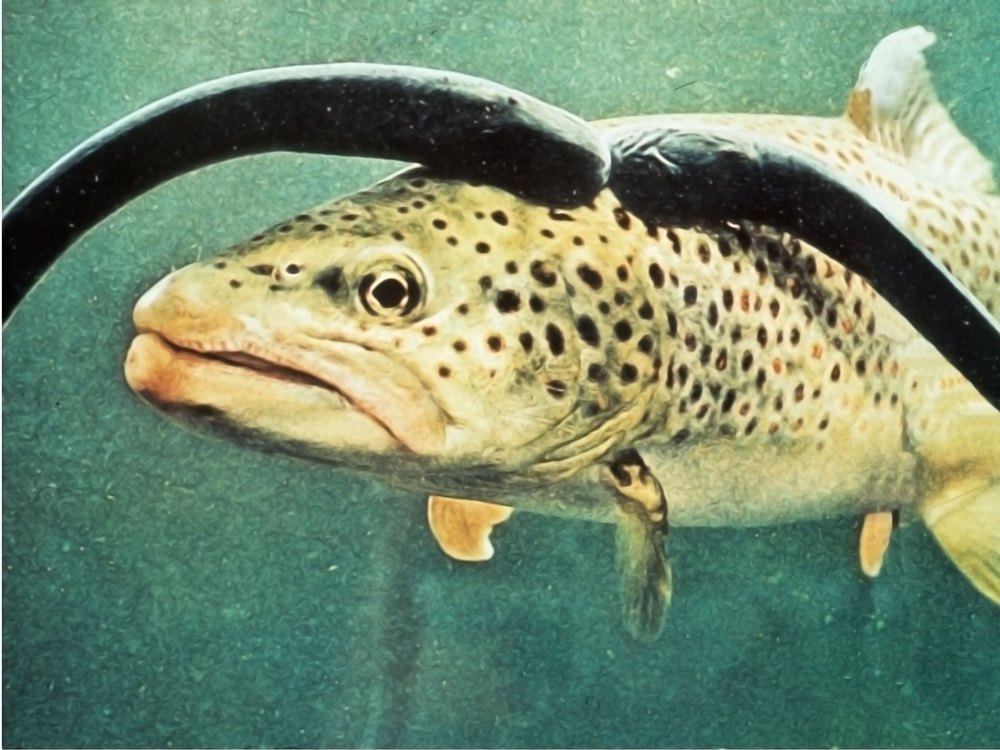

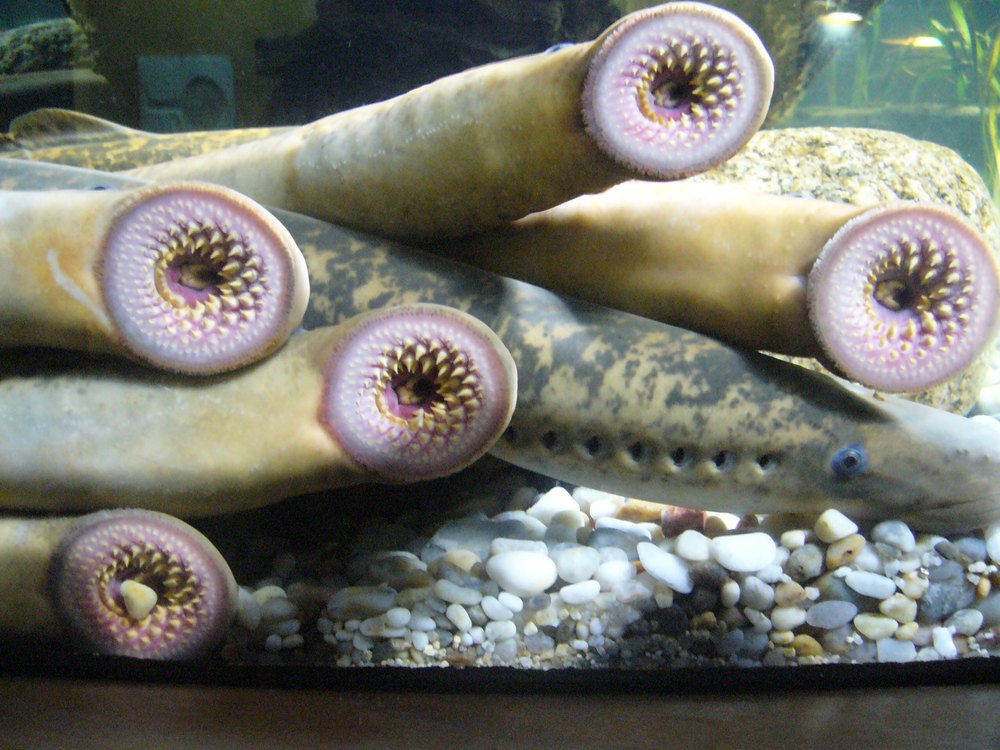

It has no jaws. Its mouth is a round sucker, the oral disc, lined with many circular rows of sharp, horn-shaped teeth that surround a toothed tongue.[4][1][6]
The larva is brown above and lighter below, and its eyes develop only when it changes into the adult form.[1][5] A young lamprey in the middle of that change, a transformer, is grey-blue above and white on the belly.[1] Breeding males grow a rope-like ridge along the back.[1][6][5]
Name
The English name is Sea Lamprey. The species name marinus is Latin for “of the sea”.[6] The genus name Petromyzon comes from the Greek petra, rock, and myzon, to suck, and refers to the way the animal sucks on to things.[6] The Sea Lamprey belongs to the family Petromyzontidae.[7][8]
In other languages
| Language | Name | Meaning |
|---|---|---|
| Welsh local | llysywen bendoll y môr | — |
| Scottish Gaelic local | creathall na mara | — |
| Irish local | An loimpre mhara | — |
| Icelandic local | Sæsteinsuga | sea stone-sucker |
| Norwegian local | Havniøye | sea nine-eye |
| Breton local | suzon | — |
| French | Lamproie marine | marine lamprey |
| Spanish | Lamprea marina | marine lamprey |
| Portuguese | Lampreia-marinha | marine lamprey |
| Italian | Lampreda di mare | lamprey of the sea |
| German | Meerneunauge | sea nine-eye |
| Dutch | Zeeprik | sea lamprey |
| Swedish | Havsnejonoga | sea nine-eye |
| Danish | Havlampret | sea lamprey |
| Polish | Minog morski | sea lamprey |
| Faroese | Sugvari | – |
| Slovenian | Morski piskur | – |
| Croatian | Morska paklara | – |
| Estonian | Merisutt | – |
| Finnish | Merinahkiainen | – |
Names are the ones listed in the IUCN Red List assessment. A meaning is given only where the name is clearly a compound.[3] These names are from the UK species inventory, EUNIS, the IUCN Red List and WoRMS, as listed by GBIF.
Body
Size
Size changes a great deal with stage and place. Wild larvae in Great Lakes streams range from 11 to 200 mm long.[1] In wild larvae of age group III from Lake Superior and Lake Michigan streams, the average length in late summer or early autumn ran from 65 to 144 mm, depending on the stream.[2] The larva changes into the adult form at 130 to 150 mm.[3] In one Lake Superior river (the Big Garlic River), wild fish caught while changing averaged 143 to 156 mm over seven years.[9] Juveniles, the young lampreys that feed after the change, measure 100 to 200 mm in the Great Lakes just after the change.[1]
Six wild juveniles caught in northern Lake Huron in September 2019 averaged 422.3 mm and 109 g.[10]
Spawning adults differ between populations. In the Big Garlic River, 722 wild spawners averaged 42.2 cm and 149 g.[11] In the St. John River in New Brunswick, 285 fish counted at a dam averaged 72.9 cm and 892.1 g for females and 72.2 cm and 872.6 g for males, with no significant difference between the sexes.[12] Wild adults caught on their way upstream in the St. Marys River and held in tanks averaged 395 to 490 mm and 147.5 to 246.5 g for males and 420 to 480 mm and 163 to 233 g for females, depending on the group.[10]
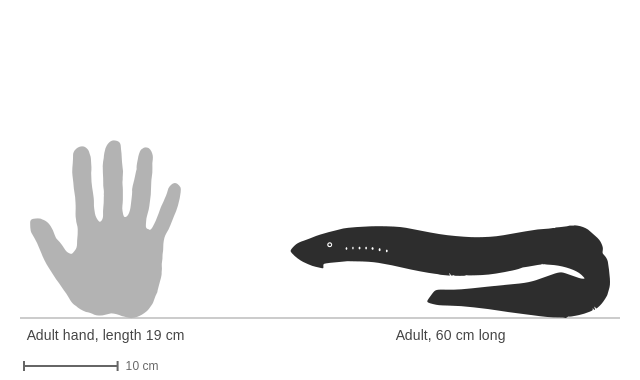
FishBase gives a maximum of 120 cm, a common length of 60.0 cm, and a published maximum weight of 2.5 kg.[6]
| Weight (adult, largest) | up to about 2.5 kg |
| Length (adult) | 30–100 cm |
Senses
Smell guides the adult. Migrating adults find spawning streams by a scent released by larvae, and spawning males release a bile acid that attracts females.[3]
Mouth and teeth
In the wild-caught adults held in tanks, the oral disc measured 25 to 32 mm across (group averages).[10] Adult teeth are cone-shaped hooks about 2 mm long; in wild juveniles they are shorter than 1 mm.[10] A tongue moves in and out like a piston and pumps the suction.[10]
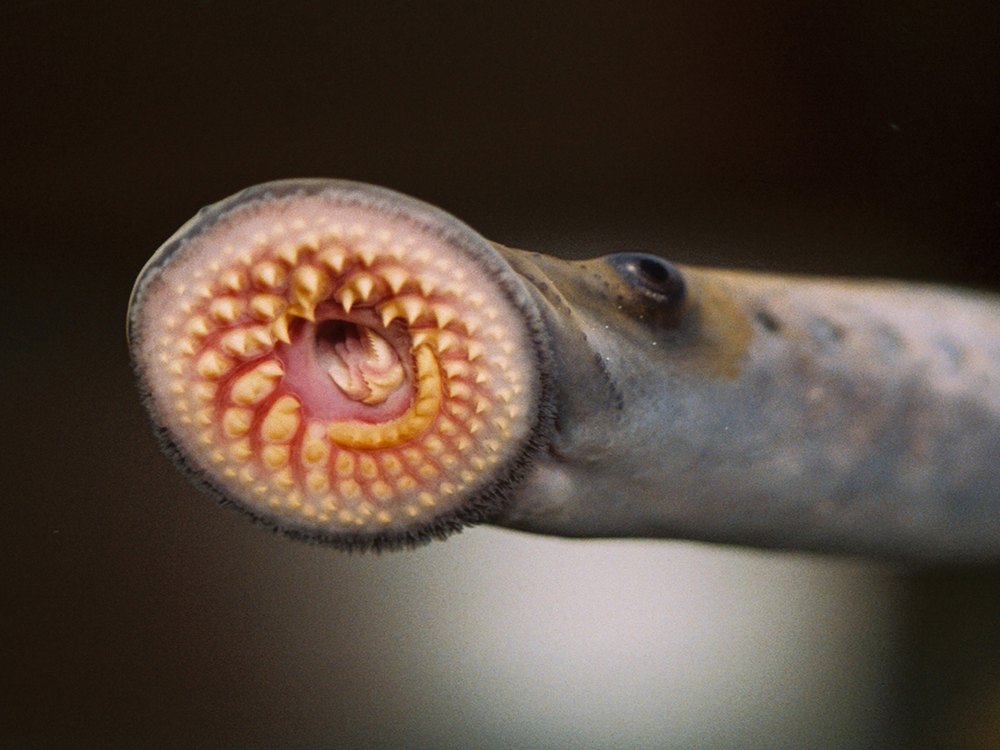

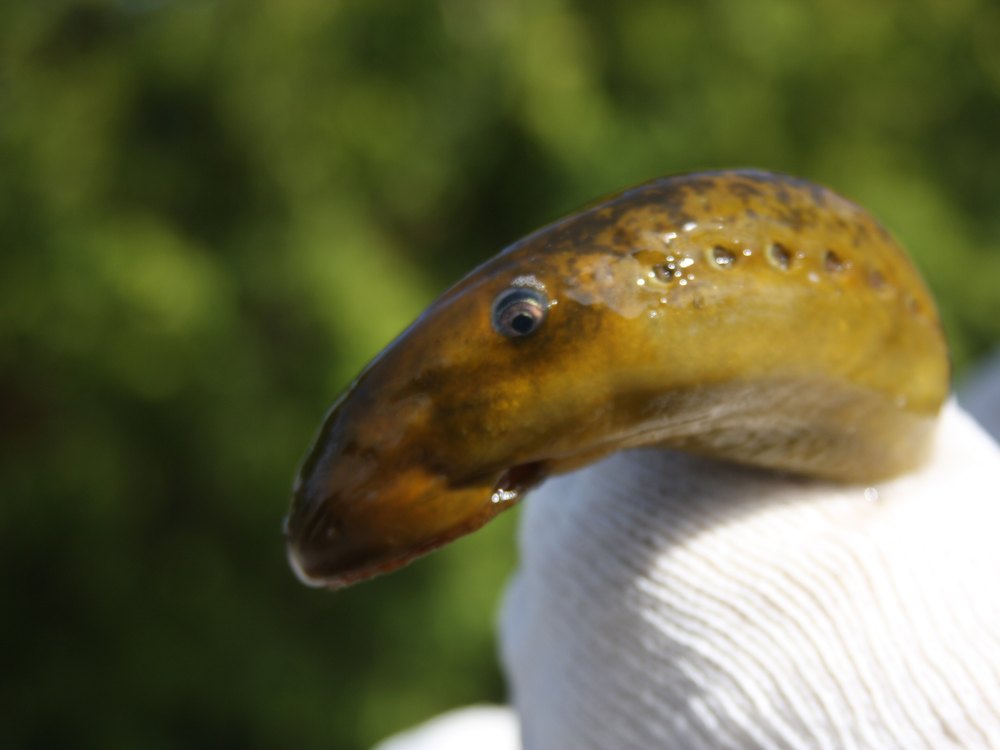

In the same tank study, adults at rest pumped the pressure to between −0.6 kPa and −26 kPa. In pull tests the maximum reached −8 kPa to −70 kPa (group averages about −33 to −39 kPa), and water flow of up to 0.45 m/s did not raise the suction.[10]
Behavior
Attachment
The parasitic adult Sea Lamprey fastens onto a fish with its sucker mouth (see Body for the teeth and the suction). While it feeds it secretes an anticoagulant, a substance that stops blood from clotting.[3][6][4] For what it feeds on see Diet.
Movement
Outside the spawning season the lamprey is mostly active at night; spawners become less nocturnal and spawn on sunny days.[3] In the Big Garlic River, a Lake Superior stream, most downstream movement of larvae happened during high water in April and May.[9]
Migration
Transformers and spawning adults move in opposite directions. In the Big Garlic River the transformers moved downstream from mid-October to November, and about 40% of one year's transformers (range 30 to 68%) left the river in a single 12-hour period.[9]
In the native Atlantic range the adults enter rivers in autumn and winter.[3] They travel 20 to 850 km inland and climb in water of 10 to 18 °C, according to FishBase.[6] In New Brunswick the spawning took place in late June and early July.[12]
In the Great Lakes the adults move into streams from March to July.[13] FishBase gives feeding journeys of up to 628 km for the parasitic adults of the Great Lakes.[6]
Spawning
In the native Atlantic range the lamprey spawns from April to July, mostly in May and early June, at 12 to 15 °C.[3] In the Great Lakes it spawns in spring and summer.[14] FishBase gives a water temperature of at least 15 °C.[6]
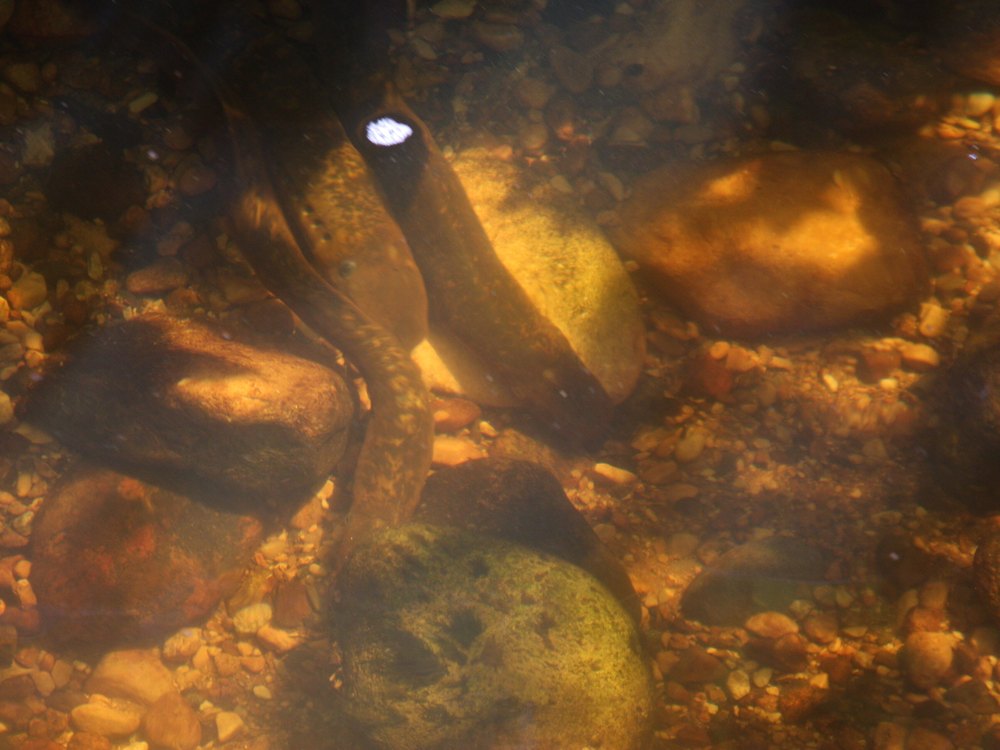
Nest building starts when the water rises above 4.5 °C. The male moves stones to make a shallow, crescent-shaped nest in coarse gravel, with stones 0.33 to 5.10 cm across, in moderate to strong current.[1][3][13] The female lays her eggs in the nest and the male fertilises them outside her body.[5]
Each spawning act lasts 2 to 5 seconds and is repeated about every 2 to 3 minutes, and every 10 minutes or more near the end. A pair spawns for 16 hours to 3.5 days, and the male may stay in the nest for 1 to 3 days afterwards.[1]

Diet
The larva
The larva (ammocoete) is a filter feeder. It lies buried in soft sediment in slow stretches and backwaters downstream of the spawning sites and takes in diatoms (single-celled algae) and detritus (bits of dead plant and animal matter) from the water.[3][6] The USFWS adds bacteria, and the GLFC describes the food as micro-organisms.[1][4]
A transformer does not feed for a period while the mouth and gut change. In the Big Garlic River transformers were found mostly under leaves, detritus and roots in deeper water, not attached to rocks.[9] See Life cycle for how long the fasting lasts.

The adult
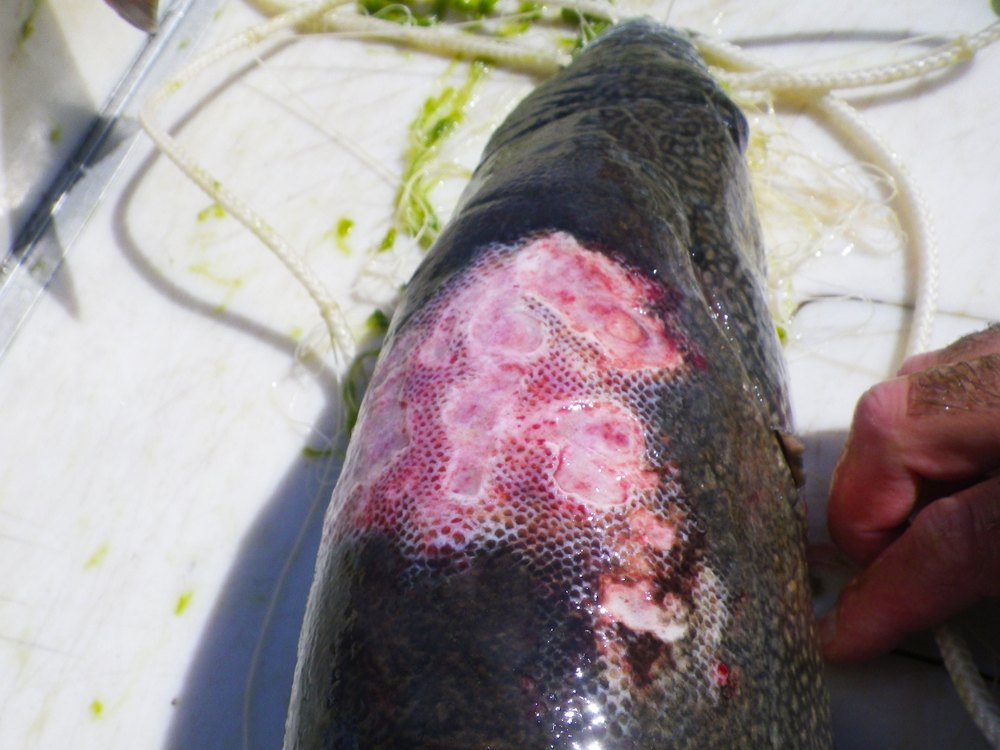
The parasitic adult attaches to a fish and feeds on its blood, body fluids and flesh.[3][6][4] IUCN adds that whales and other cetaceans are also hosts.[3] Fish named as hosts include:
- Great Lakes: lake trout, brown trout, lake sturgeon, lake whitefish, ciscoes, burbot, walleye, catfish, Chinook and coho salmon, and rainbow trout.[4][13]
- Native Atlantic range: Atlantic cod, Atlantic herring, haddock, pollock, red hake, sturgeons, Atlantic mackerel, swordfish and basking shark;[1] shad, cod, haddock and salmon at sea, and also dead or netted fish.[15]
- St. John River, New Brunswick: juveniles 156 to 403 mm long had fed on alewife, shad, white sucker and Atlantic salmon.[16]
The USFWS says any fish with enough area to attach to can serve as a host.[1] Feeding ends before spawning, so the adult that spawns no longer eats.[5] For how much fish a lamprey destroys and what it does to its hosts, see Ecology.

Life cycle
| Stage | Age / time | Notes |
|---|---|---|
| Egg | Hatches in 11 to 14 days | Counted from fertilisation; Big Garlic River, Lake Superior[11] |
| Larva | 3 to 7 years | Great Lakes tributaries of Lakes Superior and Michigan; 6 to 8 years in New Brunswick[2][12] |
| Parasitic adult | 12 to 18 months | Great Lakes; at least 2 years at sea in native Atlantic populations[4][1][3] |
| Spawning adult | Spawns once, then dies | Spring and early summer; stops feeding beforehand[3][11] |
Egg and hatching
An egg is 0.8 to 1.3 mm across.[1] In the Big Garlic River, a Lake Superior stream, eggs hatched 11 to 14 days after fertilisation, and most larvae left the nest within 22 days.[11] Hatching success averaged 6.3% in two Lake Superior streams.[11]
The larva
The larva lives buried in stream mud for years. In tributaries of Lakes Superior and Michigan, larvae changed into the adult form at 3 to 7 years old.[2] In the Big Garlic River the minimum was 5 years.[11] In New Brunswick, length data from the St. John River gave about 6 to 8 years for the native Atlantic form.[12] One year class does not change all at once, so a stream’s young adults can differ by several years in age.[9]
Becoming an adult
The change from larva to adult starts in mid-July and is probably finished by November in New Brunswick.[12] In Michigan it runs from July to October.[6] Many New Brunswick transformers feed little for 9 to 10 months after the change begins.[16]
At sea or in the lake
In the Great Lakes the parasitic phase lasts 12 to 18 months.[4][1] Lake Huron lampreys reached adult size and ripened after one year of parasitic growth.[17] Native Atlantic lampreys spend at least 2 years at sea.[3] FishBase gives 20 to 36 months at sea.[6] See Diet for what they eat.
Spawning and death
For the timing of the spawning run see Behavior. A female in the New Brunswick run carried 151,836 to 304,832 eggs, 210,228 on average (285 fish).[12] In the Great Lakes FishBase gives 43,997 to 101,932 eggs per female.[6] The adult spawns once and dies; it stops feeding before spawning and stays at or near the nest until close to death.[3][11] Big Garlic River males lost 20 to 29% of their weight after spawning and females 40 to 46%.[11]
Lifespan
One source gives a whole cycle of up to about 9 years.[14] In New Brunswick the larva spends 6 to 8 years in the stream and the time after the larval years is 3 to 4 years, 1 to 2 years longer than in the landlocked form, which together come to 9 to 12 years.[12] FishBase gives a maximum age of 11 years.[6]
Ecology
Predators
A 2020 study in south-west France tagged 49 adult Sea Lampreys on their spawning migration and followed them by radio telemetry. At least 80% of the tagged lampreys (39 of the 49) were eaten within one month, and half were eaten within about 8 days of tagging on average. The predator was the European catfish (Silurus glanis), a species introduced to those rivers, and the authors call it a serious additional threat of local extirpation for the lamprey there.[18]
FishBase lists the porbeagle shark (Lamna nasus) as a predator of adults at sea in the north-west Atlantic.[6] The Great Lakes Fishery Commission names a lack of predators as one reason the lamprey did well in the Great Lakes, where it is an invader.[13]
Hosts
For the fish it feeds on, see Diet. A study of the north-west Atlantic found that larger fish and marine mammals seem to be hosts at older ages.[19]
The effect on the host depends on the water. In its native Atlantic range the lamprey has evolved alongside its hosts and typically does not kill them, according to the Great Lakes Fishery Commission and FishBase.[13][4][6] In the Great Lakes the Commission puts the loss at more than 20 kg (40 lb) of fish over a lamprey’s 12 to 18 months of feeding, and its annual reports estimate that up to 18 kg (40 lb) of fish production is lost for every lamprey that reaches adulthood.[4][20][21] The US Fish and Wildlife Service cites Swink (2003) for 19.3 kg (43 lb) per lamprey.[1] IUCN says the invasion changed the lakes’ food web and lists the extinction of three endemic whitefishes, in combination with other factors.[3]
Role in the water
In the native range, adults that die after spawning put sea-derived nutrients into small rivers in a pulse each spring. In a Maine coastal stream, carcasses placed in the water raised algal growth by 57% to 71% right next to them, and the nutrients showed up in several families of stream insects. The effects were local and variable.[22] The larvae, buried in the stream bed, filter diatoms and detritus from the water and sediment (see Diet).[3]
Habitat and range
The Sea Lamprey (Petromyzon marinus) is anadromous, which means it is born in fresh water, feeds in salt water and returns to fresh water to spawn. IUCN lists rivers and streams, lakes of more than 8 hectares, coastal sea waters and estuaries as suitable habitat, and calls it a full migrant.[3]
Where it lives
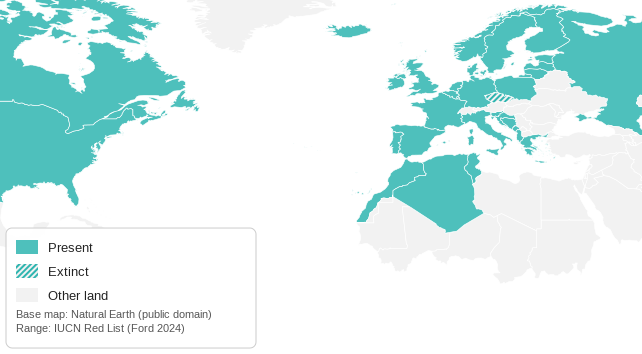
Habitats
In the north-east Atlantic IUCN gives the range as running from Iceland and Norway to the Barents Sea in north-west Russia (Ura River, Kola Peninsula). It occurs throughout the North Sea and in the south Baltic and west-central Mediterranean basins. In the Baltic it is rare and is known to travel far upriver only in the Oder, Vistula, Daugava, Narva and Luga.[3] IUCN lists it as present in countries from Iceland, the Faroe Islands and Norway through Sweden, Denmark, Germany, Poland, the Baltic states, the Netherlands, Belgium, the United Kingdom, Ireland, France, Spain and Portugal, and round the Mediterranean from Italy and the Balkans to Morocco, Algeria and Tunisia.[3] In the north-west Atlantic it occurs from the Labrador Peninsula south to Florida.[3] Off Labrador it was much more numerous in estuaries in 2020, and it is unclear whether it breeds there.[23] Strays are recorded from the Gulf of Mexico and the eastern Mediterranean.[3]
IUCN lists landlocked populations in the Great Lakes, the Finger Lakes, Oneida Lake and Lake Champlain in the north-eastern United States.[3] In the Great Lakes the Great Lakes Fishery Commission treats the lamprey as an invader from the Atlantic, and IUCN lists it as introduced in Illinois, Indiana, Michigan, Minnesota, Ohio and Wisconsin.[4][3] Whether Lake Ontario is part of the native range is disputed (see Forms and variants).
Larvae burrow into soft sediment in slow stretches and backwaters downstream of the spawning sites.[3] In the US Fish and Wildlife Service account they live in stream beds, mostly silt with sand and detritus, 1.3 to 5.2 cm deep, often under woody debris or water plants.[1] For the spawning grounds see Behavior.
In the north-west Atlantic, young lampreys under 39 cm were caught in bottom trawls on the shelf or in coastal traps, and most larger ones in midwater trawls along the shelf edge over the continental slope.[19] FishBase gives a depth of 1 to 4,099 m and a temperature of 1 to 20 °C for the species.[6] In the Great Lakes, juveniles and adults live in the open lake.[13]
Evolution
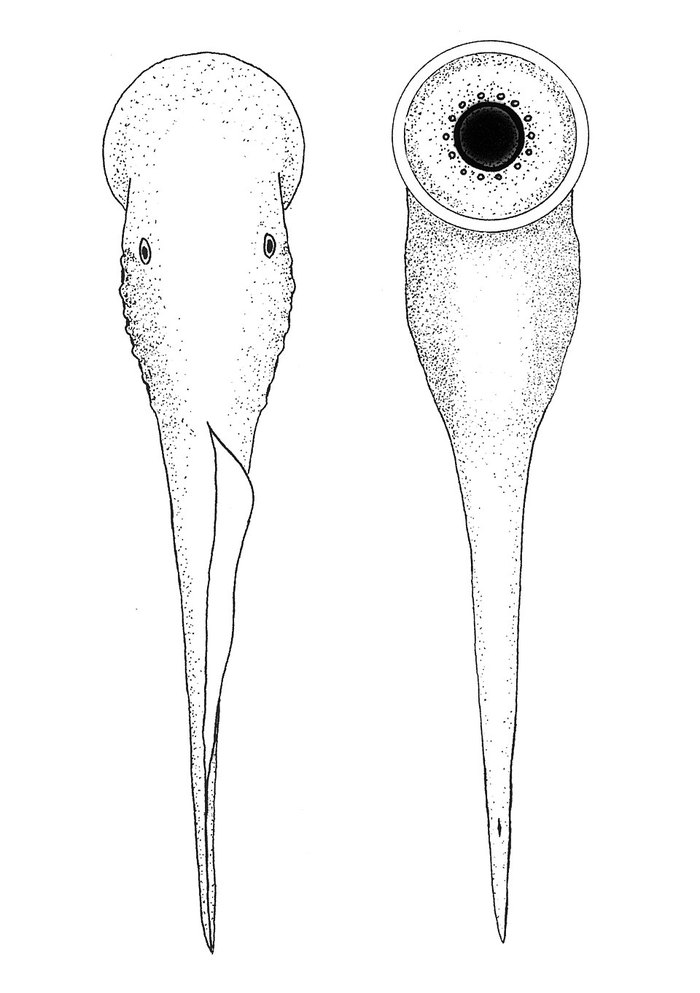
Lampreys are jawless vertebrates, and their fossil record is sparse; the first definite stem lamprey with a modern body plan comes from the Late Devonian.[24] Fossil lampreys are relatives of the Sea Lamprey, not its ancestors. The oldest is Priscomyzon riniensis from the Famennian (Late Devonian) of South Africa, which already had a large sucker mouth, ring-shaped teeth and a gill basket and is about 35 million years older than the lamprey fossils known before it.[25] A study of lamprey family trees uses its age, at least 359 million years, as the minimum for when lampreys arose.[24]
The DNA-based dates come from one 2025 study, which puts the start of the living lampreys at 93.8 million years ago (Ma), with a 95% range of 65.3 to 123.4 Ma.[24] Its authors note that a younger estimate of 78 Ma came from Wu and colleagues in 2023, a study that did not group the southern lampreys together.[24]
In the same study the family Petromyzontidae, the lampreys of the northern hemisphere, arose 24.3 Ma (range 16.4 to 33.7), at the Oligocene-Miocene boundary.[24] The Sea Lamprey belongs to the earliest branch of that family, with the Caspian lamprey (Caspiomyzon) and the North American silver lampreys (Ichthyomyzon); the Caspian lamprey split from the other two 15.5 Ma (range 10.2 to 21.2), in the middle Miocene.[24]

Forms and variants
No subspecies are recognised. IUCN, GBIF, WoRMS, Catalogue of Life and FishBase all treat the Sea Lamprey as a single species.[3][7][8][26][6] IUCN lists these names as synonyms of Petromyzon marinus: Ammocoetes bicolor Lesueur, 1818; Oceanomyzon wilsoni Fowler, 1908; Petromyzon (Bathymyzon) bairdii Gill, 1883; and Petromyzon americanus Lesueur, 1818, the name once given to the American form.[3][7][27]
Populations
IUCN describes a series of stocks and subpopulations. Sea-feeding populations live on both sides of the Atlantic, and landlocked populations live locally in Great Britain, the Great Lakes, the Finger Lakes, Oneida Lake and Lake Champlain.[3] For the Northwest Atlantic, IUCN cites regional panmixia, meaning the lampreys there breed as one mixed population.[3]
Across the Atlantic the populations differ in their mitochondrial DNA, the DNA passed down from the mother.[28] European samples were uniform over more than 2,000 km, and North American samples were more varied.[28] The same study found that North America has been growing since about 500,000 years ago and Europe only in the last 125,000 years, which fits a colonisation of Europe from an older North American population, with refuges during the last ice age.[28] Within Europe a later study found almost no genetic structure.[29]
Whether the Lake Ontario population is native or introduced is disputed. IUCN lists the Great Lakes states as introduced and New York as native.[3] A 2004 mitochondrial DNA study of 224 lampreys from 10 sites argued that the Lake Ontario population is indigenous.[30] Eshenroder (2014) argued that canals brought lampreys to Lake Ontario and Lake Champlain.[31] The Great Lakes Fishery Commission treats the Sea Lamprey in all the Great Lakes as invasive.[4]
Conservation
Status
The IUCN Red List (version 3.1) lists the Sea Lamprey as Least Concern. The assessment was made on 29 May 2022 and published in 2024; earlier assessments were Least Concern in 2013 and 2008 and Lower Risk/least concern in 1996.[3] The IUCN reasons that the species has undoubtedly declined locally in parts of its range but remains abundant and widespread worldwide. The total adult population is unknown but considered relatively large, and the trend is listed as decreasing, since local declines continue in some European countries.[3] The IUCN considers it threatened locally in parts of Europe.[3]
Threats
Dams and barriersPollutionHabitat lossClimate changeHunting[3][15]Dams and barriers. In the native Atlantic range, dams and other barriers are the threat the IUCN stresses most. They have blocked access to traditional spawning grounds and have probably reduced numbers, or removed some subpopulations altogether.[3]
Pollution. Pollution has wiped out whole populations, including those in the Thames and Clyde rivers in the United Kingdom and the Rio Ave in Portugal.[3] Sewage, industrial waste, farm nutrients and pesticides are all listed as ongoing threats.[3]
Habitat loss. An OSPAR case report (OSPAR is the commission that protects the north-east Atlantic) adds gravel extraction, silting and water taken for irrigation, which damage spawning grounds and change river flow.[15]
Climate change. The IUCN also names climate change, which alters water temperature and flow.[3]
Hunting. The lamprey is fished commercially in some parts of Europe, where it is a delicacy.[3] The OSPAR report says former fisheries in Sweden, the United Kingdom, France, Spain and Portugal are now generally limited to Spain and Portugal. It considers poor water quality, obstructions in rivers and damaged spawning grounds, rather than overfishing, to be the main reasons for the decline.[15]
Control in the Great Lakes
In the Great Lakes the lamprey is an invader, and it is controlled rather than protected. The Great Lakes Fishery Commission runs the programme with Fisheries and Oceans Canada and the US Fish and Wildlife Service. Its main tool is the lampricide TFM (a poison that kills larvae), sometimes mixed with Bayluscide. Applied in streams, it eliminates about 93% of the resident larvae while limiting harm to other animals; a granular form of Bayluscide is used in still water, where it is about 75% effective on average.[20] In 2024 crews treated 84 streams and 22 still-water areas; in 2025 they treated 93 streams and 17 still-water areas.[20][21]
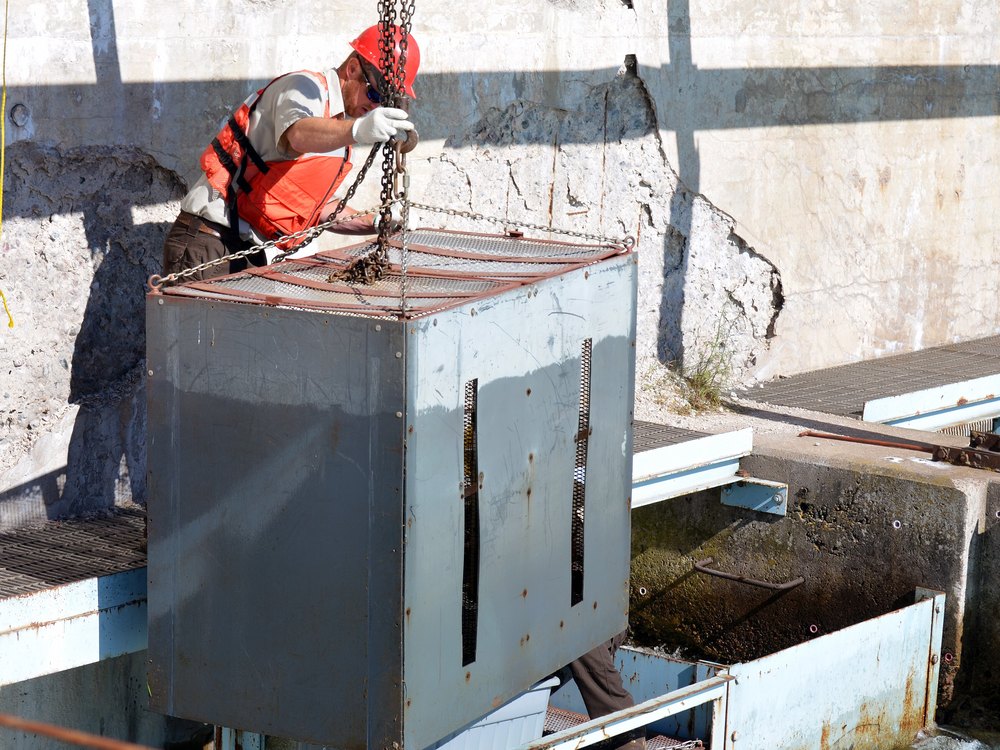

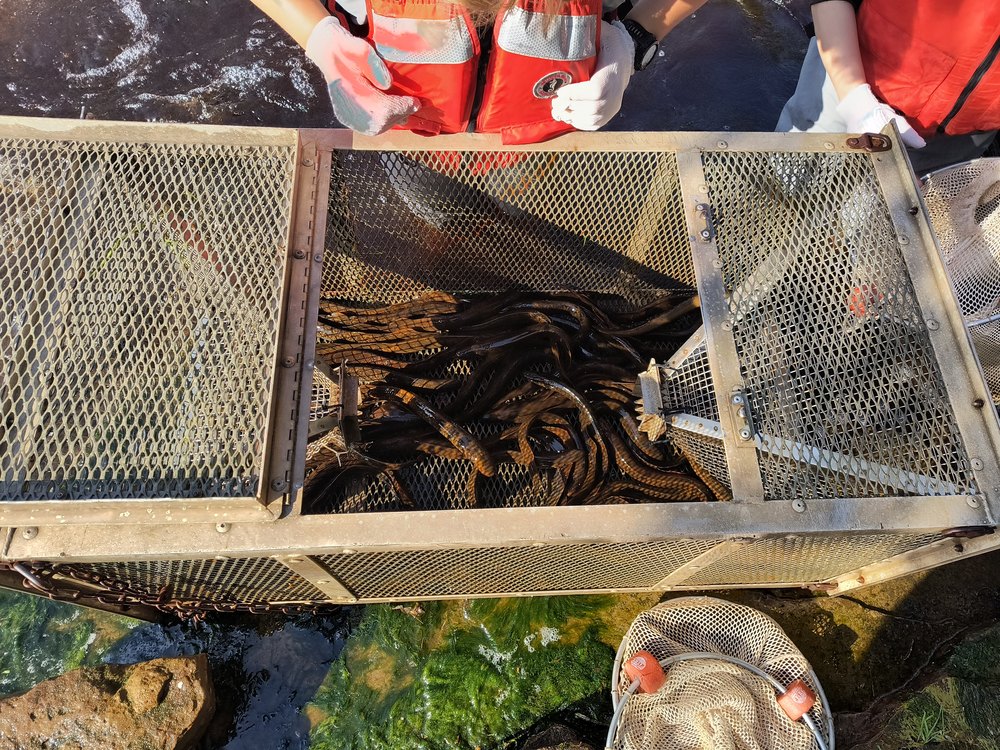

Barriers stop adults from reaching spawning streams. Across the 2024 and 2025 reports, 73 barriers were counted, 48 built for the purpose and 25 modified for other uses.[20][21] Traps catch adults at barriers and in 29 monitored streams.[21] Sterile males are released on the Cheboygan River system in Lake Huron, between 1,950 and 3,925 a year from 2021 to 2025. Larval numbers were lower in release years, but lampricide was still needed, so the release is not a full replacement.[21]
Control has cut lamprey numbers in the lakes by about 90 to 95% from the peak of the late 1950s.[32] Reduced treatment in 2020 and 2021, when travel was restricted, was followed by a rise in adults.[33] The index of adult abundance (from spawning-run traps in 29 streams, not a count of the whole lake) was above its target in Lakes Superior, Michigan and Huron in both 2024 and 2025. Lake Erie was below its target in both years (870 and 803 against 3,263), and Lake Ontario was above its target in 2024 (22,374 against 14,065) and below it in 2025 (11,584).[20][21]
Lake Champlain has had a control programme for 30 years. Suppressing about 80% of the known larvae is estimated to be necessary there.[34]
Protection in Europe
The Sea Lamprey is listed in Annex II of the EU Habitats Directive and in Annex III of the Bern Convention, both as recorded in 2008.[15] Belgium nominated it for the OSPAR list of threatened and declining species.[15] The Netherlands lists it as endangered on its Red Data list of freshwater fishes, and in the Tagus dams without fish passes block it from Spain.[15] A study of Iberian lampreys suggests that the protected areas set up under the Habitats Directive can be very relevant for lamprey conservation.[35] The IUCN says the species needs no significant additional protection at the global level.[3]
History and culture
Great Lakes
Niagara Falls kept lampreys out of the upper Great Lakes. The Welland Canal linked Lake Ontario and Lake Erie as early as the mid-1820s, and a complete overhaul was under way by 1913.[36] The first Sea Lamprey in Lake Erie was reported in 1921. It reached Lake Michigan in 1936, Lake Huron in 1937 and Lake Superior in 1938, the dates the Great Lakes Fishery Commission (GLFC) gives; the US Fish and Wildlife Service gives 1946 for Superior.[36][4][1] The population peaked in the late 1950s.[32] By the 1960s the lake trout catch in the upper Great Lakes had fallen to about 136,000 kg (300,000 lb) a year.[32]
The GLFC was established in 1955 under a Canada–US convention on Great Lakes fisheries.[36] Lampricide has been used successfully in the lakes since 1958.[37] The results of the programme are described under Conservation.
As food
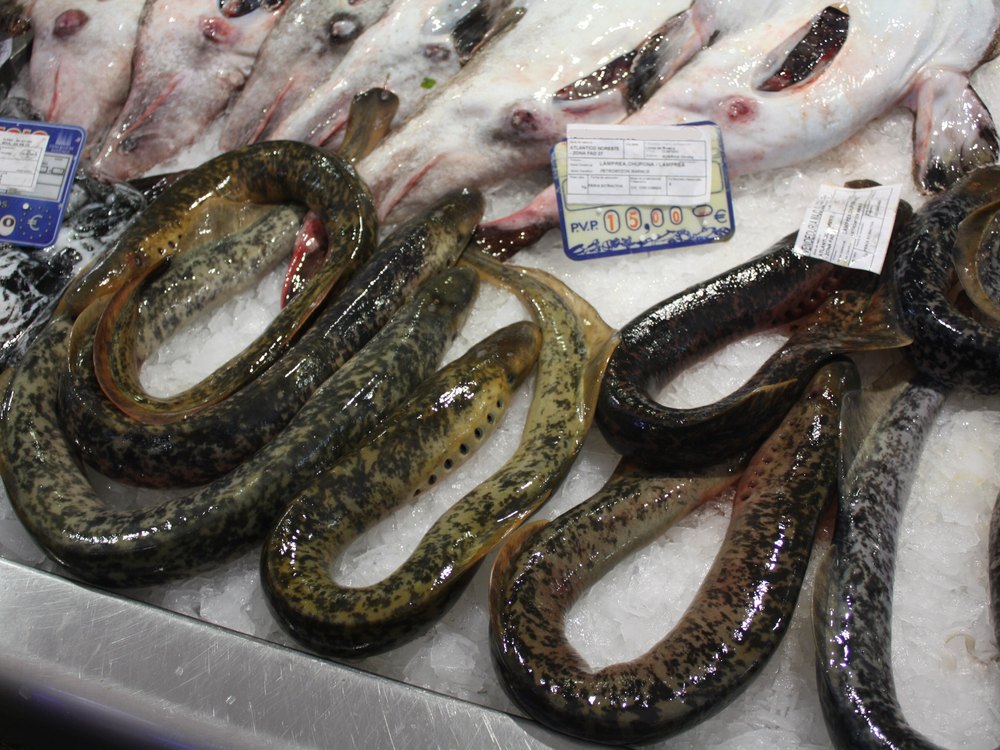
People along the River Minho in Portugal have fished the Sea Lamprey for several centuries, with drifting nets, large fyke nets and fixed traps called pesqueiras; the season runs from January to April.[38] Roughly 350 fishers work between Caminha and Valença. Monção and Melgaço have a notable cluster of restaurants that specialise in lamprey.[38]

Taxonomy
| Rank | Name |
|---|---|
| Kingdom | Animalia |
| Phylum | Chordata |
| Subphylum | Vertebrata |
| Class | Petromyzonti[7][8][26] |
| Order | Petromyzontiformes[7][8] |
| Family | Petromyzontidae (lampreys of the northern hemisphere)[7][8] |
| Genus | Petromyzon Linnaeus, 1758[7][27] |
| Species | Petromyzon marinus (Linnaeus, 1758)[3][7][8][26][6][27] |
Synonyms (10)
| Name |
|---|
| Lampetra marina (Linnaeus, 1758) |
| Petromyzon ruber (Lacepède, 1800) |
| Petromyzon lampetra (Pallas, 1814) |
| Petromyzon maximus (Cuvier, 1816) |
| Ammocoetes bicolor (Lesueur, 1818) |
| Petromyzon americanus (Lesueur, 1818) |
| Petromyzon nigricans (Lesueur, 1818) |
| Petromyzon adriaticus (Nardo, 1847) |
| Petromyzon maculosus (Gronow, 1854) |
| Batymyzon bairdii (Gill, 1883) |
A selection of the oldest names. The GBIF backbone lists 13 species-level synonyms.[39]
Higher classification
The Sea Lamprey belongs to the class Petromyzonti, the order Petromyzontiformes (the lampreys) and the family Petromyzontidae, the lampreys of the northern hemisphere.[7][8] GBIF, WoRMS, IUCN and FishBase all use the class name Petromyzonti.[3][6][7][8] Lampreys are jawless fish, and the Catalogue of Life files the order under the jawless vertebrates, Cyclostomi.[26] The genus Petromyzon holds only this species.[8]
A genus that once held many lampreys
Many lampreys were first named in Petromyzon. WoRMS lists about 50 names under the genus, and only Petromyzon marinus is still accepted.[8] Linnaeus himself put the river lamprey in the genus in 1758 as Petromyzon fluviatilis. It is now Lampetra fluviatilis.[8] The brook lamprey Petromyzon planeri Bloch, 1784 became Lampetra planeri, and Petromyzon japonicus Martens, 1868 is now counted as the Arctic lamprey, Lethenteron camtschaticum.[8] Any old book that speaks of a “Petromyzon” may therefore mean another lamprey.
Sources
- U.S. Fish and Wildlife Service, sea lamprey species page
- Purvis 1979, Great Lakes Fishery Commission Technical Report 35
- Ford 2024, IUCN Red List assessment of Petromyzon marinus
- Great Lakes Fishery Commission, sea lamprey page
- Animal Diversity Web, Petromyzon marinus
- FishBase, Petromyzon marinus summary
- GBIF Backbone Taxonomy, Petromyzon marinus
- World Register of Marine Species, Petromyzon marinus
- Manion & Smith 1978, Great Lakes Fishery Commission Technical Report 30
- Measurement of suction pressure dynamics of sea lampreys, PLOS ONE 2021
- Manion & McLain 1971, Great Lakes Fishery Commission Technical Report 16
- Beamish & Potter 1975, Journal of Zoology 177: 57–72
- Great Lakes Fishery Commission, Fact Sheet 4: Sea Lamprey, a Great Lakes invader
- Pedigree analysis and effective breeding size of sea lamprey, Evolutionary Applications 2022
- OSPAR Commission 2008, case report for sea lamprey
- Potter & Beamish 1977, Journal of Zoology 181: 113–130
- Bergstedt & Swink 1995, Canadian Journal of Fisheries and Aquatic Sciences 52: 1257–1264
- Bouletreau et al. 2020, Scientific Reports 10: 6122
- Marine distribution of the sea lamprey in the north-west Atlantic, Canadian Journal of Fisheries and Aquatic Sciences 1991
- Sea Lamprey Control Program, Annual Report 2024 (GLFC, Fisheries and Oceans Canada, U.S. Fish and Wildlife Service)
- Sea Lamprey Control Program, Annual Report 2025
- Weaver, Coghlan & Zydlewski 2016, Canadian Journal of Fisheries and Aquatic Sciences
- Van Leeuwen et al. 2021, Journal of Fish Biology 99: 2066–2070
- Hughes et al. 2025, Proceedings of the Royal Society B 292: 20242101
- Gess, Coates & Rubidge 2006, A lamprey from the Devonian period of South Africa, Nature 443: 981–984
- Catalogue of Life, Petromyzon marinus
- Eschmeyer's Catalog of Fishes, California Academy of Sciences
- Genner et al. 2012, Marine and Freshwater Research 63: 827–833
- Baltazar-Soares et al. 2023, Evolutionary Applications 16: 1169–1183
- Waldman et al. 2004, Mitochondrial DNA analysis indicates sea lampreys are indigenous to Lake Ontario, Transactions of the American Fisheries Society 133: 950–960
- Eshenroder 2014, The role of the Champlain Canal and Erie Canal as putative corridors for colonization of Lake Champlain and Lake Ontario by sea lampreys, Transactions of the American Fisheries Society 143: 634–649
- International Joint Commission, Sea lamprey: the greatest invasive control success story
- Great Lakes Fishery Commission press release, 17 December 2024
- Achieving sea lamprey control in Lake Champlain, Fishes 6(1): 2, 2021
- Mateus et al. 2012, Lampreys of the Iberian Peninsula, Endangered Species Research
- Great Lakes Fishery Commission, Cooperative Fisheries Management (history)
- Great Lakes Fishery Commission, lampricides
- Minho sea lamprey fishers, Journal of Ethnobiology and Ethnomedicine 2019
- GBIF backbone, Petromyzon marinus, synonyms