The Northern Sea Otter (Enhydra lutris kenyoni) is the Sea Otter of Alaska and the Pacific coast of Canada and Washington. The IUCN gives its range as the western Aleutian Islands to Prince William Sound, along the Pacific coast of Canada and into Oregon.[1] Several of its present populations come from otters that were moved in the 1960s and 1970s.[1][2]
Names and classification
The name kenyoni was published by D. E. Wilson in 1991, in a paper by Wilson, Bogan, Brownell, Burdin and Maminov on geographic variation in Sea Otters.[3][4] The Mammal Diversity Database, ITIS and GBIF list it as one of three subspecies, and the IUCN Red List text names the same three.[3][5][6][1] It is usually called the northern Sea Otter.[7]
Description
Northern Sea Otters reach larger adult sizes than southern ones.[8] Animal Diversity Web gives Alaska weights of 27 to 39 kg for males and 16 to 27 kg for females, but the page cites no source for these figures.[7] In British Columbia, adult males reach about 46 kg and 148 cm in total length, and adult females about 36 kg and 140 cm. These are maximum values.[9] Size also depends on food. In southwest Alaska, otters measured in 1992–97, when the population was falling, were 12 to 18% heavier and 10 to 11% longer than those measured in 1967–71, when it was near carrying capacity.[10]
Range
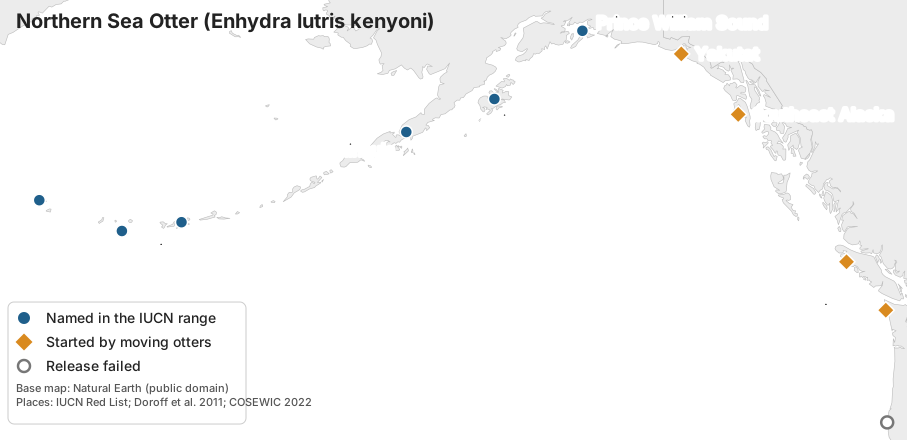
In Alaska the range is fairly continuous from the Aleutian Islands to Prince William Sound. A translocated population lives near Yakutat, and others on the outer islands of Southeast Alaska; between these and British Columbia lies a gap.[1] In British Columbia the otters now live on the west and northeast coasts of Vancouver Island and on the central coast. The extent of occurrence is 36,980 km², and the otters occupy 33 to 50% of their historical range in the province.[11] Washington has a translocated population. The IUCN says the Washington release was successful and the Oregon release was not, leaving a large gap to central California.[1]
In estimates for 2000–2005, Alaska had about 73,329 Northern Sea Otters in three stocks: 47,676 in southwest Alaska, 15,090 in south-central Alaska and 10,563 in Southeast Alaska.[12] The Southeast Alaska stock was estimated at 22,359 in an aerial survey in summer 2022 (95% credible interval 19,595 to 25,290).[13] These estimates use different methods and years, so they do not show a trend by themselves. In British Columbia the count was 8,110 in 2017, including 414 interpolated animals, up from 668 in 1990, 1,527 in 1995, 4,712 in 2008 and 6,754 in 2013. Growth was about 20.1% a year from 1977 to 1995 and about 8.7% a year after 1995.[11] The highest count in Washington was 790, in 2006.[12]
Classification evidence
The subspecies was described from skull measurements and mitochondrial DNA.[14] A 2023 study of 107 Sea Otters found five broad geographic groups, two of them in this subspecies’ range: the western Aleutians and south-central Alaska. Otters from Attu, Amchitka and Adak in the western Aleutians differed little from one another (FST of 0 to 0.02).[15] The five groups are finer than the three subspecies, and the authors do not propose changing the subspecies.[15]
The first Sea Otter genome came from a male of this subspecies named Elfin, born in 2002 and rescued as a pup near Juneau, Alaska. The assembly is 2.426 billion bases long.[16] A northern and a southern genome each have 0.0003 heterozygous sites per base, half the figure for the Giant Otter.[17]
History
When the 1911 treaty protected the species, fewer than 2,000 Sea Otters are thought to have remained in 13 remnant colonies. In the range of this subspecies they were in Alaska (the Aleutian Islands, the Alaska Peninsula, Kodiak Island and Prince William Sound) and in Canada (the Queen Charlotte Islands, a colony that has presumably died out).[1] In British Columbia, pelt landings from 1785 to 1809 totalled about 55,000, and by 1850 Sea Otters in Canada were commercially extinct.[18]
Otters were moved from remaining colonies to restore the range. In Southeast Alaska, 412 otters (89 percent from Amchitka Island and 11 percent from Prince William Sound) were released at six sites from 1965 to 1969.[13] In British Columbia, 89 otters from Alaska were released at Checleset Bay in three releases: 29 on 31 July 1969, 14 on 27 July 1970 and 46 on 15 July 1972. Many did not survive, and the population may have fallen to as few as 28.[18] In Washington, 59 otters were released in 1969 and 1970; of the 29 released in 1969, 16 were found dead within two weeks.[19] In Oregon, 93 otters were released (other sources say 95). Counts reached 20 to 23 in 1972–74 and then fell, and the release was classed as a failure.[19] One review counts seven translocations that produced five self-sustaining populations, with the Oregon and Pribilof Islands efforts failing.[2]
On 24 March 1989 the Exxon Valdez spilled an estimated 42 million litres of crude oil in Prince William Sound. The Sea Otter was one of more than 20 nearshore species considered injured.[20]
Status
In southwest Alaska the Sea Otter fell by an estimated 56 to 68% from the mid-1980s, and counts in the Aleutian archipelago fell by 70% between 1992 and 2000.[21] A 2021 study put densities at about 5% of carrying capacity. It found the evidence inconsistent with food limits, disease or contaminants, and consistent with predation (or possibly some other cause that does not depend on density).[22] Killer whale predation is the likely cause, according to a 1998 study; the cause is inferred, not directly counted.[23][22] The southwest Alaska population was listed as threatened under the Endangered Species Act in 2005. Washington lists the Sea Otter as endangered at state level.[12] The Southeast Alaska, British Columbia and Washington populations are increasing.[12][11]
In Canada the Sea Otter was assessed as Special Concern in 2007, and the assessment was confirmed in May 2022. There are about 4,000 mature individuals, 15% of the estimated historical number. Oil contamination is the main threat in British Columbia, because oil destroys the insulation of the fur.[11] The IUCN assessment covers the whole species, which it lists as Endangered (A2abe), not this subspecies alone.[1]
Sources
- IUCN Red List, Enhydra lutris (Doroff, Burdin & Larson 2021), taxonomy notes and geographic range
- Davis et al. 2019, Frontiers in Marine Science 5: 510 (future directions in sea otter research)
- Mammal Diversity Database, version 2.5 (2026), Enhydra lutris
- Wilson et al. 1991, Journal of Mammalogy 72: 22–36 (geographic variation in sea otters)
- ITIS, Enhydra lutris (TSN 180547)
- GBIF backbone, Enhydra lutris
- Animal Diversity Web, Enhydra lutris
- Griffen et al. 2024, Conservation Physiology 12: coae067 (review of sea otter bioenergetics data)
- COSEWIC 2007, status report on the Sea Otter, chapter 8 (biology)
- Laidre et al. 2006, Journal of Animal Ecology 75: 978–989 (sea otter body size in southwest Alaska; abstract)
- COSEWIC 2022, assessment summary for the Sea Otter
- Doroff et al. 2011, IUCN Otter Specialist Group Bulletin 28A (sea otter population status)
- U.S. Fish and Wildlife Service 2023, Northern Sea Otter Stock Assessment Report, Southeast Alaska stock
- COSEWIC 2007, status report on the Sea Otter, chapter 5 (species information)
- Beichman et al. 2023, Molecular Ecology 32: 281–298 (genomes of five sea otter populations)
- Jones et al. 2017, Genes 8: 379 (genome of the northern sea otter)
- Beichman et al. 2019, Molecular Biology and Evolution 36: 2631–2655 (sea otter and giant otter genomes)
- Fisheries and Oceans Canada, Sea Otter recovery strategy, chapter 1
- USGS, “Sea otters in the northern Pacific Ocean” (Our Living Resources)
- USGS Scientific Investigations Report 2011-5213 (Exxon Valdez oil spill and sea otters)
- Decline in sea otter populations along the Alaska Peninsula, 1986–2001 (2005; abstract)
- Sea otter collapse in southwest Alaska, Ecological Monographs 2021 (abstract)
- Estes et al. 1998, Science 282: 473 (decline in western Alaska)