The Asian Sea Otter (Enhydra lutris lutris) is the Sea Otter of Russia and Japan. The IUCN gives its range as Japan and the Asian coast, through the Kuril Islands, the Kamchatka Peninsula and the Commander Islands.[1] It is the nominate subspecies, the one that carries the same name as the species.[2]
Names and classification
Linnaeus named the species in 1758 as Mustela lutris. His text gives its home as “Asia and northern America”.[3] The Mammal Diversity Database gives the type locality as Kamchatka, Russia, and places five older names under this subspecies: marina (Erxleben, 1777), gracilis (Bechstein, 1799), orientalis (Oken, 1816), stelleri (Lesson, 1827) and kamtschatica (Dybowski, 1922, an unavailable name).[2] The Mammal Diversity Database, ITIS and GBIF list three subspecies, and the IUCN Red List text names the same three.[2][4][5][1] It is usually called the Asian or Commander Sea Otter.[6]
Range
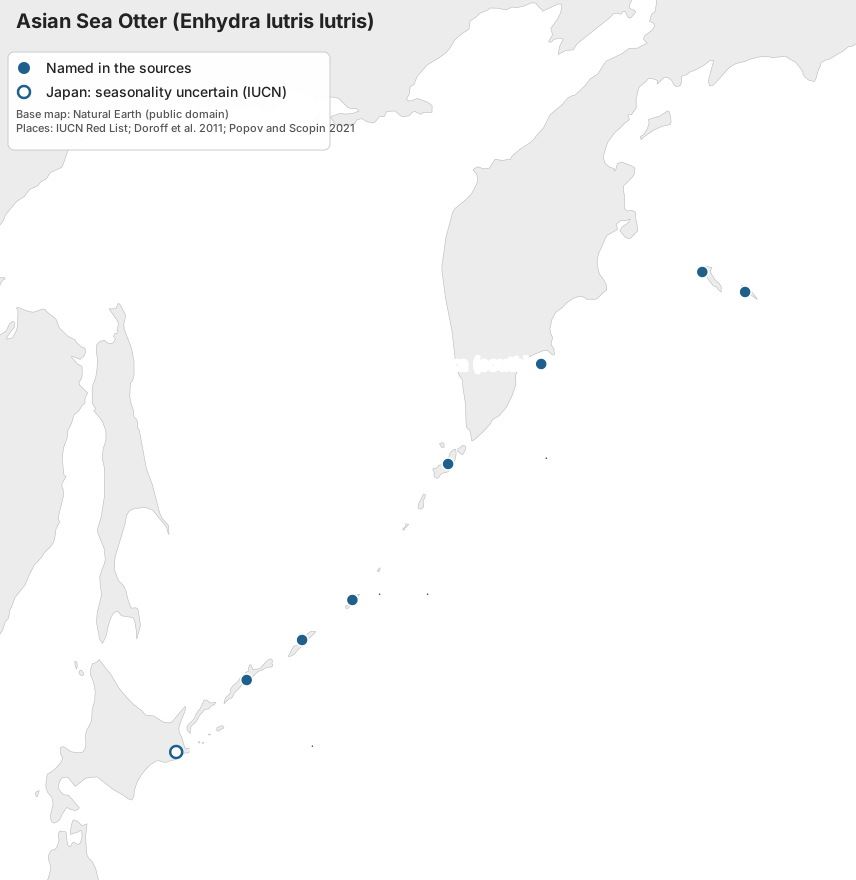
In Russia the Asian Sea Otter lives on the Kamchatka Peninsula, mostly in the south, and on the Kuril and Commander Islands. Winter sea ice limits the range in northern Kamchatka.[7] In Japan it occurs on the east coast of Hokkaido. The IUCN lists Japan as part of the range with the seasonality uncertain, and the animals there probably come from the southern Kurils.[1][7] Sea Otters were gone from Hokkaido before 1900. The first confirmed sighting of a live animal was in 1973, sightings stayed sporadic, a mother and pup were seen for the first time in 2014, and the population has grown gradually.[8]
Russia held about 22,500 Sea Otters in 2007.[7] Surveys in 2019–2023 and published sources suggest that the Kuril Islands hold hardly more than 3,000 now, with several hundred in the surveyed area against about 2,000 in 1960–1980.[9] On Urup Island, foot surveys of 40 km of coast in 2019 gave 363 (standard error 126).[10] On the Commander Islands, Bering Island held about 1,000 otters in 1984; numbers peaked near 4,000 in the late 1980s and were above 4,000 in 2007.[7] The Commander Islands population has since declined.[11] These figures come from different years and methods and should not be added together.[7]
Classification evidence
The subspecies was described from skull measurements and mitochondrial DNA.[12] A 2023 study of 107 Sea Otters found five broad geographic groups, two of them in this subspecies’ range: the Kuril Islands and the Commander Islands.[13] The five groups are finer than the three subspecies, and the authors do not propose changing the subspecies.[13]
History
Bering’s expedition wintered on Bering Island in 1741–42, and Steller found Sea Otters abundant there. The skins taken back to Kamchatka began the Russian fur trade. The Bering and Medny Islands were depleted quickly, and hunters moved east along the Aleutian Islands.[14] In the Kurils, a harvest of about 1,000 animals a year over several decades until the end of the 19th century implies at least several tens of thousands of otters before it. About 200 remained by 1912 and about 800 by 1939.[9][10] The Ainu region of northern Japan was also a source of otter fur, which was traded to Japan in the Middle Ages. The first known mention is from 1423, and trade with the Ming dynasty is recorded in 1433.[15] The 1911 treaty, signed by the United States, Great Britain for itself and Canada, Japan and Russia, barred the killing of Sea Otters at sea more than three miles from shore.[16] By then fewer than 2,000 otters are thought to have remained worldwide, in 13 remnant colonies, among them the Kuril Islands, Kamchatka and the Commander Islands.[1]
Status
The IUCN assessment covers the whole species, which it lists as Endangered (A2abe), not this subspecies alone.[1] Poaching for the illegal fur trade is documented in the Kuril Islands.[9] On the Commander Islands, a study of killer whale sightings from 2008 to 2021 found no support for killer whale predation as the cause of the decline, and another attributes it to a shortage of food after a population boom.[11][10] In Hokkaido, concern has arisen about conflicts with fisheries, and a red tide in 2021 killed sea urchins, a prey animal and a fishery resource.[8] The current legal status in Russia and Japan was not confirmed for this page.
Sources
- IUCN Red List, Enhydra lutris (Doroff, Burdin & Larson 2021), taxonomy notes and geographic range
- Mammal Diversity Database, version 2.5 (2026), Enhydra lutris
- Linnaeus 1758, Systema Naturae, 10th edition, vol. 1 (Internet Archive scan)
- ITIS, Enhydra lutris (TSN 180547)
- GBIF backbone, Enhydra lutris
- Animal Diversity Web, Enhydra lutris
- Doroff et al. 2011, IUCN Otter Specialist Group Bulletin 28A (sea otter population status)
- Hokkaido University doctoral thesis 2025 (sea otters in Hokkaido; abstract)
- “Recent surveys of the sea otter population on Kuril Islands”, Pacific Conservation Biology 2024
- Popov & Scopin 2021, Oryx 55: 529–534 (sea otters of the Kuril Islands)
- Ismail et al. 2023, Russian Journal of Theriology 22(1) (killer whales and sea otters, Commander Islands)
- COSEWIC 2007, status report on the Sea Otter, chapter 5 (species information)
- Beichman et al. 2023, Molecular Ecology 32: 281–298 (genomes of five sea otter populations)
- Oxford Global History of Capitalism, case study 23, “The Alaskan fur rush and the Russian-American Company” (2022)
- Sekiguchi 2013, Bulletin of the Hokkaido University Museum 6: 46–57 (abstract)
- Convention for the preservation and protection of fur seals and sea otters, Washington, 7 July 1911 (Foreign Relations of the United States)