The Sperm Whale (Physeter macrocephalus) is the largest toothed whale, with a huge square head that can make up a quarter to a third of its length.[1][2] It lives in all of the world’s oceans, from the equator to the edge of the pack ice.[1] Females and their young stay in groups in warm waters, while the larger males range to higher latitudes.[3][4] The whale dives routinely to about 600 m and can stay down for 45 minutes, hunting squid and fish in the dark.[1] Commercial whaling took it for oil and spermaceti until the 1986 moratorium, and the IUCN rates the species Vulnerable.[1][5][6]
Quick facts
Description
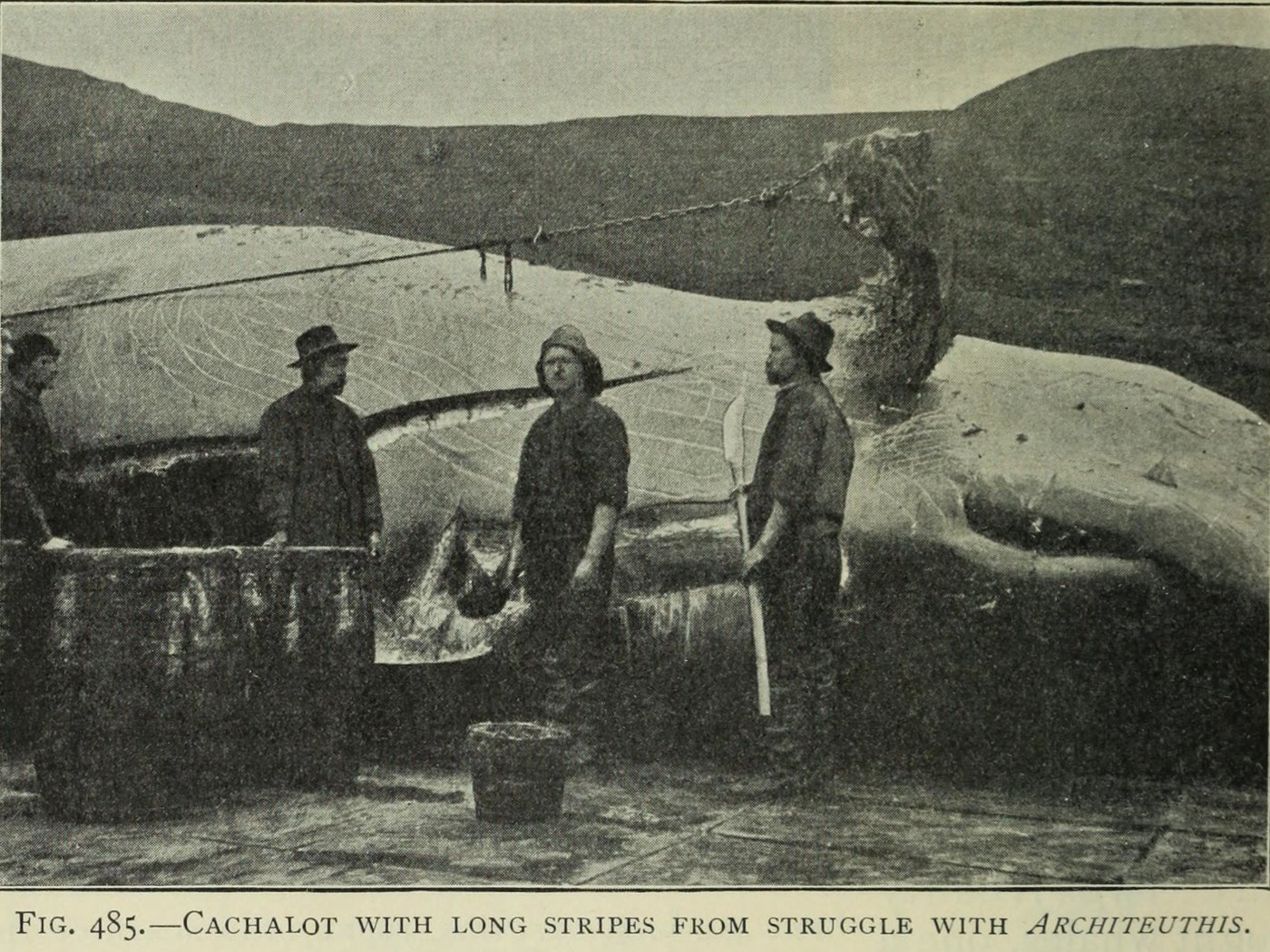
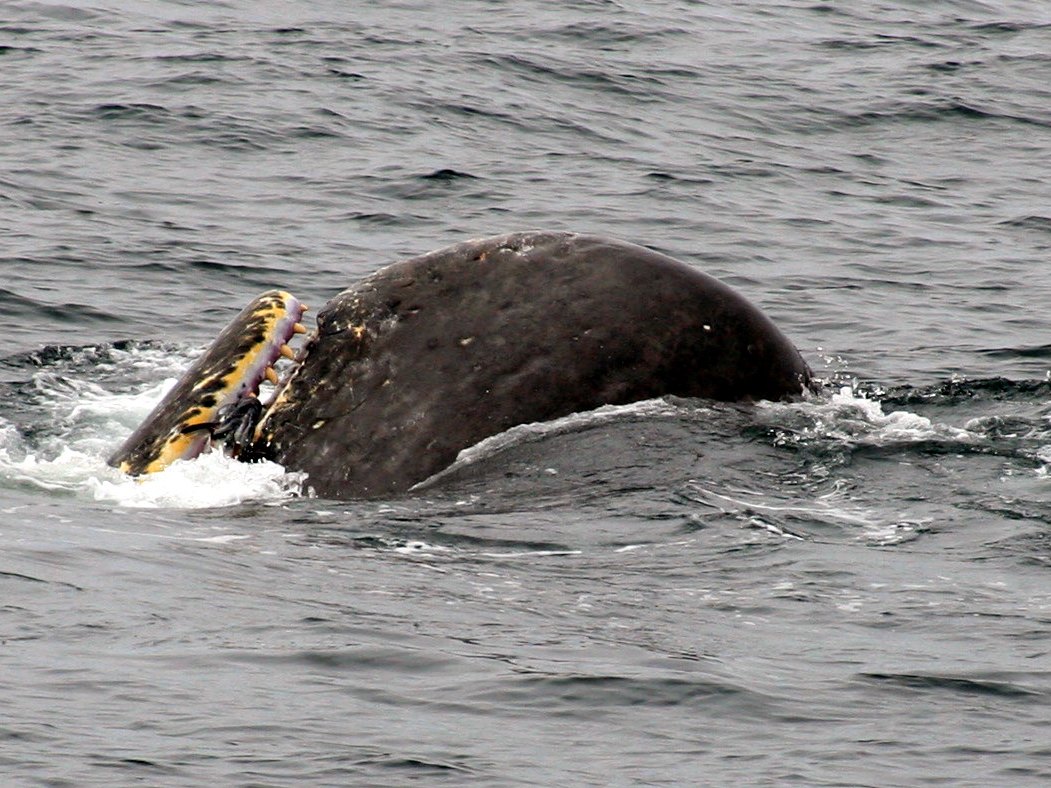
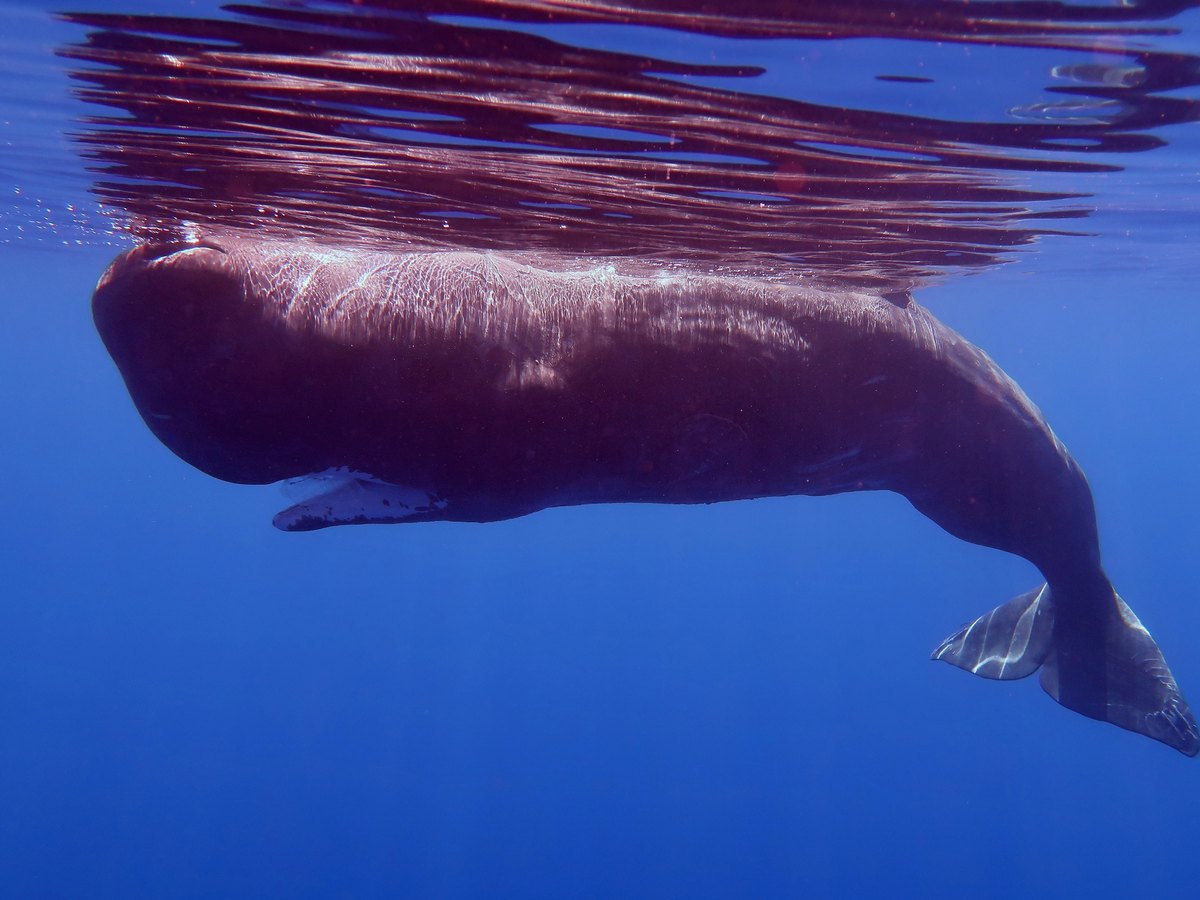
The Sperm Whale is usually dark brownish grey, with light streaks, spots and scratches.[8] The underside is lighter grey and may carry white patches.[1][8] The skin around the mouth, especially near the corners, is white, and the narrow lower jaw is white where it holds the teeth.[1][8]
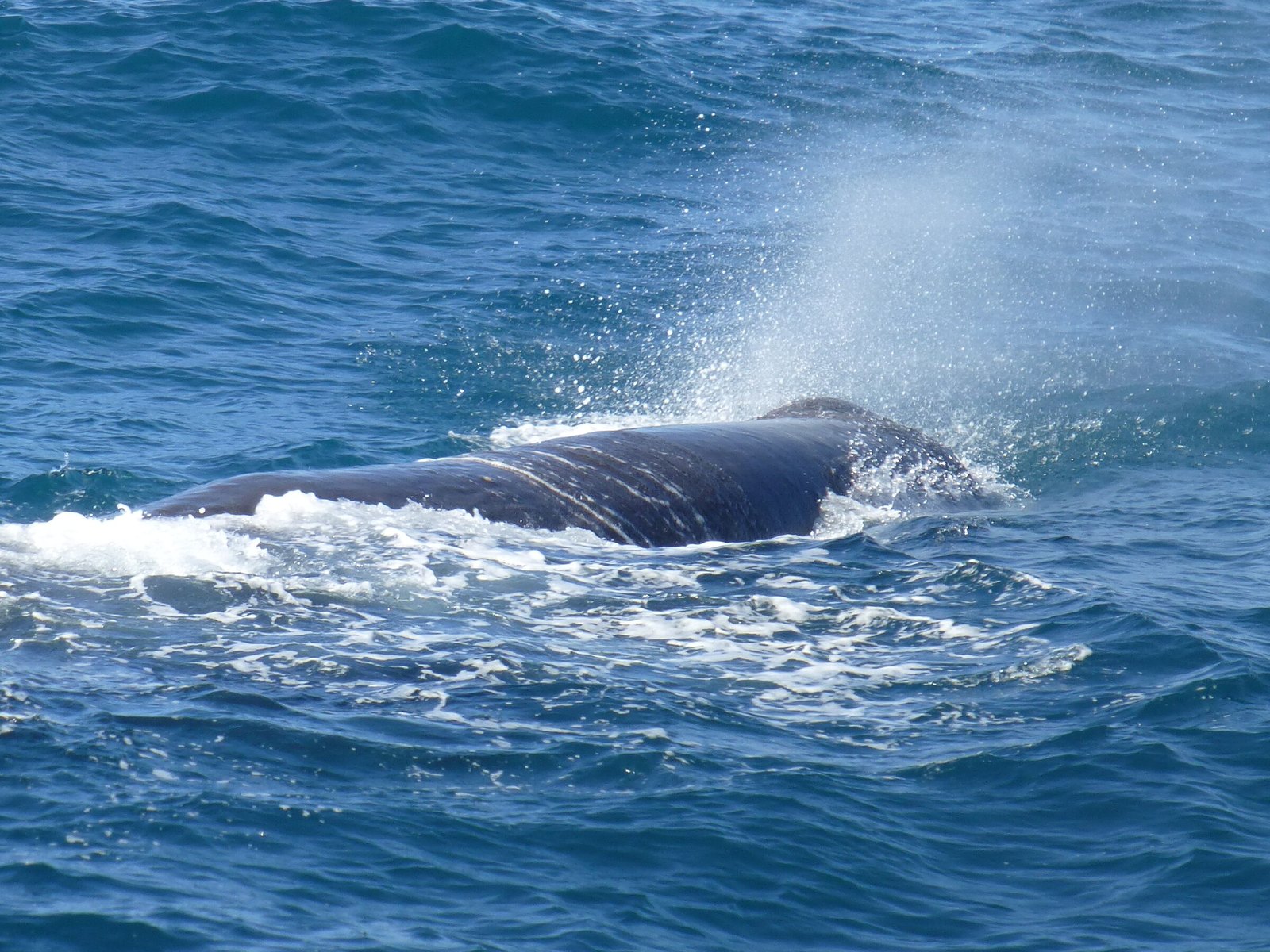
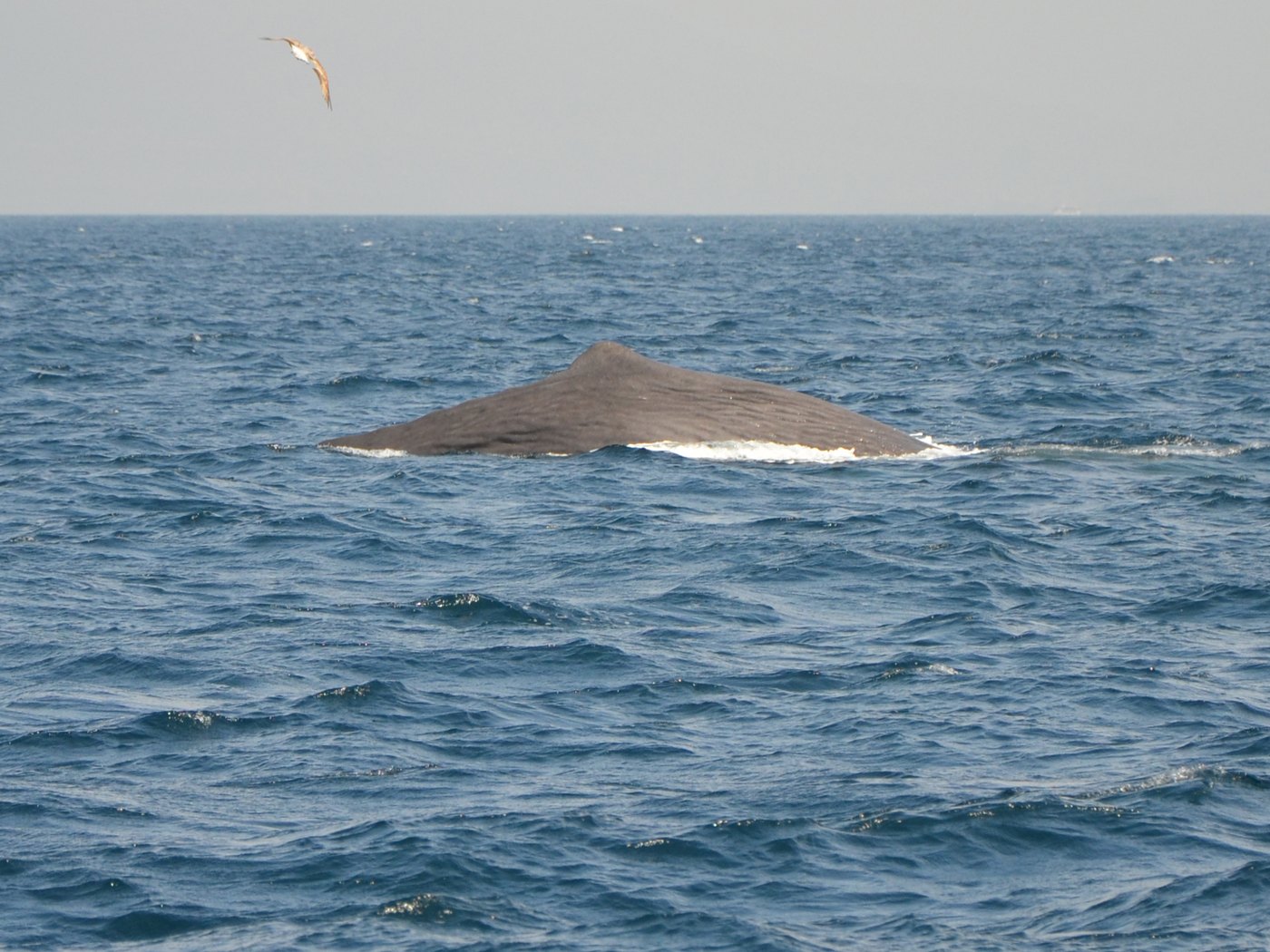
The head is blunt and squared off, with a small, underslung lower jaw.[8] Behind the head the skin looks wrinkled and shrivelled.[1][8] A single blowhole sits forward on the left side of the head, and the slit is S-shaped.[1][8][9] The blow is bushy and goes forward rather than straight up, unlike the blow of most other whales.[8]
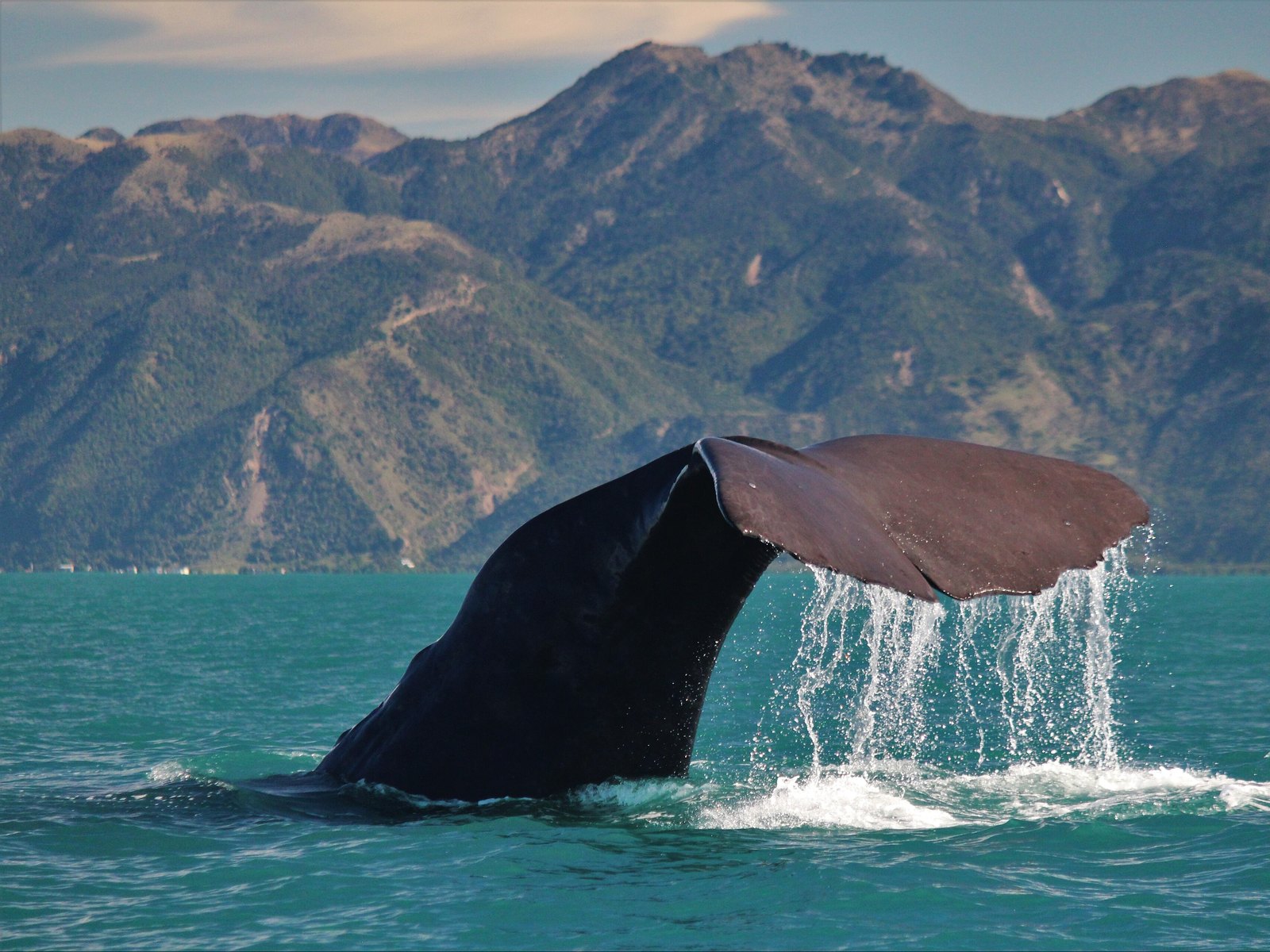
There is no tall dorsal fin. A squat, thick, usually rounded fin is followed by a row of knuckles along the spine, and the Animal Diversity Web describes a hump with a series of longitudinal ridges in its place.[1][8][9] The flippers are small and slightly tapered, and the flukes are triangular.[1][8]
Name
The animal is called the Sperm Whale or the cachalot.[10][11] Older English books also give pot whale and spermacet whale.[10] The scientific name is Physeter macrocephalus.[10][11]
“Sperm whale” refers to spermaceti, the clear oil in the head that hardens to a waxlike mass when cold.[8] The Norwegian encyclopedia Store norske leksikon explains that people once took this oil for the animal’s semen, which gave the name its first part.[12]
In other languages
| Language | Name | Notes |
|---|---|---|
| Japanese | マッコウクジラ (makkō kujira) | — |
| Portuguese | cachalote | — |
| Spanish | cachalote | — |
| French | cachalot; grand cachalot | — |
| German | Pottwal | — |
| Norwegian | spermhval; spermkval; kaskelott | spermhval and spermkval mean “sperm whale”, named for the oil in the head |
| Maori local | parāoa | also a general word for whales |
| Greenlandic local | kigutilik | — |
| Indonesian local | paus lodan | — |
Japanese, Portuguese, Spanish, French, German, Greenlandic and Indonesian names come from the World Cetacea Database and GBIF name lists; the Norwegian names and their explanation come from Store norske leksikon; the Maori entry comes from Te Aka Maori Dictionary.[12][13][14][15]
Body
Size
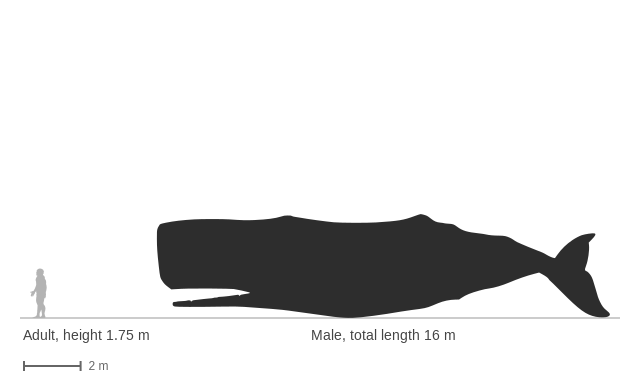
NOAA Fisheries gives adult lengths from about 12 m in females to about 16 m in males, and the American Cetacean Society gives 15 to 18 m for adult males and about 11 m for adult females.[1][8] Males are only slightly bigger than females for roughly the first 10 years and keep growing into their 30s.[1] The American Cetacean Society puts the maximum weight at up to 31,750 to 40,800 kg for males and 12,000 to 12,700 kg for females.[8]
A study of 51 whales measured from drone images found lengths from 4.1 to 16.1 m, with 80% of the whales between 7.4 and 12.6 m; in its length classes the mature females measured 10 to 12 m and the adult males 10.0 to 13.7 m, with mature males above 13.7 m.[16] In the Gulf of Alaska the median adult male was 15.7 m.[17] Whales of the northern Gulf of Mexico stock are 1.5 to 2.0 m smaller on average than whales elsewhere.[18]
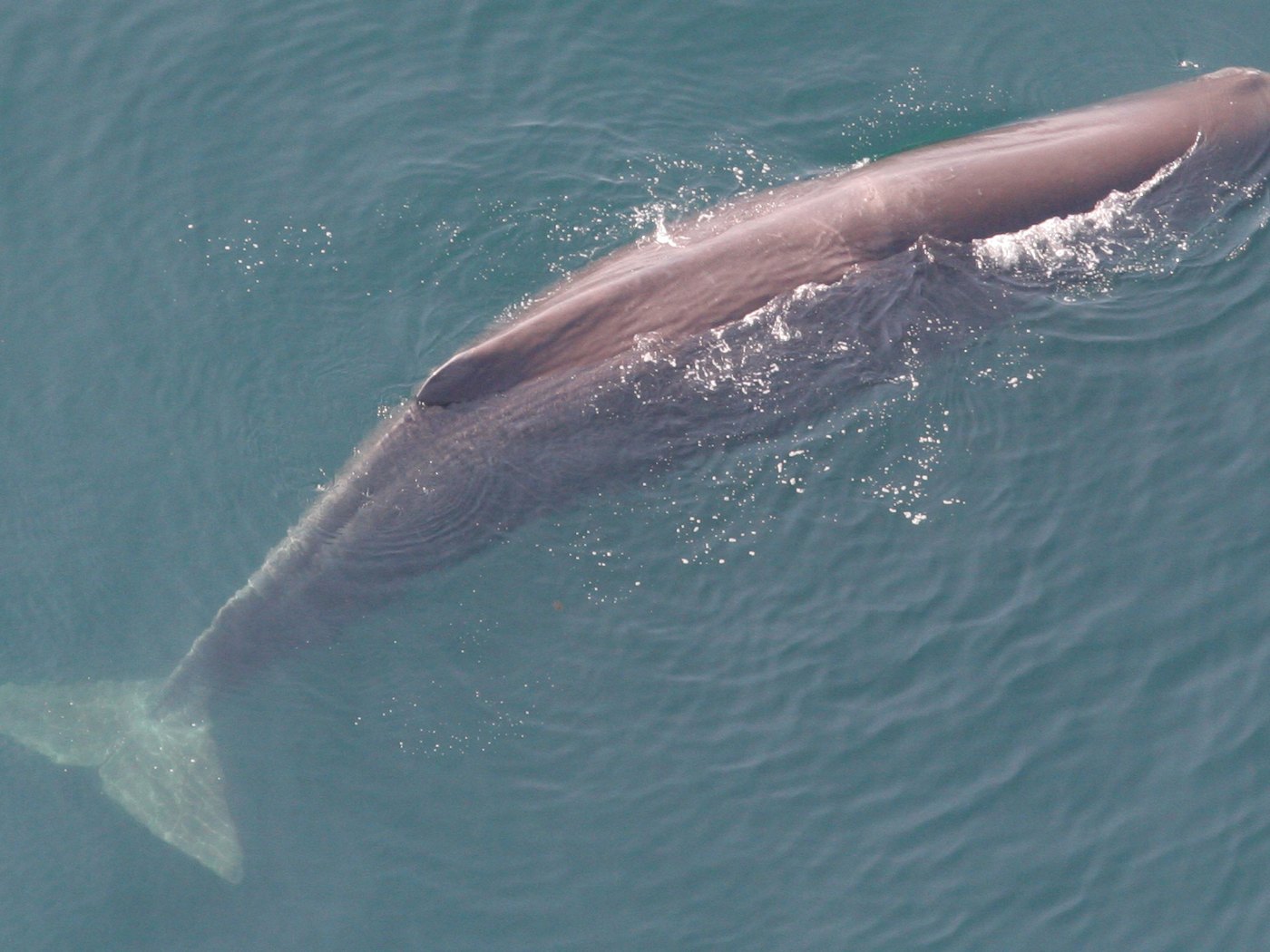
A calf is about 4 m long at birth, according to NOAA Fisheries; the American Cetacean Society gives 3.4 to 4.9 m and about 907 kg.[1][8]
| Female | Male | |
|---|---|---|
| Weight (largest) | 12.7 t | 40.8 t |
| Length | about 12 m | about 16 m |
Head and teeth
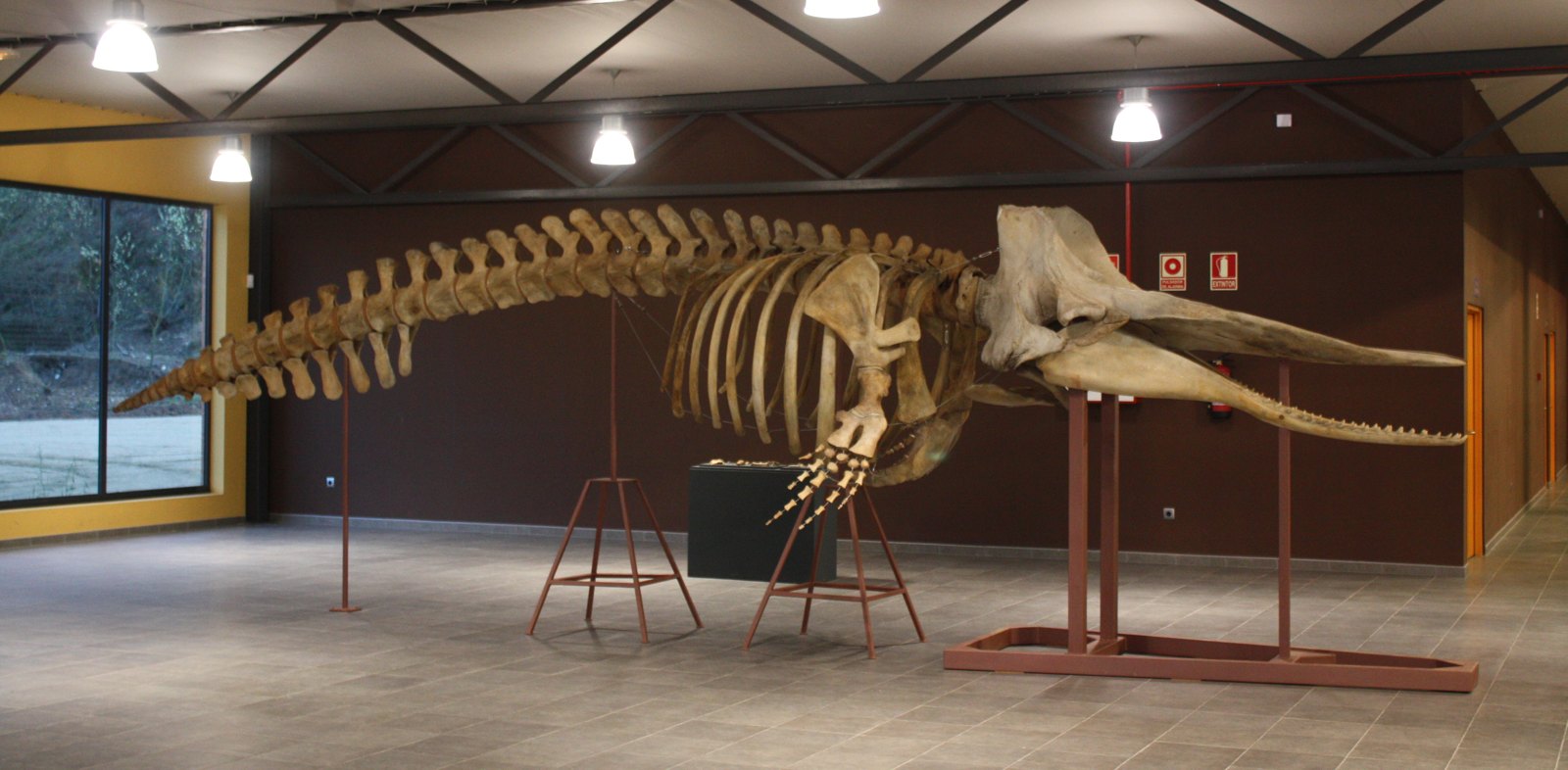
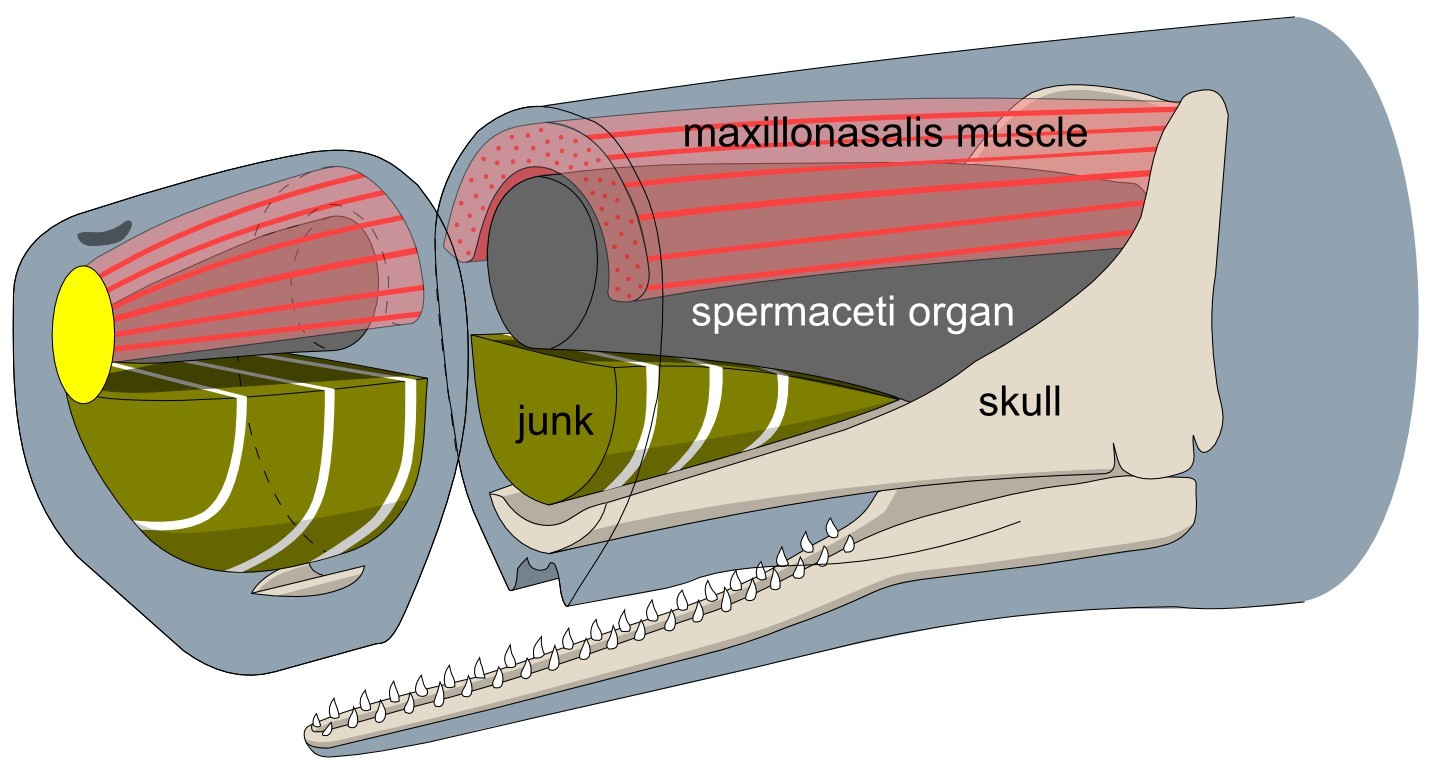
The head makes up about one third of the body length in the NOAA and American Cetacean Society accounts, and Clarke’s measurements of the organ give a quarter to a third of the length and more than a third of the weight.[1][2][8] The nose alone is about one third of the length or weight of an adult male.[19] Much of the head is the spermaceti organ, a large reservoir of clear oil.[2][8] CT scans of a newborn’s head showed that the organ is already enlarged and that it differs in size between the sexes.[20] Huggenberger and colleagues describe the enlarged nasal complex as a device that raises the directionality and source level of echolocation clicks.[21] Clarke proposed that the whale reaches neutral buoyancy below 200 m by controlling the temperature of the oil, which is one idea and not a settled result.[22]
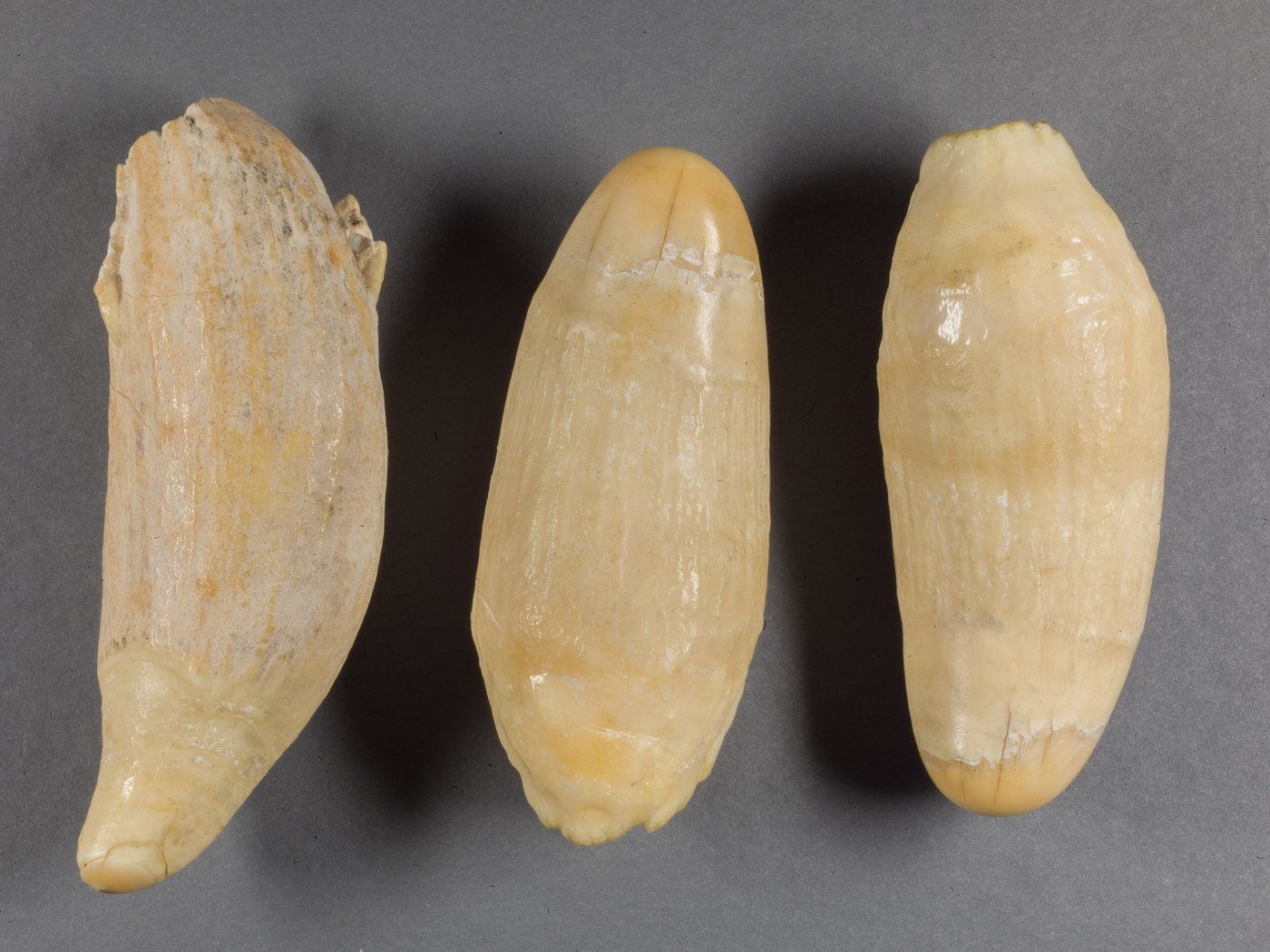
The large teeth sit in the lower jaw. NOAA counts 20 to 26 on each side, the American Cetacean Society 18 to 25, and the Animal Diversity Web 18 to 28 functional teeth.[1][8][9] The upper jaw has sockets for the lower teeth, and its tiny teeth rarely break through the gum.[1][8]
Brain
The average brain mass over 28 brains in the literature is about 7,716 g, and in large males Kojima (1951) gave an average of 7,800 g.[23] He estimated that one third of the cranial vault in such males is filled with dura, blood vessels and other non-neural tissue.[23] The cerebellum is relatively small, about 7% of the brain, against almost 14% in the Killer Whale, a different species whose largest males have brains of similar size.[23][24] The encephalization quotient is relatively low and comparable to that of baleen whales.[23]
Senses and clicks
The whale locates food and navigates by echolocation, with nearly constant clicking.[8] Usual clicks run at 10 to 20 kHz.[25] Close to prey, within some 10 m, the clicks speed up into a buzz.[25] Codas are patterns of 3 to 11 clicks lasting about one second, and slow clicks, around 3 kHz and above 200 dB, are made only by males.[25] Clicks recorded reached source levels of up to 236 dB re 1 µPa (rms), which the authors called by far the loudest sounds recorded from any biological source.[7] The Videsen team reports usual clicks of up to 240 dB re 1 µPa peak-to-peak, a different scale.[25]
Fais and colleagues tested the idea that the whale stuns prey with sound. Source levels in the buzz were more than an order of magnitude below those needed to debilitate prey, and they concluded that prey are subdued by fast jaw movements or suction.[26]
Behavior
Diving
The Sperm Whale is a deep diver. NOAA says its deep dives routinely reach about 610 m (2,000 feet) and can last 45 minutes.[1] Tags on 37 whales in the Atlantic Ocean, the Gulf of Mexico and the Ligurian Sea recorded 198 dives. The average maximum depth of the whales in the three regions was 985 m, 644 m and 827 m. An average dive cycle was a 45-minute dive followed by a 9-minute stay at the surface, and the whales spent more than 72% of their time in foraging dive cycles.[27] Tracks of two males, of about 15 m and 11 m, showed dives of 400 to 600 m and more, including one to 1,185 m, and dives lasting from 18 minutes to 1 hour 13 minutes.[28]
Tags on 23 whales showed that the body is strongly buoyant in the top 100 m and close to neutral between 250 and 850 m. The whales swam down at about 1.45 m per second and up at about 1.63 m per second.[29] Sleep has not been shown directly. In a study of tagged whales, passive vertical drifts took up 7.1% of the recording time, and 36.7% of the time when the whales were not foraging, mostly between 18:00 and midnight.[30]
Social life
Females and their young live in permanent units. NOAA gives an average of 12 females and their young per unit,[1] and a study of 18 units found about 11 females and immatures, with about two units travelling together as a group.[31] Off Dominica in the Eastern Caribbean, a study from 2005 to 2012 followed 419 whales. Its groups held 7 to 9 whales and a single unit, which averaged 6.76 whales, and 17 units were seen again over 2 to 27 years.[32] Unit members share the care of the young: a main purpose of these lasting bonds is to provide allomothers that stay with the calves at the surface while the mothers dive to feed.[33]
Males leave. Young males disperse in their early teens,[34] and males travel to higher latitudes away from their social group.[17] Off Dominica, mature males stay only a few days to a few weeks.[32] Sperm whales do not seem to have harems: large males visit female groups for only a few hours at a time.[8] Off the Gulf of Alaska, males showed heavy scarring on their heads, which the authors read as evidence of aggression.[17]
Whales also split into vocal clans. In a study of 18 units, six clans were found, five in the Pacific and one in the Caribbean, living in the same waters with different calls. The authors concluded that this most probably results from cultural transmission, and that culture may be a more important determinant of sperm whale population structure than genes or geography.[31] In the Eastern Caribbean two such clans live in the same waters, and units associate only with units of their own clan.[35]
Voice
Sperm whales make four kinds of sound. Usual clicks sit at 10 to 20 kHz. Buzzes, made within about 10 m of prey, are a fast series of clicks at a low level. Codas are rhythmic patterns of 3 to 11 clicks lasting about 1 second, and they carry less than 4 km. Slow clicks are made only by males, at long intervals of 2 to 9 seconds.[25] The usual clicks and buzzes belong to hunting (see Diet). Codas are also what separates the clans, and an analysis of recorded codas found a contextual and combinatorial structure, with variation in tempo, rubato and ornamentation, that is more expressive and structured than was believed before.[36]
Diet
The Sperm Whale feeds mostly on medium-sized squid from deep water, and it also takes fish, skates and octopus.[8] NOAA names squid, sharks, skates and fish that live in deep waters.[1] Studies of stomach contents show how wide the menu is. In 36 whales stranded in Tasmania in 1998, the remains were 101,883 squid and octopus beaks from 48 species in 14 families. By number the most common family was Histioteuthidae (the cock-eyed squids), and by mass it was Onychoteuthidae (the hooked squids).[37] In 221 whales taken between Iceland and Greenland from 1977 to 1981, fish were in 87% of the stomachs and cephalopods in 68%. The remains came from at least eight kinds of fish and 22 kinds of cephalopod, and the lumpsucker made up a major part of the diet.[38]
NOAA puts the daily amount at about 3 to 3.5% of body weight,[1] and the American Cetacean Society at about one tonne of food a day.[8]
Hunting
Prey is found in the dark with sound. Tagged whales produced regular clicks during 81% of a dive and about 18 buzzes per dive. They swam down on average 392 m from the first regular click to the first buzz, which supports the idea that the regular clicks work as a long-range sonar.[27] Close to the prey, the click rate rises into a buzz at some 10 m.[25] In the Iceland and Greenland study the prey came from depths of 400 to at least 1,200 m.[38]
Life cycle
| Stage | Size or age | Notes |
|---|---|---|
| Calf | About 4 m at birth; 4.1 to 5.5 m in drone measurements | A single calf, born after 14 to 16 months of pregnancy[1][8][16] |
| Juvenile | 5.5 to 7.6 m | Length classes from drone photographs of living whales[16] |
| Adult | Females 8.5 to 12 m, males over 13.7 m | Females mature at about 9 years (7 to 13 years across sources); males from about 10 years and breed from the late 20s[1][8][16] |
Breeding
Pregnancy lasts 14 to 16 months and ends with a single calf.[1][8][34] Large males do not keep harems. They visit female groups for a few hours at a time, and mature males live mostly alone at higher latitudes.[8][34] A male is sexually mature from about 10 years of age, but does not seem to take part in breeding until his late 20s.[8]
Calves
The newborn is about 4 m long.[1] The American Cetacean Society gives 3.4 to 4.9 m and a weight of about 1 tonne.[8] Calves nurse for up to two years or longer.[8] NOAA says a female has a calf about once every five to seven years.[1]
Calves are social centres of the female unit. The main job of these lasting bonds is to provide other adults to mind the calves at the surface while the mothers make deep foraging dives.[33] Young calves make short “peduncle dives” beside an adult female, on average 14 seconds long and mostly on her left side. How a calf takes milk is still unclear.[39]
Growing up
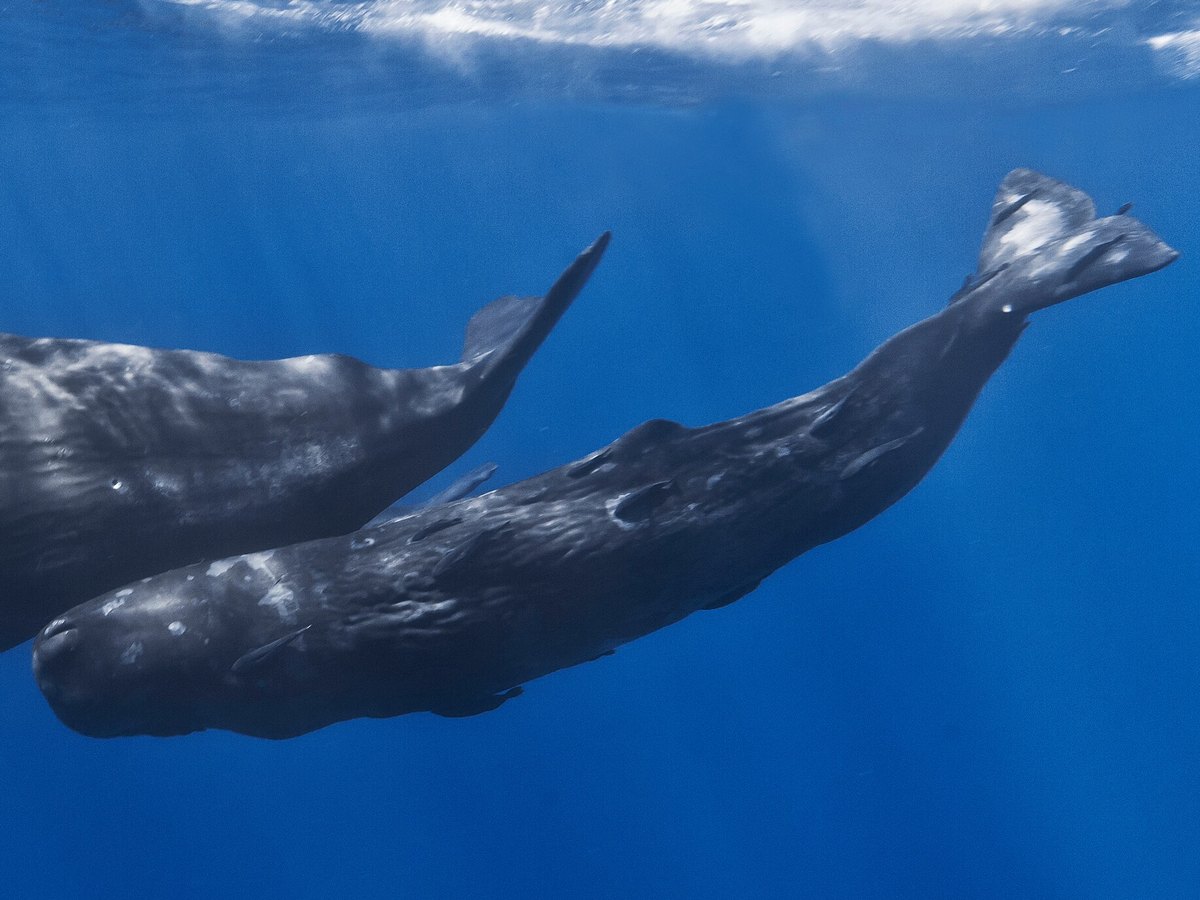
For about the first 10 years males are only slightly larger than females, and males keep growing into their 30s.[1] Females reach sexual maturity at around 9 years of age and are physically mature at around 30.[1] Males reach physical maturity at around 50 years.[1] Young males leave their group in their early teens and travel to higher latitudes.[17][34]
NOAA gives a lifespan of up to 60 years.[1]
Ecology
Predators
The Killer Whale, a different species, attacks sperm whales. A study off central California in October 1997 described about 35 killer whales attacking nine sperm whales roughly 130 km from the coast. The killer whales attacked in a “wound and withdraw” pattern, the sperm whales gathered in a tight rosette with heads together and tails outward, and one sperm whale was killed.[40] Off southern Brazil in December 2012, four killer whales met a group of twelve sperm whales, including a calf, over water 1,100 m deep and 267 km from the coast. The sperm whales did not form a rosette but swam in a line abreast, like a tight flotilla, and none was killed.[41] Published records of such attacks come only from the Pacific and Southern Oceans, and the risk of death is believed to be low.[42] Calves are the most vulnerable to killer whales and probably to large sharks. Shark stomachs have held sperm whale remains, but these most likely came from carcasses.[42] Pilot whales and false killer whales harass sperm whales, but most of these attacks do not kill.[42]
Parasites and disease
Squid of the genus Histioteuthis in the Tyrrhenian Sea host larvae of a roundworm named Anisakis physeteris.[43] An examination of four whales that stranded alive between 2020 and 2022 found mainly emaciation, and two of the whales had swallowed fishing gear and debris.[44]
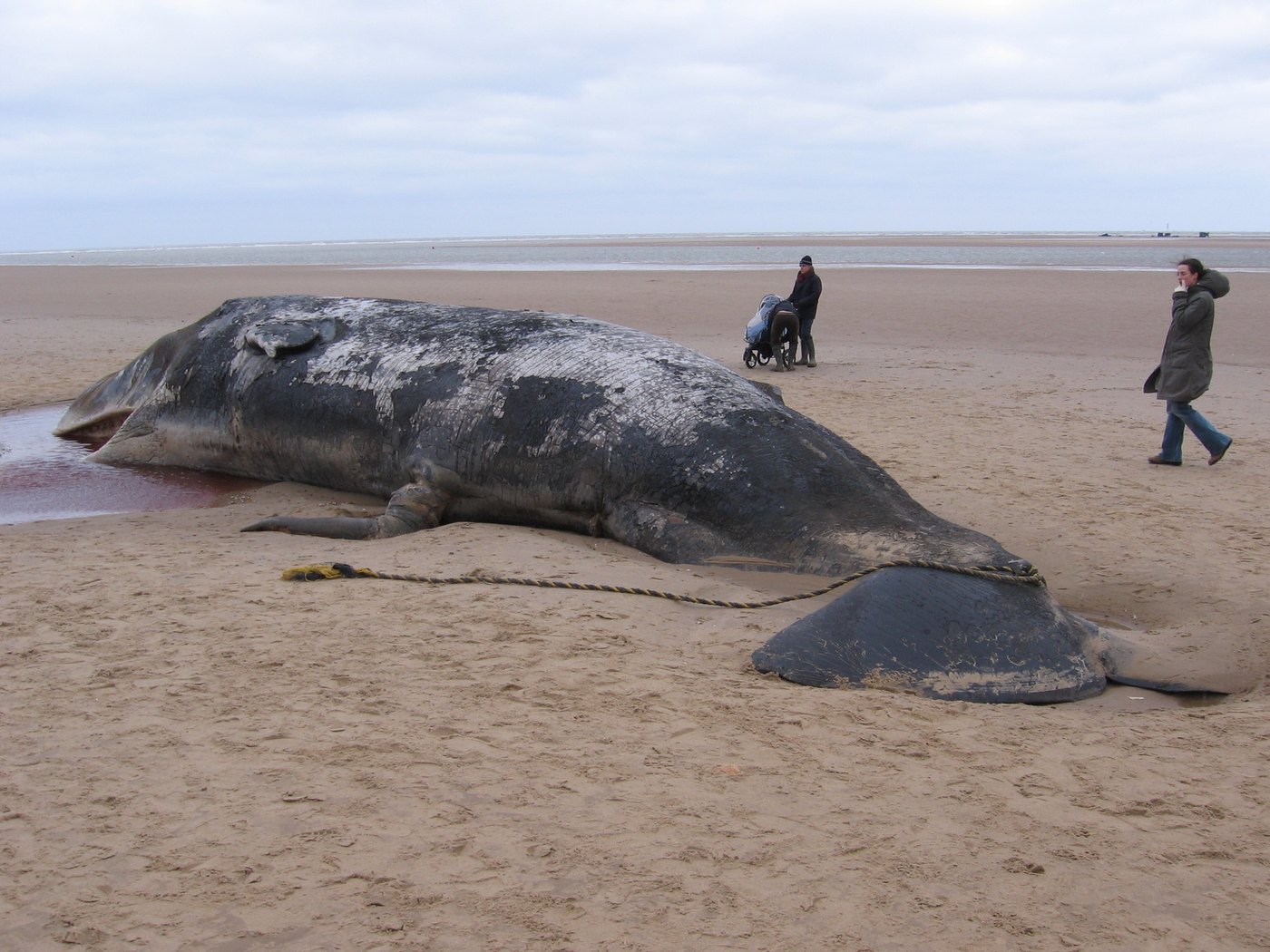
Mass strandings of males are the best documented event. Between 8 January and 25 February 2016, 30 sperm whales stranded in five countries around the North Sea, and all were immature males. Of the 27 whales examined by necropsy, nine held marine litter. The whales had entered shallow water of less than 40 m, and the authors noted that such events seldom have a single ultimate cause.[45] The 2016 event is the largest recorded sperm whale mortality in the North Sea.[45]
Role in the ocean
Sperm whales feed deep but defecate near the surface, which returns iron to the sunlit water. A 2010 study estimated that the 12,000 sperm whales of the Southern Ocean release about 50 tonnes of iron each year in their faeces. The iron feeds plankton, which pull carbon from the air. The study calculated that the extra plankton export about 400,000 tonnes of carbon a year, while the whales themselves respire about 200,000 tonnes, so the model gives a net sink of about 200,000 tonnes a year.[46]
A dead sperm whale that sinks becomes a whale fall, a food source for animals on the sea floor. Bone-covered carcasses off Cape Nomamisaki, Japan, were found to hold a new red worm species, Protodrilus puniceus, which was the most abundant ringed worm on the 2.5-year-old carcasses.[47] A sperm whale carcass placed on the continental slope at 500 m depth in Sagami Bay, Japan, was used to follow the early succession of the animals that moved in.[48] The number of whale skeletons on the sea floor has been put at more than 500,000 at any one time, a figure that counts all whales and does not single out sperm whales.[49]
Habitat and range
Where it lives
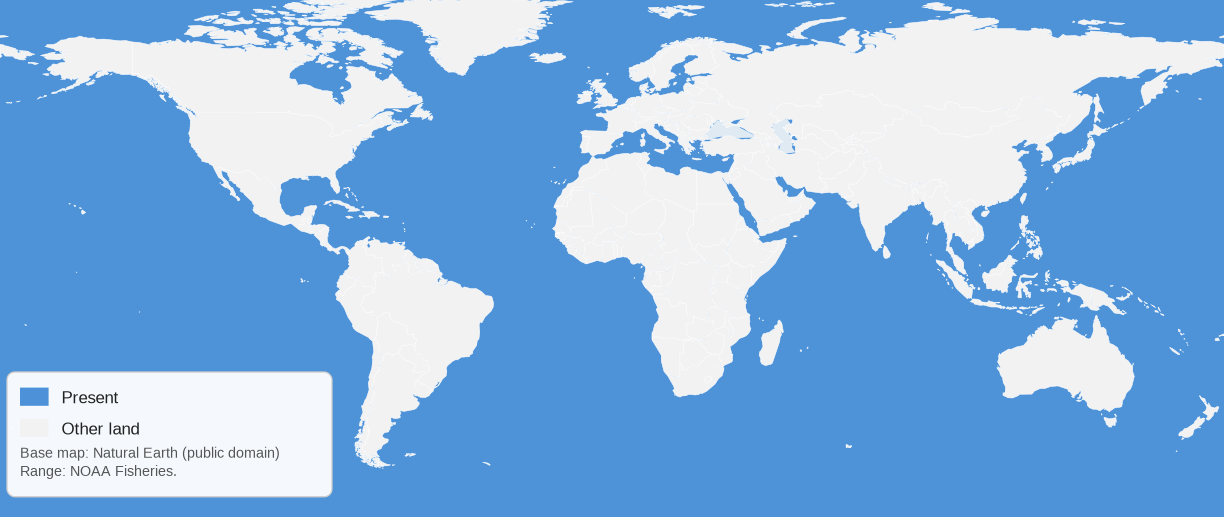
The Sperm Whale lives in all of the world’s oceans, from the equator to the edge of the pack ice in the Arctic and Antarctic.[1] It is one of the most widely distributed marine mammals, perhaps exceeded in global range only by the Killer Whale and the Humpback Whale.[4] The sexes use the ocean differently. Females and young whales stay mostly in tropical and subtropical waters, while males range to higher latitudes.[3][42] Only males enter Arctic waters, mainly in the summer feeding season, and they return to warmer water to breed.[42] Males leave their female groups as they grow up and travel to higher latitudes.[17] In the North Pacific, males are found in the Gulf of Alaska, the Bering Sea and around the Aleutian Islands, and three adult males tagged off south-eastern Alaska travelled to Baja California, the Gulf of California and the coast near the Mexico-Guatemala border.[4]
The whales also shift with the seasons. In the North Pacific they generally move to higher latitudes in summer and lower latitudes in winter, and most off California in winter lie south of 40°N.[4][50] Female and young whales photographed in the tropical Pacific moved on average about 4 km in an hour, 50 km in a day, 200 km in three days and 1,000 km over a year or more.[51] Movements seem to follow the supply of squid.[4]
The Mediterranean Sea is a partly enclosed part of the range that holds its own subpopulation.[42][52] The whales of the northern Gulf of Mexico are a separate stock whose animals are on average 1.5 to 2.0 m smaller than sperm whales elsewhere. Of 39 satellite-tagged whales followed for up to 607 days, only one, a male, left the Gulf.[18]
Habitat
The Sperm Whale lives mainly over the edge of the continental shelf, the continental slope and the open ocean, and also in partly enclosed seas such as the Mediterranean.[42] It is a deep-water animal that feeds far below the surface (see Behavior and Diet).
Population
Population figures are given by area and year. For the North Atlantic, NOAA’s best estimate from the 2021 surveys is 5,895 whales, and the agency states that there is no reliable estimate for the entire North Atlantic.[3] Along the coasts of California, Oregon and Washington, a 2018 survey gave 2,606 whales.[50] In the northern Gulf of Mexico the estimate for 2017 to 2018 is 1,180.[18] For the North Pacific stock off Alaska, a reliable estimate of abundance is considered unavailable.[4]
Two studies give wider figures. A 2022 model-based estimate by Whitehead and Shin put the global population at 736,053 whales (CV 0.218) in 1993, against a pre-whaling population of 1,949,698 in 1710, and the same study projected about 844,761 for 2022, with much uncertainty.[53] The 736,053 is an estimate for that one year, not a present count. In the Mediterranean, a design-based estimate published in 2024 was 2,673 whales (95% confidence interval 1,739 to 4,105) for the surveyed blocks, from 14,039 km of survey track.[52] Off Dominica in the Eastern Caribbean, the female units lost adults at about 4.5% a year in unit size from around 2010.[54] For the global status of the species, see Conservation.
Evolution
The tree puts the Sperm Whale on the oldest living branch of the toothed whales. Sperm whales split from all other living toothed whales in the latest Eocene, and the crown group of toothed whales dates to about 34.13 million years ago (Ma).[55] A second study dates the origin of echolocation, which all toothed whales share, to some 36 to 34 Ma.[56] The Sperm Whale and the pygmy and dwarf sperm whales (Kogia) separated about 22.11 Ma (95% CI 20.58 to 24.08), and the authors suggest the two groups belong in separate families.[55] The two living Kogia species split from each other much later, around the late Pliocene.[57]
The tree does not draw the fossil sperm whales. Rhaphicetus valenciae from Peru, 19 to 18 Ma, belongs to a group that peaked in diversity in the middle to late Miocene, so the living Physeter and Kogia are relict members of it.[58] The middle Miocene Albicetus oxymycterus, about 6 m long, shows that large size and strong teeth evolved more than once in sperm whales.[59]
Forms and variants
No subspecies of the Sperm Whale are recognised. The Mammal Diversity Database lists none as valid, and the Society for Marine Mammalogy list shows none.[10][11] Two old infrasubspecific names, cinereus and niger (Kerr, 1792), are treated as synonyms.[10] The differences that exist lie between populations and between groups of females.
Populations
A study of 1,633 whales from all oceans found low diversity in maternal (mitochondrial) DNA, which fits a population expansion less than 80,000 years ago, and strong differences by ocean, by region within some oceans and by social group.[60] Nuclear DNA, which males carry between regions, differs little.[60] In the North Pacific, females off California differ in their DNA from those off Hawaii and in the eastern tropical Pacific, and were described as a demographically independent population.[61] A 2026 study of whole genomes called the species one with weak population structure, and found close kinship between a male sampled in the North Sea and a female and her offspring sampled in the Gulf of Mexico.[62] Sperm whales in the Mediterranean Sea are assessed as Endangered, while the species as a whole remains Vulnerable.[6][52]
Clans
Female Sperm Whales live in family units of about 11 females and young. Units that share a dialect of click patterns, called codas, form a vocal clan, and a clan can span thousands of kilometres.[31] A study of 18 units found six clans, five in the Pacific and one in the Caribbean, and clans that live in the same waters stay distinct, which most probably results from cultural transmission.[31] The authors argued that culture may shape sperm whale population structure more than genes or geography.[31] In the eastern Caribbean two clans live side by side, and units associate only with units of their own clan.[35] Clans near the Galapagos Islands also moved in distinct patterns.[51] Clans are cultural groups, not subspecies.
Conservation
Status
The IUCN Cetacean Specialist Group listed the Sperm Whale as Vulnerable in its December 2019 update, which left the category unchanged.[6] A 2025 New York State assessment, citing the IUCN assessment, gives the trend as unknown and says there is no direct evidence that any part of the population has increased, though for most areas there is also no direct evidence that it has not.[42] The Mediterranean subpopulation is listed as Endangered.[52]
In the United States the species has been listed as endangered under the Endangered Species Act since 2 June 1970.[1] Because of that listing, the Northern Gulf of Mexico stock is classed as strategic.[18] The Convention on Migratory Species lists the sperm whale on Appendices I and II, and on Appendix I since 2002.[63] It is also listed in Appendix I of CITES, the convention that controls international trade in wildlife.[42] In the eastern tropical Pacific the population has struggled to reach a positive growth rate, and a CMS Concerted Action was adopted for the species in 2017.[64]
Threats
Ship strikesFishing gearShip and seismic noisePollution[1][4][42][45][50]Ship strikes. Vessel strikes are a significant threat in parts of the world such as the Canary Islands and the Mediterranean Sea.[42] One estimate puts the chance that a collision with a 50-tonne vessel at seven knots kills a whale at more than 50%.[42] Few carcasses are found: one estimate puts recovery at only 3.4% of actual deaths.[42] In the North Pacific stock, ship strikes caused 0.2 human-caused deaths a year in 2014 to 2018.[4]
Fishing gear. A sperm whale can break through or carry away fishing gear once entangled, and the species does not appear to become entangled as often as several other large whales.[42] In the Gulf of Alaska, sperm whales take fish from halibut and sablefish longlines; fisheries caused 3.3 of the 3.5 human-caused deaths and serious injuries a year in 2014 to 2018.[4] Off California, Oregon and Washington, drift gillnets killed 10 whales in 6 events across more than 9,246 sets from 1990 to 2021.[50] Four live-stranded whales examined in 2020 to 2022 were emaciated, and two had swallowed fishing gear and debris.[44]
Noise. Noise from people is one of the most significant threats; the main sources are shipping, seismic surveys and military activity.[42]
Plastics and oil. Marine litter was found in nine of 30 young males that stranded in the North Sea in 2016.[45] Plastic ingestion accounted for 0.2 deaths a year in the North Atlantic stock from 2017 to 2021.[3] After the Deepwater Horizon oil spill, the Gulf of Mexico stock showed a maximum reduction of 7%.[18]
Management
The International Whaling Commission voted at its 1982 meeting in Brighton, by 25 to 7 with 5 abstentions, to set zero catch limits on all stocks for commercial purposes.[65] The decision took effect from the 1985 to 1986 seasons.[66] NOAA dates the moratorium to 1986.[1] Sperm whales were the main target of commercial whaling from 1800 to 1987;[1] for the number killed in the 20th century, see History and culture. Japan left the IWC and resumed commercial whaling in its own waters in 2019, and its catch is of minke, Bryde's, sei and fin whales.[42]
NOAA assesses each US stock on its own, with a minimum estimate and a limit on human-caused deaths for each; the limit is 4 whales a year for California, Oregon and Washington and 9.28 for the North Atlantic.[3][50] For the North Pacific stock as a whole, no reliable estimate of numbers or trend exists.[4] See Habitat and range for the stock sizes.
History and culture
Whaling
Linnaeus named the Sperm Whale in 1758, in the tenth edition of his Systema Naturae (see Taxonomy for the two names he gave it).[67] Deep-sea hunting of the species by Americans began in the early 1700s. The New Bedford Whaling Museum dates it to 1712, when Christopher Hussey of Nantucket found a pod of sperm whales,[68] while the Nantucket Historical Association says deep-sea whaling began around 1715 and that the whales’ bodies yielded very high quality oil.[69] The prize was the head. Spermaceti candles burned with a “bright, clean, and steady light”,[70] and spermaceti was also used in oil lamps and as a lubricant.[1] Ambergris and baleen were among the other harvested items.[71]
In 1815 Nantucket had 50 ships to New Bedford’s 10, and New Bedford passed it in 1823.[72] The Nantucket Historical Association calls 1846 the peak of American whaling, the year a fire destroyed the island’s business district; the last Nantucket whaleship, the bark Oak, sailed in 1869.[73] In the mid-1850s the New Bedford fleet peaked at 329 vessels out of 593 in the American fleet. After Drake’s well struck petroleum in Pennsylvania in 1859, whale oil prices fell: in 1860 sperm oil sold at $1.40 a gallon and kerosene at 75 cents.[68] NOAA names sperm whales a primary target of commercial whaling from 1800 to 1987.[1]
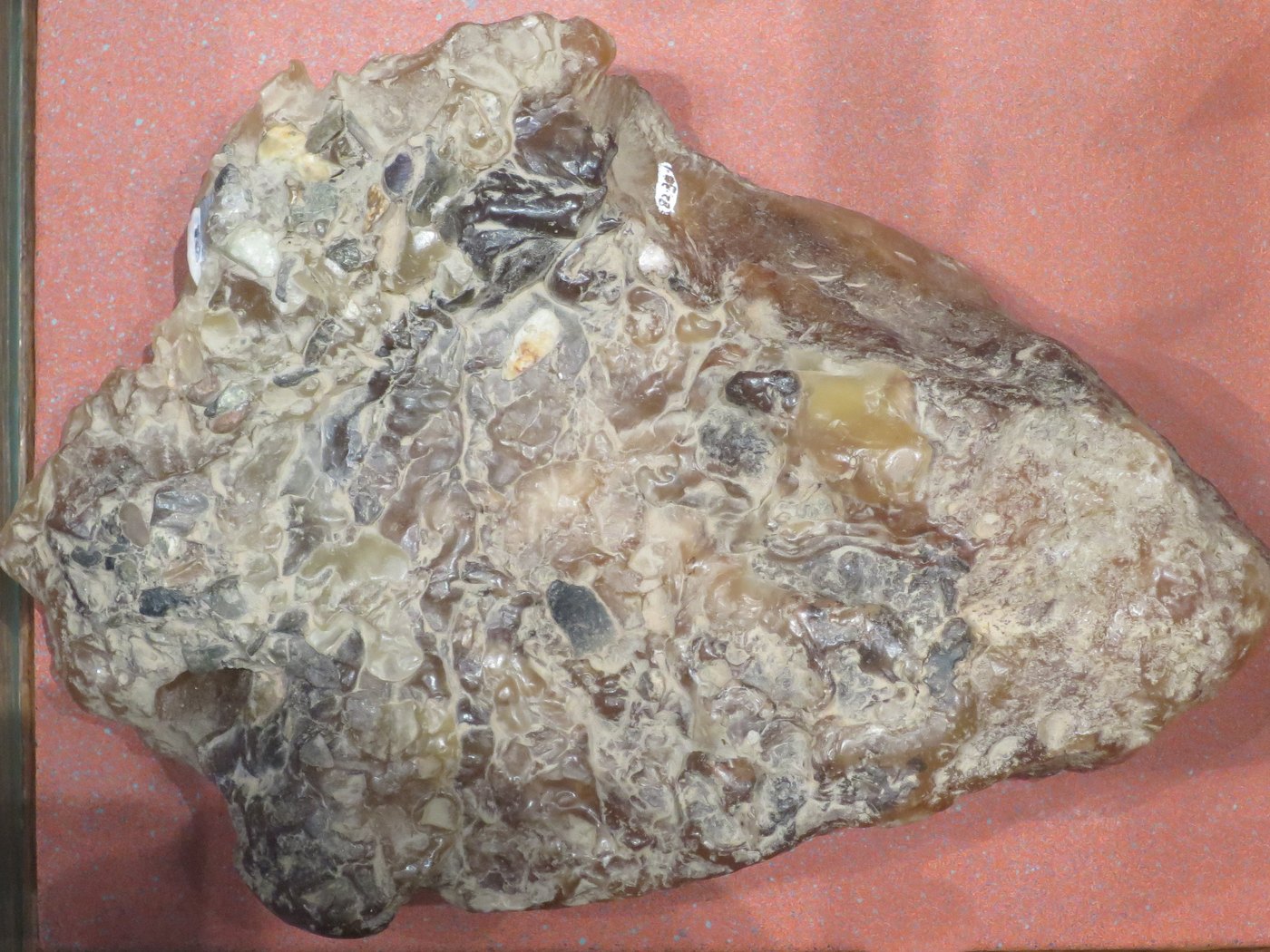


Ambergris forms when squid remains move into the whale’s intestines and bind together into a solid mass that grows over many years. Its source was identified only when large-scale whaling began in the 1800s. Perfumers use ambrein from it to make scents last longer, and synthetics have replaced it in all but the most expensive perfumes.[74]
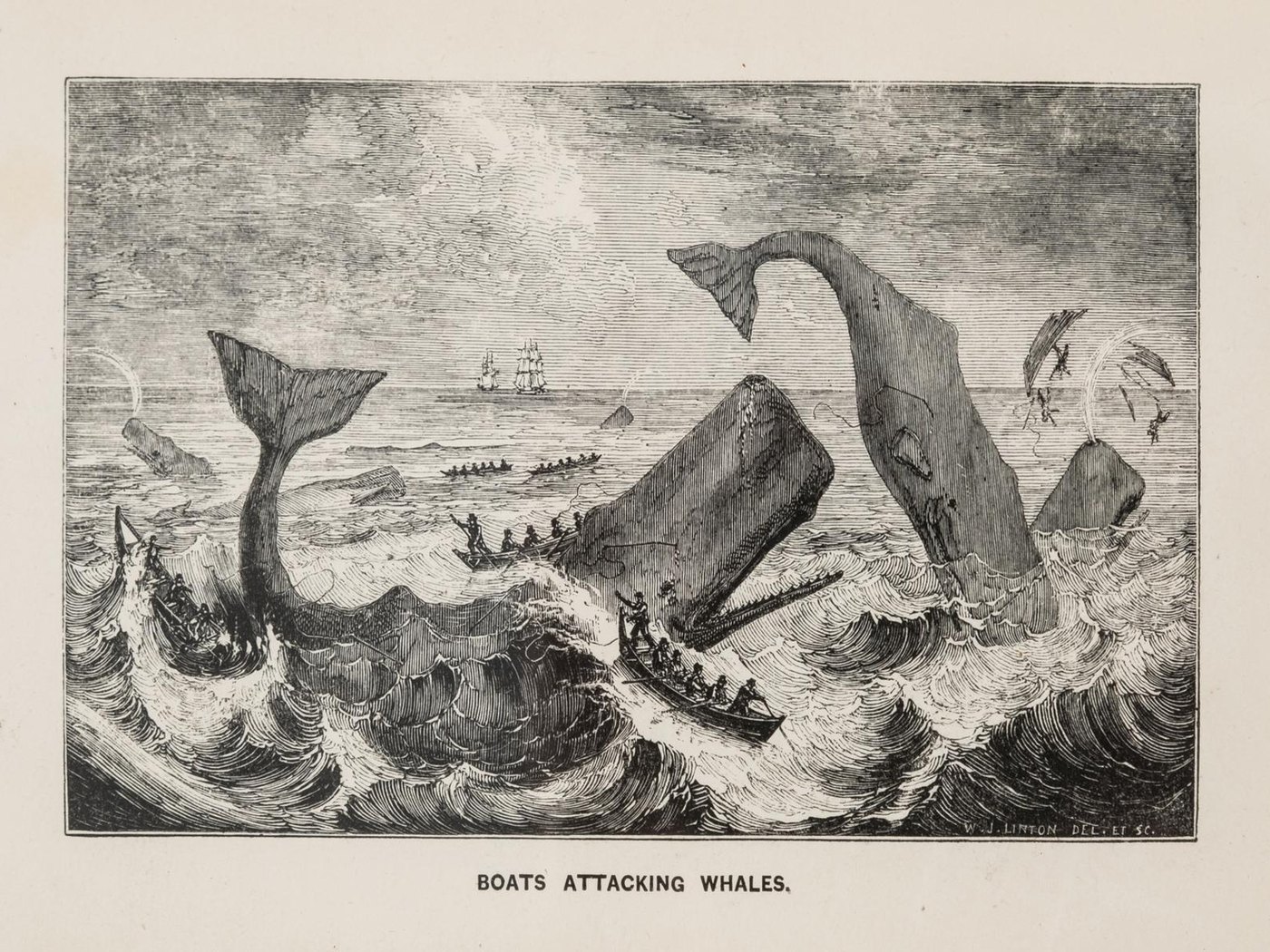

Industrial whaling in the 1900s took far more. An estimate of the catch for 1900 to 1999 counts 761,523 sperm whales, second only to the fin whale among large whales.[75] In 1982 the International Whaling Commission voted 25 to 7, with 5 abstentions, to set zero catch limits for commercial whaling on all stocks from the 1985/86 season.[65] Japan, Norway and the Soviet Union formally objected.[66]
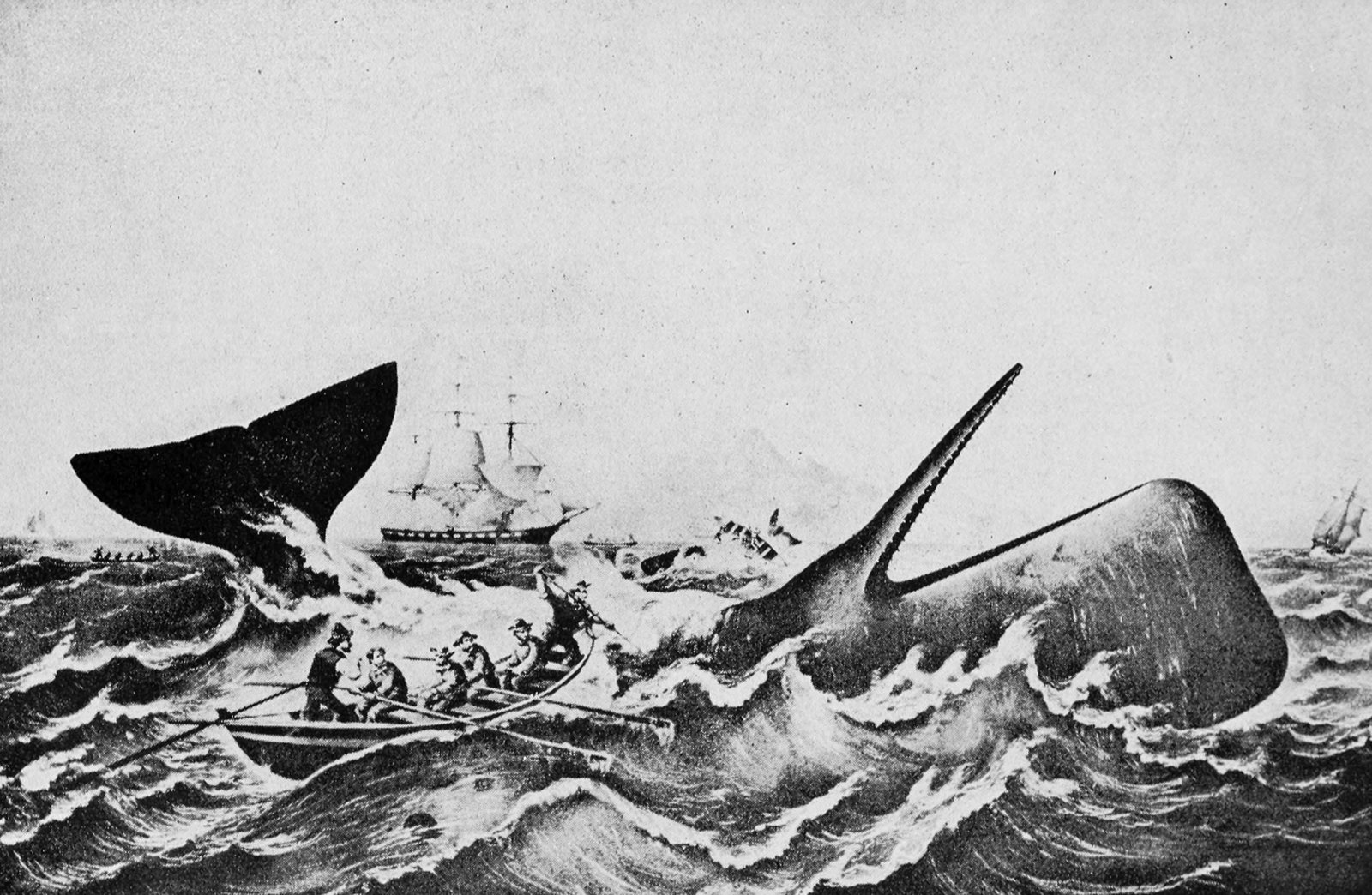

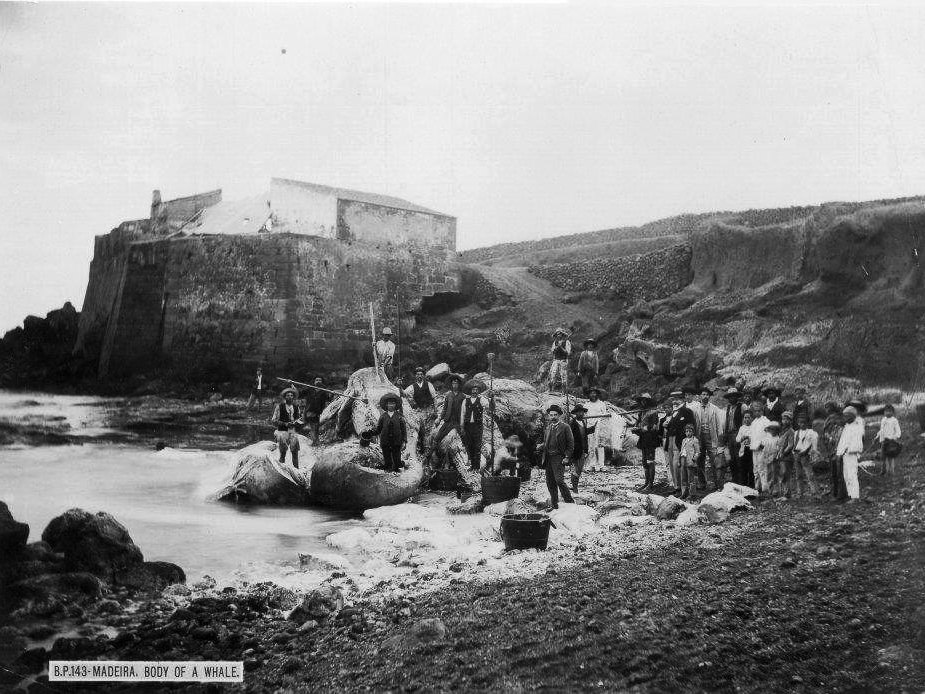
Hunting continues by hand in Lamalera, on Lembata Island in Indonesia, where villagers harpoon sperm whales from wooden sailing boats. Records exist from 1960: 909 whales were caught in the recorded years from 1960 to 2010, with a record of 56 in 1969. The authors found that one whale sustains about 100 villagers for a year.[76]

The Essex and Moby-Dick
On 20 November 1820 the Nantucket whaleship Essex was cruising in the Pacific.[77] First mate Owen Chase placed the ship at 0°40′S, 119°W and wrote that a whale “about eighty-five feet in length” struck the ship with its head, then struck again under the cathead and stove in her bows. That is Chase’s estimate, made at sea.[78] Thomas Nickerson, a cabin boy who wrote his account 50 years later, also describes two blows.[79] Chase believed the second blow was deliberate, and Melville quotes his words about “decided, calculating mischief, on the part of the whale”.[80]
Twenty men left the ship in three boats.[78] Chase’s boat was picked up by the brig Indian, Captain William Crozier, at 33°45′S, 81°03′W. By Chase’s list, five men were taken from the boats and three were left on Ducie’s Island, eight survivors in all.[78] The Massachusetts Historical Society also counts eight survivors from the three months at sea.[81]
Herman Melville signed on in late December 1840, and the 359-ton Acushnet left New Bedford on 3 January 1841.[82] A review in the London Review of Books says he read Chase’s narrative on another whaler that year.[77] In Moby-Dick, chapter 45 retells the Essex, names Chase as a man Melville had met, and says he had read his “plain and faithful narrative”.[80] The book came out in London on 18 October 1851 and in the United States on 14 November 1851.[83]
Another real whale was Mocha Dick. In 1839 J. N. Reynolds described Mocha Dick in The Knickerbocker as “white as wool”, longer than seventy feet, with not less than twenty harpoons drawn from his back. His narrative says boats were shattered by the flukes, but no ship was sunk.[84] On 20 August 1851 the Ann Alexander of New Bedford, Captain John S. Deblois, lost a boat to a whale at 5°50′S, 102°W. The whale then struck the ship once, making “a great hole entirely through her bottom”, and the crew were picked up by the Nantucket.[85]

Research
Long studies of living whales began to show the social side of the species. In 2003 Rendell and Whitehead sorted recorded calls into six vocal clans.[31] Off Dominica, a study from 2005 to 2012 followed 419 whales and reidentified 17 social units over 2 to 27 years.[32] A 2024 paper on codas, by Sharma and others, found a contextual and combinatorial structure, and called the whales’ vocalisations more expressive and structured than previously believed.[36] The coda recordings it used were about 9,000 codas from Eastern Caribbean families.[86] Project CETI, a nonprofit launched in 2020, works to decode these sounds.[87]
A 14.6 m male that stranded on Nantucket on 7 June 2002 was assembled as a skeleton at the New Bedford Whaling Museum, finished in March 2005; the museum gives its age at death as about 30 years.[88]
Taxonomy
| Rank | Name |
|---|---|
| Kingdom | Animalia |
| Phylum | Chordata |
| Subphylum | Vertebrata |
| Superclass | Tetrapoda[92] |
| Class | Mammalia |
| Subclass | Theria[92] |
| Infraclass | Eutheria[92] |
| Order | Artiodactyla[10] |
| Suborder | Odontoceti[92] |
| Family | Physeteridae (sperm whales)[13] |
| Genus | Physeter Linnaeus, 1758[13] |
| Species | Physeter macrocephalus (Linnaeus, 1758)[10][14][89] |
Synonyms (10)
| Name |
|---|
| Physeter catodon (Linnaeus, 1758) |
| Physeter microps (Linnaeus, 1758) |
| Physeter tursio (Linnaeus, 1758) |
| Physeter andersonii (Borowski, 1780) |
| Physeter novaeangliae (Borowski, 1780) |
| Phiseter cylindricus (Bonnaterre, 1789) |
| Phiseter mular (Bonnaterre, 1789) |
| Phiseter trumpo (Bonnaterre, 1789) |
| Physeter maximus (G.Cuvier, 1798) |
| Catodon macrocephalus (Lacépède, 1804) |
A selection of the oldest names. The GBIF backbone lists 26 species-level synonyms.[91]
Higher classification
Whales belong to the order Artiodactyla, the even-toed hoofed mammals, which also holds cattle, pigs and hippos.[10] Within it, the sperm whale is the only living species of its genus and of the family Physeteridae, and it is a toothed whale.[10][13] The pygmy and dwarf sperm whales (Kogia) are its closest living relatives. They are much smaller and sit in their own family, Kogiidae.[55][57]
Macrocephalus or catodon
Linnaeus put two names for sperm whales on the same page, macrocephalus and catodon. His text for catodon was obscure, and authors used macrocephalus until Oldfield Thomas picked catodon in 1911 because it came first on the page. Many followed him.[67] Husson and Holthuis (1974) argued that the first author to show the two were one species, Blasius (1857), had kept macrocephalus, so that name stands. They also chose a neotype for catodon (a replacement type specimen), a 16 m whale that stranded in the Netherlands in 1937, which makes catodon a synonym.[67] The Mammal Diversity Database notes that catodon has line priority, but follows the 2023 review by Jefferson and colleagues, whose appendices aim to settle the dispute.[10][90] Today macrocephalus is the accepted name in all the lists above.
Sources
- NOAA Fisheries, Sperm Whale (Physeter macrocephalus) species page
- Clarke, M. R. 1978. Structure and proportions of the spermaceti organ in the sperm whale. Journal of the Marine Biological Association of the United Kingdom 58: 1–17
- NOAA Fisheries. 2024. Sperm Whale (Physeter macrocephalus): North Atlantic Stock. Marine Mammal Stock Assessment Report 2023 (revised June 2024)
- Young, N. C. et al. 2026. Sperm whale (Physeter macrocephalus): North Pacific Stock. In: Alaska Marine Mammal Stock Assessments, 2024. NOAA Technical Memorandum NMFS-AFSC-503, pp. 217–221
- NOAA Fisheries, International Whaling Commission
- IUCN SSC Cetacean Specialist Group. 6 updated cetacean Red List assessments published in December 2019
- Møhl, B., Wahlberg, M., Madsen, P. T., Heerfordt, A. and Lund, A. 2003. The monopulsed nature of sperm whale clicks. Journal of the Acoustical Society of America 114: 1143–1154
- American Cetacean Society. 2004. Fact sheet: Sperm Whale (Physeter macrocephalus) (revised February 2004)
- Ballenger, L. 2003. Physeter catodon. Animal Diversity Web, University of Michigan Museum of Zoology
- Mammal Diversity Database, Physeter macrocephalus Linnaeus, 1758 (taxon 1006461)
- Society for Marine Mammalogy, Committee on Taxonomy. List of marine mammal species and subspecies (version April 2026)
- Store norske leksikon, spermhval
- Fordyce, R. E. and Perrin, W. F. 2026. World Cetacea Database, Physeter macrocephalus Linnaeus, 1758. In: WoRMS (AphiaID 137119)
- GBIF Secretariat, Physeter macrocephalus Linnaeus, 1758, GBIF Backbone Taxonomy (species 8123917)
- Te Aka Māori Dictionary, parāoa
- Eguiguren, A., Gaspard, D., Clarke, C. M. K. and Whitehead, H. 2026. Inferring sperm whale (Physeter macrocephalus) sex and developmental stage using aerial photogrammetry. Scientific Reports 16: 17744
- Posdaljian, N., Solsona-Berga, A., Hildebrand, J. A., Soderstjerna, C., Wiggins, S. M., Lenssen, K. and Baumann-Pickering, S. 2024. Sperm whale demographics in the Gulf of Alaska and Bering Sea/Aleutian Islands: an overlooked female habitat. PLoS ONE 19: e0285068
- NOAA Fisheries. 2021. Sperm Whale (Physeter macrocephalus): Northern Gulf of Mexico Stock. Marine Mammal Stock Assessment Report (2020 report, April 2021)
- Møhl, B., Wahlberg, M., Madsen, P. T., Miller, L. A. and Surlykke, A. 2000. Sperm whale clicks: directionality and source level revisited. Journal of the Acoustical Society of America 107: 638–648
- Cranford, T. W. 1999. The sperm whale's nose: sexual selection on a grand scale? Marine Mammal Science 15: 1133–1157
- Huggenberger, S., André, M. and Oelschläger, H. H. A. 2016. The nose of the sperm whale: overviews of functional design, structural homologies and evolution. Journal of the Marine Biological Association of the United Kingdom 96: 783–806
- Clarke, M. R. 1978. Buoyancy control as a function of the spermaceti organ in the sperm whale. Journal of the Marine Biological Association of the United Kingdom 58: 27–71
- Ridgway, S. H., Carlin, K. P., Van Alstyne, K. R., Hanson, A. C. and Tarpley, R. J. 2016. Comparison of dolphins’ body and brain measurements with four other groups of cetaceans reveals great diversity. Brain, Behavior and Evolution 88: 235–257
- Ridgway, S. H. and Hanson, A. C. 2014. Sperm whales and killer whales with the largest brains of all toothed whales show extreme differences in cerebellum. Brain, Behavior and Evolution 83: 266–274
- Videsen, S. K. A., Raimondi, T., Sørensen, P. M. et al. 2026. Extreme rhythm keeping in long-range slow click communication of sperm whales. Annals of the New York Academy of Sciences 1559: e70289
- Fais, A., Johnson, M., Wilson, M., Aguilar Soto, N. and Madsen, P. T. 2016. Sperm whale predator-prey interactions involve chasing and buzzing, but no acoustic stunning. Scientific Reports 6: 28562
- Watwood, S. L., Miller, P. J. O., Johnson, M., Madsen, P. T. and Tyack, P. L. 2006. Deep-diving foraging behaviour of sperm whales (Physeter macrocephalus). Journal of Animal Ecology 75: 814–825
- Watkins, W. A., Daher, M. A., Fristrup, K. M., Howald, T. J. and Notarbartolo di Sciara, G. 1993. Sperm whales tagged with transponders and tracked underwater by sonar. Marine Mammal Science 9: 55–67
- Miller, P. J. O., Johnson, M. P., Tyack, P. L. and Terray, E. A. 2004. Swimming gaits, passive drag and buoyancy of diving sperm whales Physeter macrocephalus. Journal of Experimental Biology 207: 1953–1967
- Miller, P. J. O., Aoki, K., Rendell, L. E. and Amano, M. 2008. Stereotypical resting behavior of the sperm whale. Current Biology 18: R21–R23
- Rendell, L. E. and Whitehead, H. 2003. Vocal clans in sperm whales (Physeter macrocephalus). Proceedings of the Royal Society B 270: 225–231
- Gero, S., Milligan, M., Rinaldi, C., Francis, P., Gordon, J., Carlson, C., Steffen, A., Tyack, P., Evans, P. and Whitehead, H. 2014. Behavior and social structure of the sperm whales of Dominica, West Indies. Marine Mammal Science 30: 905–922
- Gero, S., Gordon, J. and Whitehead, H. 2013. Calves as social hubs: dynamics of the social network within sperm whale units. Proceedings of the Royal Society B 280: 20131113
- Aluma, Y., Baron, Z., Barrett, R. et al. 2026. Description of a collaborative sperm whale birth and shifts in coda vocal styles during key events. Scientific Reports 16: 9206
- Gero, S., Bøttcher, A., Whitehead, H. and Madsen, P. T. 2016. Socially segregated, sympatric sperm whale clans in the Atlantic Ocean. Royal Society Open Science 3: 160061
- Sharma, P., Gero, S., Payne, R., Gruber, D. F., Rus, D., Torralba, A. and Andreas, J. 2024. Contextual and combinatorial structure in sperm whale vocalisations. Nature Communications 15: 3617
- Evans, K. and Hindell, M. A. 2004. The diet of sperm whales (Physeter macrocephalus) in southern Australian waters. ICES Journal of Marine Science 61: 1313–1329
- Martin, A. R. and Clarke, M. R. 1986. The diet of sperm whales (Physeter macrocephalus) captured between Iceland and Greenland. Journal of the Marine Biological Association of the United Kingdom 66: 779–790
- Gero, S. and Whitehead, H. 2007. Suckling behavior in sperm whale calves: observations and hypotheses. Marine Mammal Science 23: 398–413
- Pitman, R. L., Ballance, L. T., Mesnick, S. I. and Chivers, S. J. 2001. Killer whale predation on sperm whales: observations and implications. Marine Mammal Science 17: 494–507
- Sucunza, F., Andriolo, A., Dalla Rosa, L., Castro, F. R., Danilewicz, D. and Zerbini, A. N. 2022. Sperm whale, Physeter macrocephalus, harassment by killer whales, Orcinus orca, in the western South Atlantic Ocean. Latin American Journal of Aquatic Mammals 17: 129–132
- Rickard, M. 2025. Species status assessment: Sperm whale (Physeter macrocephalus). New York State Department of Environmental Conservation, State Wildlife Action Plan 2025 (updated 16 February 2025)
- Palomba, M., Mattiucci, S., Crocetta, F., Osca, D. and Santoro, M. 2021. Insights into the role of deep-sea squids of the genus Histioteuthis (Histioteuthidae) in the life cycle of ascaridoid parasites in the Central Mediterranean Sea waters. Scientific Reports 11: 7135
- Bloodgood, J. C. G., Cramer, E. J., Cloyed, C. S. et al. 2026. Emaciation and marine debris contribute to sperm whale Physeter macrocephalus strandings in southeastern USA: comparing 4 cases from 2020–2022. Diseases of Aquatic Organisms 166: 1–19
- IJsseldijk, L. L., van Neer, A., Deaville, R. et al. 2018. Beached bachelors: an extensive study on the largest recorded sperm whale Physeter macrocephalus mortality event in the North Sea. PLoS ONE 13: e0201221
- Lavery, T. J., Roudnew, B., Gill, P., Seymour, J., Seuront, L., Johnson, G., Mitchell, J. G. and Smetacek, V. 2010. Iron defecation by sperm whales stimulates carbon export in the Southern Ocean. Proceedings of the Royal Society B 277: 3527–3531
- Sato-Okoshi, W., Okoshi, K. and Fujiwara, Y. 2015. A new species of Protodrilus (Annelida, Protodrilidae), covering bone surfaces bright red, in whale-fall ecosystems in the northwest Pacific. The Biological Bulletin 229: 209–219
- Aguzzi, J., Fanelli, E., Ciuffardi, T., Schirone, A., De Leo, F. C., Doya, C., Kawato, M., Miyazaki, M., Furushima, Y., Costa, C. and Fujiwara, Y. 2018. Faunal activity rhythms influencing early community succession of an implanted whale carcass offshore Sagami Bay, Japan. Scientific Reports 8: 11163
- Baco, A. R. and Smith, C. R. 2003. High species richness in deep-sea chemoautotrophic whale skeleton communities. Marine Ecology Progress Series 260: 109–114
- NOAA Fisheries. 2024. Sperm Whale (Physeter macrocephalus): California/Oregon/Washington Stock. Marine Mammal Stock Assessment Report (revised 14 May 2024)
- Whitehead, H., Coakes, A., Jaquet, N. and Lusseau, D. 2008. Movements of sperm whales in the tropical Pacific. Marine Ecology Progress Series 361: 291–300
- Boisseau, O., Reid, J., Ryan, C., Moscrop, A., McLanaghan, R. and Panigada, S. 2024. Acoustic estimates of sperm whale abundance in the Mediterranean Sea as part of the ACCOBAMS Survey Initiative. Frontiers in Marine Science 11: 1164026
- Whitehead, H. and Shin, M. 2022. Current global population size, post-whaling trend and historical trajectory of sperm whales. Scientific Reports 12: 19468
- Gero, S. and Whitehead, H. 2016. Critical decline of the Eastern Caribbean sperm whale population. PLoS ONE 11: e0162019
- McGowen, M. R., Tsagkogeorga, G., Álvarez-Carretero, S., dos Reis, M., Struebig, M., Deaville, R., Jepson, P. D., Jarman, S., Polanowski, A., Morin, P. A. and Rossiter, S. J. 2020. Phylogenomic resolution of the cetacean tree of life using target sequence capture. Systematic Biology 69: 479–501
- Steeman, M. E., Hebsgaard, M. B., Fordyce, R. E., Ho, S. Y. W., Rabosky, D. L., Nielsen, R., Rahbek, C., Glenner, H., Sørensen, M. V. and Willerslev, E. 2009. Radiation of extant cetaceans driven by restructuring of the oceans. Systematic Biology 58: 573–585
- Velez-Juarbe, J., Wood, A. R., De Gracia, C. and Hendy, A. J. W. 2015. Evolutionary patterns among living and fossil kogiid sperm whales: evidence from the Neogene of Central America. PLoS ONE 10: e0123909
- Lambert, O., de Muizon, C., Urbina, M. and Bianucci, G. 2020. A new longirostrine sperm whale (Cetacea, Physeteroidea) from the lower Miocene of the Pisco Basin (southern coast of Peru). Journal of Systematic Palaeontology 18: 1707–1742
- Boersma, A. T. and Pyenson, N. D. 2015. Albicetus oxymycterus, a new generic name and redescription of a basal physeteroid (Mammalia, Cetacea) from the Miocene of California, and the evolution of body size in sperm whales. PLoS ONE 10: e0135551
- Alexander, A., Steel, D., Hoekzema, K., Mesnick, S. L., Engelhaupt, D., Kerr, I., Payne, R. and Baker, C. S. 2016. What influences the worldwide genetic structure of sperm whales (Physeter macrocephalus)? Molecular Ecology 25: 2754–2772
- Mesnick, S. L., Taylor, B. L., Archer, F. I. et al. 2011. Sperm whale population structure in the eastern and central North Pacific inferred by the use of single-nucleotide polymorphisms, microsatellites and mitochondrial DNA. Molecular Ecology Resources 11 (Suppl. 1): 278–298
- Hoelzel, A. R., Gkafas, G. and Engelhaupt, D. 2026. Trans-oceanic kinship in the sperm whale (Physeter macrocephalus). Biology Letters 22: 20250666
- Convention on Migratory Species, Physeter macrocephalus species page
- Eguiguren, A., Avila, I., Mesnick, S., Cantor, M., Hersh, T., Pérez-Puig, H., Rosero, P., Rendell, L., Whitehead, H., Rojas, C. and Alava, J. J. 2025. Integrating cultural dimensions in sperm whale (Physeter macrocephalus) conservation: threats, challenges and solutions. Philosophical Transactions of the Royal Society B 380: 20240142
- U.S. House of Representatives, Subcommittee on International Organizations. 1982. Hearing record (HRG-1982-FOA-0050) with the summary of the 34th meeting of the International Whaling Commission, Brighton, 19–24 July 1982
- UK House of Commons. 22 July 1986. Commercial whaling (written answer), Hansard vol. 102 c118W
- Husson, A. M. and Holthuis, L. B. 1974. Physeter macrocephalus Linnaeus, 1758, the valid name for the sperm whale. Zoologische Mededelingen 48(19): 205–217
- New Bedford Whaling Museum, Timeline 1602 to present
- Nantucket Historical Association, When did Nantucketers begin whaling?
- National Park Service, Rodman Candleworks (New Bedford Whaling National Historical Park)
- National Park Service, New Bedford Whaling National Historical Park, The whale hunt
- National Park Service, New Bedford’s whaling heritage (New Bedford Whaling National Historical Park)
- Nantucket Historical Association, Why did Nantucketers stop whaling?
- Natural History Museum, London, What is ambergris?
- Rocha, R. C., Jr., Clapham, P. J. and Ivashchenko, Y. V. 2014. Emptying the oceans: a summary of industrial whaling catches in the 20th century. Marine Fisheries Review 76(4): 37–48
- Egami, T. and Kojima, K. 2013. Traditional whaling culture and social change in Lamalera, Indonesia: an analysis of the catch record of whaling 1994–2010. Senri Ethnological Studies 84: 155–176
- Nichols, P. 2001. Look, look, what ails the ship, she is upsetting. London Review of Books 23(5), 8 March 2001
- Chase, O. 1821. Narrative of the most extraordinary and distressing shipwreck of the whale-ship Essex, of Nantucket. New York: W. B. Gilley (transcription, University of Delaware Plough Boy site)
- Nickerson, T. (written 1876); edited by Chase, H. W. and Stackpole, E. A. 1984. The loss of the ship “Essex” sunk by a whale. Nantucket Historical Association
- Melville, H. 1851. Moby-Dick; or, The Whale, chapter 45, “The Affidavit”
- Massachusetts Historical Society, The Beehive blog (November 2019), Shipwrecks and survivors
- National Park Service, New Bedford Whaling National Historical Park, Herman Melville
- Yale University Library, Moby Dick: context and resources
- Reynolds, J. N. 1839. Mocha Dick: or the white whale of the Pacific: a leaf from a manuscript journal. The Knickerbocker 13(5): 377–392 (transcription)
- Littell's Living Age vol. 31, no. 393 (29 November 1851), pp. 415–416. Loss of the ship Ann Alexander (reprint from the Panama Herald)
- MIT Schwarzman College of Computing, Exploring the mysterious alphabet of sperm whales
- Radcliffe Institute for Advanced Study, Harvard University, The CETI moment
- New Bedford Whaling Museum, Sperm Whale (skeleton)
- ITIS, Physeter macrocephalus Linnaeus, 1758 (TSN 180488)
- Jefferson, T. A., Mead, J. G. and Kinze, C. C. 2023. Nomenclature of the larger toothed whales (odontocetes): a historical review. Smithsonian Contributions to Zoology 655
- GBIF backbone, Physeter macrocephalus, synonyms
- ITIS, Physeter macrocephalus, classification