The Sunda Pangolin (Manis javanica) is a scaly mammal of Southeast Asia. It has no teeth in its jaws and feeds on ants and termites.[1][2] It lives in nine countries, from Myanmar to Indonesia, and its presence in China is uncertain.[1] The IUCN Red List assessed it as Critically Endangered in 2019, mainly because of hunting and trade.[1] The Philippine pangolin, once counted as the same animal, is now a separate species.[1][3]
Quick facts
Description
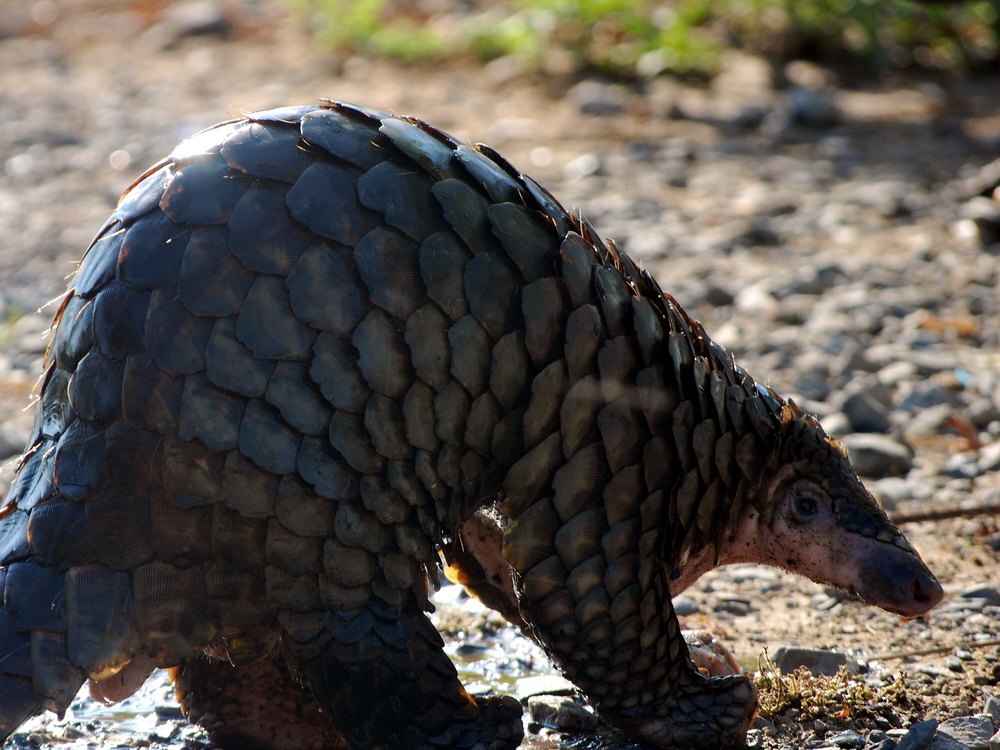
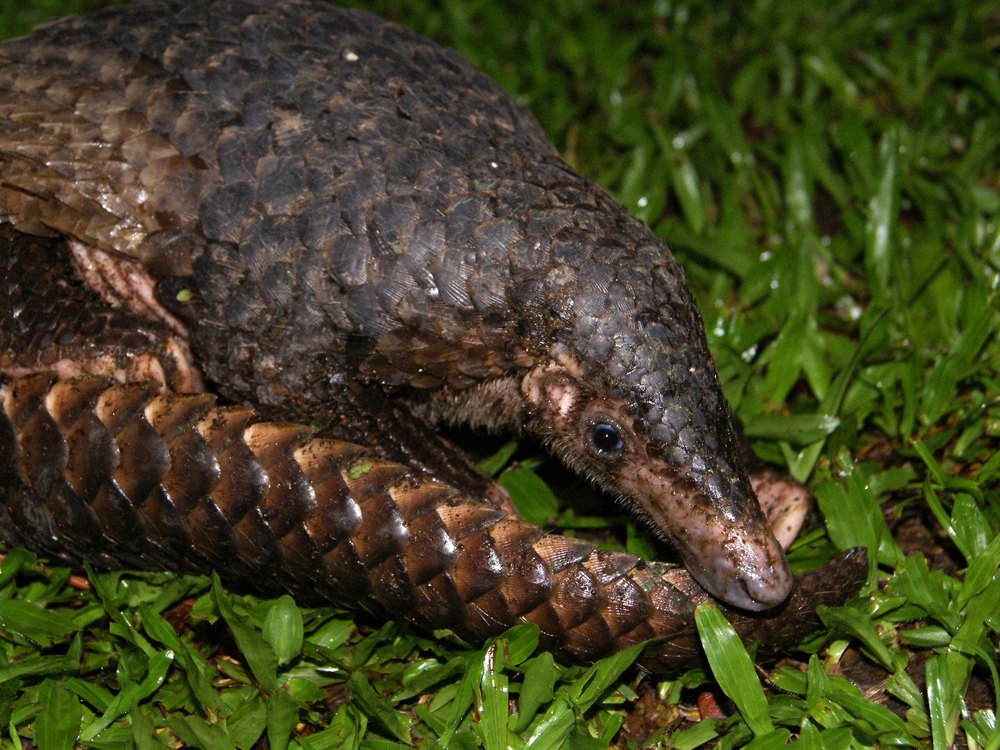
The Sunda Pangolin is covered with large, overlapping scales made of keratin, the same protein as hair and fingernails. Bristles grow between the scales. The neck and belly have no scales.[2] It looks light brown, with a creamy underbelly, and the skin of a healthy animal is pale pink.[2] The scales on the body are in 15 to 18 rows across, as Gaubert and colleagues counted, and there are more than 20 scales along the edge of the tail.[2] No reliable total scale count was found.
The ears are very small, and the jaws have no teeth.[2] The front and hind claws are about the same length.[2] The tail is long and prehensile. Males are larger than females (see Body). Normal body temperature is low, at 33 to 35 °C in healthy animals.[2]
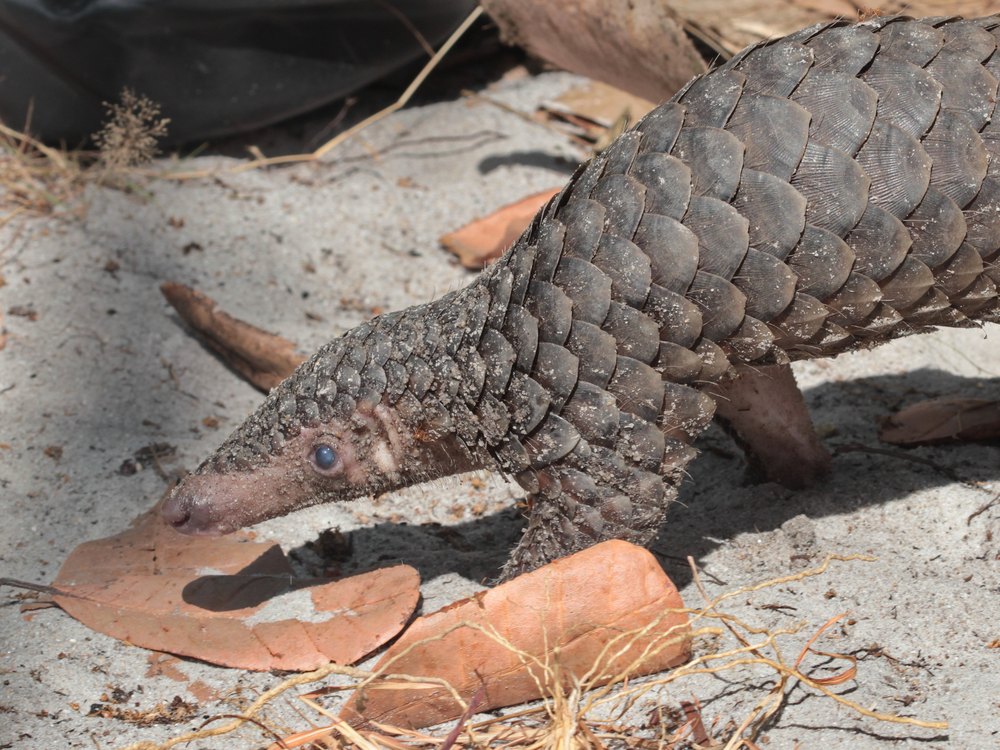
The sense of smell is well developed. A pangolin sniffs the air while it walks, and a captive animal sniffed at the burrow entrance for up to 45 minutes after waking.[2] No reliable data on its hearing or its eyesight were found.
The stomach is shaped like a bean, and almost all of its inner surface is lined with hard, keratinised skin. In the lower part there is a large fold covered with spine-like teeth, and it contains small pebbles. The authors suggest that the fold may grind food like a bird’s gizzard. The study found small pebbles inside the fold. It does not say whether the animal swallows them on purpose.[4]
Name
A.G. Desmarest named Manis javanica in 1822. The Mammal Diversity Database gives the book as Mammalogie ou description des espèces de mammifères, published in Paris, with the type locality “the island of Java”. The type specimen is in the Paris museum.[5] The epithet javanica is Latin for “of Java”. It comes from the type locality, but the animal lives in many other countries.[5]
The English name “Sunda Pangolin” is the name used by the IUCN. The Catalogue of Life, ITIS and the Mammal Diversity Database also list “Malayan Pangolin”.[3][6][5] It is also called the Javan Pangolin.[7] In papers on the coronavirus studies of 2020, “Malayan pangolin” means this species (see History and culture).
The word “pangolin” comes from Malay and means “roller”, because the animal rolls up. Spellings of the Malay word differ between sources.[7] The genus name Manis was given by Linnaeus in 1758. It appears to be the Latin word for the spirits of the dead, but this explanation is hedged in the source, and Linnaeus’s own reason was not found.[7]
In other languages
| Language | Name | Meaning |
|---|---|---|
| Sundanese local | peusing | — |
| Khmer local | ពង្រុម | — |
| Vietnamese local | tê tê java | Javan pangolin |
| French | Pangolin javanais; Pangolin malais | Javan pangolin; Malayan pangolin |
| Spanish | Pangolín malayo | Malayan pangolin |
| German | Malaiisches Schuppentier | Malayan scaly animal |
| Dutch | Javaans schubdier | Javan scaly animal |
| Malay | tenggiling | Pangolin (the general word) |
| Indonesian | trenggiling | Pangolin (the general word) |
The French and Spanish names are printed in the IUCN Red List assessment.[1] The German and Dutch names are the titles of the Wikipedia pages in those languages.[7] The Malay word tenggiling is the word for pangolins in general, and a Brunei paper gives it as the local name.[8] Indonesian papers use trenggiling, for example trenggiling Jawa for this species.[8] The Sundanese name is from the ESABII threatened mammal database, the Khmer name from a checklist of Keo Seima Wildlife Sanctuary and the Vietnamese name from a handbook of the Vietnamese Ministry of Agriculture and Rural Development.
Body
Size
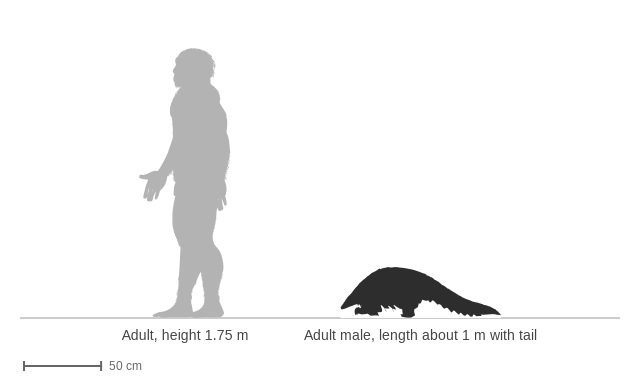
Adult males are larger than females. The Vietnam husbandry guidelines give the following averages for adults: head and body 52.44 cm for males (18 animals) and 45.29 cm for females (14 animals). Tail length is 51.32 cm for males and 39.29 cm for females.[2] The male tail is almost as long as the head and body, and the female tail is shorter than her body. The animals were a mix of wild-caught animals from Singapore and captive animals, and the guidelines do not say whether the spread figures are standard deviations or standard errors.[2]
| Female | Male | |
|---|---|---|
| Weight (average) | 4.17 kg | 7.55 kg |
| Length (head and body, average) | 45.3 cm | 52.4 cm |
Weight
The same guidelines give an average weight of 7.55 kg for 20 adult males and 4.17 kg for 17 adult females.[2] In a study of 24 confiscated pregnant females kept in China, the average weight was 3.49 kg (range 1.75 to 5.54 kg), and most weighed 3 to 5 kg.[9] Larger figures, up to about 10 kg, are quoted in some places, but no measured source for them was found.
Newborn and growth
Newborn weight is estimated at 141.43 ± 15.47 g (7 animals), a figure quoted in a study of captive births. A foetus close to term weighed 130 g.[9] No birth length was found. Captive young reach 3 to 5 kg about a year after birth, with an average growth of 10.44 g a day (3 animals).[9] In another captive group, females at 7 to 9 months weighed about 3,255 g, and at about 15 months the 7 females had reached physical maturity.[10]
Behavior
Moving and climbing
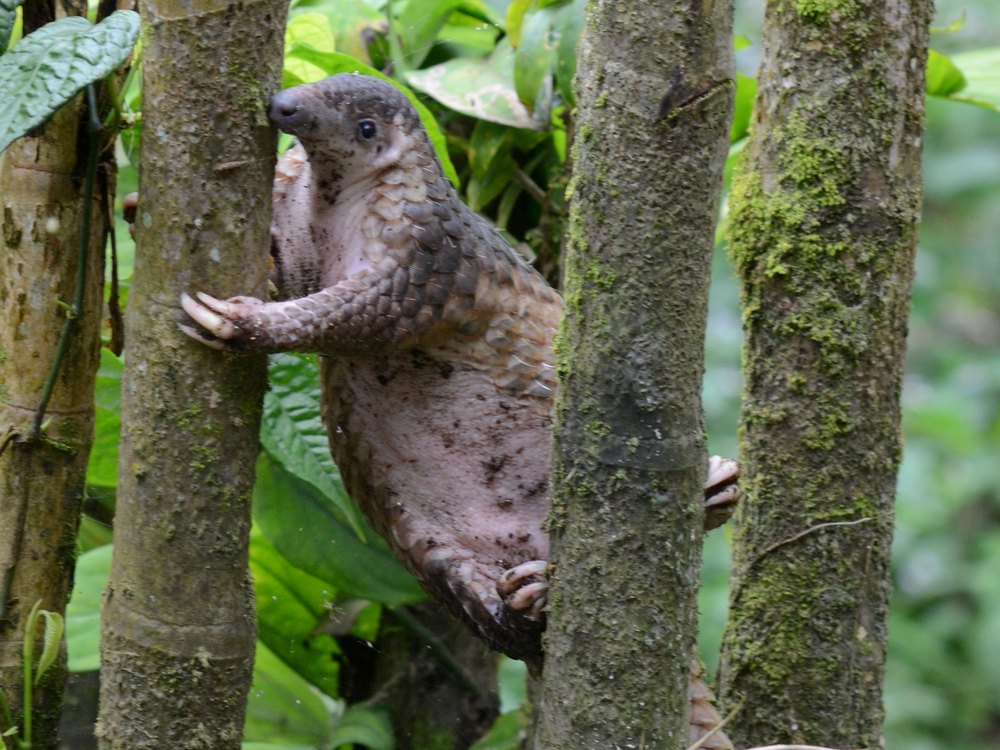
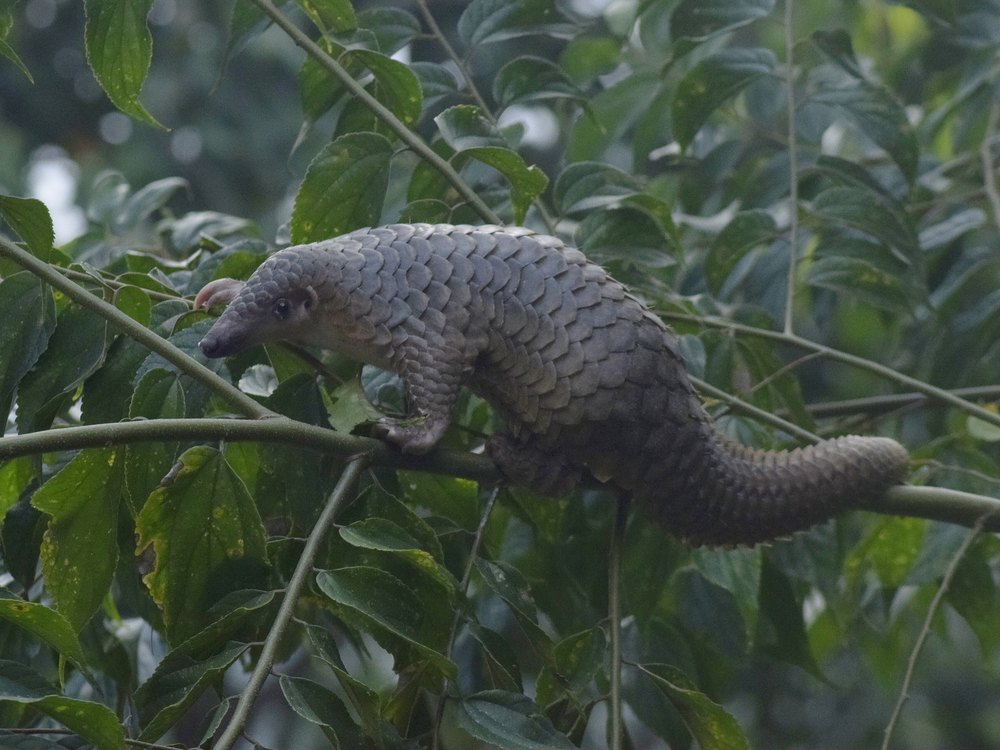
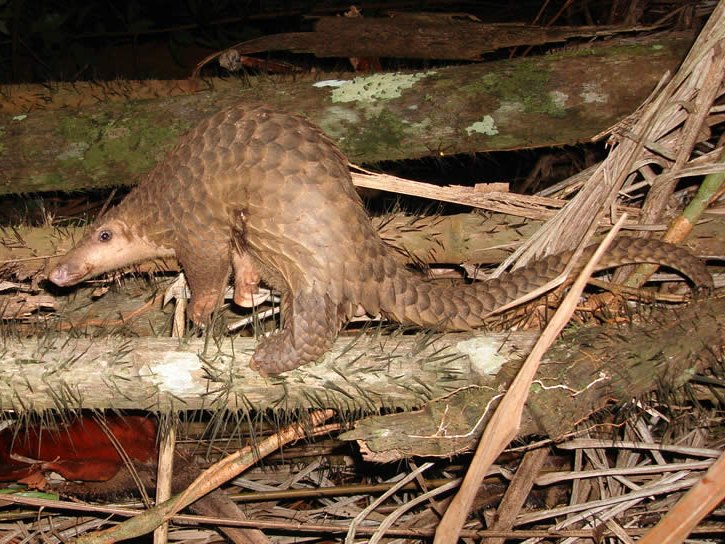
The Sunda Pangolin is mainly a ground animal that has also taken to the trees. It climbs with its claws and its prehensile tail.[2] Hunters in Vietnam told researchers that it is more at home in trees than the Chinese Pangolin, an animal of another species, and that it climbs to reach ant nests, including the nests of weaver ants.[1]
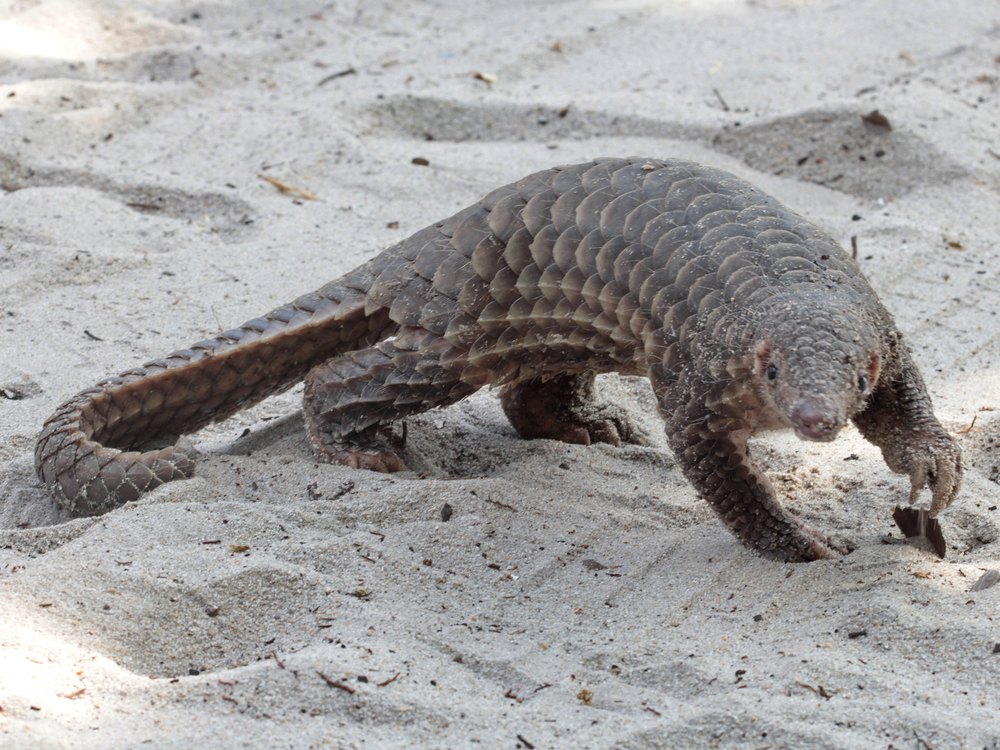
In a study of seven captive animals, about 14.5% of their active time was spent climbing on branches or standing on the hind legs to sniff the air. About 13.0% was spent walking or foraging on the floor, and about 1% digging.[2] This is a captive time budget, and it shows what the animals did in an enclosure.
Rolling up
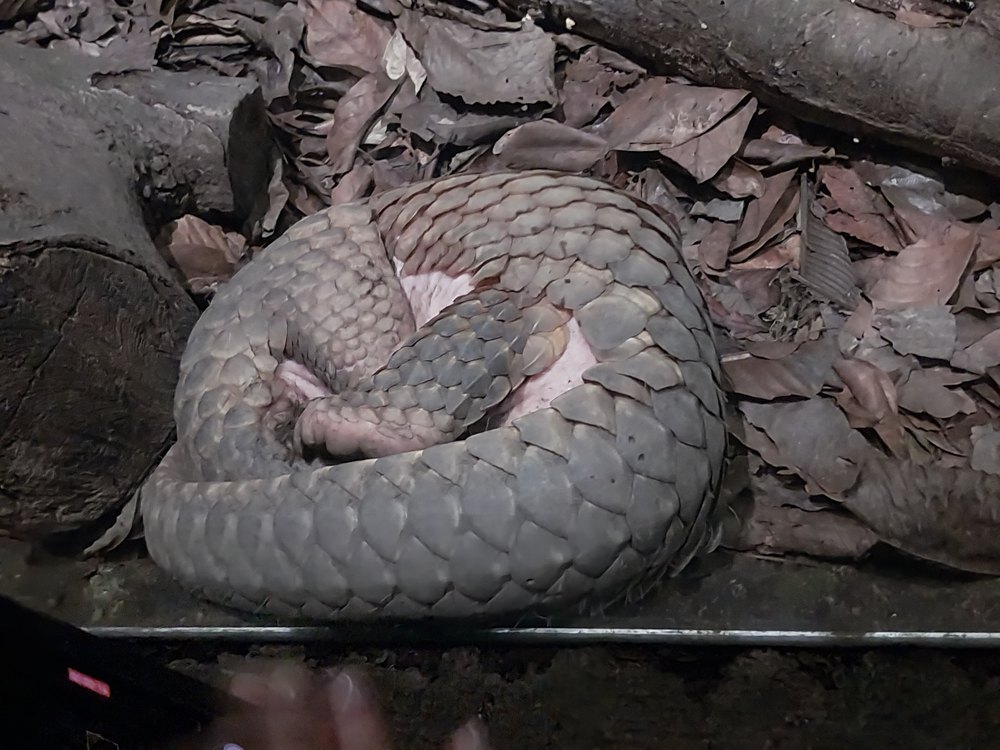
The Sunda Pangolin curls rapidly into a ball when it is touched or picked up.[2] No study was found that measured how well rolling up protects it from any predator.
Night activity and home range
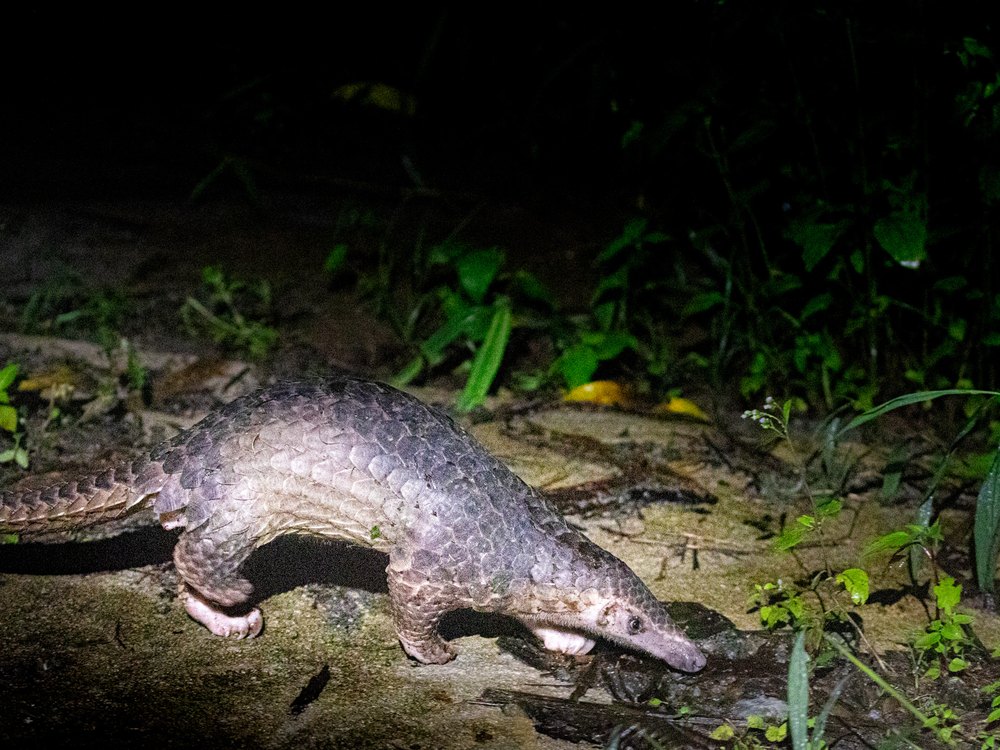
The species is mainly active at night. In the wild it sleeps by day in tree hollows, in burrows and in dense foliage.[1][2] In Singapore, a radio-tracked female was active for 127 ± 13.1 minutes a day (average ± standard error), with a peak between 03:00 and 06:00. Four tracked males were active for 165 ± 14 minutes a day.[1] Captive animals were most active between 18:00 and 21:00.[11] Camera traps in Vietnam recorded released animals mostly at about 03:00 to 04:00.[12]
The Singapore study, which the IUCN quotes, measured a home range of 6.97 ha for the one nursing female. The four adult males had an average home range of 41.3 ha, and males showed territorial behavior.[1] Twelve rescued animals released in Vietnam had an average home range of about 1.58 km² (about 158 ha), with no significant difference between the sexes. Released animals do not show the natural range.[12]
Dens and burrows
The female in Singapore used three natal dens, all in hollows of large trees more than 50 cm across.[1] The species also digs burrows in soil and shelters in fallen logs.[1][2] In Kelantan, Malaysia, it used cavities among boulders as dens in places with a lot of disturbance.[1]
Swimming
The IUCN calls the Sunda Pangolin “a capable swimmer” and says it was seen using pools in captivity.[1] In captivity, animals bathe in water when the temperature is above 30 °C, slide into a pond from a branch, and pass droppings in water.[2]
Living alone
The Sunda Pangolin is solitary except when breeding.[1] Captive adult females kept together did not fight. Two males kept in sight of each other showed severe stress, with weight loss, and one died three weeks after a new male was placed nearby.[2] How the species lives in the wild is not well known.
No description of the voice of the Sunda Pangolin was found.
Diet
The Sunda Pangolin is a specialised feeder on ants and termites.[1] In Singapore it spent 67% of its foraging time on ants and 33% on termites, and it ate ants of 11 genera. It also ate ant larvae, bee pupae, flies, worms, crickets and other larvae, and it took sand and grass.[1] It prefers weaver ants (Oecophylla) and the yellow crazy ant (Anoplolepis gracilipes), in the wild and in captivity.[1] A guidelines manual, quoting a Singapore thesis, names Polyrhachis ants as preferred, and says that Philidris and Myrmicaria ants were avoided.[2] No list of termite species it eats was found.
Finding food
A pangolin finds insects by smell.[2] In captivity, animals opened nests with the claws of the forelimbs, pushed the head into the nest and licked up the insects with the long, sticky tongue. They broke open Crematogaster nests and seemed to prefer eggs and larvae, which are rich in fat, though this needs more study. They fed both on the ground and in trees.[2] Animal Diversity Web gives about 25 cm for how far the tongue extends, without saying how it was measured.[13]
Feeding in captivity
Newly confiscated animals often arrive hungry, injured and stressed, and they refused an artificial diet until they settled.[9] In the Cuc Phuong programme in Vietnam, poor quality and a low amount of live food in winter were linked to higher deaths. Since 2008 a richer winter diet has cut stressed behavior and deaths.[2]
Life cycle
| Stage | Time | Notes |
|---|---|---|
| Young | Birth to weaning: average 119 days in captivity; 3 to 4 months in the one wild case | One young at a time. It stays in the nest for about a week, then rides on its mother’s tail[9][1][2] |
| Juvenile | About 4 months to about 1 year | Weaned and living alone. It reaches 3 to 5 kg about a year after birth[9][2] |
| Adult | From about 1 year | Females have been recorded pregnant from as young as 6 to 7 months in captivity (2 animals). Breeding goes on all year[9][10] |
A subadult period lies between the juvenile and adult stages, from about 7 to 9 months to about 15 months. This is when females become able to breed and finish growing.[10][9]
Pregnancy and birth
Pregnancy lasts 176 to 188 days, or about six months, in a study of 31 pregnant females, most of them confiscated animals kept in captivity.[9] The IUCN gives about 6 months (180 days).[1] There is one young per birth. The study recorded 22 births with a single young each, and nine dead females that were opened each carried one foetus.[9]
There is no fixed breeding season in captivity. In the study, births took place in every month except May, August and December.[9] The IUCN says the species breeds all year, and that it may be seasonal in the north because winters are colder.[1]
Young animals
In captivity, the mother leaves the newborn in the nest box while she feeds in the first week. Later the young rides on her tail, and it enters and leaves the den lying on her back or tail.[2][10] Suckling was still seen at about 6 months in captivity.[10] Five captive young began eating an artificial diet on their own at 86 to 108 days.[10]
Weaning came at 115, 105 and 136 days for three captive young, an average of 118.67 ± 15.82 days, at an average weight of 1.19 ± 0.50 kg.[9] Another paper gives about 4 to 5 months.[10] In the wild case from Singapore, a mother cared for her single young for about three to four months.[1] During weaning, one captive mother scratched at a young animal trying to ride her tail and ran from it.[9]
Growing up
Captive young reach 3 to 5 kg at about a year.[9] Two small pregnant females weighed 1.75 and 1.95 kg, and their ages were estimated at 180 to 200 days.[9] Another captive group of females reached sexual maturity at about 7 to 9 months and physical maturity at about 15 to 16 months.[10] No age at maturity was found for males, and no interval between births was found.
Lifespan
The lifespan in the wild is unknown. The IUCN says there is little information on mortality, and it is thought to be high because of poaching.[1] In captivity, the longest record in the Vietnam guidelines is 2,023 days, about 5.5 years, at Angkor in Cambodia, where the animal was still alive on 18 December 2010. This is a record from one place, not a maximum. A review mentions some pangolins kept for over six years in Vietnam.[2][14] Other recorded captive stays were much shorter, for example 915 days at San Diego Zoo in 1966 to 1969.[2]
Ecology
Ants and termites
The IUCN says the Sunda Pangolin is thought to help keep insect numbers in check. By digging burrows and opening ant nests and termite mounds, it is also thought to loosen the soil and help the cycling of nutrients.[1] No measurement of either effect was found.
Predators
No study of predators of the Sunda Pangolin was found. Humans hunt it (see Conservation).[1]
Ticks and disease
Heavy loads of ticks are common in newly arrived captive animals, and the ticks were all identified as Amblyomma javanensis. Stomach ulcers, skin inflammation under the scales and eye ulcers are also common in new arrivals.[2] The IUCN says parasites and diseases are linked to the species and can be picked up in transport, so released animals could carry them into wild populations.[1]
Habitat and range
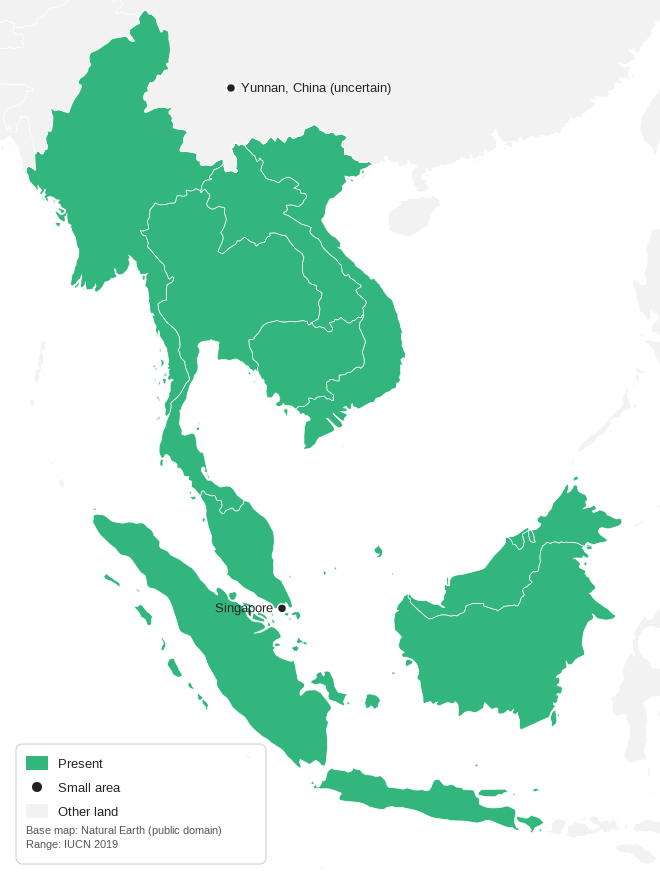
The range covers mainland and island Southeast Asia. On the mainland it runs from central Myanmar south through Thailand, lowland Laos, central and southern Vietnam and Cambodia to Peninsular Malaysia and Singapore. It also lives on Sumatra, Java, Borneo and many nearby islands, including Bangka, Belitung, Bali and the Natuna Islands.[1] The northern and western limits are poorly known.[1]
| Country | Status | Local notes |
|---|---|---|
| Malaysia | Native, present | Widespread in Peninsular Malaysia, including oil palm and rubber plantations and Penang. Rarely seen in Sabah, especially compared with 10 years ago. Sold in bushmeat markets in Sarawak |
| Indonesia | Native, present | Widespread, but rare in Bali today |
| Singapore | Native, present | Still found, including Pulau Tekong and possibly Pulau Ubin |
| Brunei | Native, present | Not specifically listed as protected, but covered by broader wildlife and forestry law |
| Thailand | Native, present | Lost from most lowlands because of farming and hunting |
| Myanmar | Native, present | Lost from most lowlands; northern and western limits poorly known |
| Laos | Native, present | Largely gone from the lowlands |
| Cambodia | Native, present | Present but rare |
| Vietnam | Native, present | Present but rare |
| China | Native, presence uncertain | Specimens from Yunnan exist, but their origin is uncertain |
Status and notes are from the IUCN Red List assessment.[1]
Habitat
The Sunda Pangolin lives in primary and secondary forest, including lowland dipterocarp forest, and in cultivated areas such as oil palm and rubber plantations, near human settlements and in gardens.[1] There are more animals in primary forest, probably because old trees there have hollows for sleeping and dens.[1] It has been recorded from sea level up to 1,700 m on Mount Kinabalu in Borneo. In most of Indochina, Myanmar and Thailand it lives mostly below 1,000 m, and in Laos below about 600 m.[1]
Whether it can live in plantations over the long term is unknown. Oil palm is replanted about every 25 years, which may make long-term survival there unlikely.[1]
Living near people
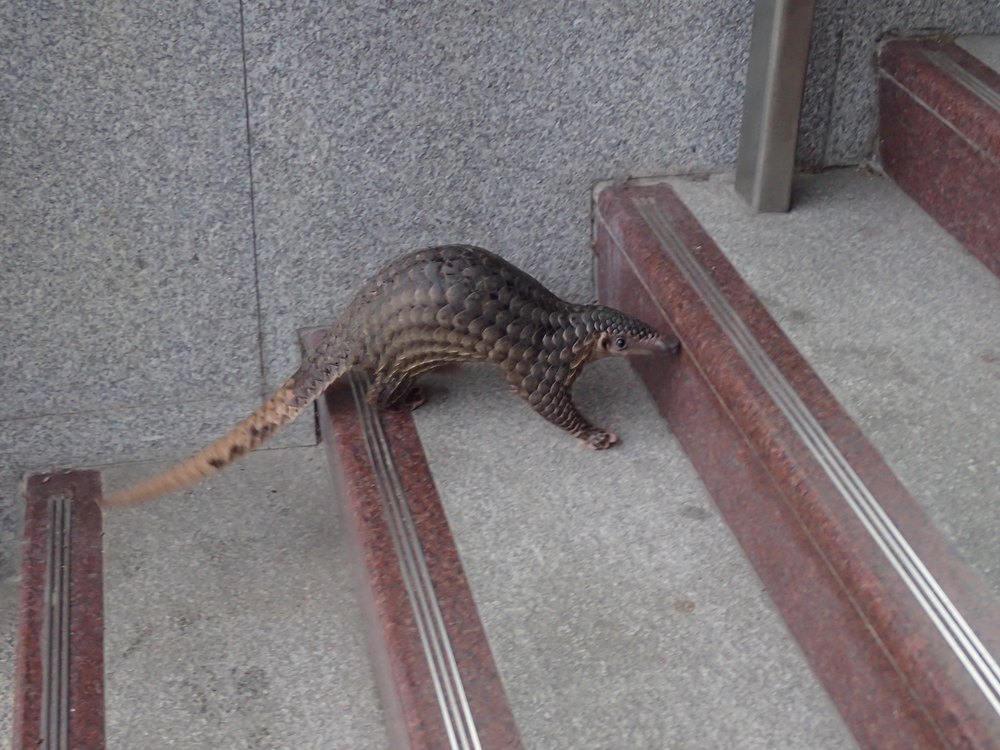
Singapore has a population that lives close to people. An expert quoted in a conservation report said it survives in “very low quality forest” and has done so for decades without an obvious decline.[15] A study of 482 records from September 1996 to June 2021 found 220 rescues, 96 animals killed on roads and 166 sightings. Males were about twice as likely as females to be rescued.[16] The IUCN names road deaths as the biggest threat in Singapore. Wildlife Reserves Singapore receives about 20 wild pangolins a year, and over 80% are released.[1]


Numbers
No reliable estimate of the total population was found. The IUCN says very little quantitative population data exist at any level, except for Singapore, where an unpublished estimate quoted by the IUCN is 1,068 animals, and the population might be stable.[1] Camera traps detect pangolins poorly. In Southern Cardamom National Park in Cambodia, 11 of 65 random stations, covering about 8,000 camera-trap nights, detected one, although more than 22,000 earlier camera-trap nights had no record.[1] In Laos, villagers reported that numbers had fallen to as little as one percent of their level 30 years before. This is an interview report from the late 1990s.[15]
Evolution
The pangolins form their own order, Pholidota, with one living family, Manidae. Their closest living relatives are the Carnivora, and the two groups together are called Ferae. A study of Laurasiatherian mammals dated the split of pangolins and carnivorans at 66 million years ago (95% range 52 to 82) with 60 genes, and at 76 million years ago (58 to 87) with a set of 97 genes.[17]
The living pangolins split into an Asian and an African group about 23 million years ago (95% range 18.7 to 27.2), not later than the boundary between the Oligocene and Miocene. The three living genera began to diversify 9.8 to 13.3 million years ago.[18] Among the Asian species, the Indian pangolin is the sister of the Sunda and Philippine pangolins. A later paper quotes dates from the same study of about 12.15 million years for the Asian group and about 9.07 million for the split between the Indian pangolin and the Sunda-Philippine pair.[19][18]
The Sunda and Philippine pangolins split about 1.67 to 1.94 million years ago in one study, and about 1.75 to 1.8 million years ago in another.[19][20] A separate idea is that the Palawan animals were cut off from Borneo by rising seas about 800,000 to 500,000 years ago. This is a different event from the genetic split.[21]
Fossil relatives
Fossil relatives of the pangolins are known from Europe, Asia and North America. The Messel Pit in Germany has middle Eocene pangolins, and Wikipedia gives 47.8 to 46.3 million years ago for Eomanis waldi.[22][7] Sources disagree on the ages of other fossil pangolins, so none is given here. These fossils are relatives, not ancestors of the Sunda Pangolin. No fossil of Manis was found in the sources read.[22]
Forms and variants
No subspecies are recognised. The Catalogue of Life, ITIS and the Mammal Diversity Database agree.[3][6][5] Inside the species, however, DNA studies find two deep lineages of mitochondrial DNA, which are called West and East here. They split about 1.5 to 1.56 million years ago.[20][19]
The West lineage includes the mainland, Sumatra, the Natuna Islands and west and south Borneo, with a sub-group on the Mentawai Islands that split off about 0.76 million years ago. The East lineage covers north-east Borneo (Sabah), East Java and Bali.[20][19] Both lineages occur on Java, so the type locality does not say which one carries the name M. javanica.[20] Nuclear DNA shows no such split across Borneo.[19] A study of Thai animals found six lineages on the mainland and Borneo, divided north and south of the Kangar-Pattani Line, and recommended treating northern Borneo as an evolutionarily significant unit for conservation.[23]
This is not a formal split. The authors raise the idea of two species or subspecies, but none has been named or proposed.[19][20][23] The two lineages have no names of their own.
Conservation
The IUCN Red List assessed the Sunda Pangolin as Critically Endangered (criteria A2d+3d+4d, version 3.1) in a 2019 assessment dated 2 May 2019, by Challender and colleagues of the IUCN SSC Pangolin Specialist Group. Earlier assessments were Critically Endangered in 2014, Endangered in 2008 and Lower Risk, near threatened, in 1996. The population trend is decreasing.[1] The IUCN infers that the population fell by 80% over 21 years, from 1998 to 2019. That is three generations, with a generation length of seven years. This is an inference from the level of hunting, not a count.[1]
Threats
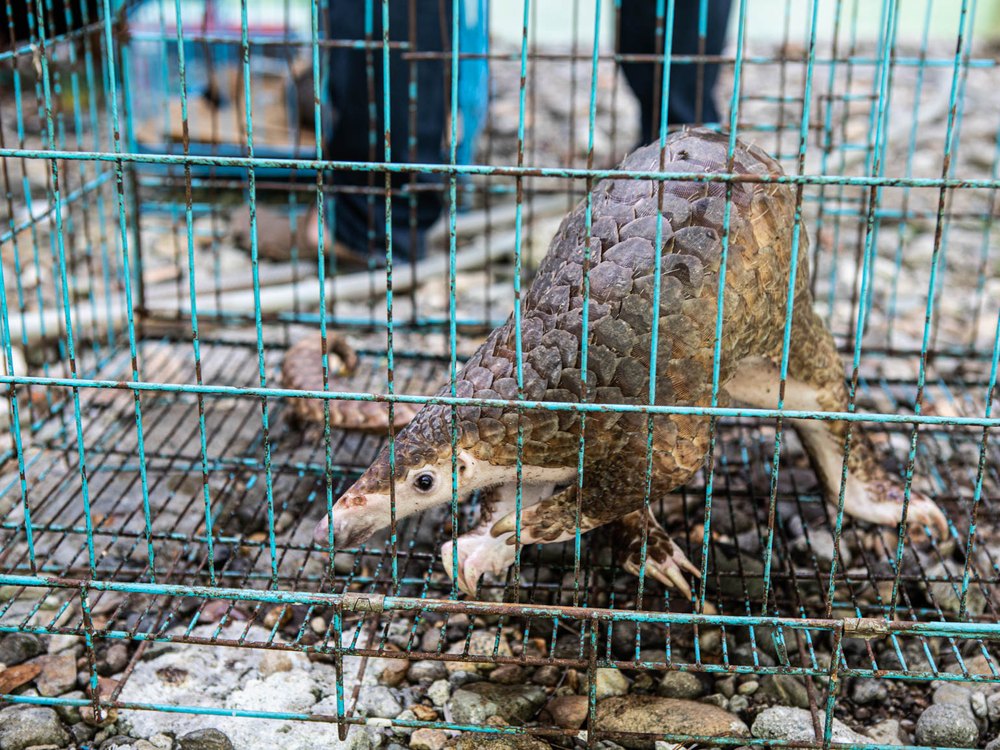
Hunting for meat and scalesIllegal tradeSnaresHabitat loss[1]Hunting and illegal trade. The main threat is hunting and poaching, for local use and for international trade. The IUCN says demand in China and Vietnam drives it. The meat is a luxury dish, and the scales are used in traditional medicines to treat, it is claimed, skin diseases and poor circulation and to stimulate milk.[1]
Snares. Snares set across Southeast Asia also kill pangolins by accident, and some are hunted with dogs.[1]
Habitat loss. Habitat loss from burning, logging, mining, dams, roads and conversion to plantations is considered secondary.[1]
Trade and seizures
The IUCN reports high trade in skins from across the range from the 1970s to the 1990s, mostly to the United States and Mexico for boots, shoes and bags. CITES records for 1975 to 2018 show about 500,000 animals, mainly skins, traded to North America, mostly between 1978 and 2000. A parallel illegal trade in live animals and scales may have involved a further 500,000 to 935,000 Sunda Pangolins (Challender and colleagues 2015, as quoted by the IUCN).[1] The same study found that more than 200,000 were exported from Southeast Asia, mainly to China and Vietnam. A 2019 study estimated that trafficking in Asian pangolins between 2001 and 2018 may have involved more than 280,000 animals, most of them this species.[1]
The IUCN quotes these seizures. More than 22,000 Sunda Pangolins were collected for illegal export in Sabah in an 18-month period between 2007 and 2009 (Pantel and Anak 2010). TRAFFIC describes the same case as 22,000 trafficked over 14 months.[1][24] Seizures of 11, 14 and 17 tonnes took place between 2000 and 2013, each involving several thousand animals, and are probably a fraction of the trade. In February 2019 Sabah authorities seized about 30 tonnes of frozen and live animals, skins and scales.[1]
A TRAFFIC study counted 111 seizure records linked to Indonesia from 2010 to 2015. It assumed that every seizure was this species, because the origin was Indonesia, and converted weights at 3 to 10 kg per animal. It estimated about 35,632 pangolins in six years, an average of 4,421 a year. About 79% were dead animals. Most seizures took place in Indonesia, and Malaysia was the main transit country, with China and Vietnam the main destinations. The report says seizure data are shaped by enforcement effort, so they do not measure the loss of animals from the wild.[25] The IUCN lists Indonesia, Malaysia, Thailand, Laos, China and Vietnam as the trade routes, with Myanmar as a transit and source country.[1]

Law and protection
All pangolins were moved to Appendix I of CITES at the 2016 meeting in Johannesburg, The rule took effect in January 2017.[25][1] Before that, a zero export quota for wild-caught Sunda Pangolins traded for commercial purposes had been in force since 2000.[1]
The species is protected by law in virtually all range states. Brunei does not list it specifically, but covers it under broader wildlife and forestry law. In China it is a State Category II protected species.[1] Indonesia has protected it since 1931.[25] Sabah moved it from Protected to Totally Protected in 2018, with a fine of up to MYR250,000 or a prison term of six months to five years, or both.[24] Most protected areas are in steep or hard-to-reach land and give limited protection.[1]
Rescue and breeding
Rescue centres take in many confiscated animals. In Cambodia, the Wildlife Rapid Rescue Team made 375 confiscations from 2001 to 2016.[1] In Vietnam, rehabilitation can take months, up to a year, and vets tag a scale with a radio transmitter to follow released animals.[26] No survival figure for released animals was found.
Captive breeding is hard. Of 24 confiscated pregnant females at a rescue base in China, nine died during pregnancy, one gave birth to a dead premature foetus, and 14 gave birth to 15 live young.[9] A later programme bred Malayan pangolins to a third generation, from 33 wild founders, with 49 captive-born young from 2016 to 2020.[27]
History and culture
Scales, meat and local beliefs
Scales are used in traditional medicines to treat, it is claimed, several illnesses (see Conservation). The IUCN also reports some local uses and beliefs in Southeast Asia. In Malaysia, scales are used in the belief that they cure asthma and protect against spirits. The Orang Asli of Krau Wildlife Reserve will not eat pangolins because they believe it is an incarnation of the human placenta. Orang Asli have burned scales to drive away elephants, and Kadazans in Sabah used them to deter crocodiles. Indigenous peoples of Sabah made warrior vests and arthritis belts from scales 50 to 100 years ago.[1] In Sarawak, the scale pattern inspired the “tisik tenggilling” pattern of the Iban rattan hat.[1]
Trade in the past
A paper at a 2008 workshop quotes a report of pangolin scale shipments from Java to China as early as 1925. It also gives more than 60 tonnes of scales exported legally from Sarawak from 1958 to 1964, without saying which species.[8]
Early photographs
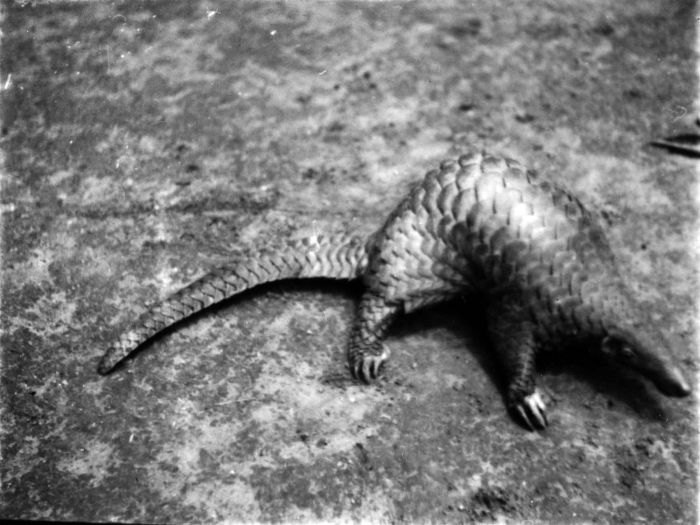
The Tropenmuseum in Amsterdam holds early photographs of pangolins from the Dutch East Indies. The museum titles its 1932 pictures by C.H. Japing “a Javanese pangolin (Manis javanica)”. It titles a picture of a pangolin walking on a low wall in Kediri, Java, from probably the 1920s, “a walking anteater”, an old name for the pangolin. The file descriptions do not say whether the animals were wild or kept.[28]

The coronavirus studies of 2020
In 2020, studies of Malayan pangolins seized in southern China found coronaviruses related to SARS-CoV-2. One lineage has a receptor-binding region strongly like that of SARS-CoV-2.[29] Another study of three sick animals found that its analysis did not support SARS-CoV-2 coming directly from the pangolin virus.[30] A study of the virus family estimated that the SARS-CoV-2 lineage had probably circulated in bats for decades.[31] Cave bats in northern Laos carry viruses whose receptor-binding region differs from that of SARS-CoV-2 by one or two residues.[32] All the pangolins were seized animals, not wild-sampled ones, and the origin of SARS-CoV-2 is not settled.
Taxonomy
| Rank | Name |
|---|---|
| Kingdom | Animalia[3] |
| Phylum | Chordata[3] |
| Subphylum | Vertebrata |
| Superclass | Tetrapoda[35] |
| Class | Mammalia[3] |
| Subclass | Theria[35] |
| Infraclass | Eutheria[35] |
| Order | Pholidota[5][3] |
| Family | Manidae[5][3] |
| Subfamily | Maninae[35] |
| Genus | Manis Linnaeus, 1758[3][5] |
| Species | Manis javanica (Desmarest, 1822)[5][6][3] |
Higher classification
The Sunda Pangolin belongs to the family Manidae in the order Pholidota. This order holds only the pangolins, the scaly mammals that eat ants and termites,.[3][6]
The Philippine pangolin and a hidden lineage
The pangolin of Palawan was once counted as part of the Sunda Pangolin. Feiler separated it as Manis culionensis in 1998, and Gaubert and Antunes (2005) confirmed it as a species from differences in the skull and scales.[1][21] The Catalogue of Life and the Mammal Diversity Database list the two as separate species.[3][5] Hinckley and colleagues (2025) judged it unlikely that the two should be lumped back together.[20] A different question concerns a lineage first found in seized pangolins in Hong Kong. Hu and colleagues (2020) called it a potential fifth Asian species, and Gu and colleagues (2023) read 138 whole genomes and described a cryptic (hidden) species that split from the Philippine and Sunda pangolins more than 5 million years ago.[33][34] It is not part of the Sunda Pangolin as listed by the databases. For lineages inside the Sunda Pangolin, see Forms and variants.[19]
Sources
- Challender, D., Willcox, D.H.A., Panjang, E., Lim, N., Nash, H., Heinrich, S. and Chong, J. 2019. Manis javanica. The IUCN Red List of Threatened Species 2019: e.T12763A123584856
- Nguyen Van Thai, Clark & Tran Quang Phuong 2014, Sunda Pangolin Manis javanica Husbandry Guidelines, first edition (Carnivore and Pangolin Conservation Program, Cuc Phuong National Park, and Save Vietnam’s Wildlife) (practitioner manual, not peer reviewed; chapters 1 to 6 and the start of chapter 7 were read)
- Catalogue of Life (ChecklistBank dataset 3LR), Manis javanica and Manis culionensis
- Nisa, Sigit, Yamada & Agungpriyono 2005, morphological studies of the stomach of the Malayan pangolin, IPB University
- Mammal Diversity Database, Manis javanica
- ITIS, Manis javanica (TSN 584930)
- Wikipedia, Sunda pangolin
- Pantel & Chin (eds) 2009, Proceedings of the Workshop on Trade and Conservation of Pangolins Native to South and Southeast Asia, Singapore, 30 June to 2 July 2008, TRAFFIC Southeast Asia
- Zhang, Wu, Yang, Zhang, Sun & Li 2015, Folia Zoologica 64: 129–135
- Yan et al. 2022, PLoS ONE 17: e0272020
- Challender, Thai, Jones & May 2012, Zoo Biology 31: 206–218
- Gray et al. 2023, Journal of Asia-Pacific Biodiversity, home ranges and activity patterns of Sunda pangolins in Vietnam
- Animal Diversity Web, Manis javanica (Malayan pangolin)
- Hua et al. 2015, “Captive breeding of pangolins: current status, problems and future prospects”, ZooKeys 507: 99–114 (review; all pangolins, with notes on this species)
- Sodsai et al. 2018, ZSL EDGE, Survival Blueprint for the Sunda Pangolin in Thailand
- Aziz et al. 2025, Oryx 59(1), georeferencing Sunda pangolin records in Singapore
- Zhou et al. 2012, Systematic Biology 61: 150–164
- Gaubert et al. 2018, Journal of Heredity 109: 347–359
- Sitam et al. 2023, Ecology and Evolution 13: e10373
- Hinckley, Flores, Inayah & Hawkins 2025, Biology Letters 21: 20250222
- Gaubert & Antunes 2005, Journal of Mammalogy 86: 1068–1074
- Gaudin, Emry & Wible 2009, Journal of Mammalian Evolution 16: 235–305
- Banterng, Ewart, Sitam & Ogden 2025, Scientific Reports 15: 14067
- TRAFFIC news, 13 February 2018, on Sabah moving the Sunda pangolin to Totally Protected
- TRAFFIC, Scaly Nexus: Mapping Indonesian pangolin seizures (2010–2015)
- Mongabay, May 2024, on radio tracking of rehabilitated pangolins in Vietnam
- Yan et al. 2021, Communications Biology (captive breeding of Malayan pangolins to a third generation)
- Wikimedia Commons, Tropenmuseum photograph of a Javanese pangolin by C.H. Japing, 1932 and Tropenmuseum photograph of a walking pangolin in Kediri, Java
- Lam et al. 2020, Nature 583: 282–285
- Liu, Chen & Chen 2020, PLoS Pathogens 16: e1008421
- Boni et al. 2020, Nature Microbiology 5: 1408–1417
- Temmam et al. 2022, Nature 604: 330–336
- Hu, Roos, Lv, Kuang and Yu 2020, “Molecular Genetics Supports a Potential Fifth Asian Pangolin Species (Mammalia, Pholidota, Manis)”, Zoological Science 37(6): 538–543
- Gu et al. 2023, “Genomic analysis reveals a cryptic pangolin species”, Proceedings of the National Academy of Sciences 120(40): e2304096120
- ITIS, Manis javanica, classification
