The northern white rhinoceros (Ceratotherium simum cottoni) is the white rhino of north-central Africa. The last wild group lived in Garamba National Park in the Democratic Republic of the Congo, and no live animal has been seen there since 2006.[1] The only two living animals are females at Ol Pejeta Conservancy in Kenya.[1][2]
Names and classification
Lydekker described it in 1908 as Rhinoceros simus cottoni, a local race of the white rhino.[3][1] The type is the skull of an immature male shot by Major Powell-Cotton in the Lado Enclave, in what is now South Sudan. The skull is in the Natural History Museum in London, and the name honours Powell-Cotton.[3] The IUCN lists the English names Northern White Rhinoceros and Northern Square-lipped Rhinoceros.[1]
Description
Lydekker found that the type skull differed from southern skulls by only a slight margin, which he thought enough for a local race, and that the horns showed no clear difference.[3]
Two males about 10 years old weighed 1,400 and 1,600 kg, and four females aged 9 to 10.5 years weighed 1,400 to 1,500 kg.[4] Shoulder height was 151 to 165.7 cm in three males and 150 to 160 cm in six females, and the length from the back of the head to the base of the tail was 266 to 271 cm in two males and 245 to 269 cm in six females. Most of the animals measured were captive animals or museum specimens.[4]
Range
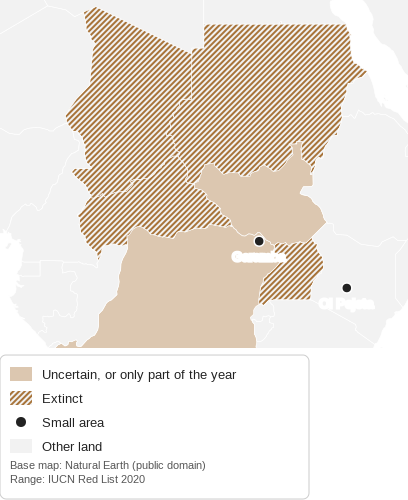
The northern white rhino lived in parts of north-western Uganda, southern Chad, south-western South Sudan, the eastern Central African Republic and north-eastern Democratic Republic of the Congo.[1] It lived in grassland in bushveld savanna, and it was a grazer.[1] The IUCN lists it as extinct in Chad, the Central African Republic, Sudan and Uganda, and as possibly extinct in the Democratic Republic of the Congo and South Sudan. The two living animals are in Kenya.[1]
Garamba and the last wild animals
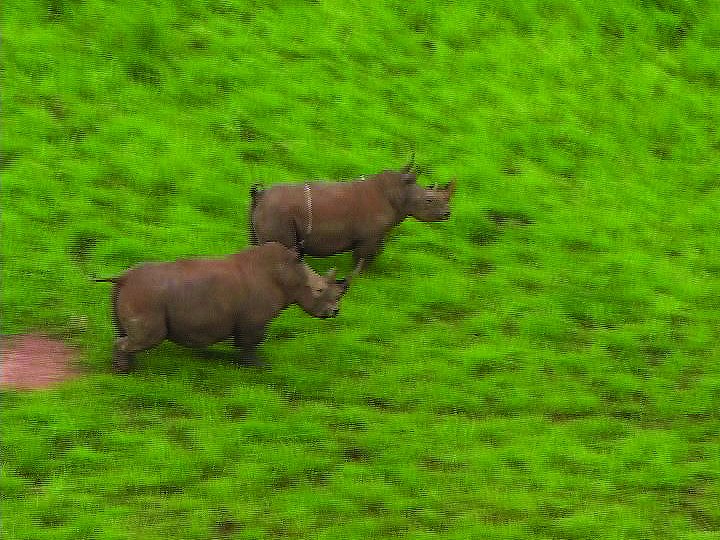
The last confirmed wild group lived in Garamba National Park and the hunting areas around it, in the north-east of the Democratic Republic of the Congo. The northern white rhino population is believed to have stood at about 2,360 in 1960.[1] Poaching rose during the war of the late 1990s, but good breeding kept the group fairly steady until 2003, when poaching escalated. Eleven carcasses were found in the three months from March to May 2004.[1] Confirmed numbers fell from 30 in April 2003 to four in August 2005.[1] No live rhino has been seen since 2006 and no sign of one since 2007, despite a systematic ground search in 2008. Reports of a few animals in a remote part of South Sudan have not been confirmed.[1]

Classification evidence
The IUCN, ITIS and the Mammal Diversity Database list the northern white as a subspecies.[1][5][6] Groves and colleagues (2010) ranked it as a separate species, Ceratotherium cottoni, on differences in teeth and skull, and Groves and Grubb (2011) kept that rank.[4][6] Genetic studies by Harley and colleagues (2016) and Moodley and colleagues (2018) favour subspecies, and the IUCN African Rhino Specialist Group continues to treat the two forms as subspecies.[1][7][8] The full account, with the different estimates of when the two forms split, is under Taxonomy on the species page.
History
Four of the last breeding northern white rhinos lived at Dvur Kralove Zoo in Czechia. In 2009 they were moved to Ol Pejeta Conservancy, a private conservancy in Kenya, in the hope that a more natural setting and diet, and mixing with southern white rhinos, would encourage them to breed.[1][9] The two females came into season and mated, but no calves were born, and the two males later died.[1]
Nola and Sudan
Nola lived at the San Diego Zoo Safari Park in California. She was euthanised on 22 November 2015, aged 41, after surgery on 13 November to drain an infected abscess in her pelvic region; she had stopped eating. Her death left three northern white rhinos, all at Ol Pejeta: two females and the male Sudan.[10]
Sudan, the last male, was euthanised on 19 March 2018, aged 45, and Ol Pejeta announced it the next day. He had age-related complications and a deep infection in his back right leg, and could no longer stand. He was born in the wild in Sudan and was taken to a Czech zoo.[9]
Najin and Fatu
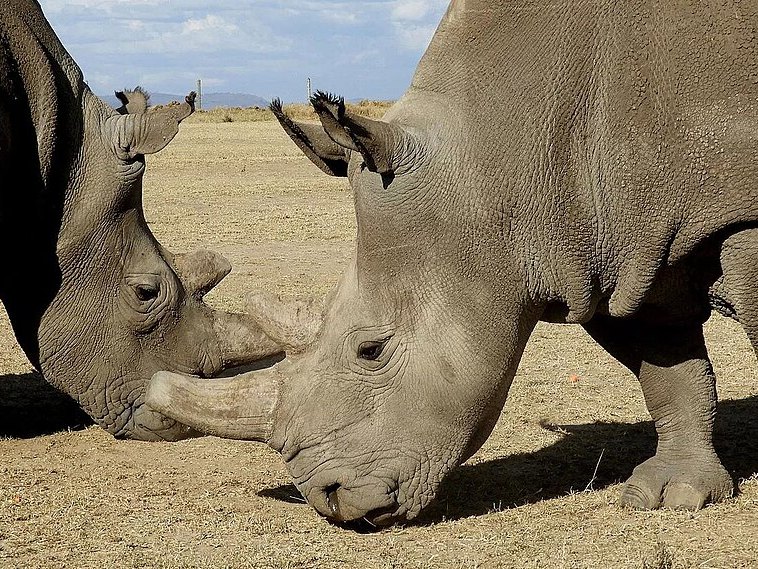
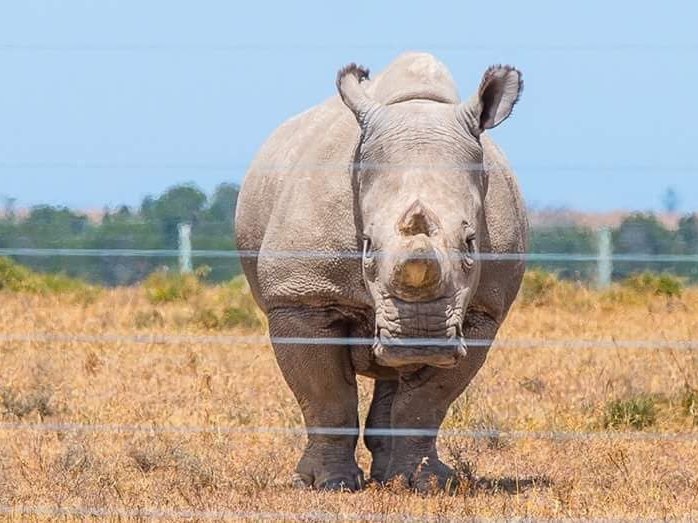
Najin, the daughter of Sudan, and her daughter Fatu are the two survivors.[9] Najin was born on 11 July 1989 and Fatu on 29 June 2000. They live in a 700-acre enclosure at Ol Pejeta, guarded day and night by armed rangers.[2]


Status
The IUCN Red List (2020) lists the subspecies as Critically Endangered (Possibly Extinct in the Wild), under criteria A2abcd; C1+2a(i,ii); D.[1] It has been Critically Endangered in every assessment since 1996.[1] The Garamba group is considered probably extinct, and the category stays “possibly” extinct until South Sudan is surveyed.[1] The two living females are not counted in the assessment, because they have not bred since being returned to the wild.[1] The IUCN says that the survival of the subspecies depends on assisted reproduction.[1]
Assisted reproduction
Researchers have collected eggs from the two females and hold sperm from five northern white males that have died. The plan is to make embryos in the laboratory and place them in southern white surrogate mothers.[1] Cells from other dead animals might also be turned into stem cells to make more eggs and sperm.[1] The work is led by the BioRescue team, with Ol Pejeta.[11][12]
On 24 September 2023 a southern white embryo was transferred into a southern white surrogate, Curra, at Ol Pejeta. A pregnancy with a male fetus of about 70 days was confirmed, the first rhino pregnancy from an embryo transfer, but Curra died later in 2023.[11]
By April 2026 Ol Pejeta counted 39 pure northern white embryos, including one new embryo from Fatu in early 2026. Three northern white embryo transfers were made into southern white surrogates in the second half of 2025, and none of these attempts has led to a long-term pregnancy. Six embryo transfers had been made in all, and two more proven southern white females were added as possible surrogates.[12]
Sources
- IUCN Red List assessment of Ceratotherium simum ssp. cottoni, northern white rhinoceros (Emslie 2020; assessed 6 January 2020)
- Ol Pejeta Conservancy, Najin and Fatu
- Lydekker 1908, The white rhinoceros, The Field 111 (2878): 319, 22 February 1908 (description of Rhinoceros simus cottoni; Rhino Resource Center record)
- Groves, Fernando & Robovský 2010, The sixth rhino: a taxonomic re-assessment of the critically endangered northern white rhinoceros, PLoS ONE 5(4): e9703
- Integrated Taxonomic Information System, Ceratotherium simum (TSN 625001)
- Mammal Diversity Database, Ceratotherium simum
- Harley et al. 2016, Comparison of whole mitochondrial genome sequences of northern and southern white rhinoceroses, Conservation Genetics 17: 1285–1291
- Moodley et al. 2018, Proceedings of the Royal Society B 285: 20181567
- PBS NewsHour (Associated Press), 20 March 2018, report on the death of Sudan
- Scientific American, Extinction Countdown, 22 November 2015, Northern white rhino dies, leaving just three
- BioRescue / Leibniz Institute for Zoo and Wildlife Research, press page on the first rhino embryo transfer (MDC Berlin)
- Ol Pejeta Conservancy, news release, 22 April 2026 (northern white rhino embryos and transfers)