The southern white rhinoceros (Ceratotherium simum simum) is the nominate subspecies, the one that carries the same name as the species, and the white rhino of southern Africa south of the Zambezi.[1] It is the most numerous of the rhinos, and South Africa is its stronghold.[1]
Names and classification
Burchell named the species Rhinoceros simus in 1817, from animals he shot on 16 October 1812 near Chue Spring, north of Kuruman, in South Africa.[2][3][4] The southern animals therefore carry the original name, and the northern form was named later, in 1908.[5] The lectotype is OUM 8221, held at the Oxford University Museum.[6] IUCN texts call it the Southern White Rhinoceros, and GBIF also lists the name Southern Square-lipped Rhinoceros.[1][7]
Description
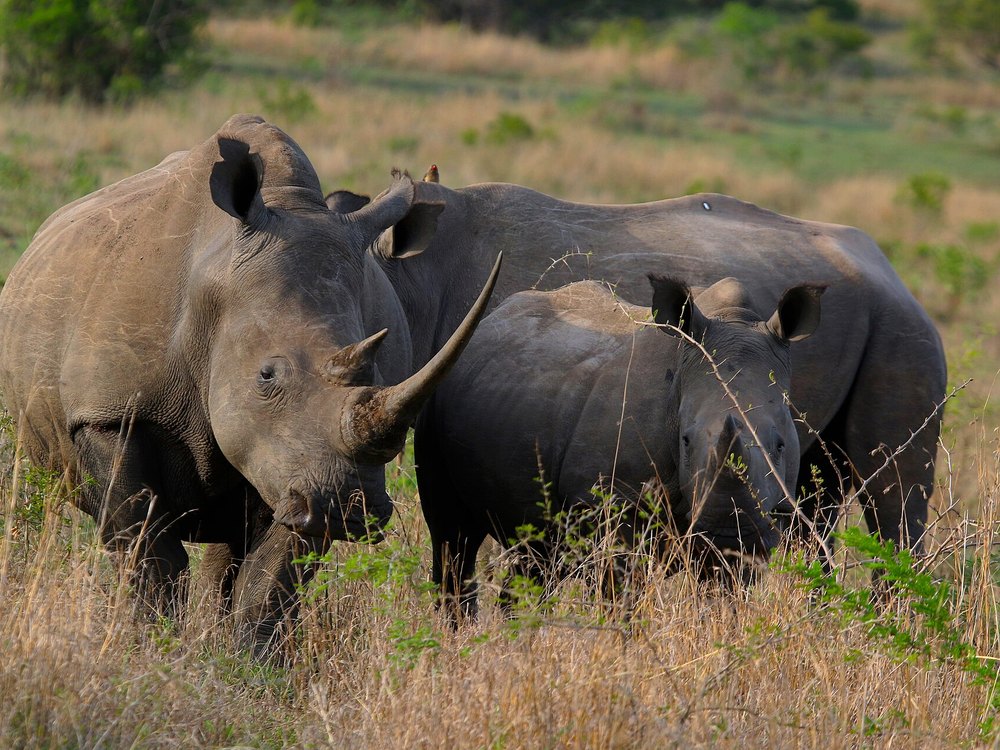
Southern white rhinos measured in the wild and aged by their teeth weighed 2,000 to 2,400 kg in adult males and 1,500 to 1,700 kg in adult females. Males reach full weight at 10 to 15 years.[8][9] Shoulder height is 165 to 188 cm in males (11 measured) and 155.6 to 185 cm in females (8 measured). The length from the back of the head to the base of the tail is 259 to 284 cm in males and 248 to 273 cm in females.[9]
Range
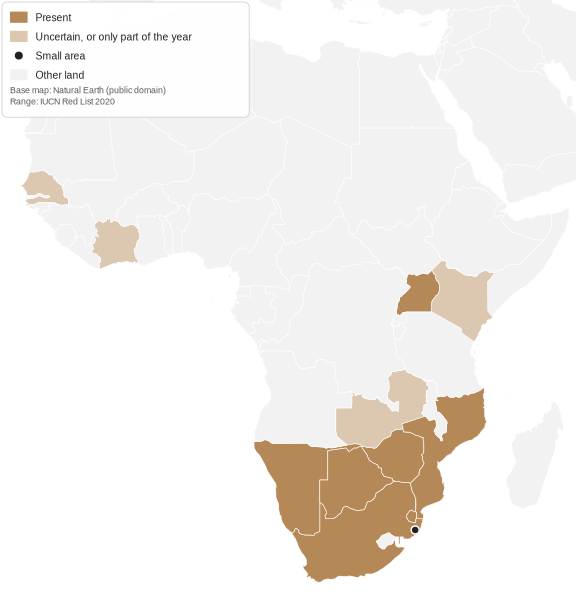
The southern white rhino once lived in the bushveld of southern Africa south of the Zambezi River, in grassland and savanna, and it is a grazer.[1] South Africa holds most of the subspecies, about 86.5% at the end of 2012.[1] Smaller groups were reintroduced in Namibia, Botswana, Zimbabwe and Eswatini, which were part of the range. The few in Mozambique were poached out, and small numbers now survive there after better protection.[1] Animals have also been introduced outside the former range, in Kenya, Zambia and Uganda.[1]
Estimated numbers at the end of 2017 were 15,625 in South Africa, 975 in Namibia, 510 southern white rhinos in Kenya, 452 in Botswana, 367 in Zimbabwe, 66 in Eswatini, 29 in Mozambique, 22 in Uganda and 14 in Zambia.[1]

Classification evidence
The IUCN, ITIS, the Mammal Diversity Database and GBIF list one white rhino species with two subspecies.[1][10][6][11] Groves and colleagues (2010) rank the northern form as a separate species, Ceratotherium cottoni, which would leave the southern form as Ceratotherium simum itself.[9] The IUCN African Rhino Specialist Group continues to treat the two as subspecies.[1] The full account is under Taxonomy on the species page.
History
Settlers hunted the southern white rhino for sport and cleared its land for farming, and by the 1890s only one small population was left, in KwaZulu-Natal.[1] The refuge was at the meeting of the Black and White Umfolozi rivers in Zululand, where a reserve was proclaimed in 1897.[12] Campaigns that killed game to control tsetse fly later put the refuge at risk: the one in 1920 left 25 white rhinos, and in 1939 a plan to abolish the reserve was stopped.[12] An aerial count in August 1965 found 812 rhinos, 606 in Umfolozi and 206 outside it.[12]
Operation Rhino
Operation Rhino was a Natal Parks Board programme that moved white rhinos out of Umfolozi. Work began in 1960, and Ian Player, the Chief Conservator of Zululand, wrote the account of it.[12] Rhinos were darted from foot or from a vehicle, followed by horsemen, and crated with an antidote. The Palmer Cap-chur dart gun made the work possible, and the drug M99 was used on wild rhinos from 1963.[12]
Of 499 white rhinos immobilised in Umfolozi, 63 went to zoos, 330 to other reserves in southern Africa, and 43 were marked and released for study. Ninety-two went to Kruger National Park between June 1962 and September 1964, the first eight went to Rhodesia in 1962, and 18 went to Ndumu.[12] Player called the build-up and re-population of the species one of the most successful operations in wildlife conservation.[12]
Status
The IUCN assesses the white rhino as a whole and lists it as Near Threatened (2020); the species page has the numbers and threats.[1] South Africa’s own regional list also rates it Near Threatened (A4ad).[13]
South Africa’s population of this subspecies is in CITES Appendix II, which allows international trade only in live animals going to approved destinations and in hunting trophies. It was moved down from Appendix I in 1994, and Eswatini’s animals in 2004.[1][13] From 2010 to 2022 South Africa exported 1,034 live white rhinos: 54% for reintroduction, 29% to zoos and 8% for breeding, mostly to Namibia (44%), China (21%) and Botswana (10%).[13]
Game ranches
All South African groups live in fenced protected areas or on private or community game farms and reserves.[13] At the end of 2023 South Africa held 5,406 white rhinos on state land (39%) and 8,585 on private land (61%). The private total includes about 1,986 in the largest semi-intensive breeding operation, which African Parks bought in 2023 and plans to return to the wild over about ten years.[13] Falling live-sale prices and rising security costs have led a growing number of owners to try to get rid of their rhinos.[1]
Sources
- IUCN Red List assessment of Ceratotherium simum (Emslie 2020; version 3.1, assessed 6 January 2020)
- Burchell 1817, Bulletin des Sciences, par la Société philomatique de Paris 1817: 96–97 (original description of Rhinoceros simus)
- Rookmaaker 2003, Why the name of the white rhinoceros is not appropriate, Pachyderm 34: 88–95
- International Rhino Foundation, Facing down a crisis: how we almost lost the white rhino (rhinos.org)
- Lydekker 1908, The white rhinoceros, The Field 111 (2878): 319, 22 February 1908 (description of Rhinoceros simus cottoni; Rhino Resource Center record)
- Mammal Diversity Database, Ceratotherium simum
- GBIF vernacular names of Ceratotherium simum
- Hillman-Smith et al. 1986, Age estimation of the white rhinoceros, Journal of Zoology 210: 355–377
- Groves, Fernando & Robovský 2010, The sixth rhino: a taxonomic re-assessment of the critically endangered northern white rhinoceros, PLoS ONE 5(4): e9703
- Integrated Taxonomic Information System, Ceratotherium simum (TSN 625001)
- GBIF Backbone Taxonomy, Ceratotherium simum
- Player, Translocation of white rhinoceros in South Africa, Oryx
- South African Scientific Authority, Non-detriment finding for Ceratotherium simum simum, Cer_sim_Oct2024, 1 October 2024 (sanbi.org)