Orycteropus afer erikssoni is a very large forest aardvark of the northern Congo basin.[1]
Names and classification
Lönnberg named it Orycteropus erikssoni in 1906, as a species, in Arkiv för Zoologi 3. The paper was read in September 1905 and published in January 1906.[1][2] The type locality is given only as “Northern Congo”; the more exact “lower Bomu River” comes from Hatt in 1932.[1][3] Lönnberg named it in honour of the donor, Lieutenant Karl Eriksson, and noted that Eriksson had also delivered the first specimens of the okapi to Sir Harry Johnston.[1] Lydekker made it a subspecies of afer in 1908.[4][5]
The Mammal Diversity Database treats this name as a synonym of the single species, Orycteropus afer.[4] Taylor’s 2011 account lists it among 18 named subspecies, but says that neither their validity nor the limits of their ranges are properly known.[6]
Description
Lönnberg described it as about 2 m long, with a light sandy-brown to yellowish-white body, dark feet and a broad dark band over the shoulders. The ears and tail are very short, the hair is short and the snout is very long. The skull measured 278 mm.[1] The type is a skeleton with pieces of skin in the Stockholm museum; the skin was stained with brick-red earth, so its colour is not a sure guide.[1]
Range
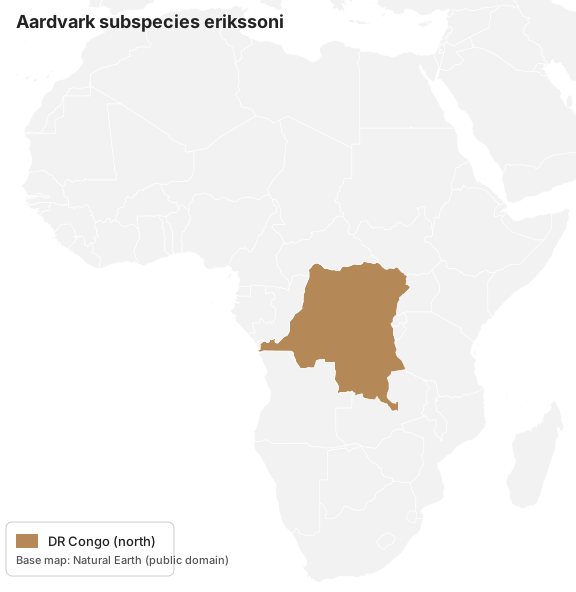
It is a forest form of the northern Congo basin, in the north of the DR Congo.[6][3]
Forest and savanna forms
In 1932 Hatt compared it with faradjius, a savanna form of the north-east Congo. He found erikssoni slightly larger, with shorter ears and longer front claws (the third claw on the front foot about 54–55 mm, against 40–45 mm).[3][7]
Status
Eighteen subspecies have been named, but that number is almost certainly too high, and because so little material exists, neither the status nor the limits of range of the subspecies are known.[8] Treat this name as a historical description, not as a settled form. See the full list of names.
Sources
- Lönnberg 1906, Arkiv för Zoologi 3
- Allen 1939, “A checklist of African mammals”, Bulletin of the Museum of Comparative Zoology 83
- Hatt 1932, “The aardvark of the Haut-Uele”, American Museum Novitates 535
- Mammal Diversity Database, Orycteropus afer
- Lydekker 1908, The Game Animals of Africa
- Taylor 2011, Order Tubulidentata, in Handbook of the Mammals of the World, vol. 2
- Hatt 1934, Bulletin of the American Museum of Natural History 66(7)
- California Academy of Sciences, Afrotheria research page: Tubulidentata (secondary)