Orycteropus afer wertheri is an aardvark of north-east Tanzania, described from a skin from the hinterland of Bagamoyo.[1]
Names and classification
Matschie named it Orycteropus wertheri in 1898, as a full species, in C. W. Werther’s book on the highlands of northern German East Africa (pp. 266–267).[1][2] He named it in honour of its discoverer, Premier-Lieutenant Werther, and called it the aardvark of the Kingani area.[1] Lydekker made it a subspecies of afer in 1908.[3][4]
The Mammal Diversity Database treats this name as a synonym of the single species, Orycteropus afer.[3] Taylor’s 2011 account lists it among 18 named subspecies, but says that neither their validity nor the limits of their ranges are properly known.[5]
Description
The original description gives short hair, iron-grey with a faint reddish tone, with blackish-brown shoulders, thighs and feet. The snout and ears are long: the ear measured 17.2 cm, and the animal was 196 cm long in total.[1] It was described from the skin alone, held in the Berlin museum.[1] Grote found the ears of matschiei shorter (15.2 cm).[6]
Range
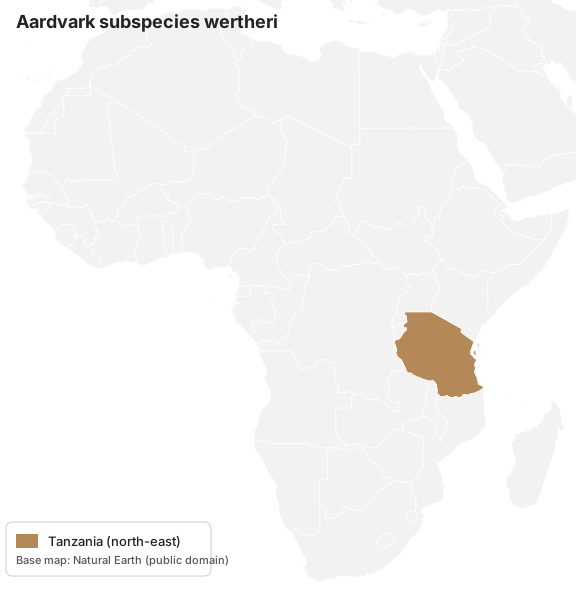
Taylor gives its range as north-east Tanzania.[5] The type skin came from the hinterland of Bagamoyo.[1]
Status
Eighteen subspecies have been named, but that number is almost certainly too high, and because so little material exists, neither the status nor the limits of range of the subspecies are known.[7] Treat this name as a historical description, not as a settled form. See the full list of names.
Sources
- Matschie 1898, in Werther, Die mittleren Hochländer des nördlichen Deutsch-Ost-Afrika
- Allen 1939, “A checklist of African mammals”, Bulletin of the Museum of Comparative Zoology 83
- Mammal Diversity Database, Orycteropus afer
- Lydekker 1908, The Game Animals of Africa
- Taylor 2011, Order Tubulidentata, in Handbook of the Mammals of the World, vol. 2
- Grote 1921, “Neue Erdferkel (Orycteropus) aus Deutsch-Ostafrika und Kamerun”, Archiv für Naturgeschichte 87A
- California Academy of Sciences, Afrotheria research page: Tubulidentata (secondary)