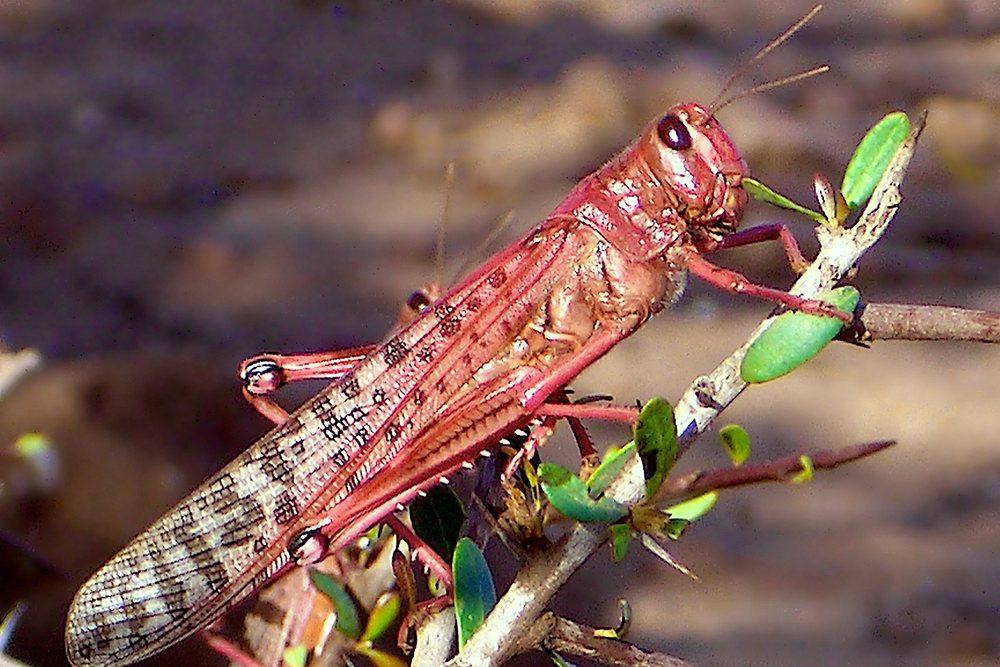
The gregarious form is the Desert Locust living in crowds. Its hoppers are black or yellow and black, and its adults are pink when young and yellow when mature. They gather in bands and swarms, and the adults fly by day.[1][2][3]
Appearance
Gregarious hoppers turn black within hours of hatching when they are crowded, and later become yellow and black.[4][2] Gregarious adults are pink when young and yellow when mature.[1] They have relatively longer wings and a relatively broader head than solitarious locusts.[4] Colour is only a hint: swarms of locusts that still have solitarious colours have been found.[4]

Behavior
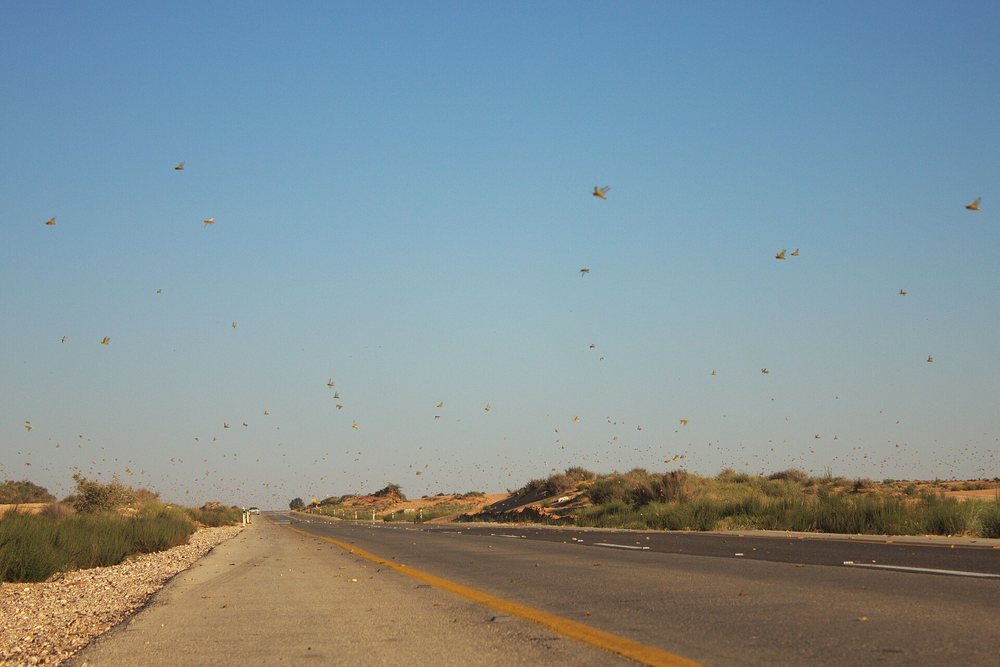
Gregarious locusts are very active, walk fast, groom often and are attracted to other locusts.[3] Hoppers form bands that march together by day, with up to over 30,000 first-stage hoppers per square metre in the densest groups.[4] Adults form swarms of 40–80 million locusts per square kilometre, and the swarms fly by day.[1]

Life cycle
A gregarious female lays pods of fewer than 80 eggs.[5] Gregarious hoppers usually have five growth stages.[6] The brain is about 30% larger overall than a solitarious locust’s.[7] In a study of the nervous system, 214 genes were active differently in long-term gregarious and solitarious adults.[8] The bold colours work as a warning only when the locusts have eaten poisonous plants: lizards learned to avoid gregarious locusts fed on one such plant, but not solitarious ones.[9]
Origin and change
Plagues are made of bands and swarms of gregarious locusts, so the change to this form is the first step to a plague.[4] Going back to the solitarious form is slower than the change to this one. After isolation, a gregarious locust loses some gregarious behaviour within hours, then stays semi-gregarious for at least a week.[3]
Sources
- FAO Locust Watch, frequently asked questions about locusts
- FAO, instructions for the Desert Locust survey form (archived copy)
- Rogers et al. 2014, Journal of Insect Physiology 65: 9–26 (rapid gregarization)
- Symmons 1994, FAO The Desert Locust Guidelines I: Biology and behaviour
- Symmons & Cressman 2001, FAO Desert Locust Guidelines 1: Biology and behaviour (archived copy)
- Pelissie et al. 2016, PLOS ONE 11: e0155736 (extra moult in solitarious hoppers)
- Ott & Rogers 2010, Proceedings of the Royal Society B 277: 3087–3096 (brains of the two forms)
- Badisco et al. 2011, PLOS ONE 6: e28110 (gene activity in the two forms)
- Sword et al. 2000, Proceedings of the Royal Society B 267: 63–68 (warning colour)