The Akita is a large, sturdily built spitz-type dog from Japan, listed by the FCI as a companion dog.[1] It has a thick, curled tail carried over the back and a double coat.[1]
The breed standard
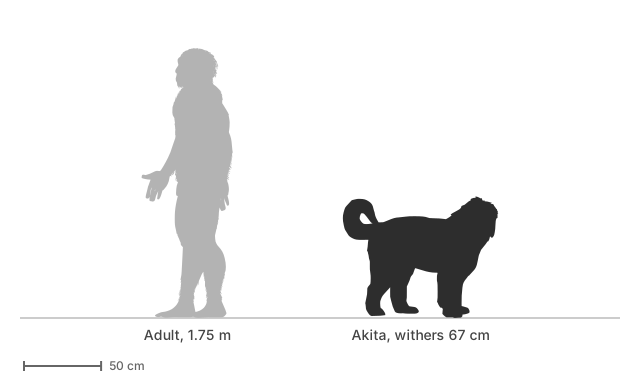
The FCI standard asks for a large, well-balanced dog with a tough constitution. Height at the withers is 67 cm for dogs and 61 cm for bitches, with a tolerance of 3 cm either way. No weight is given. The outer coat is harsh and straight over a soft, dense undercoat. Accepted colours are red fawn, sesame (red fawn hairs with black tips), brindle and white. All colours except white must have “urajiro”, a whitish coat on the sides of the muzzle, the cheeks, the underside of the jaw, the neck, the chest, the body, the tail and the inside of the legs.[1] The standard describes the temperament as composed, faithful, docile and receptive. It disqualifies aggressive or overly shy dogs.[1]
Name and origin
According to the FCI standard, the dog takes its name from the Akita region, where medium-sized bear-hunting dogs called Akita Matagis were used as fighting dogs from 1603. From 1868 they were crossed with Tosas and Mastiffs. Dog fighting was banned in 1908, but the breed was kept and improved as a large Japanese dog, and nine superior examples were designated “Natural Monuments” in 1931. The standard adds that after the Second World War the breed existed as three distinct types, which fanciers then worked to merge again.[1] This history rests on the FCI text alone. A study of breed relationships uses the Akita to represent its Asian Spitz group, one of 23 breed clades, and describes that group as among the most divergent and possibly older than the rest.[2] The AKC recognised the Akita in 1972.[3]
Health and lifespan
No study of Akita lifespan was found. In a Swedish study of 104 dogs with sebaceous adenitis, an immune-mediated skin disease, the Akita was one of the three most common breeds, with 10 cases. The study gives no rate for the breed.[4]
Behavior
In an owner-reported survey of 99 Akitas, 3.0% were reported to have snapped, bitten or tried to bite an unfamiliar person in the recent past, 1.0% a member of the household and 29.3% an unfamiliar dog. The averages across the 33 breeds in the survey were 4.7%, 2.0% and 10.7%.[5] The authors point to dog-directed aggression in Akitas as a breed pattern.[5] Breed explains only about 9% of behavioural differences between individual dogs, so an individual’s behaviour can differ a lot from the breed’s average.[6]
Popularity
The Akita ranked 62nd on the AKC’s list of most popular breeds in 2025.[7]
Sources
- FCI breed standard 255, Akita
- Parker et al. 2017, Cell Reports 19: 697–708
- American Kennel Club, breeds by year recognized
- Egenvall et al. 2008, Acta Veterinaria Scandinavica 50: 11 (sebaceous adenitis in Swedish dogs)
- Duffy, Hsu & Serpell 2008, Applied Animal Behaviour Science 114: 441–460
- Morrill et al. 2022, Science 376 (breed and behaviour)
- American Kennel Club, most popular dog breeds of 2025