The Border Collie is a sheepdog from Great Britain. The FCI describes it as tenacious, hard-working, keen, alert and intelligent.[1]
The breed standard
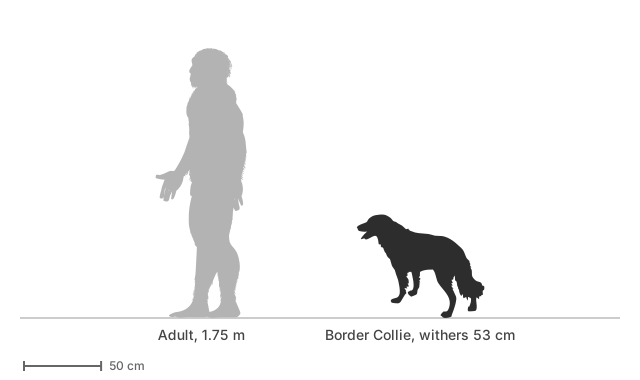
The FCI standard sets an ideal height at the withers of 53 cm for males, with females slightly less. No weight is given. The body is slightly longer than the height at the shoulder. There are two coat varieties, moderately long and smooth, both with a dense topcoat and a soft, dense undercoat. A variety of colours is allowed, but white should never predominate. Eyes are usually brown, but in merles one or both may be blue in whole or in part.[1]
Name and origin
The FCI standard names Great Britain as the origin and prints no history. The International Sheep Dog Society, which registers working sheepdogs in Britain, dates its formation to 1906.[2] The AKC recognised the Border Collie in 1995.[3]
Health and lifespan
In UK veterinary records, the life expectancy at birth of Border Collies was 12.10 years, the third longest of 18 breeds, behind the Jack Russell Terrier and the Yorkshire Terrier.[4] In a separate owner survey of Kennel Club registered dogs that died in 2014, the median age at death of 119 Border Collies was 11.9 years, and the breed was counted among the longer-lived breeds.[5] The two figures measure different things and should not be added or averaged.
Behavior
In an owner-reported survey of 163 Border Collies, 8.0% were reported to have snapped, bitten or tried to bite an unfamiliar person in the recent past, 1.8% a member of the household and 13.5% an unfamiliar dog. The averages across the 33 breeds in the survey were 4.7%, 2.0% and 10.7%.[6] Breed explains only about 9% of behavioural differences between individual dogs, so an individual’s behaviour can differ a lot from the breed’s average.[7]
Popularity
The Border Collie ranked 26th on the AKC’s list of most popular breeds in 2025, up four places from 30th.[8]
Sources
- FCI breed standard 297, Border Collie
- International Sheep Dog Society, who we are
- American Kennel Club, breeds by year recognized
- Teng et al. 2022, Scientific Reports 12 (life tables by breed, UK veterinary records)
- Lewis et al. 2018, Canine Genetics and Epidemiology 5: 10 (owner survey of Kennel Club registered dogs that died in 2014)
- Duffy, Hsu & Serpell 2008, Applied Animal Behaviour Science 114: 441–460
- Morrill et al. 2022, Science 376 (breed and behaviour)
- American Kennel Club, most popular dog breeds of 2025