The Beagle is a small scent hound from Great Britain, used to hunt hare by following a scent.[1] The FCI describes it as a sturdy, compactly built hound with a merry, even temperament.[1]
The breed standard
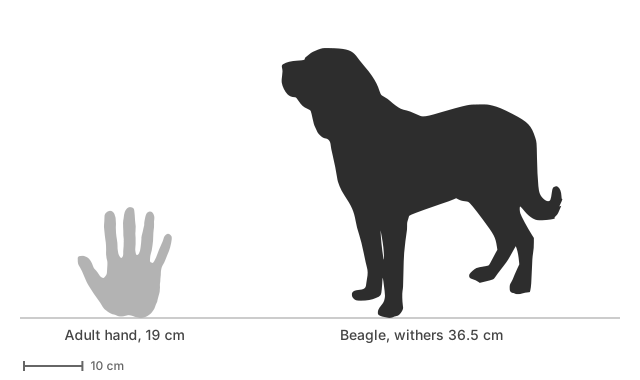
The FCI standard sets a desirable height at the withers of 33–40 cm and gives no weight. The coat is short, dense and weatherproof. Accepted colours include tricolour (black, tan and white), blue, white and tan, badger pied, hare pied, lemon pied, red and white, and all white, with a white tip to the tail. Ears are long with rounded tips and hang close to the cheeks.[1] The standard calls the Beagle bold, alert, intelligent and of even temperament, showing no aggression or timidity.[1] The median adult Beagle in a study of UK veterinary records weighed 18.19 kg (males 19.70 kg, females 16.59 kg).[2]
Name and origin
The FCI says the Beagle is “said to have been bred down from the larger Foxhound” to hunt on foot with people, preferably after hare, and that it is still used in packs. It adds that wirehaired Beagles small enough to be carried in a hunting jacket pocket existed in the reigns of Henry VIII and Elizabeth I.[1] A 2025 paper reports that the breed was formally recognised by the UK Kennel Club in 1885.[2] The AKC also recognised it in 1885.[3]
Health and lifespan
In UK veterinary records for 2019, the median age at death of 322 Beagles was 11.28 years (females 11.70, males 10.75). Cancers were the leading cause of death.[2] The commonest disorders in a random sample of 3,729 Beagles were obesity (24.3%), periodontal disease (17.8%), overgrown nails (11.6%), outer ear infection (11.2%) and anal sac impaction (10.6%).[2] A separate UK life table, based on a small sample of 172 Beagles, gave a life expectancy at birth of 9.85 years. That measures something different from the median age at death, and the authors flag the small sample.[4]
Behavior
In an owner-reported survey of 63 Beagles, 7.9% were reported to have snapped, bitten or tried to bite an unfamiliar person in the recent past, 7.9% a member of the household and 9.5% an unfamiliar dog. The averages across the 33 breeds in the survey were 4.7%, 2.0% and 10.7%.[5] The authors list Beagles among the breeds with the greatest share of dogs reported to bite or try to bite their owners.[5] Breed explains only about 9% of behavioural differences between individual dogs, so an individual’s behaviour can differ a lot from the breed’s average.[6]
Popularity
The Beagle ranked 7th on the AKC’s list of most popular breeds in 2025.[7] In UK veterinary records for 2019, Beagles made up 0.88% of all dogs.[2]
Sources
- FCI breed standard 161, Beagle
- O’Neill et al. 2025, Companion Animal Health and Genetics 12: 1 (Beagles under UK veterinary care)
- American Kennel Club, breeds by year recognized
- Teng et al. 2022, Scientific Reports 12 (life tables by breed, UK veterinary records)
- Duffy, Hsu & Serpell 2008, Applied Animal Behaviour Science 114: 441–460
- Morrill et al. 2022, Science 376 (breed and behaviour)
- American Kennel Club, most popular dog breeds of 2025