The Boxer is a medium-sized, smooth-coated, sturdy dog from Germany, listed by the FCI as a companion, guard and working dog.[1]
The breed standard
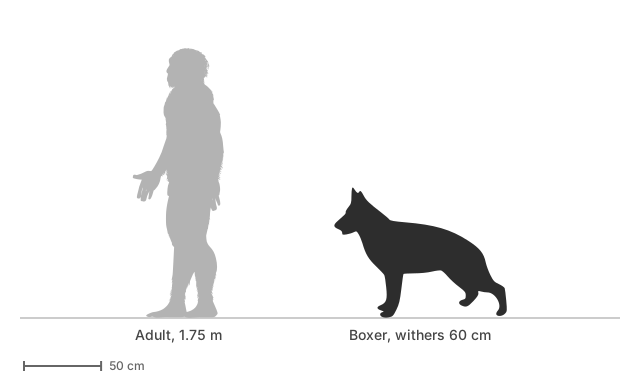
The FCI standard sets a height at the withers of 57–63 cm for dogs and 53–59 cm for bitches. Dogs weigh over 30 kg at about 60 cm, and bitches about 25 kg at about 56 cm. The coat is short, hard and glossy. The colour is fawn or brindle with a black mask, and white markings are acceptable up to one third of the ground colour. The lower jaw protrudes beyond the upper, so the Boxer is undershot, and the tail is left natural.[1] The standard describes a fearless, self-confident, calm dog that is harmless with its family but distrustful of strangers.[1] The mean adult weight in a study of UK veterinary records was 30.43 kg.[2]
Name and origin
The FCI says the small Brabant Bullenbeisser is regarded as the immediate ancestor of the Boxer. Bullenbeissers were bred by huntsmen to seize game and hold it until the huntsman arrived, which needed wide jaws.[1] A 2023 paper adds that the breed was developed in late nineteenth-century Germany by crossing the Bullenbeisser with English Bulldogs and other breeds.[2] The AKC recognised the Boxer in 1904.[3]
Health and lifespan
In UK veterinary records for 2016, the median longevity of 346 Boxers that died was 10.46 years, with no difference by sex or between white and non-white dogs. Leading causes of death were unrecorded (21.1%), cancer (12.4%) and brain disorders (9.5%).[2] The commonest disorders were outer ear infection (7.2%), epulis (a gum growth, 5.8%), corneal ulceration (5.0%) and periodontal disease (4.6%). The authors suggest strong breed predispositions to epulis and corneal ulceration.[2] A separate UK life table gave a life expectancy at birth of 10.04 years.[4] In an owner survey of Kennel Club registered dogs that died in 2014, the median age at death of 170 Boxers was 8.8 years, and the breed was counted among the shorter-lived breeds.[5] These studies measure different things, so their figures differ.
Behavior
In an owner-reported survey of 70 Boxers, 5.7% were reported to have snapped, bitten or tried to bite an unfamiliar person in the recent past, 0% a member of the household and 15.7% an unfamiliar dog. The averages across the 33 breeds in the survey were 4.7%, 2.0% and 10.7%.[6] Breed explains only about 9% of behavioural differences between individual dogs, so an individual’s behaviour can differ a lot from the breed’s average.[7]
Popularity
The Boxer ranked 18th on the AKC’s list of most popular breeds in 2025.[8]
Sources
- FCI breed standard 144, Boxer
- O’Neill et al. 2023, Canine Medicine and Genetics (Boxers under UK veterinary care)
- American Kennel Club, breeds by year recognized
- Teng et al. 2022, Scientific Reports 12 (life tables by breed, UK veterinary records)
- Lewis et al. 2018, Canine Genetics and Epidemiology 5: 10 (owner survey of Kennel Club registered dogs that died in 2014)
- Duffy, Hsu & Serpell 2008, Applied Animal Behaviour Science 114: 441–460
- Morrill et al. 2022, Science 376 (breed and behaviour)
- American Kennel Club, most popular dog breeds of 2025