The Great Dane is a giant companion and guard dog from Germany, despite its English name. The FCI lists it as the “Deutsche Dogge”.[1]
The breed standard
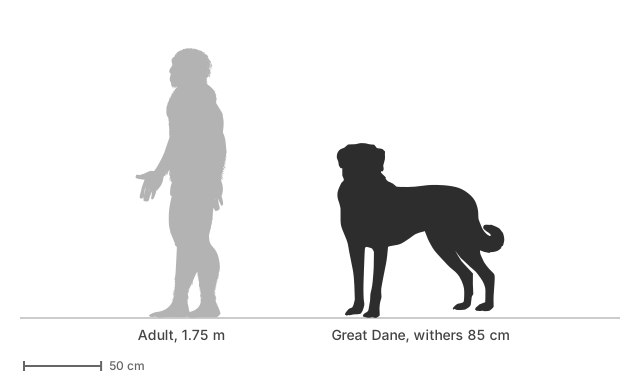
The FCI standard requires a height at the withers of at least 80 cm and no more than 90 cm for males, and at least 72 cm and no more than 84 cm for females. A dog below the minimum is disqualified. No weight is set. The coat is very short, dense and glossy. There are three colour varieties: fawn and brindle; harlequin, merle and black; and blue. The standard calls for a friendly, devoted and confident dog, and disqualifies blind or deaf dogs.[1] In a study of UK veterinary records, the median Great Dane weighed 60.5 kg.[2]
Name and origin
The FCI names the old “Bullenbeisser” and the boar-hunting hounds as forerunners. In 1878 a committee in Berlin decided to group these varieties as “Deutsche Doggen”, and the first standard was laid down in 1880.[1] The Royal Kennel Club (UK) agrees that the breed’s origins lie in Germany, in heavier dogs that hunted wild boar in packs.[3] The American Kennel Club recognised the breed in 1887.[4]
Health and lifespan
In a study of giant dog breeds under UK veterinary care, the median age at death of 113 Great Danes that died in 2019 was 8.90 years. The figure for all giant breeds combined was 8.94 years.[2] The authors found shorter lifespans in giant breeds overall than in dogs generally. Because the study covered one year, ages at death depend on which dogs died in that year.[2] Large and giant breeds, Great Danes among them, are prone to gastric dilatation-volvulus (bloat with twisting of the stomach). In a study of 11 breeds, 30 of the 105 dogs that developed it (28.6%) died. That figure covers all breeds in the study, not Great Danes alone.[5]
Behavior
In an owner-reported survey of 53 Great Danes, 5.7% were reported to have snapped, bitten or tried to bite an unfamiliar person in the recent past, 1.9% a member of the household and 9.4% an unfamiliar dog. The averages across the 33 breeds in the survey were 4.7%, 2.0% and 10.7%.[6] This is a small sample.[6] Breed explains only about 9% of behavioural differences between individual dogs, so an individual’s behaviour can differ a lot from the breed’s average.[7]
Popularity
The Great Dane ranked 22nd on the American Kennel Club’s list of most popular breeds in 2025. The list counts US registrations only.[8]
Sources
- FCI breed standard 235, Deutsche Dogge (Great Dane)
- O’Neill et al. 2026, giant dog breeds under primary veterinary care in the UK
- Royal Kennel Club (UK), Great Dane breed page
- American Kennel Club, breeds by year recognized
- Glickman et al. 2000, Journal of the American Veterinary Medical Association 216: 40–45 (gastric dilatation-volvulus in large and giant breeds)
- Duffy, Hsu & Serpell 2008, Applied Animal Behaviour Science 114: 441–460
- Morrill et al. 2022, Science 376 (breed and behaviour)
- American Kennel Club, most popular dog breeds of 2025