The Greyhound is a sighthound developed in Great Britain. The FCI describes it as strongly built and muscular, with a long head and neck, a deep chest and remarkable stamina.[1]
The breed standard
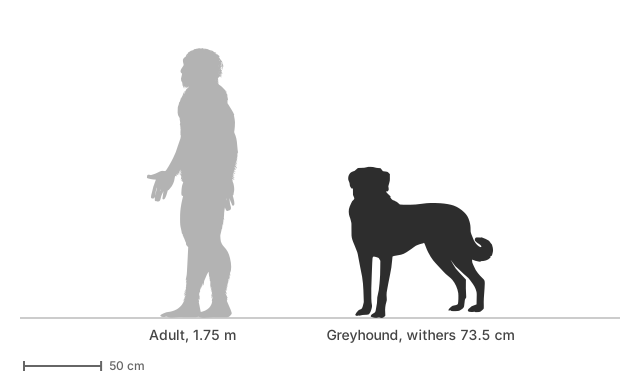
The FCI standard gives an ideal height of 71–76 cm for males and 68–71 cm for females. It sets no weight. The coat is fine and close, in black, white, red, blue, fallow or brindle, or any of these broken with white. The temperament is described as intelligent, gentle, affectionate and even tempered.[1] The Royal Kennel Club (UK) notes that the Greyhound seen in the show ring is larger and heavier than the racing Greyhound.[2] In a study of UK veterinary records from 2016, adult Greyhounds averaged 29.7 kg, with males at 32.3 kg and females at 27.2 kg. Black (39.2%), black and white (20.8%) and brindle (12.0%) were the commonest colours.[3]
Name and origin
The FCI says experts are not unanimous but consider that the Greyhound could have had its origins in the Middle East. It notes drawings of Greyhound-type dogs in Ancient Egyptian tombs, and says the type was developed to a standard in Britain.[1] The Royal Kennel Club (UK) also describes long-legged hounds of this type on the walls of Ancient Egyptian tombs, and says the Greyhound was developed in Britain.[2] The American Kennel Club recognised the breed in 1885.[4]
Health and lifespan
The UK study of Greyhounds under general veterinary care in 2016 covered 5,419 dogs, many of them pets that had finished racing. Based on 474 deaths, the median longevity (age at death) was 11.4 years, with females at 11.8 and males at 11.2. Cancer (21.5%) was the commonest cause of death, followed by collapse (14.3%) and musculoskeletal disease (7.8%). Because the figure comes from dogs that died in the study year, it may understate how long Greyhounds live.[3] Of a random half of the dogs, 77.5% had at least one disorder recorded. The commonest were periodontal (gum and tooth) disease at 39.0%, overgrown nails at 11.1% and wounds at 6.2%.[3]
Behavior
In an owner-reported survey of 62 Greyhounds, 1.6% were reported to have snapped, bitten or tried to bite an unfamiliar person in the recent past, 0% a member of the household and 1.6% an unfamiliar dog. The averages across the 33 breeds in the survey were 4.7%, 2.0% and 10.7%.[5] The authors list Greyhounds among the breeds least aggressive towards both people and dogs.[5] Breed explains only about 9% of behavioural differences between individual dogs, so an individual’s behaviour can differ a lot from the breed’s average.[6]
Popularity
The Greyhound ranked 151st on the American Kennel Club’s list of most popular breeds in 2025. The list counts US registrations only.[7]
Sources
- FCI breed standard 158, Greyhound
- Royal Kennel Club (UK), Greyhound breed page
- O’Neill et al. 2019, Canine Genetics and Epidemiology, Greyhounds under general veterinary care in the UK during 2016
- American Kennel Club, breeds by year recognized
- Duffy, Hsu & Serpell 2008, Applied Animal Behaviour Science 114: 441–460
- Morrill et al. 2022, Science 376 (breed and behaviour)
- American Kennel Club, most popular dog breeds of 2025