The Poodle is a French companion dog with a curly or corded coat, recognised in four sizes. It was originally used for hunting waterfowl.[1]
The breed standard
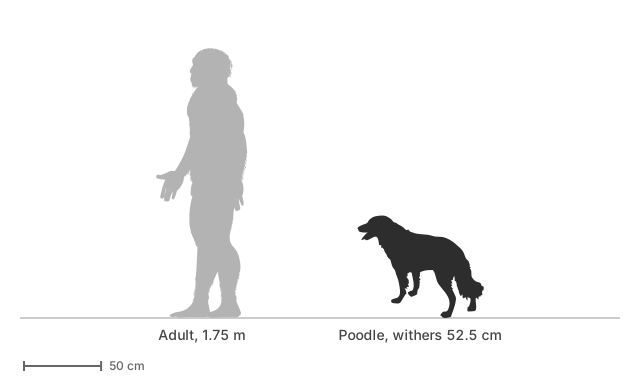
The FCI standard describes a dog of medium proportions with a frizzy coat that is either curly or corded.[1] It sets four size bands by height at the withers: Standard, over 45 cm up to 60 cm; Medium, over 35 cm up to 45 cm; Miniature, over 28 cm up to 35 cm; and Toy, over 24 cm up to 28 cm. The standard gives no weights.[1]
Permitted colours are solid black, white, brown, grey and fawn, plus several parti-colour, tan-marked, tricolour and brindle patterns. Beige and its paler shades are not admitted.[1] The standard also says that tail docking is no longer authorized.[1]
Name and origin
The FCI text says the French name caniche comes from cane, the French word for a female duck. It says the breed descends from the Barbet, was first called the caniche in 1743, and became popular as a companion because of its friendly, loyal character, its four sizes and its colours.[1] A study of breed relationships places the Poodle in a clade (a branch of the breed family tree) of its own.[2] The AKC recognised the Poodle in 1887.[3]
Health and lifespan
In the Dogs Trust table of UK dogs, the Poodle has a median life expectancy of 14.0 years (95% confidence interval 13.8–14.1), based on 6,427 dogs of which 2,399 had died.[4] The table has one row for all Poodle sizes together, so it does not show whether the sizes differ. An earlier study of dogs in England found that the Miniature Poodle was among the longest-lived breeds.[5] No disease figures for the Poodle are given here.
Behavior
In an owner-reported survey of 169 Poodles (standard, miniature and toy together), 1.2% were reported to have snapped, bitten or tried to bite an unfamiliar person in the recent past, 0% a member of the household and 7.7% an unfamiliar dog. The averages across the 33 breeds in the survey were 4.7%, 2.0% and 10.7%.[6] The sizes were not separated, so the results say nothing about one size.[6] Breed explains only about 9% of behavioural differences between individual dogs, so an individual’s behaviour can differ a lot from the breed’s average.[7]
Popularity
The Poodle ranked 6th on the AKC’s list of most popular breeds in 2025.[8]
Sources
- FCI breed standard 172, Poodle
- Parker et al. 2017, Cell Reports 19: 697–708 (DNA relationships of 161 breeds)
- American Kennel Club, breeds by year recognized
- Dogs Trust, “Life expectancy for 155 breeds and crossbred group” table (UK; median life expectancy)
- O’Neill et al. 2013, The Veterinary Journal 198: 638–643 (longevity of owned dogs in England, abstract)
- Duffy, Hsu & Serpell 2008, Applied Animal Behaviour Science 114: 441–460
- Morrill et al. 2022, Science 376 (breed and behaviour)
- American Kennel Club, most popular dog breeds of 2025