The Parson Russell Terrier is a small working terrier from Great Britain, bred to go to ground after fox. The FCI describes it as workmanlike, active and agile, and as bold and friendly.[1]
The breed standard
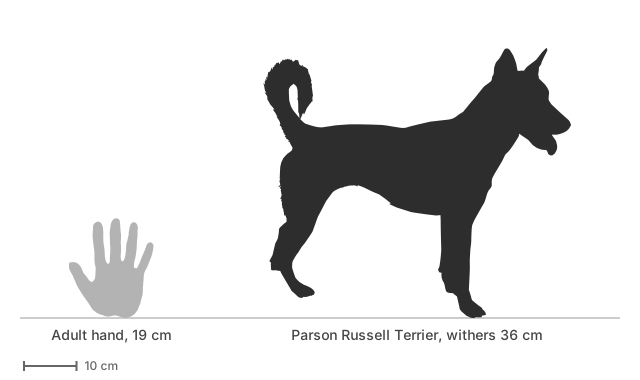
The FCI standard gives an ideal height of 36 cm for males and 33 cm for females. It sets no weight. The chest must be small enough to be spanned behind the shoulders by average-sized hands, which suits a dog that goes to ground. The coat may be rough, broken or smooth, but is always harsh, flat and dense. The colour is white or mostly white with tan, lemon or black markings. The standard describes both docked and undocked tails, and says tails were previously customarily docked.[1]
Name and origin
The FCI says the breed comes from a strain of Fox Terriers bred by a Victorian hunting parson, the Reverend John Russell. Terrier fanciers argued for years over a vaguely defined type called “the Jack Russell”, until the type was recognised under the name Parson Russell Terrier.[1] The Royal Kennel Club (UK) traces the line to Trump, a white terrier with head and tail markings that Russell bought in 1819. It says the club recognised the breed in 1990 as the Parson Jack Russell Terrier, and changed the name in 1999 to tell it apart from the Jack Russell.[2] The American Kennel Club recognised the breed in 2000.[3]
Health and lifespan
Spinocerebellar ataxia is an inherited disease of the breed. It causes progressive loss of coordination and balance, usually first noticed between 6 and 12 months of age. A genetic study linked it to a variant in the CAPN1 gene.[4] The study gives no figure for how common the disease is.
Behavior
In an owner-reported survey of 78 dogs that owners described as Jack Russell Terriers, 7.7% were reported to have snapped, bitten or tried to bite an unfamiliar person in the recent past, 3.8% a member of the household and 21.8% an unfamiliar dog. The averages across the 33 breeds in the survey were 4.7%, 2.0% and 10.7%.[5] The survey used the owners’ own breed label and does not separate the Parson Russell Terrier from other types. The authors name Jack Russell Terriers among the breeds with the greatest share of dogs reported to bite or try to bite people.[5] Breed explains only about 9% of behavioural differences between individual dogs, so an individual’s behaviour can differ a lot from the breed’s average.[6]
Popularity
The Parson Russell Terrier ranked 121st on the American Kennel Club’s list of most popular breeds in 2025. The list counts US registrations only.[7]
Sources
- FCI breed standard 339, Parson Russell Terrier
- Royal Kennel Club (UK), Parson Russell Terrier breed page
- American Kennel Club, breeds by year recognized
- Forman, De Risio & Mellersh 2013, PLoS ONE 8: e64627 (spinocerebellar ataxia in the Parson Russell Terrier)
- Duffy, Hsu & Serpell 2008, Applied Animal Behaviour Science 114: 441–460
- Morrill et al. 2022, Science 376 (breed and behaviour)
- American Kennel Club, most popular dog breeds of 2025