Myrmeleon formicarius is an antlion, an insect related to the lacewings. Its larva digs a funnel-shaped pit in loose, dry ground and waits at the bottom, buried with only its jaws showing, to seize ants and other small animals that slide in. After about two years the larva builds a cocoon (a case of sand grains) and turns into a winged adult that lives for only a few weeks. The species lives across Europe, but not in the British Isles.[1][2][3]
Quick facts
Description
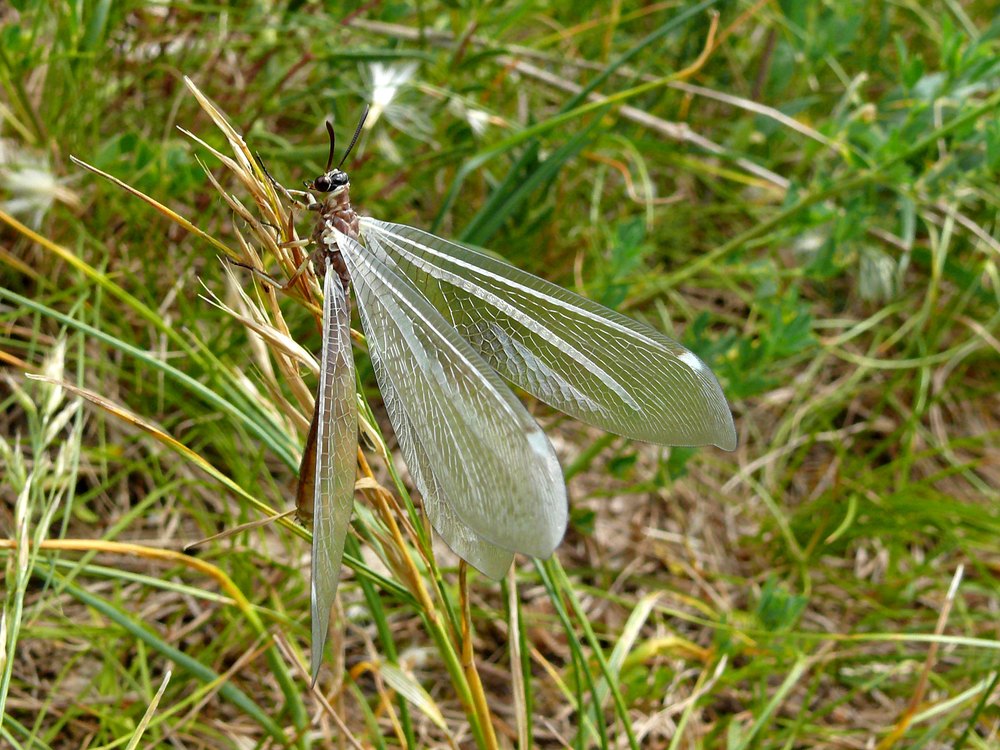
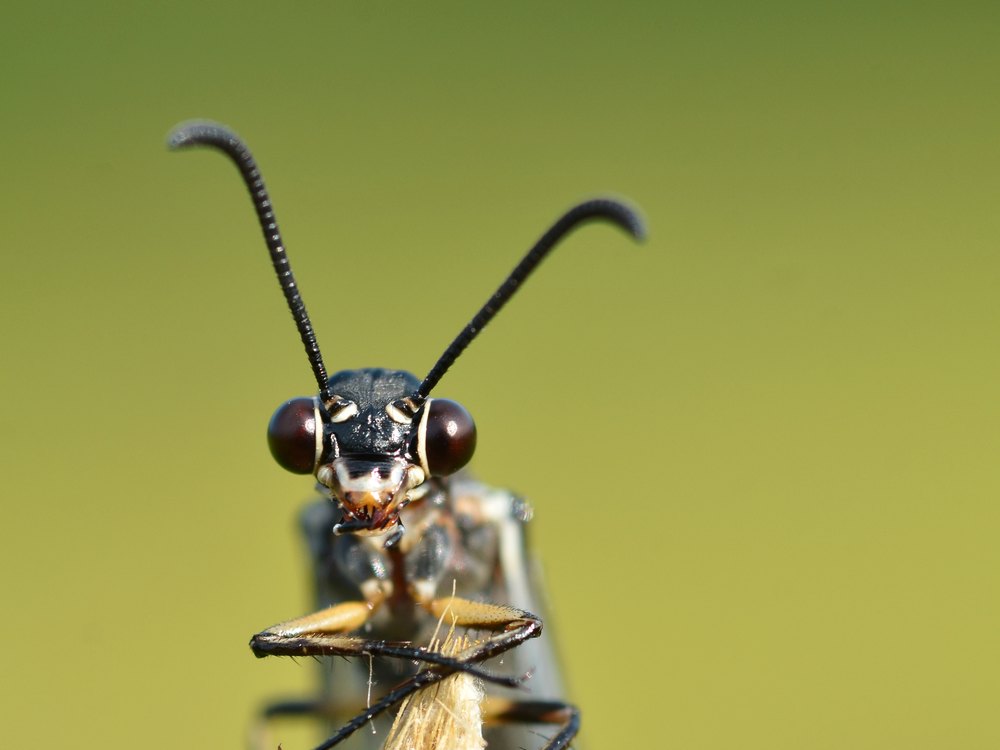
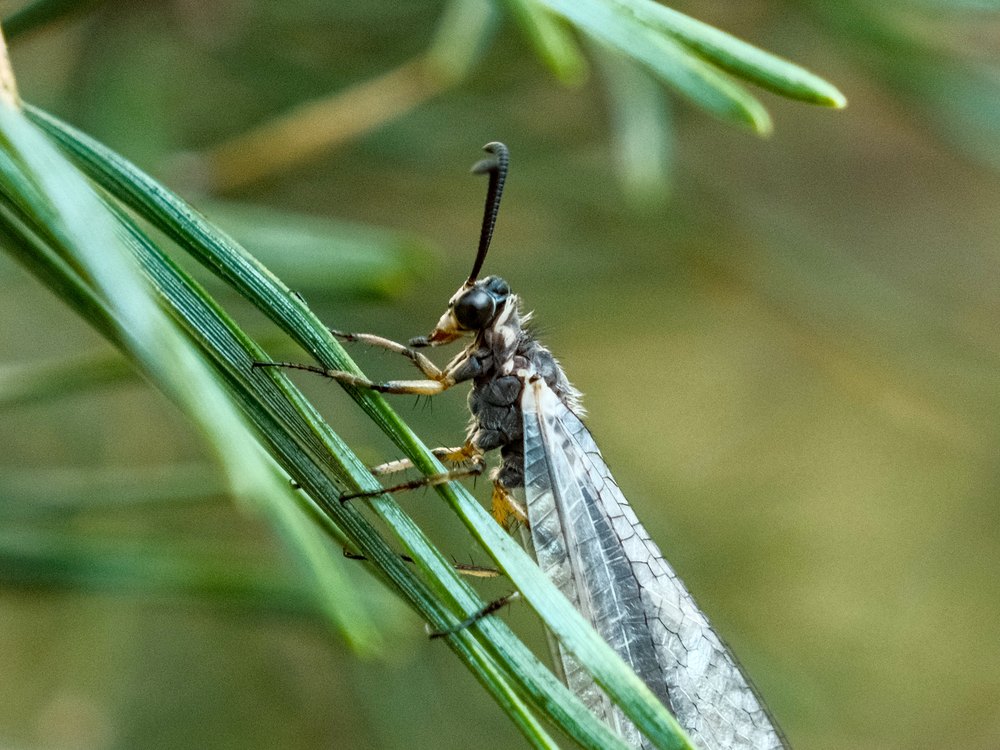
The adult has four clear, unspotted wings. Its antennae end in a club, which separates it from a dragonfly. The pattern on the head and on the plate behind it, together with its long forewings, tells it from other Myrmeleon species.[1]
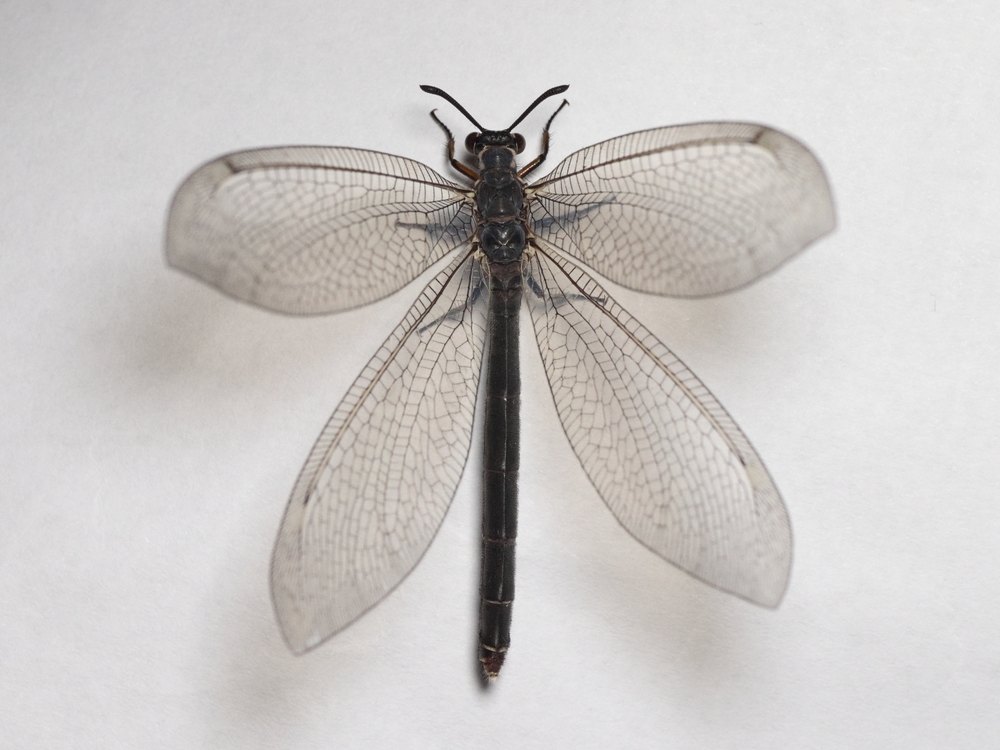

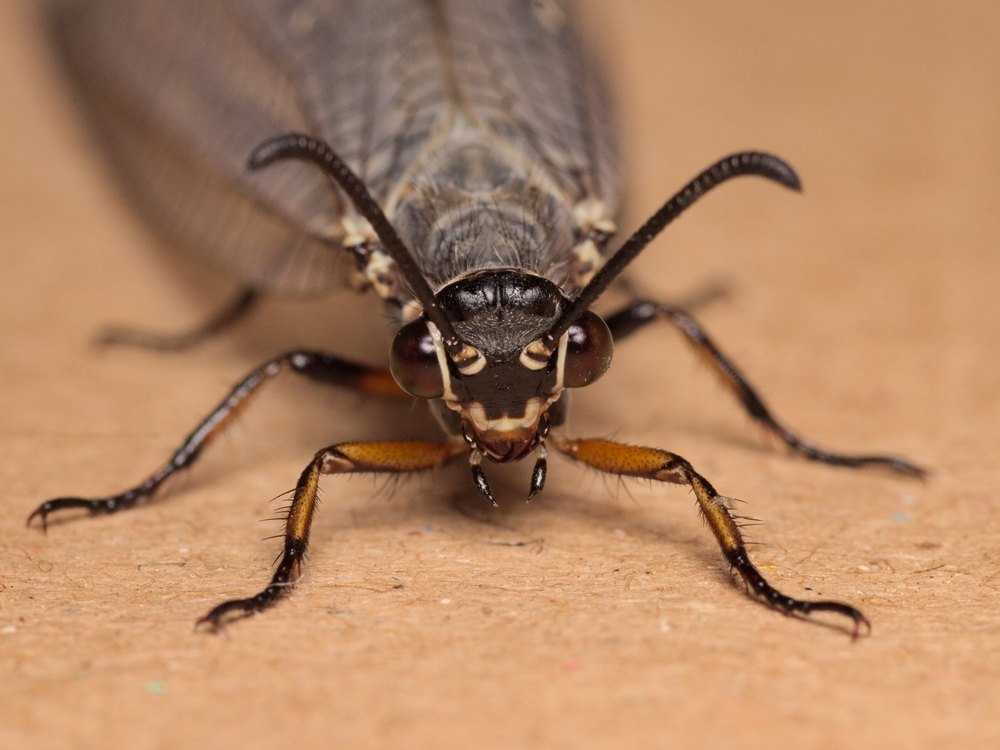

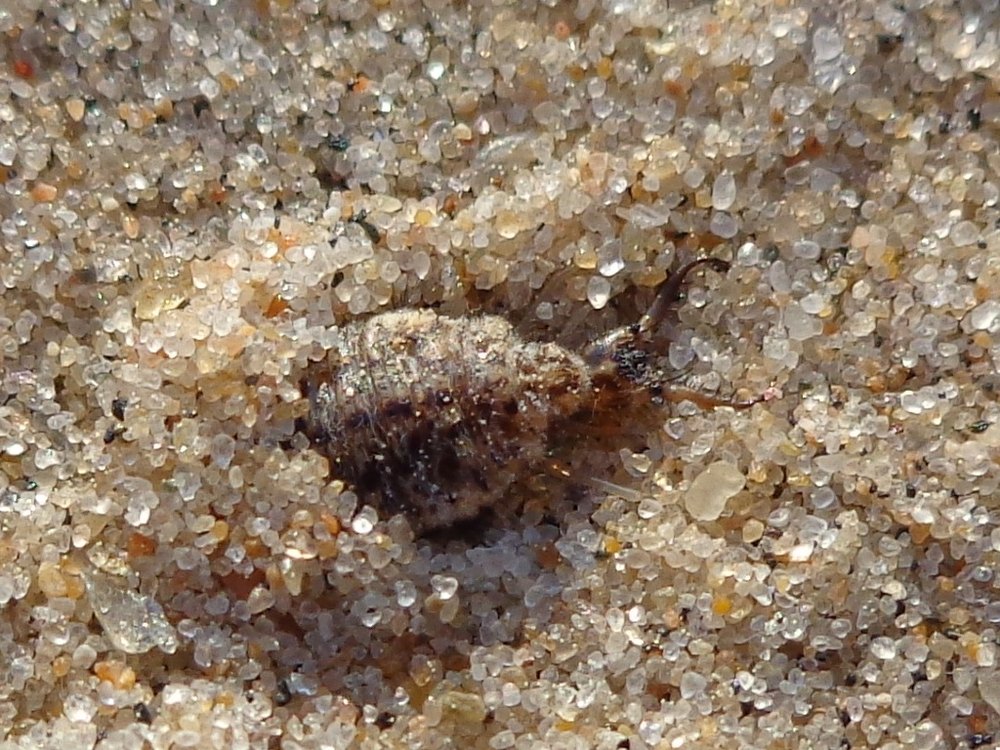
The larva looks very different. Its hind legs carry dark spots, which are the mark that tells it apart from other antlion larvae in central and northern Europe.[4][1]
Name
“Antlion” is the word for the whole family, Myrmeleontidae.[5]
This species has long been mixed up with Euroleon nostras, an antlion with similar pits. In 1857 Brauer used the name formicarium for the larva of Euroleon nostras, so older papers on formicarius or formicarium can describe the wrong animal.[4] The larva of Euroleon nostras lacks the dark hind-leg spots described under Description and is reddish.[4][2] Several look-alike species also live in southern Europe (see Evolution).[6]
In other languages
| Language | Name | Meaning |
|---|---|---|
| Danish local | Plettet myreløve | spotted antlion |
| Swedish local | fläckig myrlejonslända | spotted antlion fly |
| Dutch | Zwartkopmierenleeuw | Black-headed antlion |
| German | Gemeine Ameisenjungfer | Common ant maiden |
The Dutch name comes from a paper on antlions in a Dutch national park.[7] The German name comes from the Austrian nature conservation society’s leaflet for the 2010 Insect of the Year.[8] A meaning is given only where the name is clearly a compound. The Danish name is from the Danish national checklist and the Swedish name from Dyntaxa, as listed by GBIF.
Body
Size
The larva grows through three instars (an instar is one growth stage between moults) and measures 3 to 17 mm in body length across all three.[2] In a measurement of 22 preserved wild-collected third-instar larvae from Italy, Portugal, Romania and Sicily, the body length averaged 9.11 mm, the head 2.28 mm long and 2.04 mm wide, and the jaws 2.41 mm.[4] That study ranks it as the largest European larva of its tribe, the Myrmeleontini.[4]
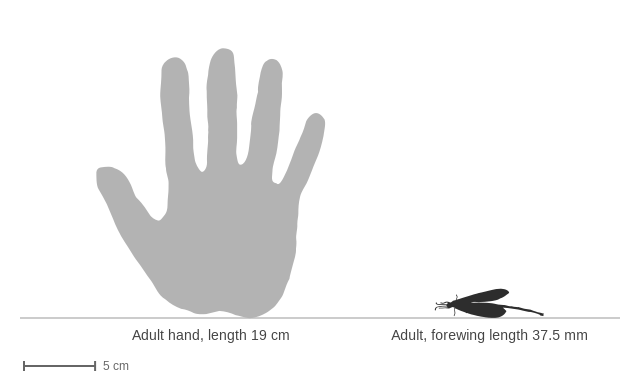
The adult has a forewing of about 35 to 40 mm and a wingspan of 70 to 85 mm.[1][2] In a captive study in Japan, larvae weighed 37.6 mg on average at the moult to the third instar.[9]
| Wingspan (adult) | 70–85 mm |
| Larva length | 3–17 mm |
Larval jaws and senses
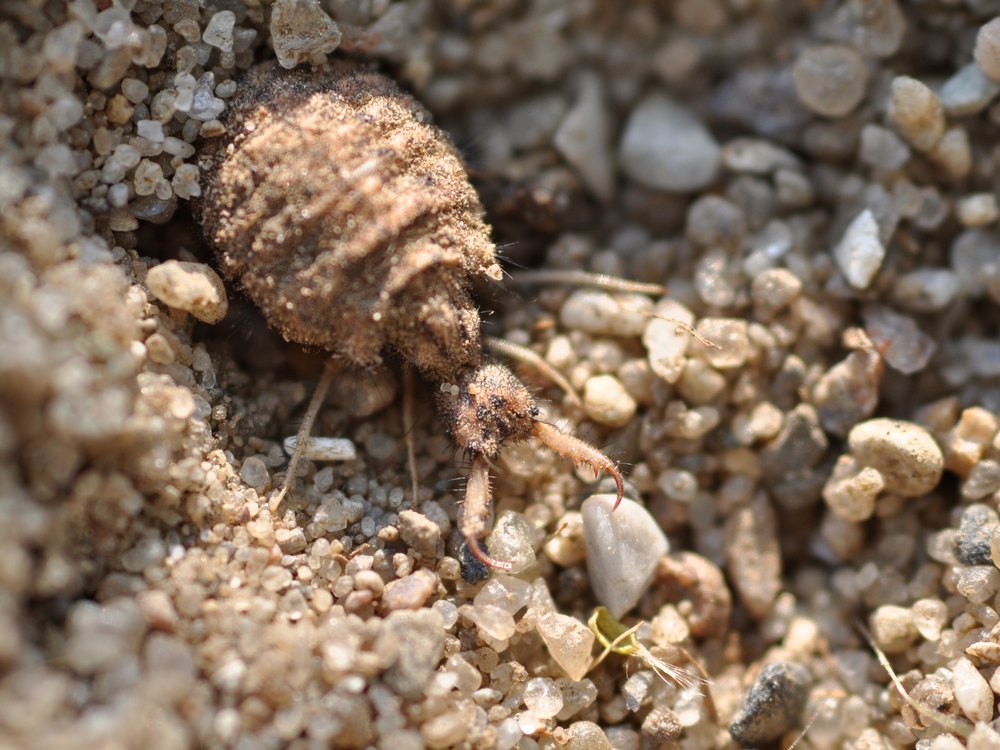
The larva’s jaws and part of its lower mouthparts are enlarged and grooved so that together they enclose a food channel. A canal in the lower mouthpart injects digestive fluid into the prey, and the liquefied food is sucked up the food channel.[1][2] The jaws are about as long as the head.[4] Strong bristles on the body, mostly on the thorax, let the larva feel the faintest vibrations in the sand.[1][2]

Behavior
The pit trap
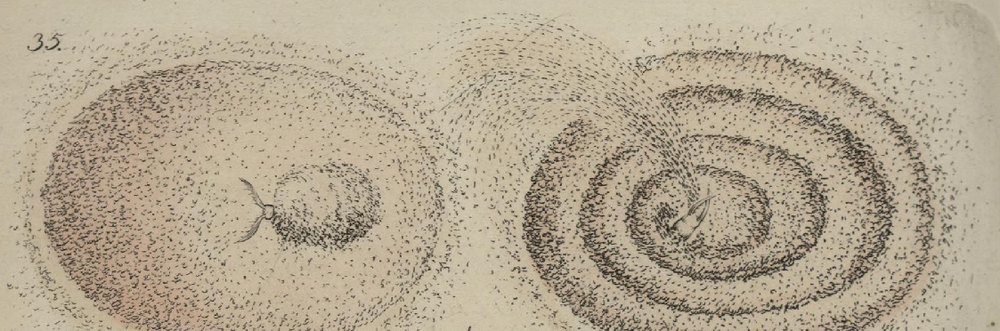
The larva of Myrmeleon formicarius catches prey in a pit trap, a funnel-shaped pit in loose ground. It first searches for a place, crawling backwards just under the surface.[1][2] At a suitable spot it digs in a spiral, using its head as a shovel and flicking the loosened material back and sideways over the rim with quick throws.[2] After two to four turns the result is a round pit with trickling side walls, 1 to 3 cm deep.[2] The finest grains stay at the centre of the pit.[2] Pits are at most about 8 cm across.[1]
The pit sits in loose, fine, dry material in the sun and out of the rain, such as sand, tree mould or sawdust, often under roots, rock overhangs or house walls.[2] Rain halts the digging.[2] A laboratory study of larvae of this species and of Euroleon nostras found that pit width generally followed grain size.[10] The female chooses the site when she lays her eggs, and the larva seldom relocates its pit, though in need it can move more than 30 m.[2][9]

Hunting
The larva waits at the bottom of the pit, buried with only its open jaws showing, for weeks or even months if needed.[1][2] It notices approaching prey by vibrations in the sand and snaps in a fraction of a second.[1][2] If the prey scrambles up the slope, the larva flicks sand at it or undermines the wall, and sand thrown at sliding prey also pushes it toward the jaws.[1][2] Feeding takes several hours, depending on the size of the prey, and the empty husk is thrown out of the pit.[1]
In a captive study of larvae in Japan, the larvae stopped digging and stopped reacting to prey in winter: well-fed larvae went dormant earlier than poorly fed ones, but all were dormant by 24 December.[9] Captive larvae fed to the maximum also stopped building pits when full and rebuilt them later.[9]
The adult
The winged adult is nocturnal and flies weakly with a fluttering flight. By day it sits pressed against stems and twigs with its wings folded.[1][2] Adults are active from May to August.[1] The adult can hover on the spot, like a dragonfly.[1]


Diet
The larva eats mainly ants at most sites, and also spiders, woodlice and caterpillars.[1] At some sites the prey is almost only woodlice or springtails, which gather by the dozen in the pits.[2] Large or fast prey such as flies and big beetles often escape, and the larva may throw them out early.[2]
In a captive study of larvae in Japan, first instars were fed fruit flies, second instars fruit flies and chironomid larvae (non-biting midge larvae), and third instars chironomid larvae.[9] Fully fed larvae drank only part of the body fluid of each prey and dropped the rest, while hungry larvae emptied the prey almost completely.[9] Larvae given a single chironomid every 20 days still completed their development, and 62% to 100% of the larvae at every feeding level made cocoons (the sand cases in which the larva turns into an adult).[9]
The adult catches small flying insects in flight and takes soft-bodied insects such as aphid larvae from perches.[1][2]
Life cycle
| Stage | What it looks like / size |
|---|---|
| Egg | Laid in early to mid summer[2] |
| Larva | 3 to 17 mm long over three instars; about 2 years[2][1] |
| Pupa | Cocoon about 1 cm across; pupa about 15 days[2] |
| Adult | Forewing 35 to 40 mm; lives about 2 to 4 weeks[1] |
Stages
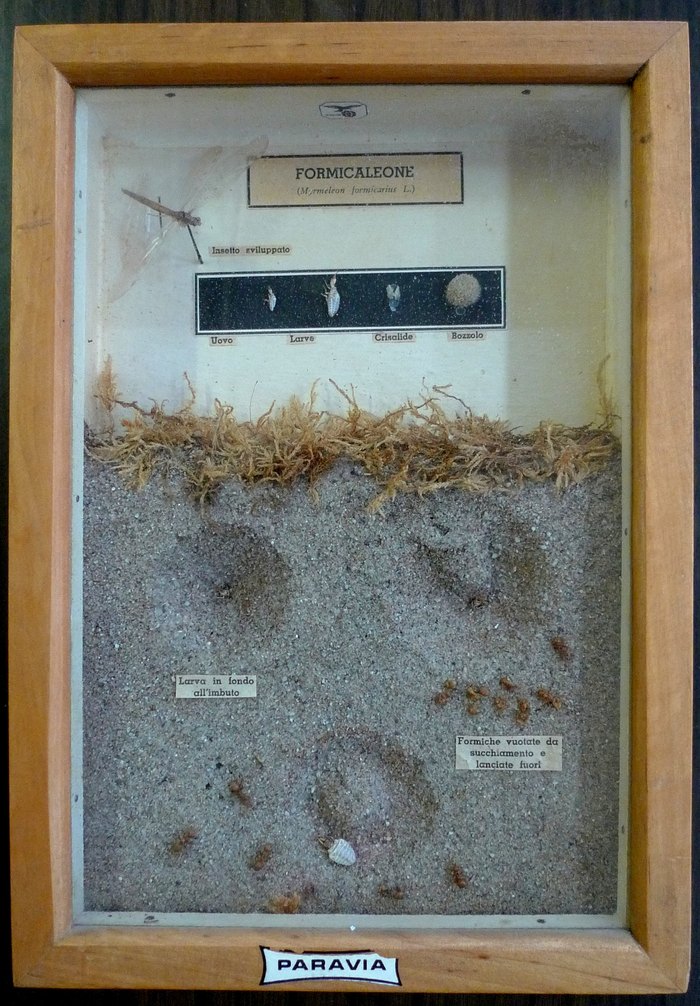
The female lays her eggs in early to mid summer, in a wide window that shifts from year to year. She lays them singly or in small groups in a shallow pit at the surface, and the eggs are coated with sand or plant debris, which hides them.[2] The larva that hatches grows through three instars. The larva moults into the second instar in autumn, or in spring after the winter rest, and into the third instar between June and October of the following year. The third-instar larva spends a second winter in its pit.[2]
In the next spring the third-instar larva builds a round cocoon about 1 cm across, just below the surface. It is glued to the surrounding ground and is hard to find.[2] Inside, the larva rests as a pre-pupa for about 18 days. It then moults into the pupa (the resting stage in which the larva turns into an adult), which lasts about 15 days.[2]
The pupa bites a half-circle lid out of the cocoon and pushes its head and front body out. The adult then emerges and climbs a nearby plant, where it spreads and hardens its wings.[2] The adult is on the wing between May and August and lives about 2 to 4 weeks.[1]

Generation time
One generation takes about two years, but it can take one to three depending on the weather.[1] Two years is the usual length in Central Europe, and there is never more than one generation per year.[2] A one-year cycle is possible in captivity: in a captive study in Japan, larvae that were fed generously as first and second instars became adults in the second calendar year, about a year after hatching. The author judged that wild larvae, with a poorer food supply, can hardly do this.[9]
In the same study the third-instar period, winter included, lasted 245.1 ± 8.3 days and was the same at every feeding level.[9]
Ecology
Competition
In the Netherlands and central Europe the larvae of Myrmeleon formicarius share sandy ground with those of another pit-building antlion, Euroleon nostras. In a study of Dutch dunes, about one third of the places with M. formicarius larvae also held E. nostras, and the M. formicarius pits always lay at the edge of an E. nostras group, never surrounded by it.[11] The two species choose different spots: 83% of M. formicarius pit groups (36 groups) were on level ground, against 21% of E. nostras groups (76 groups), which mostly dug on slopes under overhanging sand or plants.[11] Vergoossen, citing earlier work, states that in mixed populations deaths rise mainly among M. formicarius, which compete less well for food and mostly dig at the edges of a colony.[7] The same paper shows the remains of an M. formicarius larva among prey remains thrown out of an E. nostras pit.[7]
A 2025 laboratory study of larvae of both species found that both first chose medium-sized sand grains. When the medium sand was moistened, both species moved to a coarser, dry grade, and M. formicarius built larger pits in coarser sand while E. nostras built larger pits in the sand it preferred.[10]
Parasites and enemies
An Italian species sheet lists parasitoids of the larvae (insects whose young develop inside a host and kill it): wasps of the genera Hybothorax and Cryptus.[12]
Habitat and range
Habitat
The larva needs loose, dry, fine sand in open, sunny ground that is sheltered from rain. Italian authors describe the species as fairly tolerant of different habitats, but it avoids very hot, dry climates, and in southern Europe it favours places with trees or woodland nearby.[12][6][4] In Dutch dunes it lives mainly in open, level dune slacks with sandy dry vegetation or a mosaic of heath and sand, and it is absent from lime-rich dunes.[11] At Meinweg National Park antlion larvae dug pits along sandy paths with steep edges, at the foot of pine and oak trees, on soil heaps and at the base of fallen trees and structures.[7] In Italy, pits are abundant along banks where an overhanging rock or tree roots keep rain off loose soil.[12] In Korea larvae live in dry fine soil in open grassland or on cut slopes beside trails.[13]


In southern Europe the species lives mainly in mountains, such as Pollino, Aspromonte and Etna in Italy, and in fresh deciduous woods near the coast.[6][4]
Range
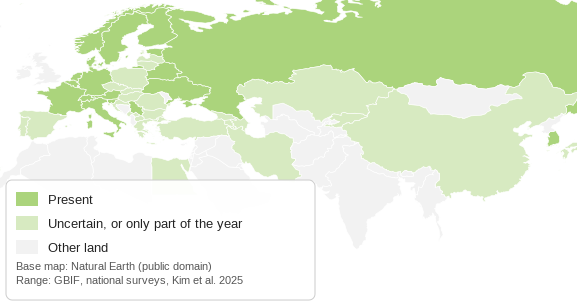
The species is widespread across Europe, with records from the Netherlands, Belgium, Germany, Austria, Switzerland, France, Italy, Denmark, Sweden, Norway, Finland and Estonia, and eastwards through Ukraine and Russia.[3][6][11][12][8] In Italy it occurs in every region from Valle d’Aosta to Sicily except Sardinia.[12] In the Netherlands it is restricted to sandy, lime-poor ground.[11] GBIF has no records from Great Britain or Ireland.[3]
The edges of the range are less certain. Records from Spain, Portugal, the Balkans, Turkey, the Caucasus, Central Asia, Egypt, China and Japan are uncertain, and in parts of the Mediterranean, related species such as Myrmeleon gerlindae and M. noacki take its place.[3][6][13] In South Korea it was confirmed in 2025, where it is local in Gangwon-do, Chungcheongbuk-do and Gyeongsangbuk-do.[13]
Evolution
The order Neuroptera holds the lacewings, antlions and their relatives. A study of the order by Winterton and others (2018) found that the owlflies, once a separate family, sit inside the antlions.[14] A later study of 207 species reached the same result and merged the owlflies into the antlion family, which now has four subfamilies.[15] Myrmeleon formicarius belongs to the subfamily Myrmeleontinae.[15]
The age of the antlion family depends on the study and on the fossils used to calibrate it. Michel and others (2017) put its origin in the Cretaceous, about 135 to 138 million years ago, depending on the calibration, and found that all of its higher-level lineages arose in the Early Cretaceous.[16] That study also found that several antlion genera are not single natural groups.[16]
Within the genus, Myrmeleon formicarius sits in the formicarius group, a set of look-alike species that share the lack of a small wing structure (the pilula axillaris) in the male hind wing, similar male genitalia and similar habits. Besides Myrmeleon formicarius, which lives from Europe into Siberia, the group holds Myrmeleon gerlindae in the western Mediterranean, Myrmeleon noacki in the eastern Mediterranean and Myrmeleon punicanus on Sicily and Pantelleria.[6] Myrmeleon punicanus was only described in 2012, so older records from the Mediterranean may include these relatives.[6]
Forms and variants
No subspecies are recognised: GBIF, the Catalogue of Life and ITIS list none as accepted.[3][5][17] GBIF carries 16 synonyms, among them Hemerobius formicalynx Linnaeus, 1758, Myrmeleon innotatus Rambur, 1842, Myrmeleon dasypterus Hagen, 1858, Myrmeleon neutrus Fischer von Waldheim, 1822, Myrmeleon nigrivenosus Okamoto, 1905 and the spelling Myrmeleo formicarius.[3] The names M. formicarius nigrilabrus and M. formicarius var. immaculatus are also listed there as synonyms and not as subspecies.[3]
Conservation
Status
Myrmeleon formicarius has not been evaluated by the IUCN, so it has no global Red List category. In Estonia, the national biodiversity portal lists it as Least Concern.[18]
For the Netherlands, a survey in 1997 counted antlion pits in two 1 km squares of the non-calcareous (lime-poor) dunes of Noord-Holland and extrapolated the result to the 23.3 km² of dunes north of Bergen aan Zee. Boer estimated 2,000 to 2,500 individuals, about 800 per km² of open dune, for that one region only. He noted that much of the population is hidden, because the adults fly at night and not every larva builds a visible pit.[11]
Threats
Larvae need warm, open, rain-sheltered sand, and the threats below all remove it. Natural succession (the gradual growth of plants over bare ground) closes open spots; in the Dutch dunes Boer studied, bare patches overgrow within about a year, which is too fast for a larva whose development takes two years.[11] In Meinweg National Park, shade from growing shrubs and trees is described as fatal for warm, sheltered pit sites.[7]
Too many rabbits disturb the pits.[11] Walkers, cross-bikers and heavy vehicles damage sandy paths and the steep sandy edges where larvae build their pits.[11][7] Keeping steep, sunny sand edges along paths, and creating new ones, is the management that the Meinweg study recommends.[7]
Habitat loss
History and culture
The first description
Myrmeleon formicarius was described by Carl Linnaeus in 1767, and the databases still accept his name and date for the species.[3][17]
Taxonomy
| Rank | Name |
|---|---|
| Kingdom | Animalia |
| Phylum | Arthropoda |
| Subphylum | Hexapoda |
| Class | Insecta |
| Subclass | Pterygota[21] |
| Infraclass | Neoptera[21] |
| Superorder | Holometabola[21] |
| Order | Neuroptera |
| Suborder | Myrmeleontiformia[21] |
| Superfamily | Myrmeleontoidea[21] |
| Family | Myrmeleontidae |
| Subfamily | Myrmeleontinae[21] |
| Tribe | Myrmeleontini[21] |
| Genus | Myrmeleon |
| Species | Myrmeleon formicarius (Linnaeus, 1767)[3][5][17] |
Synonyms (10)
| Name |
|---|
| Formicaleo formicalynx (Linnaeus, 1758) |
| Hemerobius formicalynx (Linnaeus, 1758) |
| Myrmecoleon formicalynx (Linnaeus, 1758) |
| Myrmeleon formicalynx (Linnaeus, 1758) |
| Formicaleo formicarius (Linnaeus, 1767) |
| Hemerobius formicarius (Linnaeus, 1767) |
| Myrmecoleon formicarius (Linnaeus, 1767) |
| Myrmeleo formicarius (Linnaeus, 1767) |
| Myrmeleon neutrus (Fischer von Waldheim, 1822) |
| Myrmecaelurus innotatus (Rambur, 1842) |
A selection of the oldest names. The GBIF backbone lists 13 species-level synonyms.[20]
Higher classification
The European antlion is in the family Myrmeleontidae, the antlions, in the order Neuroptera, which also holds the lacewings. Machado and colleagues (2019) merged the owlflies into the antlion family and place this species in the subfamily Myrmeleontinae (see Evolution).[15] The genus Myrmeleon is large: GBIF lists nearly 200 accepted species.[19]
Sources
- Anderle 2010, “Das Insekt des Jahres 2010: Die Gewöhnliche Ameisenjungfer”, Entomologica Austriaca 17: 231–236 (review, in German)
- Gepp 2010, “Der Ameisenlöwe (Myrmeleon formicarius), Insekt des Jahres 2010”, Entomologische Nachrichten und Berichte 54(1): 1–7 (review, in German)
- GBIF Secretariat, Myrmeleon formicarius Linnaeus, 1767, GBIF Backbone Taxonomy (species 2100670; accepted name, 16 synonyms; occurrence counts by country)
- Badano and Pantaleoni 2014, “The larvae of European Myrmeleontidae (Neuroptera)”, Zootaxa 3762(1): 1–71
- Catalogue of Life, Myrmeleon (Myrmeleon) formicarius Linnaeus, 1767 (accepted name; ChecklistBank)
- Pantaleoni, Badano et al. 2012, “Myrmeleon punicanus n. sp.”, Bulletin of Insectology 65(1): 139–148
- Vergoossen 2023, “Mierenleeuwen in het Nationaal Park De Meinweg”, Natuurhistorisch Maandblad 112(8): 205–212
- Naturschutzbund Österreich, “Insekt des Jahres 2010: Ameisenlöwe”, leaflet (in German)
- Matsura 2003, “Influence of feeding frequency on a life cycle of the antlion Myrmeleon formicarius”, Japanese Journal of Entomology (N.S.) 6(1): 19–25
- Klokočovnik, Bantan and Devetak 2025, “Substrate choice in antlion larvae: particle size and moisture”, Journal of Insect Behavior 38(2): 18
- Boer 1999, antlions in the dunes of Noord-Holland, Entomologische Berichten 59(4): 45–52
- Letardi, “Myrmeleon formicarius”, species sheet of the Italian Neuroptera, ENEA
- Kim, Ahn and Kim 2025, Myrmeleontidae of Korea, ZooKeys 1262: 97–174 (treatment of Myrmeleon formicarius)
- Winterton, Lemmon, Gillung et al. 2018, “Evolution of lacewings and allied orders using anchored phylogenomics (Neuroptera, Megaloptera, Raphidioptera)”, Systematic Entomology 43(2): 330–354
- Machado, Gillung, Winterton et al. 2019, “Owlflies are derived antlions: anchored phylogenomics supports a new phylogeny and classification of Myrmeleontidae (Neuroptera)”, Systematic Entomology 44(2): 418–450
- Michel, Clamens, Béthoux et al. 2017, “A first higher-level time-calibrated phylogeny of antlions (Neuroptera: Myrmeleontidae)”, Molecular Phylogenetics and Evolution 107: 103–116
- ITIS, Myrmeleon formicarius Linnaeus, 1767 (TSN 982665)
- Eesti Elurikkuse Infosüsteem, Myrmeleon formicarius (Estonian biodiversity portal; national red list category)
- GBIF Secretariat, Myrmeleon Linnaeus, 1767, GBIF Backbone Taxonomy (genus 2100347; accepted species and publication)
- GBIF backbone, Myrmeleon formicarius, synonyms
- ITIS, Myrmeleon formicarius, classification