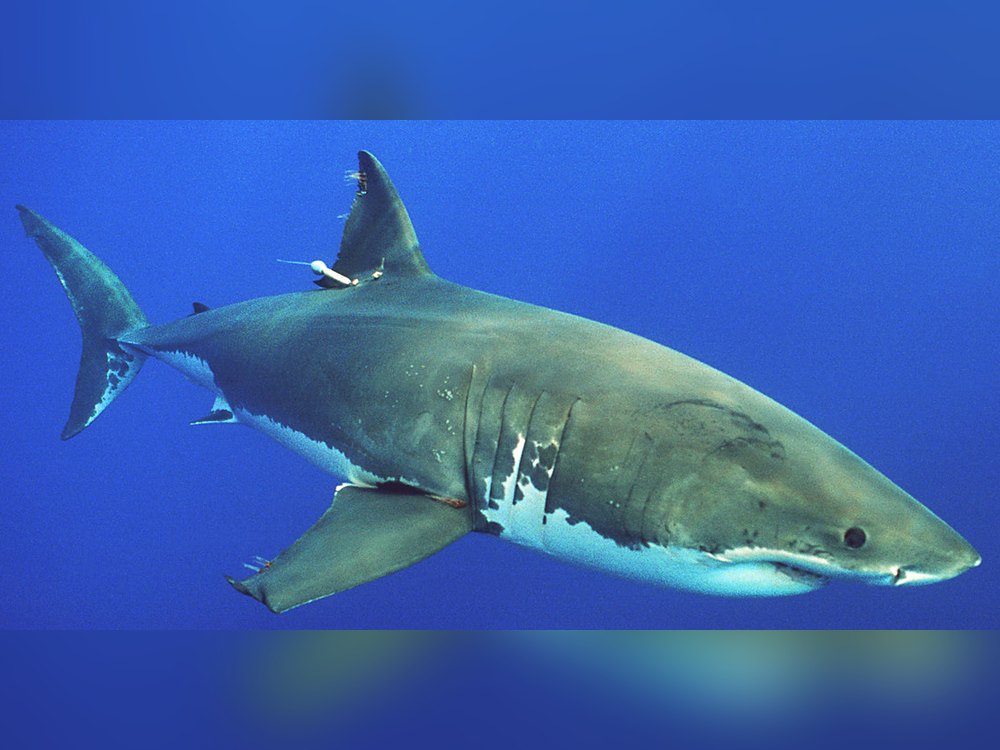
The Great White Shark (Carcharodon carcharias) is a large shark of coastal and open seas. It lives in most temperate and tropical oceans and is found most often in temperate waters.[1] It is the only living species of its genus.[2] Females give birth to live young, and the unborn sharks feed on eggs inside the mother.[1][3] The IUCN Red List lists the species as Vulnerable. It estimates that the global population fell by 30 to 49% over three generations, a span of 159 years.[1]
Quick facts
Description
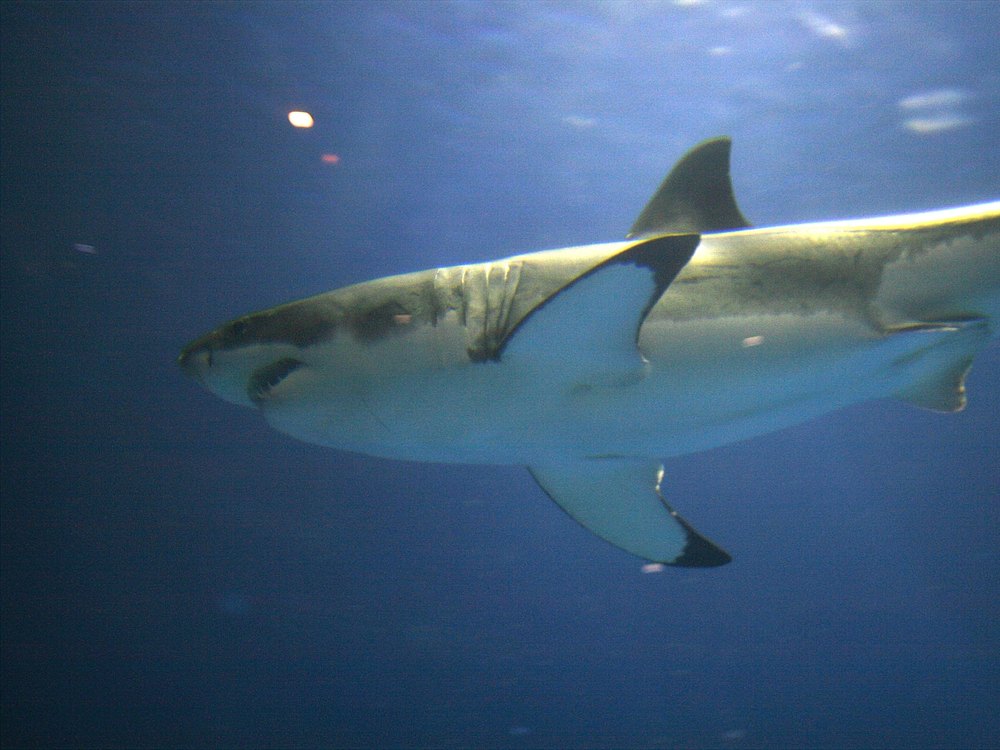
The Great White Shark is a large shark of the family Lamnidae, in the order Lamniformes, the mackerel sharks. It belongs to the class Chondrichthyes, the cartilaginous fishes.[1][5][6] The IUCN describes it as a large coastal and open-water shark.[1] The other living members of its family are the shortfin and longfin makos, the salmon shark and the porbeagle.[7]
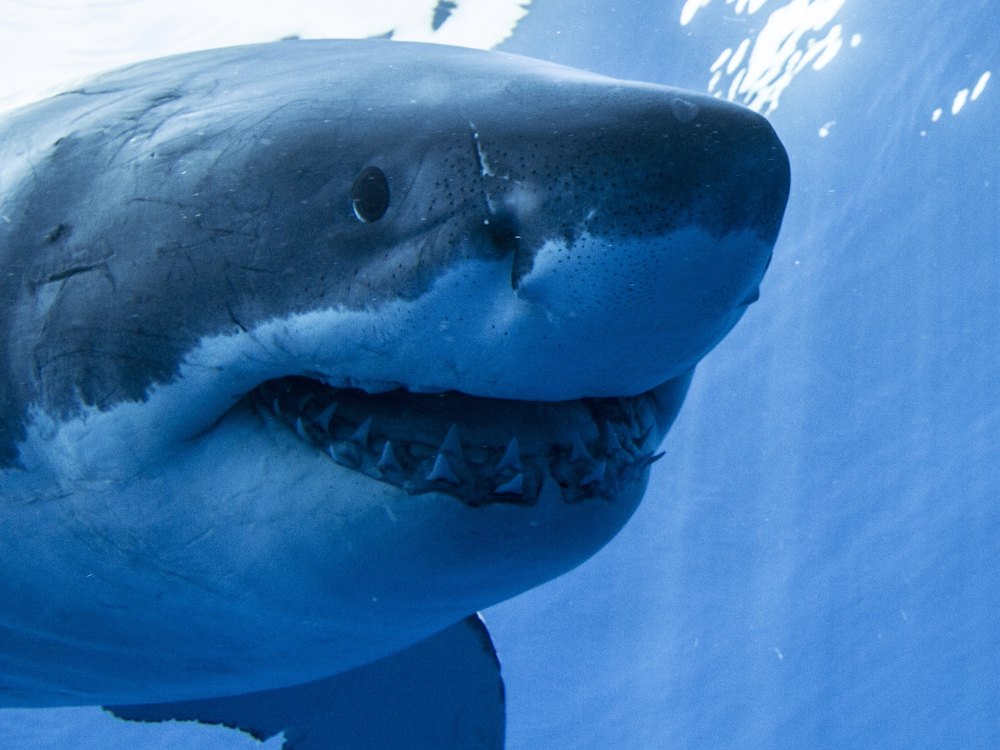

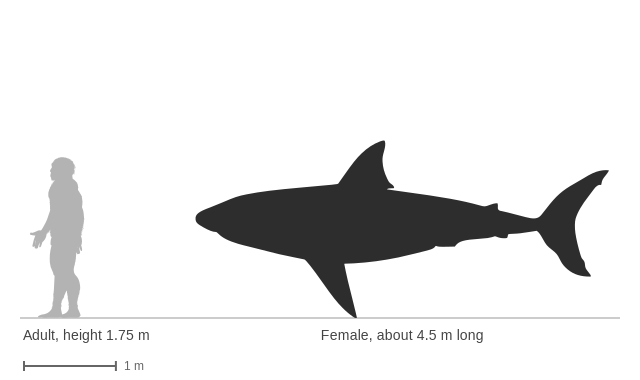
Females grow larger than males. The largest animals measured in one long dataset from the western North Atlantic were a female of 526 cm and a male of 493 cm, both given as fork length.[8] Males mature at 310 to 410 cm total length, and most females at 400 to 500 cm.[1] See Body for the sizes and the way they were measured.


Teeth
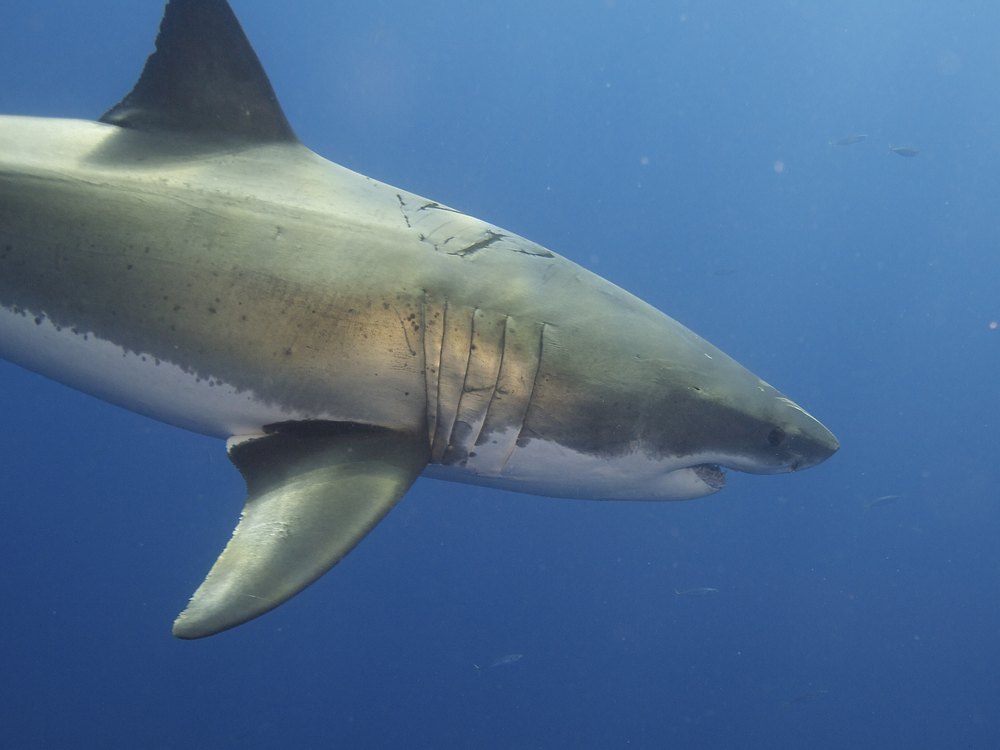
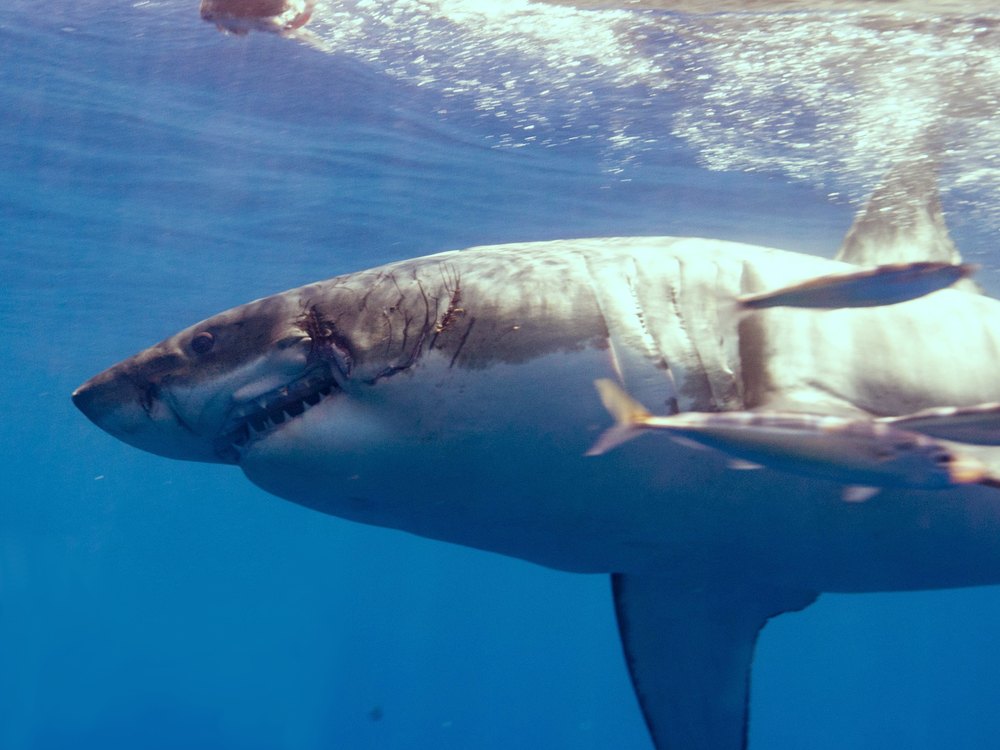
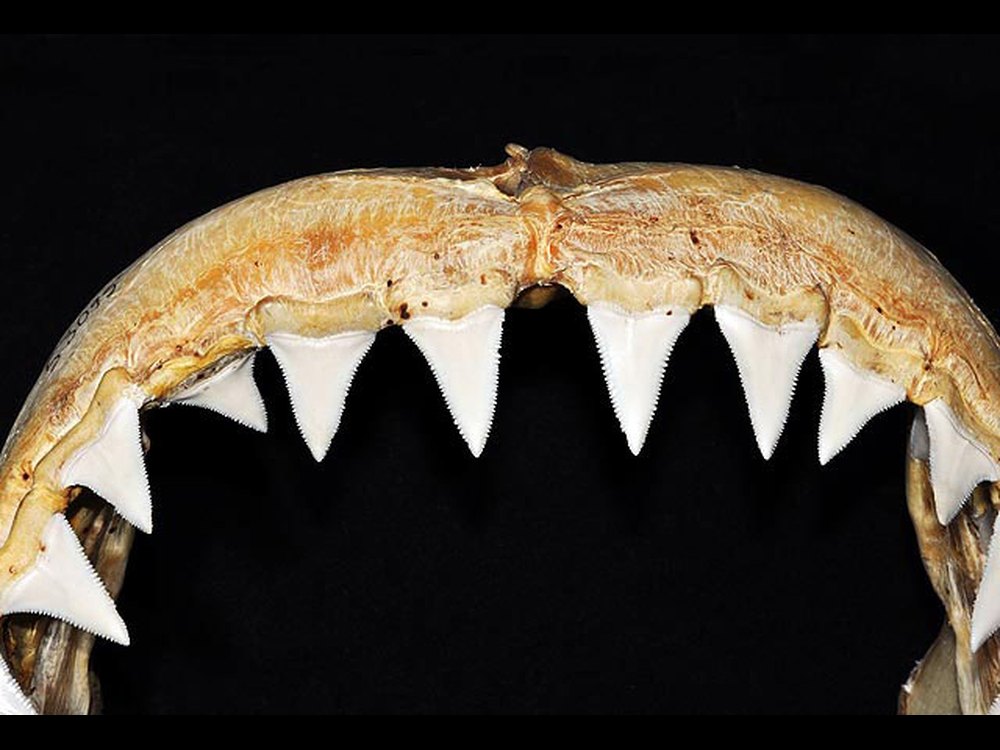
The teeth of a Great White Shark are triangular and have serrated edges. Nyberg and colleagues (2006) found that the serrations are distinct from those of the extinct megatooth sharks, and similar in size to the slightly serrated teeth of makos.[9] The teeth have a bone-like inner structure, a trait of the mackerel sharks, and the shark replaces them throughout its life, starting in the embryo.[10]


Name
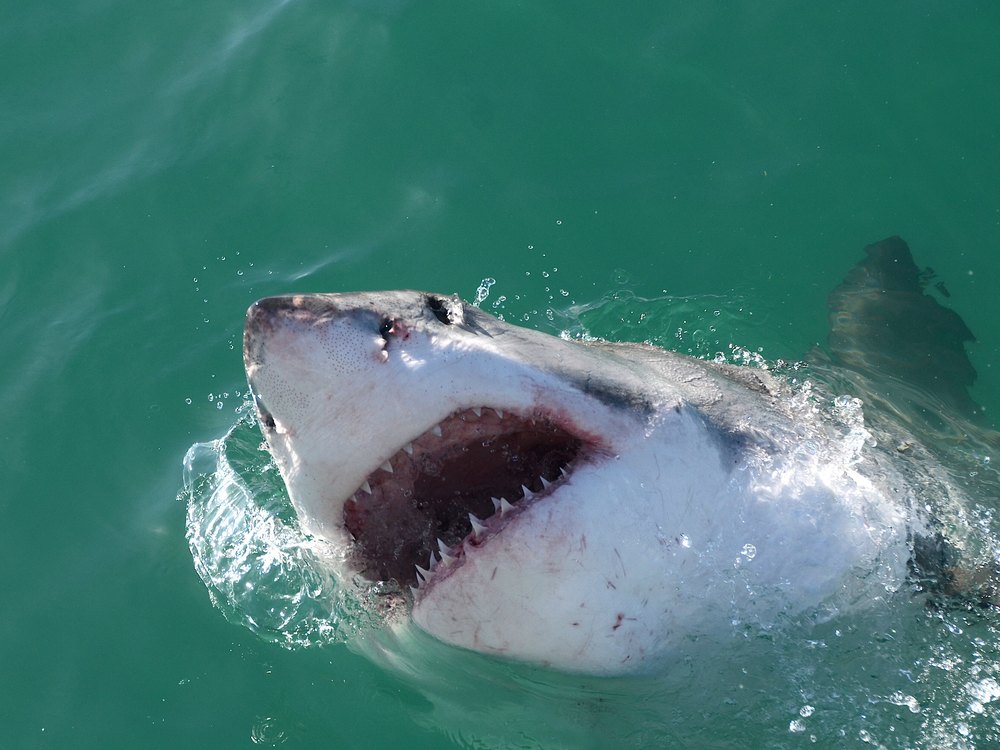
“Great White Shark” is the common name used on this page, and the IUCN lists both “White Shark” and “Great White Shark”.[1] FishBase also lists “white pointer”.[11] The New Zealand law that protects the species is called the Wildlife (White Pointer Shark) Order 2007.[12]
The scientific name is Carcharodon carcharias (Linnaeus, 1758). Linnaeus first described the species as Squalus carcharias on page 235 of the 10th edition of Systema Naturae.[13] The genus name Carcharodon is credited to Smith, 1838.[14][5] FishBase says the species name comes from the Greek karkharias, “shark”, from karkharos, “sharp or jagged”, which refers to the teeth. For the genus, FishBase says the first part presumably refers to Carcharias, and odon is Greek for “tooth”.[11]
In other languages
| Language | Name | Note |
|---|---|---|
| Maltese local | kelb il-baħar abjad | white sea dog |
| French | grand requin blanc | |
| German | Weißer Hai | |
| Spanish | tiburón blanco | |
| Portuguese | tubarão-branco | |
| Italian | squalo bianco | |
| Dutch | witte haai | |
| Afrikaans | witdoodshaai | |
| Japanese | hohojirozame | Written in Latin letters in the source |
| Māori | mangō taniwha | Defined in the Māori Dictionary as the white shark, also known as the great white shark[15] |
| Hawaiian | niuhi | Listed by FishBase and Animal Diversity Web; neither names a Hawaiian-language source[11][6] |
Most names come from the FishBase list of common names. The list does not say which language each name belongs to, so the languages were inferred from the words, and native speakers have not checked them.[11] The Maltese name is from the EUNIS biodiversity database, as listed by GBIF.
Body
Size
The IUCN says the maximum size of the Great White Shark is “undetermined, but estimated at 600–640 cm total length”, after Compagno 2001.[1] This is an estimate, and not a measured animal. The largest animals measured in one primary dataset were a female of 526 cm and a male of 493 cm, caught in the wild in the western North Atlantic. Hamady and colleagues (2014) give these as fork length, which is shorter than total length.[8] Males are smaller than females.[1][8]
| Measure | Value | Source note |
|---|---|---|
| Largest size, estimated | 600–640 cm total length | The IUCN says the maximum size is “undetermined”, after Compagno 2001[1] |
| Largest female measured | 526 cm fork length | Western North Atlantic, caught in 1983[8] |
| Largest male measured | 493 cm fork length | Western North Atlantic, caught in 1986[8] |
| Size at birth | 120–150 cm total length | After Francis 1996, as quoted by the IUCN[1] |
| Males mature | 310–410 cm total length | After Pratt 1996, Compagno 2001 and Tanaka et al. 2011, as quoted by the IUCN[1] |
| Most females mature | 400–500 cm total length | Some were reported as immature at 472–490 cm[1] |
| Female | Male | |
|---|---|---|
| Fork length (largest measured) | 526 cm | 493 cm |
| Total length (maximum, estimated) | 600–640 cm | |
Weight
Animal Diversity Web gives a weight of “up to 3,000 kg”, in round numbers.[6]
Warm body
Most fishes take the temperature of the water around them. The Great White Shark is different. Goldman (1997) measured the stomach temperature of three sharks at the South Farallon Islands, California, and found that it stayed up to 14.3 °C above the water and varied much less than the water did. The study concluded that the shark is endothermic, which means it keeps part of its body warm.[4] This is called regional endothermy, because only parts of the body are warm.
Senses
The shark has electroreception, which it uses with the ampullae of Lorenzini, and a sense of smell.[6]
Ryan and colleagues tested the vision of the Great White Shark. The study found that the retina of a young white shark has poor spatial resolving power. A simulation of the shark’s view of footage from Taronga Zoo could not tell seals, swimmers and surfers apart.[16] The authors caution that not every bite is a case of mistaken identity and that other senses are used as well.[16] Whether bites on people are mistakes remains an open question.
The shark can hear low sounds. In a playback study, white sharks spent less time around a baited camera rig when an artificial sound was played, and they showed no clear change when orca calls were played.[17] No recording or description of a voice of the Great White Shark was found.
Behavior
Breaching and strikes
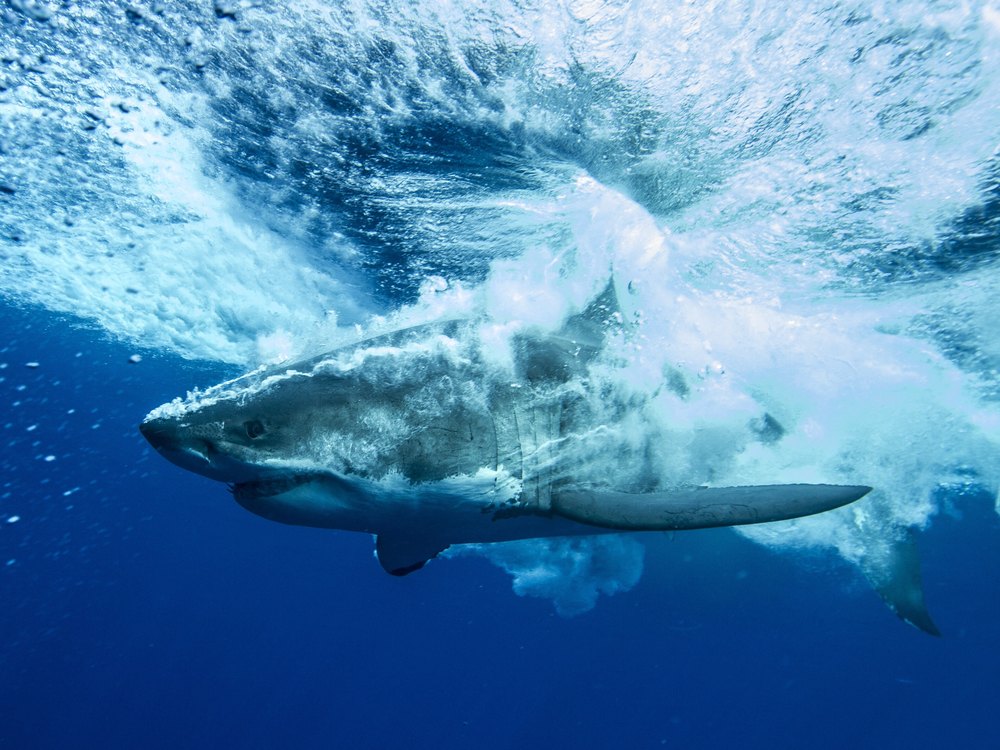
At False Bay, a study of 2,088 predatory attacks on Cape fur seals, recorded from 1997 to 2003, found that the attacks were mostly on lone young-of-the-year seals, almost only in winter, and mostly within two hours of sunrise.[18]

Near the surface
Most records of the species are from shallow water. FishBase gives a usual depth of 0 to 250 m.[11] The IUCN gives a range from the surface to 1,200 m.[1] The sharks also make long, deep dives. A tagged female dived to about 980 m in water as cold as 3.4 °C.[19]

Alone or together
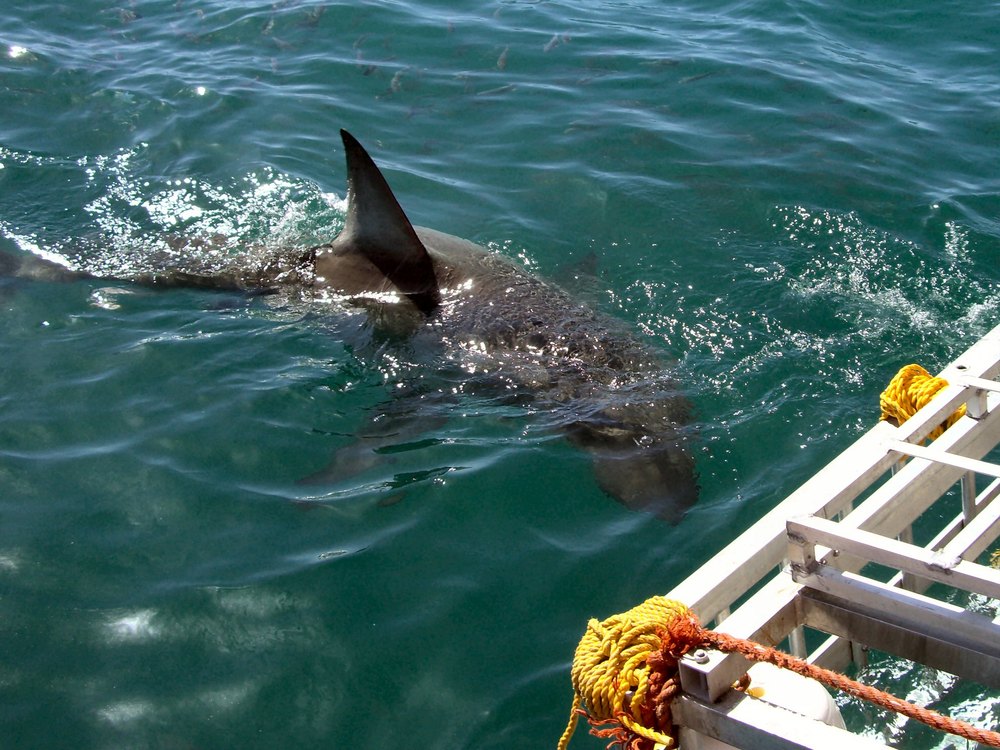
The Great White Shark is mostly solitary. At Gansbaai, a ten-year study of sharks drawn to bait found a loose rank by size, with sharks following, giving way and sometimes splash-fighting. A study at Mossel Bay, also in South Africa, found random associations and only a weak structure by sex and size. Its authors call large open-water sharks generally solitary.[20] Both studies watched sharks that gathered at food, and may not show how the sharks behave elsewhere.
Migration and tagging
Satellite tags have shown long journeys. Bonfil and colleagues (2005) tracked a female tagged off South Africa in November 2003. She travelled more than 20,000 km, to Australia and back, in just under nine months, and returned to the place where she had been tagged. The study suggests that sharks may return to the area where they were born, and found that females do make transoceanic trips.[19] The IUCN also reports long trans-oceanic movements between South Africa and Australasia, and between California and the Hawaiian Islands.[1]
In the western North Atlantic, Skomal and colleagues (2017) tagged sharks of 2.4 to 5.2 m with satellite tags from 2009 to 2014. They found a seasonal move from the northeastern shelf waters in summer to wintering areas off the southeastern United States and in the Gulf of Mexico.[21] A review of 649 records from 1800 to 2010 found the summer range mainly from Massachusetts to New Jersey and the winter range mainly off Florida.[22]

Diet
The Great White Shark is a carnivore. FishBase lists bony fishes, sharks, rays, seals and other marine mammals among its prey.[11] Animal Diversity Web says young sharks eat smaller fishes, squid, stingrays and small sharks, and that adults eat seals, sea lions, dolphins and whale carcasses. That account comes from a page written largely by and for college students, so it is given only as reported.[6]
The diet changes with size. Estrada and colleagues (2006) analysed isotopes in the vertebrae of 27 sharks of 128 to 526 cm total length from the western North Atlantic. The study found two shifts, one after birth, from yolk to fish, and one at 341 cm, from fish to marine mammals.[23]
Scavenging on whales
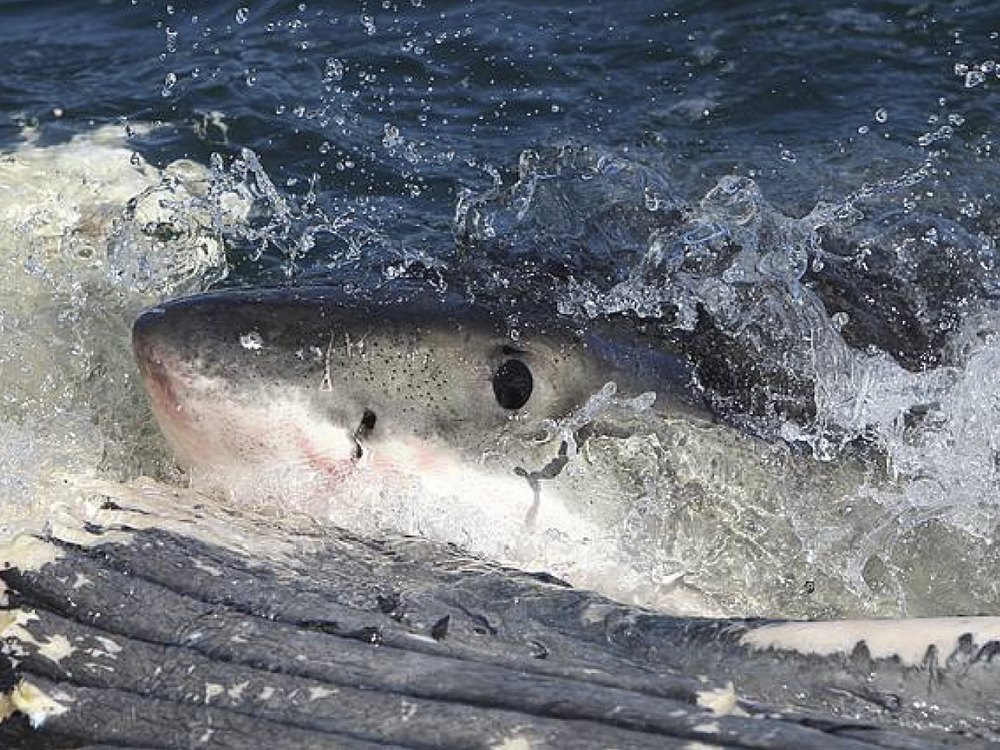
The Great White Shark also feeds on whale carcasses. Fallows, Gallagher and Hammerschlag (2013) published a study titled “White sharks scavenging on whales and its potential role in further shaping the ecology of an apex predator”.[24] Animal Diversity Web also lists whale carcasses as food of adults.[6]

Hunting seals and sea lions
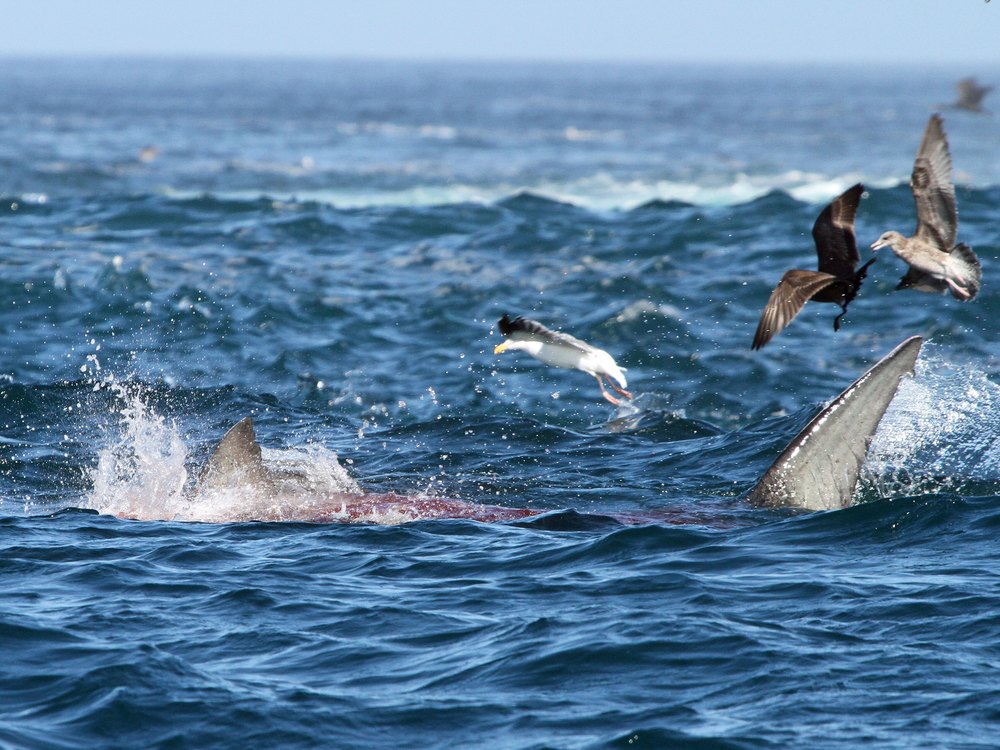
The seal hunts of the Great White Shark have been studied at Seal Island in False Bay. Martin and colleagues (2005) analysed 2,088 predatory attacks on Cape fur seals from 1997 to 2003. They found that the attacks were mainly on lone young-of-the-year seals, almost only in winter, and mostly within two hours of sunrise.[18] At the Farallon Islands in California, seals are also a food of the shark. There, killer whales have displaced the sharks (see Ecology).[25]

Life cycle
| Stage | Size and age | Notes |
|---|---|---|
| Embryo | Inside the mother; length 543–624 mm early and 1,028–1,072 mm later; time not known for certain | Feeds on yolk, then uterine milk, then nutrient eggs[3] |
| Pup | About 1.2–1.5 m at birth | Born live[1] |
| Juvenile | Up to about 3 m; sizes are approximate | No source gives clear stage limits for this species |
| Adult | Males mature at 310–410 cm, most females at 400–500 cm; females at 30–33 years in recent estimates | Older estimates put female maturity at 7–15 years[1] |
Ages and stage limits are estimates and differ between studies. No birth of this species has been confirmed.
Birth and pups
The Great White Shark gives birth to live young. The IUCN describes the reproduction as aplacental viviparous, with oophagy and histotrophy, with litters of 2 to 17 and a suspected reproductive cycle of two to three years.[1] Aplacental means that the embryos have no placenta. Oophagy means that the embryos eat eggs, and histotrophy means that they feed on a fluid made by the mother.
Sato and colleagues (2016) studied a pregnant female caught off Okinawa and found three phases of feeding: yolk, then uterine milk, then nutrient eggs.[3] The female was 4,950 mm long and carried six embryos of 543 to 624 mm that weighed 530 to 782 g. A second, late-pregnancy female, 5,050 mm long, carried four embryos of 1,028 to 1,072 mm. The uteri held 50 to 70 nutrient eggs.[3] The study did not give a length of pregnancy, and none has been observed, so the time is not known for certain.
No birth has been confirmed. Size at birth is 120 to 150 cm, from Francis 1996, as quoted by the IUCN.[1]
Growth and age
The age of the Great White Shark is read from counts of growth bands in the vertebrae, and bomb radiocarbon measured in the vertebrae has been used to check those counts. Hamady and colleagues (2014) studied the vertebrae of eight sharks from the western North Atlantic. Their results gave up to 40 years for the largest female and 73 years for the largest male. Counts of the bands alone gave 6 to 35 years for females and 9 to 52 years for males.[8] The growth curves for the two largest sharks had to be shifted by 7 and 21 years to fit, and the 73 years is an estimate for one animal.[8]
Natanson and Skomal (2015) studied 81 sharks collected from 1963 to 2010 in the western North Atlantic and validated ages up to 44 years. They found slower growth and a longer life than earlier work.[26] In the southwestern Indian Ocean, Christiansen and colleagues (2016) used 51 sharks of 140 to 422 cm fork length, with band ages of 1 to 38 years.[27]
The IUCN accepts that the maximum age is likely above 30 years, at least 44 years and possibly 73. It gives 30 to 33 years as the age at which females mature, from radiocarbon-validated ages. It says these are possibly more accurate than the older estimates of 7 to 15 years for female maturity and 18 to 30 years for the maximum age. It also says that the female age at maturity is possibly more contentious.[1] The IUCN gives a generation length of 53 years, and 29.5 years if the younger values are used.[1] No reliable data on captive lifespan were found.
Ecology
Orcas
Orcas, also called killer whales, affect where white sharks feed. Jorgensen and colleagues (2019) used long-term tagging and survey data at Southeast Farallon Island, California. They found that brief visits by orcas displaced white sharks and disrupted their feeding for long periods. The shark’s predation on seals was lower in years with more close orca encounters, and tagged sharks moved to other aggregation sites.[25] The study is about displacement and does not show that orcas kill white sharks.
Other studies report effects in other places. A 2022 paper by Towner and colleagues, whose title says that killer whale predation drives white shark absence, covers Gansbaai, South Africa. Reports of its findings describe five white shark carcasses with missing livers in 2017, after which the sharks did not return for weeks or months.[28] In South Australia, Reeves and colleagues (2026) studied 12 years of sightings and acoustic tracking at the Neptune Islands. After an orca predation event in February 2015, the sharks were absent for 69 days. There were six long absences in the study, and the longest was 92 days. The study concluded that orcas can cause an immediate departure but are unlikely to be the only cause of long absences.[29]
Parasites
The tapeworm Clistobothrium carcharodoni was described by Dailey and Vogelbein in 1990 from the spiral valve, a part of the gut, of the Great White Shark.[30] Randhawa (2011) matched adult worms from white sharks with larval worms from Risso’s dolphins, which the paper reports as the first molecular link between white sharks and whales or dolphins as hosts.[31]
Habitat and range
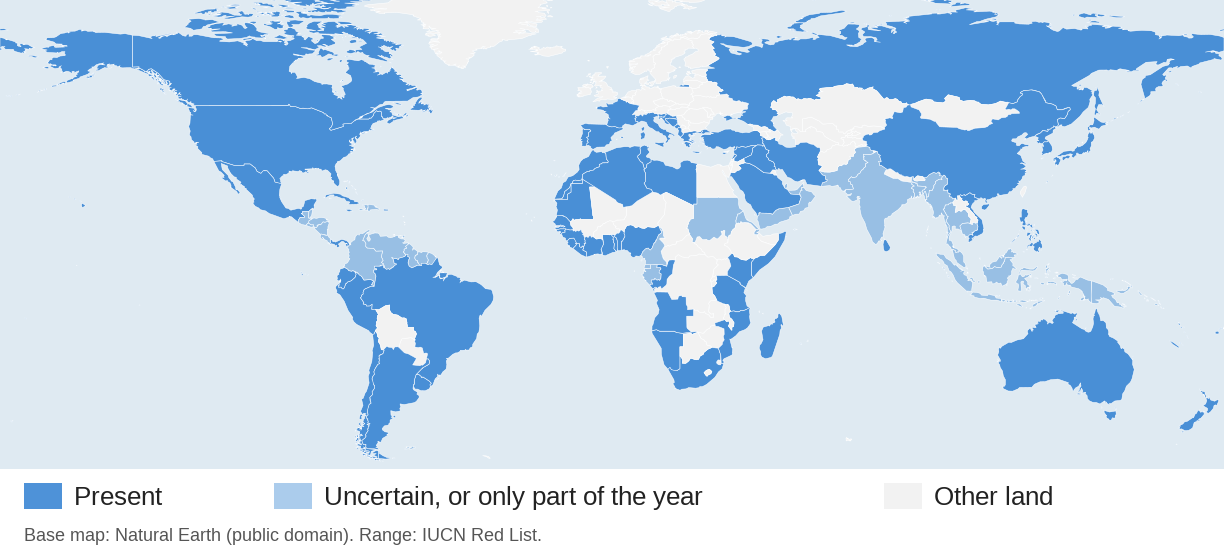
The IUCN describes the Great White Shark as “wide-ranging throughout most temperate and tropical oceans but occurs most frequently in temperate waters”.[1] Compagno (2001), as quoted in the Canadian status report, gives a range in both hemispheres from 60° N to 60° S.[32] The IUCN says the distribution is not disjunct, and that interchange between some areas may be limited.[1]
| Ocean area | IUCN status | Notes |
|---|---|---|
| Atlantic Ocean | Native | Eastern central, northeast, northwest, southeast, southwest and western central areas. Western North Atlantic range is Newfoundland to northern Brazil, after Compagno 2001[1][32] |
| Indian Ocean | Native | Eastern and western areas[1] |
| Pacific Ocean | Native | Eastern central, northeast, northwest, southeast, southwest and western central areas. Eastern North Pacific range is the central Bering Sea to Mazatlán, Mexico, after Compagno 2001[1][32] |
| Mediterranean and Black Sea | Native | The Black Sea is named in the FAO area and not as a country[1] |
| Arctic and Southern Oceans | Not listed | The IUCN lists no native fishing area there[1] |
The IUCN list of countries is long and is shown on the map. The 2022 amendment corrected the country list and the distribution map.[1]
Habitat
The IUCN calls the shark pelagic, meaning it lives in open water. It is most common in temperate continental shelf waters, but it also ranges into estuaries and the open ocean, and it occurs to depths of 1,200 m.[1] FishBase gives a depth of 0 to 1,280 m and a usual depth of 0 to 250 m, and says it is primarily a coastal and offshore inhabitant of continental and island shelves. The same page says that the 1,280 m report of Bigelow and Schroeder (1948) is erroneous.[11]
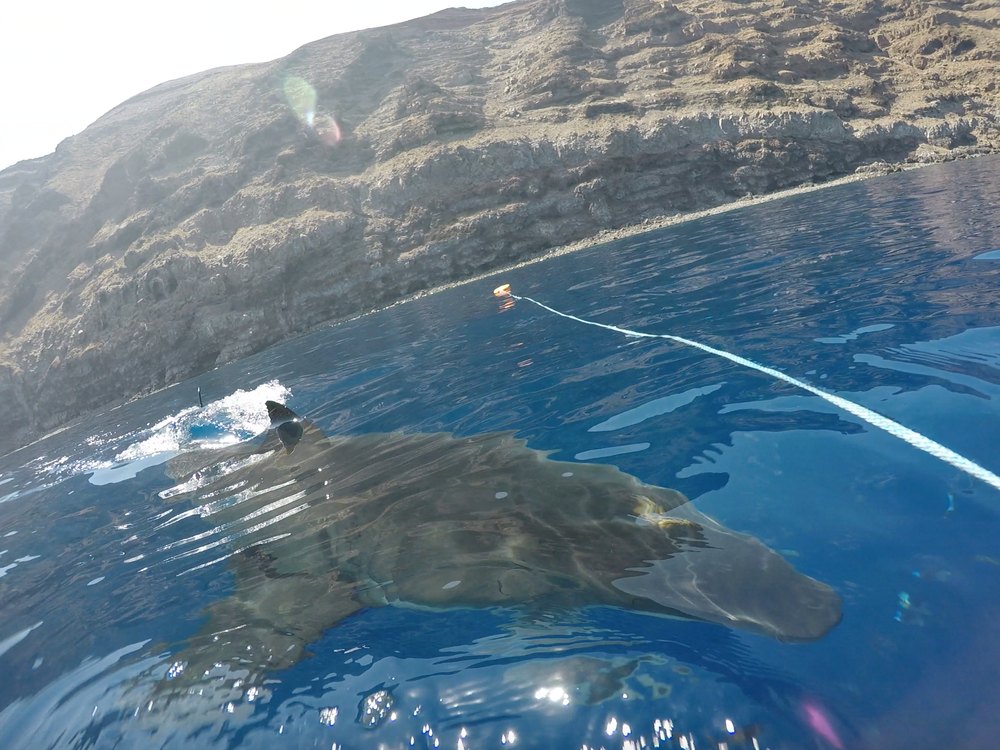
Some places are known as gathering sites. Winton and colleagues (2023) photographed 393 individual sharks off Cape Cod, Massachusetts, from 2015 to 2018, and estimated a population of about 800 sharks, with a range of 393 to 1,286.[33] Gansbaai is the largest aggregation site in South Africa, according to Towner and colleagues (2022).[28]

Evolution
The genus Carcharodon appears in the fossil record in the late Oligocene, and Ehret and colleagues (2023) say it has a near-global distribution. That date depends on how broadly the genus is drawn. Ehret and colleagues include the broad-toothed mako Carcharodon hastalis, a fossil species, while other authors keep it in the genus Cosmopolitodus, and older papers call it Isurus hastalis. These are three names for one fossil species.[2][34][9]
Teeth that look like those of the modern species appear around the Miocene-Pliocene transition in the Pacific, and soon after in the Mediterranean, according to Collareta and colleagues (2023).[35] Ehret and colleagues (2023) say the record of the species goes back to the Pliocene.[2] The Pliocene lasted from about 5.3 to 2.6 million years ago, as given by Collareta and colleagues.[35] A 2012 paper from Argentina describes late Miocene teeth as close to the modern species but more primitive, so they are not clearly the same species.[36]
Carcharodon hubbelli, a fossil species from Peru, is a link between the broad-toothed mako and the white shark, according to Ehret and colleagues (2012).[34] It is dated to 5 to 8 million years ago, depending on the paper: 6 to 8 million years ago in 2012 and 5 to 7 million years ago in 2023.[34][2]
Not a descendant of the megalodon
The Great White Shark did not come from the giant megalodon. Nyberg and colleagues (2006) compared two ideas, that the white shark came from the broad-toothed mako lineage or from the megatooth sharks. They found no significant difference in tooth shape between the white shark and Isurus hastalis, found that tooth growth was closer to that of I. hastalis than to the megalodon, and concluded that the white shark came from an extinct group of mako sharks and not from the megatooth sharks.[9] Perez and colleagues (2021) agree that the megalodon evolved from Otodus obliquus and is a separate lineage from the white shark. They place it in the family Otodontidae, and the white shark in the family Lamnidae.[37] Cooper and colleagues (2020) say the two species likely belong to different families.[38]
The megalodon died out between 2.6 and 3.6 million years ago. Pimiento and Clements (2014) put it at about 2.6 million years ago, Boessenecker and colleagues (2019) at about 3.6 million years ago, and Kast and colleagues (2022) at 3.5 million years ago.[39][40][41] The two species lived at the same time in the Pliocene.[35]
Forms and variants
No subspecies are recognised. WoRMS, the Catalogue of Life, FishBase, Animal Diversity Web and the Catalog of Fishes list none.[7][14][11][6][13] Genetic studies do find structure between regions. The IUCN says genetic data suggest one global population with some structure between ocean basins, with likely male-biased dispersal and female philopatry, which means that females return to the area where they were born.[1]
Andreotti and colleagues (2016) studied 302 sharks from South Africa and added 58 sequences from five populations around the world. They found three distinct clades worldwide that could not be connected with 95% confidence. One holds the Mediterranean and the Indo-Pacific (Australia and California), one holds the northwestern Atlantic (Florida) and the Indian Ocean (South Africa), and one is a single divergent type found only in South Africa. They also found very low genetic diversity in South Africa.[42]
Two studies tell different stories about the Mediterranean sharks. Gubili and colleagues (2011) sequenced four rare Mediterranean sharks and found little difference from Indo-Pacific sharks and a strong separation from Atlantic and western Indian Ocean sharks. They explained this by long-distance dispersal in the past.[43] Leone and colleagues (2020) used historical jaws from the 19th and 20th centuries. They concluded that the Mediterranean lineage most likely appeared about 3.23 million years ago, by dispersal from Australian and Pacific populations through the Central American Seaway, before the Isthmus of Panama closed. They say this contradicts the older explanation.[44]
In the northeastern Pacific, Jorgensen and colleagues (2010) found that tagged sharks keep returning to the same coastal hotspots and form a population that is genetically distinct from earlier-known clades.[45] Oñate-González and colleagues (2015) used 186 mitochondrial sequences and found two adult groups, one at central California and one at Guadalupe Island.[46]
In Australia, the picture is disputed. Blower and colleagues (2012) studied 97 mostly young sharks and found a difference between the eastern and southwestern coasts.[47] Clark and colleagues (2025) studied about 650 sharks with about 7,000 genetic markers and found no genetic structure between the eastern and southern coasts. They estimated an effective population size of fewer than 500 sharks.[48]
Conservation
The IUCN Red List lists the Great White Shark as Vulnerable (criteria A2bd, version 3.1). The assessment was made on 7 November 2018 and published in 2019. An amended version was published in 2022 by Rigby and colleagues of the IUCN SSC Shark Specialist Group, and the population trend is decreasing. Earlier assessments were Vulnerable in 2019, 2009, 2000 and 1996, and Insufficiently Known in 1994 and 1990.[1] The 2022 amendment corrected the list of countries and the distribution map.[1]
Population
The IUCN says there are no data on the absolute global population size.[1] It estimates that the population fell by 30 to 49% over three generations, which it puts at 159 years, with a generation length of 53 years. The IUCN says the shark is increasing in the Northeast Pacific and Indian Ocean and declining from historic levels in the Northwest Atlantic and South Pacific.[1] A model of four trend series gave a median fall of 53.8% over 159 years, or 39.4% with a shorter generation length. Because of the uncertainty, expert judgement gave the 30 to 49% figure. The IUCN calls the regional trends highly variable and extrapolated over a very long period.[1]
The IUCN quotes these regional estimates. There were 5,460 sharks in eastern Australasia in 2017, with a range of 2,909 to 12,802, and more than 2,000 in the Northeast Pacific in 2012.[1] In South Africa the figures were 1,279 in KwaZulu-Natal in 1996, 908 at Gansbaai in 2007 to 2011, 723 in False Bay in 2004 to 2012 and 389 at Mossel Bay in 2008 to 2010. The IUCN says there are concerns about the validity of a South African total of 438 for 2011.[1][49] The IUCN says the Mediterranean population is suspected to have declined by at least 80% over 69 years, from 1947 to 2016, based on anecdotal records and limited fisheries data.[1]
Other studies add local figures. Winton and colleagues (2023) estimated about 800 sharks, with a range of 393 to 1,286, off Cape Cod.[33] Chapple and colleagues (2011) estimated 219 mature and sub-adult sharks at central California sites.[50] Curtis and colleagues (2014) found a significant decline in the western North Atlantic in the 1970s and 1980s, and apparent increases since the 1990s.[22] Baum and colleagues (2003) reported that white sharks declined by more than 75% over 15 years in logbooks of Northwest Atlantic longline fleets. A 2005 paper by Burgess and colleagues, titled “Is the collapse of shark populations in the Northwest Atlantic Ocean and Gulf of Mexico real?”, questions it.[51][52]
Threats
BycatchBeach protection netsTrade in fins and jaws[1]Bycatch. The IUCN says the Great White Shark is caught around the world, mostly as bycatch in inshore fisheries with longlines, setlines, gillnets, trawls, rod and reel, and fish traps. It is rarely caught in offshore open-sea fisheries.[1]
Beach protection nets. It is also targeted in beach protection programs in Australia and South Africa, which use drum lines and nets, although some programs release live sharks. The IUCN notes a relatively high survival after release in net fisheries.[1]
Trade in fins and jaws. Fins and jaws have a high market value, and the meat may be used fresh, locally or for export.[1]
Overall effect. The IUCN rates the scope of the threats as a minority of the population (under 50%) and the severity as unknown.[1]
Law and treaties
The shark is on CITES Appendix II, since 2004, and on Appendices I and II of the Convention on Migratory Species, since 2002.[1][53] In 2012 the General Fisheries Commission for the Mediterranean banned keeping the shark and required careful release. The IUCN says the implementation by member parties has been very slow.[1] It also says that many fishing nations and the European Union have domestic rules to protect the species, but that follow-up at the domestic level has been seriously lacking.[1]
Some national laws are reported as follows. South Africa is reported to have protected the species in 1991, as the first country to do so.[32][54] In Australia the shark is listed as Vulnerable and Migratory under the federal EPBC Act and has a recovery plan. The 2002 recovery plan was replaced by a plan in 2013.[55] Wikipedia gives 1999 for the protection and 2000 for the Vulnerable listing.[56] In New Zealand the shark has been protected in its waters since 2007 under the Wildlife (White Pointer Shark) Order 2007.[12] In the United States, federal rules have banned harvest since 1997.[32][56]
The IUCN lists conservation actions in place, including a recovery plan, a monitoring scheme, a harvest management plan and education programs, and presence in at least one protected area. It says that site protection, harvest management, trade management and species recovery are still needed, as is research on population size and trends.[1]
History and culture
First description
Linnaeus described the species as Squalus carcharias in 1758, in the 10th edition of Systema Naturae, on page 235. He gave the place as “Europa”, and no type specimen is known. The Catalog of Fishes says the place should be restricted to the Mediterranean Sea or the northeastern Atlantic. A neotype named by Fricke in 1999 is invalid.[13]
Records
Wikipedia, citing Ellis and McCosker, reports that the all-tackle rod-and-reel record is a Great White Shark of 1,208 kg (2,663 lb), caught by Alf Dean in southern Australian waters in 1959.[56]
Bites on people
The International Shark Attack File counts bites that are confirmed to be by a species. Its species table, updated on 25 January 2022 and covering the years from 1580, lists 292 non-fatal and 59 fatal unprovoked bites by the Great White Shark, 351 in all.[57] The file warns that identifying the shark is difficult, and that its list leans toward species that are easy to identify.[57] Its 2023 report lists three fatal bites on surfers by white sharks in Australia that year. The report says the rise in 2023 may be chance, but may also reflect more white sharks near beaches popular with surfers.[58]
Jaws
The novel Jaws by Peter Benchley was published in 1974, and the film by Steven Spielberg followed in 1975.[56] Benchley said in 1995, as quoted in a later article, “I couldn’t write Jaws today”. Spielberg said in a BBC radio interview in 2022, as quoted, that he really, truly regretted the feeding frenzy by fishermen that followed the film.[59]
Shark nets and drum lines
Beach netting began in Sydney in 1937, according to a CSIRO study.[60] Durban installed shark nets in 1952, modelled on the New South Wales program.[54] The Queensland program began in 1962.[60] The IUCN reports that the Queensland catch rate fell by 92% over 54 years, from 1962 to 2015.[1]
Cage diving
Wikipedia reports that the film-maker Jacques Cousteau used a shark cage while making The Silent World, released in 1956. It says cage diving became more popular as a tourist activity in the 2000s.[56]
Tagging
Boustany and colleagues (2002) reported tracking white sharks with pop-up satellite tags, and found that their migratory movements, depth and temperature ranges were wider than previously thought.[61] In 2005, Bonfil and colleagues reported a dive to 980 m.[19]
In captivity
The Monterey Bay Aquarium has collected data on the white shark since 2002. By 2012 it had kept six white sharks for a total of 633 days.[62] A male of 3.5 m caught in a net off Okinawa in January 2016 was brought to the Okinawa Churaumi Aquarium and died about three days after it arrived, according to news reports.[63]

Taxonomy
| Rank | Name |
|---|---|
| Kingdom | Animalia[7][14] |
| Phylum | Chordata[7][5] |
| Subphylum | Vertebrata |
| Class | Chondrichthyes[5][6][1] |
| Order | Lamniformes[7][5][14][11][6] |
| Family | Lamnidae[7][5][14][11][6] |
| Genus | Carcharodon Smith, 1838 (in Müller and Henle)[14][5] |
| Species | Carcharodon carcharias (Linnaeus, 1758)[7][14][11][13] |
Synonyms (10)
| Name | |
|---|---|
| Squalus carcharias (Linnaeus, 1758) | Original name |
| Carcharias lamia (Rafinesque, 1810) | Not available (Opinion 723); suppressed |
| Carcharias verus (Cloquet, 1817) | |
| Carcharias atwoodi (Storer, 1848) | |
| Carcharias vorax (Owen, 1853) | |
| Carcharodon smithii (Agassiz, 1838) | |
| Carcharodon capensis (Smith, 1839) | |
| Carcharodon rondeletii (Müller and Henle, 1839) | |
| Carcharodon albimors (Whitley, 1939) | |
| Squalus caninus (Osbeck, 1765) |
A selection. WoRMS lists 18 synonyms and the Catalog of Fishes lists 13.[7][13] The Catalog of Fishes gives the type locality as “Europa” (see History and culture).
The order Lamniformes and the family Lamnidae are the same in all the databases read. The class is not. WoRMS, the Catalogue of Life and FishBase use Elasmobranchii, which means sharks and rays. ITIS, Animal Diversity Web and the IUCN Red List use Chondrichthyes, the cartilaginous fishes, and ITIS puts Elasmobranchii below it as a subclass.[7][5][14][11][6][1] This page uses Chondrichthyes, the better-known name and the one the IUCN uses. The shark belongs to both groups.
| Source | Class | Order |
|---|---|---|
| WoRMS | Elasmobranchii | Lamniformes[7] |
| ITIS | Chondrichthyes (Elasmobranchii as a subclass) | Lamniformes[5] |
| Catalogue of Life | Elasmobranchii | Lamniformes[14] |
| FishBase | Elasmobranchii | Lamniformes[11] |
| Animal Diversity Web | Chondrichthyes | Lamniformes[6] |
| IUCN Red List | Chondrichthyes | Lamniformes[1] |
Only one species lives in the genus Carcharodon.[2] The family Lamnidae has five living species: the Great White Shark, the shortfin mako, the longfin mako, the salmon shark and the porbeagle.[7] No subspecies are recognised (see Forms and variants).
Sources
- Rigby, Barreto, Carlson, Fernando, Fordham, Francis, Herman, Jabado, Jones, Liu, Lowe, Marshall, Pacoureau, Romanov, Sherley & Winker 2022, Carcharodon carcharias (amended version of 2019 assessment), The IUCN Red List of Threatened Species 2022: e.T3855A212629880
- Ehret, Tennyson, Richards & Boessenecker 2023, Journal of the Royal Society of New Zealand 54: 609–619, first records of two mackerel shark species from New Zealand
- Sato, Nakamura, Tomita, Toda et al. 2016, Biology Open, how great white sharks nourish their embryos: evidence of lipid histotrophy
- Goldman 1997, Journal of Comparative Physiology B 167: 423–429, regulation of body temperature in the white shark
- ITIS, Carcharodon carcharias (TSN 159901), full hierarchy
- Animal Diversity Web, Carcharodon carcharias
- WoRMS, Carcharodon carcharias (Linnaeus, 1758), AphiaID 105838, record, classification, synonyms and the children of Lamnidae, Isurus, Lamna and Lamniformes
- Hamady, Natanson, Skomal & Thorrold 2014, PLoS ONE 9(1): e84006, vertebral bomb radiocarbon suggests extreme longevity in white sharks
- Nyberg, Ciampaglio & Wray 2006, Journal of Vertebrate Paleontology 26: 806–814, tracing the ancestry of the great white shark using fossil teeth
- A Cornell thesis on white shark dentition, on the bone-like structure of the teeth and the replacement of teeth from the embryo onward
- FishBase, Carcharodon carcharias, species summary and list of common names
- New Zealand White Shark Conservation Trust, page on the New Zealand acts that protect the white shark, and a news release on the 2007 protection
- Eschmeyer’s Catalog of Fishes, Carcharodon carcharias, California Academy of Sciences
- Catalogue of Life (ChecklistBank dataset 3LR), Carcharodon carcharias
- Māori Dictionary, entry “mangō taniwha”
- Ryan, Slip, Chapuis, Collin et al. 2021, Journal of the Royal Society Interface, a shark’s eye view: testing the ‘mistaken identity theory’ behind shark bites on humans
- Chapuis, Collin, Yopak, McCauley, Kempster, Ryan, Schmidt, Kerr, Gennari, Egeberg & Hart 2019, Scientific Reports 9: 6924, the effect of underwater sounds on shark behaviour
- Martin, Hammerschlag, Collier & Fallows 2005, Journal of the Marine Biological Association of the UK 85: 1121–1135, predatory behaviour of white sharks at Seal Island, South Africa
- Bonfil, Meÿer, Scholl, Johnson et al. 2005, Science 310: 100–103, transoceanic migration, spatial dynamics and population linkages of white sharks
- Studies of white shark social behaviour at Gansbaai and Mossel Bay, South Africa, in an MDPI and a Frontiers paper
- Skomal, Braun, Chisholm & Thorrold 2017, Marine Ecology Progress Series 580, movements of the white shark in the North Atlantic Ocean
- Curtis, McCandless, Carlson, Skomal et al. 2014, PLoS ONE 9: e99240, seasonal distribution and historic trends in abundance of white sharks in the western North Atlantic
- Estrada, Rice, Natanson & Skomal 2006, Ecology 87: 829–834, isotopes in the vertebrae of white sharks and their feeding over a lifetime
- Fallows, Gallagher & Hammerschlag 2013, PLoS ONE, white sharks scavenging on whales and its potential role in further shaping the ecology of an apex predator
- Jorgensen, Anderson, Ferretti, Tietz et al. 2019, Scientific Reports 9, killer whales redistribute white shark foraging pressure on seals
- Natanson & Skomal 2015, Marine and Freshwater Research 66: 387–398, age and growth of the white shark in the western North Atlantic Ocean
- Christiansen, Campana, Fisk & Cliff 2016, Marine Biology 163: 144, bomb radiocarbon age and growth of the white shark from the southwestern Indian Ocean
- Towner, Watson, Kock, Papastamatiou et al. 2022, African Journal of Marine Science, fear at the top: killer whale predation drives white shark absence at South Africa’s largest aggregation site
- Reeves, Barnett, Donnelly, Meyer et al. 2026, Wildlife Research, absence or avoidance? White shark response to killer whale predation risk
- Dailey & Vogelbein 1990, Journal of the Helminthological Society of Washington, description of Clistobothrium carcharodoni from the spiral valve of the white shark
- Randhawa 2011, Journal of Parasitology, insights using a molecular approach into the life cycle of a tapeworm infecting great white sharks
- COSEWIC status report on the white shark, chapters 4 and 10 (canada.ca; an older report, with the page dated 2018)
- Winton, Fay & Skomal 2023, Marine Ecology Progress Series 715, an open spatial capture-recapture framework for estimating the abundance of white sharks at aggregation sites
- Ehret, MacFadden, Jones, DeVries, Foster & Salas-Gismondi 2012, Palaeontology 55: 1139–1153, origin of the white shark Carcharodon and the Pisco Formation of Peru
- Collareta, Casati, Di Cencio & Bianucci 2023, Life 13: 2085, the deep past of the white shark in the Mediterranean Sea
- Cione, Cabrera & Barla 2012, Geobios 45: 167–172, oldest record of the Great White Shark (Lamnidae, Carcharodon; Miocene) in the Southern Atlantic
- Perez, Leder & Badaut 2021, Palaeontologia Electronica 24(1): a09, body length estimation of Carcharodon and Otodus
- Cooper, Pimiento, Ferrón & Benton 2020, Scientific Reports 10: 14596, body dimensions of the extinct giant shark Otodus megalodon
- Pimiento & Clements 2014, PLoS ONE 9: e111086, when did Carcharocles megalodon become extinct
- Boessenecker, Ehret, Long & Churchill 2019, PeerJ 7: e6088, the Early Pliocene extinction of the mega-toothed shark Otodus megalodon
- Kast, Griffiths, Kim & Rao 2022, Science Advances 8: eabl6529, megatooth sharks and trophic position
- Andreotti, von der Heyden, Henriques, Rutzen, Meyer, Oosthuizen & Matthee 2016, Journal of Biogeography 43: 328–339, new insights into the evolutionary history of white sharks
- Gubili, Bilgin, Kalkan, Karhan, Jones, Sims, Noble & Griffiths 2011, Proceedings of the Royal Society B 278: 1679–1686, white sharks on a Mediterranean walkabout
- Leone et al. 2020, Journal of Biogeography 47: 1119–1129, Pliocene colonization of the Mediterranean by Great White Shark
- Jorgensen, Reeb, Chapple, Anderson et al. 2010, Proceedings of the Royal Society B 277: 679–688, philopatry and migration of Pacific white sharks
- Oñate-González, Rocha-Olivares, Saavedra-Sotelo & Sosa-Nishizaki 2015, Journal of Heredity 106: 347–354, mitochondrial genetic structure of white sharks in the northeastern Pacific
- Blower, Pandolfi, Bruce et al. 2012, Marine Ecology Progress Series 455: 229–244, population genetics of Australian white sharks
- Clark, Butcher, Weeks, Huveneers et al. 2025, Diversity and Distributions 31: e13946, genomic assessment of Australian white sharks
- Towner, Wcisel, Reisinger, Edwards et al. 2013, PLoS ONE 8: e66035, the first population estimate for white sharks in South Africa using photo identification
- Chapple, Jorgensen, Anderson, Kanive et al. 2011, Biology Letters, a first estimate of white shark abundance off Central California
- Baum, Myers, Kehler, Worm et al. 2003, Science 299: 389–392, collapse and conservation of shark populations in the Northwest Atlantic
- Burgess, Beerkircher, Cailliet, Carlson et al. 2005, Fisheries 30(10): 19–26, is the collapse of shark populations in the Northwest Atlantic Ocean and Gulf of Mexico real?
- Convention on Migratory Species, Carcharodon carcharias species page
- FAO document X2098E, chapter 15, on shark meshing
- Fisheries Research and Development Corporation, Status of Australian Fish Stocks 2023, Carcharodon carcharias (fish.gov.au, PDF; short text, no protection years)
- Wikipedia, Great white shark and related pages (secondary; used only where named in the text)
- Florida Museum, International Shark Attack File, species implicated in attacks, 1580 to present
- International Shark Attack File, 2023 shark attack report
- Popular Science, March 1995 interview with Peter Benchley, and Steven Spielberg’s BBC Radio interview of 2022, both as quoted in a 2023–24 Popular Science article (quoted text only)
- CSIRO study of the New South Wales shark meshing program (Marine and Freshwater Research, MF10162), on the start of netting in Sydney in 1937 and in Queensland in 1962
- Boustany, Davis, Pyle, Anderson et al. 2002, Nature 415: 35–36, expanded niche for white sharks
- Hamilton R. (Monterey Bay Aquarium) 2012, “Conservation value of having a white shark on exhibit”, keynote abstract, International Aquarium Congress 2012
- News reports on the male white shark that died at the Okinawa Churaumi Aquarium in January 2016