Canis lupus arabs is the Arabian wolf, the small desert wolf of the Arabian Peninsula and the southern deserts of the Levant.[1]
Names and classification
Pocock named it in 1934, and GBIF and ITIS both list it as an accepted subspecies of the Grey Wolf.[2][3] ITIS bases its entry on Mammal Species of the World 3 (2005).[3] The Mammal Diversity Database lists no subspecies of the Grey Wolf and shows arabs only as a synonym of Canis lupus.[4] The usual common name is Arabian wolf; GBIF also gives “Arab Wolf”.[1][2]
Studies and reviews place the Asian wolves of the region in two subspecies: pallipes, the wolf of Mediterranean and semi-arid climates, and arabs, the wolf of the southern deserts of the Levant and the Arabian Peninsula.[1] Only pallipes has been confirmed in Iran and only arabs in Arabia, and no data show where the two meet.[1]
Description
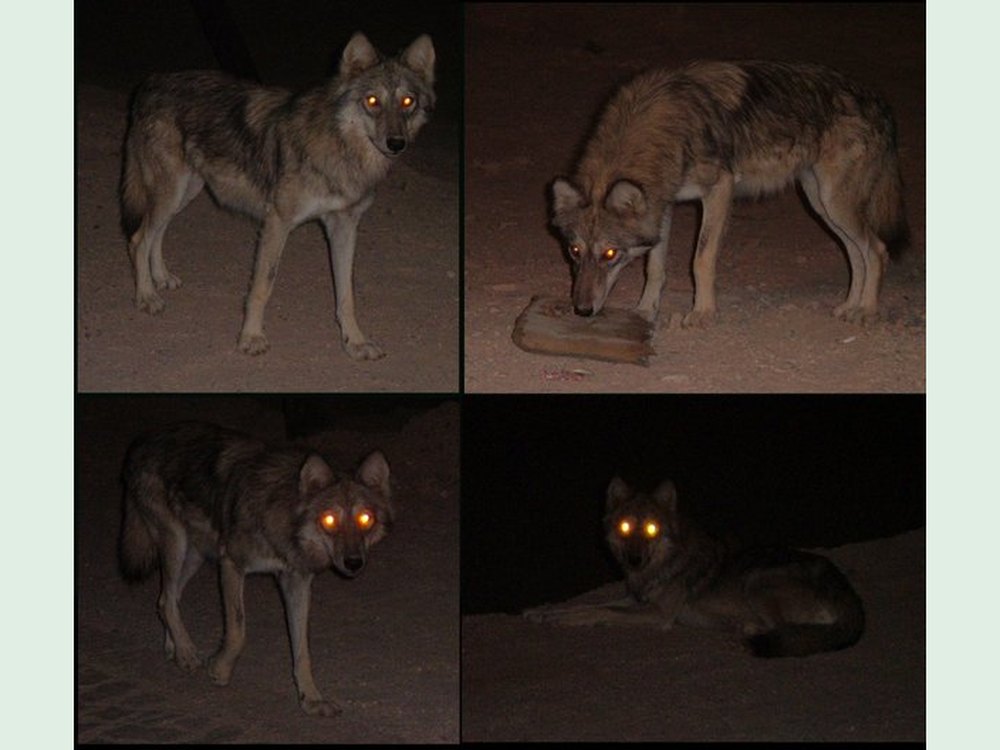
The Arabian wolf is the smallest subspecies of the Grey Wolf. The Indian wolf pallipes is described as up to 1.5 times larger.[1] In Israel, wolves of the southern desert are smaller and have shorter hair than wolves of the Mediterranean Golan Heights.[1]

Range
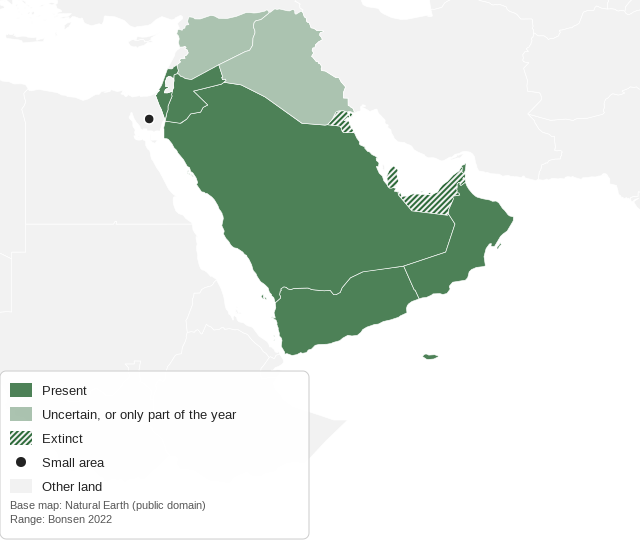
The range covers eleven countries: Egypt (Sinai), Iraq, Israel and the Palestinian Territories, Jordan, Kuwait, Oman, Qatar, Saudi Arabia, Syria, the United Arab Emirates and Yemen.[1] The most plausible extent is more than 3 million km², from the southern deserts of Iraq and possibly Syria south through the deserts of the Levant and Arabia.[1]
It lives in arid and hyper-arid desert and also in mountains that have snow in winter, such as Al-Lawz (2,400 m) in north-western Saudi Arabia.[5] In Israel it is common in the Negev and Arava, and in Saudi Arabia it is common and widespread but declining.[1] It is rare in Sinai, declining in protected areas of Jordan, Oman and Yemen, and has died out in Kuwait, Qatar and the United Arab Emirates.[1] Its status in Iraq and Syria is unknown.[1]
In the Negev, Israel, wild wolves had an average home range of 34.6 km², travelled 13.7 km a day on average (up to 42 km in a day), and dispersed 50 to 150 km.[6] Packs are generally smaller than in North America and Europe, and single wolves and pairs are often seen.[1] Near farms the diet is mostly cattle carrion, fruit and rubbish. In 777 scats from the Negev, cattle carrion was in 62.5%, fruit and plants in 51.4%, human rubbish in 37.2% and native prey, such as gazelles, in 6.3%.[6][1] Where wild prey is scarce, livestock becomes a large part of the diet.[1]
Classification evidence
Bray and colleagues (2014) compared mitochondrial DNA (cytochrome b and the control region) from 88 dry-skin samples of wild wolves killed on roads or by poachers in Saudi Arabia and 15 captive animals. They found that Saudi wolves are closer to the Eurasian wolves, dogs included, than to the Indian wolf, and that two subspecies in Arabia are not supported. They concluded that the name arabs should be kept for the Arabian wolf.[7] They also report that some researchers do not recognise the subspecies, naming Mech and Boitani (2004), Rueness and colleagues (2011) and Gaubert and colleagues (2012).[7] A 2022 thesis calls the idea of two Middle Eastern subspecies “continued speculation” and notes inconsistencies in the literature.[1] How far dogs have mixed with Arabian wolves is unclear.[7]
Status
In the Negev and Arava, scat DNA from 95 samples taken in 2007 and 2008 gave estimates from 86 to 177 wolves, depending on the method; a 2022 thesis sums this up as 90 to 150 wolves in an area under 15,000 km².[6][1] For Saudi Arabia, Yemen and Oman together, 500 to 600 wolves and a declining trend were reported in 2004.[1] No estimates exist for Sinai, Jordan, Iraq or Syria.[1]
The Arabian Peninsula regional assessment lists the Grey Wolf as Endangered (Mallon and Budd, 2011).[1] A 2025 paper gives Vulnerable, citing a 2023 update.[5] Israel protects the wolf by law, yet the nature authority removed 37 wolves from the southern Negev in 2005 to 2008 to protect the Critically Endangered Acacia gazelle.[6] In Saudi Arabia hunting a wolf can bring a fine of up to 80,000 riyals, but wolves are among the most persecuted carnivores there, and shooting after livestock attacks is the main conflict in Tabuk province.[5] Other threats are scarce wild prey, habitat loss, roads and possible mixing with free-ranging dogs.[5][1]
Sources
- Bonsen, G. 2022. Human-mediated landscapes of fear shape trophic cascades in shared desert ecosystems of the Middle East: elucidating the ecological roles of the Arabian wolf. PhD thesis, University of Technology Sydney.
- GBIF Secretariat. GBIF Backbone Taxonomy: Canis lupus arabs Pocock, 1934. Global Biodiversity Information Facility, record accessed 2026.
- Integrated Taxonomic Information System (ITIS). Canis lupus arabs Pocock, 1934, TSN 726811. Record updated 2025.
- Mammal Diversity Database. Species list, Canis lupus (id 1005943) and its synonyms. American Society of Mammalogists, data file accessed 2026.
- Alatawi, A. S. 2025. Arabian wolf (Canis lupus arabs) in north-western Saudi Arabia: status, threats and conservation. Biology 14(7): 839.
- Cohen, T. M., King, R., Dolev, A., Boldo, A., Lichter-Peled, A. and Bar-Gal, G. K. 2013. Genetic characterization of population structure and gene flow in the Arabian wolf of the Negev desert, Israel. Oryx 47(2): 228–236.
- Bray, T. C., Mohammed, O. B., Butynski, T. M., Cunningham, P. L., Drouilly, M., de Jong, Y. A., Wronski, T., Alagaili, A. N. and Hiller, M. 2014. Genetic variation and subspecific status of the grey wolf (Canis lupus) in Saudi Arabia. Mammalian Biology 79(6): 409–413.