Canis lupus signatus is the Iberian wolf, the wolf of Spain and Portugal, found mainly in the north-west and centre of the peninsula.[1]
Names and classification
Cabrera named it in 1907.[2] In English it is the Iberian wolf or Spanish wolf; in Spanish and Portuguese it is lobo ibérico.
Lists disagree on whether it is a subspecies. The Integrated Taxonomic Information System (ITIS) lists Canis lupus signatus, and GBIF shows it as accepted in several contributed checklists, while the GBIF backbone itself has only the species.[3][4] Ramírez and colleagues (2006) note that the subspecies “is not commonly recognized”, citing Nowak (2003) and Sillero-Zubiri and colleagues (2004).[2] The 2022 European wolf assessment by the Large Carnivore Initiative for Europe does not use the subspecies name and assesses an “Iberian population”.[1]
Range
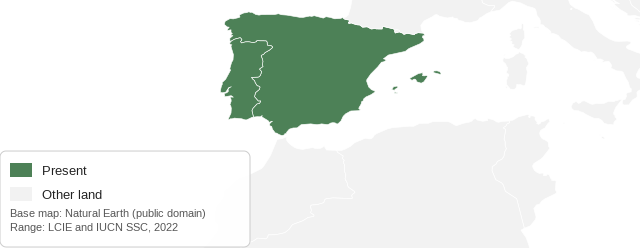
Where it lives
Wolves live mainly in the north-western quarter and the centre of Iberia, in both Spain and Portugal. The population does not reach the Pyrenees, although a few wolves from the Alps are now settling there. Wolves are spreading south, and are now found on both banks of the Duero river. The group in the Sierra Morena in southern Spain seems to be extinct.[1]
The Iberian population is about 2,500 wolves (2,024 to 2,990), described as rather stable and slowly spreading south and east.[1] The 2012–2014 national census in Spain counted 297 packs.[5]
Diet
Diet depends on what is available. In two protected areas of central-west Portugal, south of the Douro, where wild hoofed animals are scarce, a study of 295 scats from three packs (2011 to 2014) found goat in 62 percent, cattle in 20 percent, sheep in 13 percent and wild boar in 4 percent, so that over 90 percent of the diet was livestock.[6] In Montesinho Natural Park in north-east Portugal, 85 scats (2017 to 2019) held roe deer in 44 percent, red deer in 26 percent and wild boar in 24 percent, and wild hoofed animals made up 83 percent of the diet. The authors linked the lower use of livestock to the higher number of wild hoofed animals.[7]
Classification evidence
Ramírez and colleagues (2006) cite skull-shape work that separates Iberian wolves from Italian and eastern European wolves, and DNA studies of mitochondrial DNA and microsatellites (short repeated stretches of DNA) that show a notable difference from other Eurasian wolves. They conclude that Iberian wolves have been separated from all other European wolves for a long time.[2] Among 107 wolves from across Spain, 1999 testing found three mitochondrial haplotypes (types of DNA sequence), none shared with dogs.[8] A 2023 study of whole mitochondrial genomes found 10 haplotypes in 19 historical Iberian specimens but only 6 in 29 modern wolves, so diversity fell even as numbers grew from the 1970s.[9]
History
Until the 19th century wolves lived over about 440,000 km² of Spain. In the 1986–88 census they occupied about 100,000 km², with 294 packs, mostly in the north-west.[5] In the early 1990s there were an estimated 2,000 to 2,500 wolves in Iberia.[2] A captive breeding programme, a European Endangered species Programme, began in 1994 with 40 animals in 13 institutions.[2] In Spain, 623 wolves were legally killed in 2008–2013, 29 of them in strictly protected areas, while none were legally killed in Portugal in those years.[5]
Status
The 2022 European assessment keeps the Iberian population at Near Threatened because management differs from region to region, there is no management plan for the whole population, poisoning and shooting are hard to predict, and some southern groups are almost isolated.[1] Portugal rates the wolf Endangered on its national Red List.[1]
In Spain, wolves north of the Duero were on Annex V of the EU Habitats Directive, which allows controlled hunting or culling, and wolves south of it on Annexes II and IV, which give strict protection. Since September 2021 the whole Spanish range is on the national list of species under special protection, so recreational hunting is no longer possible, although culling is still allowed under conditions.[5] In Portugal the wolf is protected under a national plan.[1] In Spain, livestock losses were about 7,000 attacks a year, with about 2.5 million euros paid in compensation a year, by some regions only.[5]
Sources
- Large Carnivore Initiative for Europe and IUCN SSC, 2022, Assessment of the conservation status of the Wolf (Canis lupus) in Europe, report T-PVS/Inf(2022)45 for the Bern Convention, Council of Europe
- Ramírez, O., Altet, L., Enseñat, C., Vilà, C., Sánchez, A. & Ruiz, A., 2006, Genetic assessment of the Iberian wolf Canis lupus signatus captive breeding program, Conservation Genetics 7, 861–878
- Integrated Taxonomic Information System (ITIS), Canis lupus signatus Cabrera, 1907, TSN 1271734
- GBIF Secretariat, species search for the subspecies Canis lupus signatus Cabrera, 1907 (accepted in several contributed checklists)
- Ordiz, A., Canestrari, D. & Echegaray, J., 2022, Wolf management in Spain: policy brief, Frontiers in Environmental Science, published 18 February 2022
- Torres, R. T., Silva, N., Brotas, G. & Fonseca, C., 2015, To eat or not to eat? The diet of the endangered Iberian wolf in a human-dominated landscape in central Portugal, PLoS ONE 10(6), e0129379
- Figueiredo, A. M. et al., 2020, What does the wolf eat? Assessing the diet of the endangered Iberian wolf (Canis lupus signatus) in northeast Portugal, PLoS ONE 15(3), e0230433
- Vilà, C. & Wayne, R. K., 1999, Hybridization between wolves and dogs, Conservation Biology 13, 195–198
- Salado, I. et al., 2023, Loss of mitochondrial genetic diversity despite population growth: the legacy of past wolf population declines, Genes 14(1), 75