Canis lupus italicus is the Italian wolf, also called the Apennine wolf, the wolf of the Italian peninsula that has spread from the Apennines into the western Alps.[1]
Names and classification
Altobello named it in 1921.[2] In English it is the Italian wolf or Apennine wolf; in Italian it is lupo appenninico or lupo italiano.[3]
Lists disagree on whether it is a subspecies. The Integrated Taxonomic Information System (ITIS) lists Canis lupus italicus as a valid subspecies, and GBIF shows it as accepted in three contributed checklists, although the GBIF backbone itself has only the species Canis lupus.[2][4] The 2022 wolf assessment by the Large Carnivore Initiative for Europe, written for the Bern Convention, does not use the subspecies name. It assesses an “Italian peninsula population” instead.[1]
Description
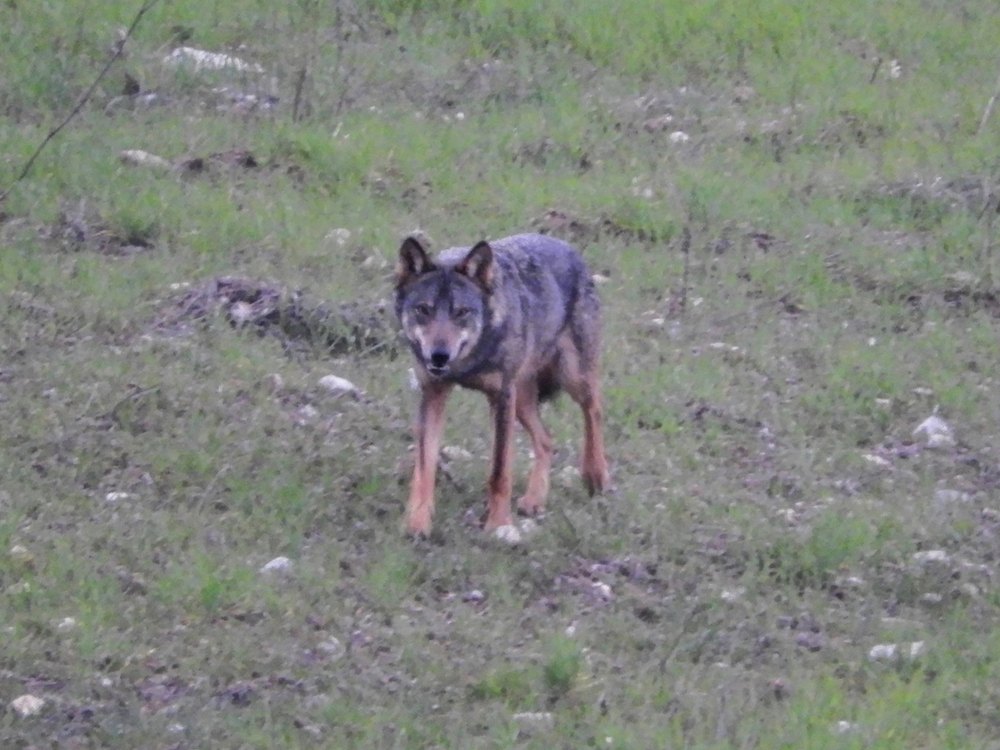
WWF Italia gives adult males of the Italian wolf 25 to 40 kg and adult females 20 to 35 kg, with a head-and-body length of 100 to 140 cm and a shoulder height of 50 to 70 cm. It says Italian wolves are of intermediate weight, and that the biggest wolves, 60 to 80 kg, live only in the far north.[3] The coat is mainly grey-fawn, more reddish-brown in summer, and the wolf moults once a year between spring and early autumn.[3]

Range
Where it lives
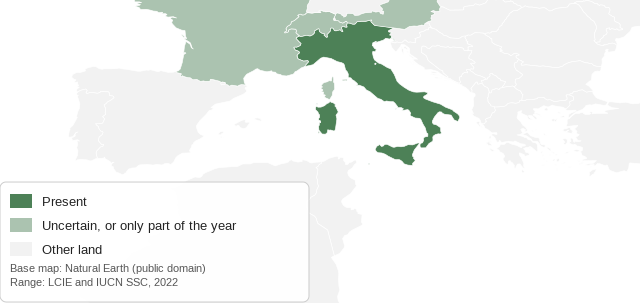
Wolves live along the whole Apennines, from Emilia to Calabria, and reach northern Lazio and central western Tuscany. The range is narrow and long, mostly in the mountains.[1] From the 1990s wolves spread from the Apennines into the Alps, and the western and central Alps now hold a population of about 1,900 wolves (2021–22), shared between Italy, France, Switzerland and Austria. The estimate is only an indication because animals cross borders and may be counted twice.[1]
The Italian peninsula population was estimated at 2,388 wolves (95% interval 2,020 to 2,645) in 2021–22, up from 1,580 in the 2016 figure.[1] The Italian national survey of October 2020 to April 2021 gave 3,307 wolves for the whole country (interval 2,945 to 3,608), of which 946 lived in the Alps.[1]
Diet and packs
A review of Italian diet studies found wild boar in every study, with an average frequency of occurrence of 0.49 in the wolf’s food, followed by roe deer at 0.24 and livestock at 0.18.[5] WWF Italia gives packs an average of 2 to 7 wolves, territories of 100 to 500 km² and 2 to 6 pups born in spring.[3]
Classification evidence
Nowak and Federoff (2002) studied skulls and concluded that the Italian wolf is a separate subspecies, and found no sign that dog hybrids had changed the skulls they measured.[6] In 2000, a DNA study of the mitochondrial DNA, the DNA passed down from mothers, found that all 101 Italian wolves tested shared one haplotype, a type of DNA sequence found nowhere else, while 26 Bulgarian wolves carried seven.[7] Later work found a small set of mitochondrial types that occur only in Italy.[8] A 2017 study of 92 wolves from Italy, Slovenia, Greece and Bulgaria placed every wolf sampled in Italy in its own population, and its authors concluded that the Italian population is distinct.[8]
History
WWF Italia puts the first Italian estimate, in the early 1970s, at only about 100 wolves. Legal protection began in 1971 and was widened in 1977.[3] The wolf of Sicily, described as cristaldii, is extinct and is not part of italicus.[1]
Status
The 2022 European assessment rates both the Italian peninsula population and the western and central Alpine population as Near Threatened. The reasons given are the narrow range, poisoning and illegal shooting, and locally many wolf–dog hybrids.[1] Road deaths and conflict over livestock are also named.[1] In Italy the wolf is strictly protected under the EU Habitats Directive (Annexes II and IV) and the Bern Convention (Appendix II), and hunting it is not allowed.[1] Studies in the 1990s found no dog genes in Italian wolves, but later work has found hybrids in parts of Italy.[9][1]
Sources
- Large Carnivore Initiative for Europe and IUCN SSC, 2022, Assessment of the conservation status of the Wolf (Canis lupus) in Europe, report T-PVS/Inf(2022)45 for the Bern Convention, Council of Europe
- Integrated Taxonomic Information System (ITIS), Canis lupus italicus Altobello, 1921, TSN 1271733
- WWF Italia, 2016, Cattivo a chi? (report on the wolf in Italy, March 2016)
- GBIF Secretariat, species search for the subspecies Canis lupus italicus Altobello, 1921 (accepted in three contributed checklists)
- Mori, E. et al., 2017, What does the wild boar mean to the wolf?, European Journal of Wildlife Research 63, 9
- Nowak, R. M. & Federoff, N. E., 2002, The systematic status of the Italian wolf Canis lupus, Acta Theriologica 47(3), 333–338
- Randi, E., Lucchini, V. et al., 2000, Mitochondrial DNA variability in Italian and East European wolves: detecting the consequences of small population size and hybridization, Conservation Biology 14(2), 464–473
- Montana, L. et al., 2017, Combining phylogenetic and demographic inferences to assess the origin of the genetic diversity in an isolated wolf population, PLoS ONE 12(5), e0176560; and Montana, L. et al., 2017, A new mitochondrial haplotype confirms the distinctiveness of the Italian wolf (Canis lupus) population, Mammalian Biology 84, 30
- Vilà, C. & Wayne, R. K., 1999, Hybridization between wolves and dogs, Conservation Biology 13, 195–198