Canis lupus lycaon is the Eastern wolf, or Algonquin wolf, a tawny wolf of the forests of central Ontario and south-western Quebec that most current lists treat as a species of its own, Canis lycaon.[1][2][3]
Names and classification
Schreber named it Canis lycaon in 1775. The Mammal Diversity Database gives the type locality as the vicinity of Quebec, Quebec, and the type specimen as lost.[2] Other names are Algonquin wolf, Eastern timber wolf and Great Lakes wolf.[2]
Lists that treat it as its own species, Canis lycaon, are ITIS (since 2025), GBIF and the Mammal Diversity Database, which cites vonHoldt and colleagues (2016) for the split.[1][4][2] Canada’s expert committee COSEWIC (2015) treats it as a wildlife species of its own, Canis sp. cf. lycaon, and the 2021 management plan says it is not a subspecies of the Grey Wolf.[3][5] Chambers and colleagues (2012) also call the species rank well supported.[6] Until 2024 the Canadian law used the name Canis lupus lycaon; an order in force on 17 June 2024 changed it to Canis sp. cf. lycaon.[7]
The US Fish and Wildlife Service does not follow this. In its 2020 rule it said the question is unresolved, that peer reviewers of its 2013 proposal judged the case for a species too weak, and that it keeps treating wolves of the north-eastern United States as Canis lupus.[8] The 1967 US listing was of C. l. lycaon, the Eastern timber wolf.[8]
Description
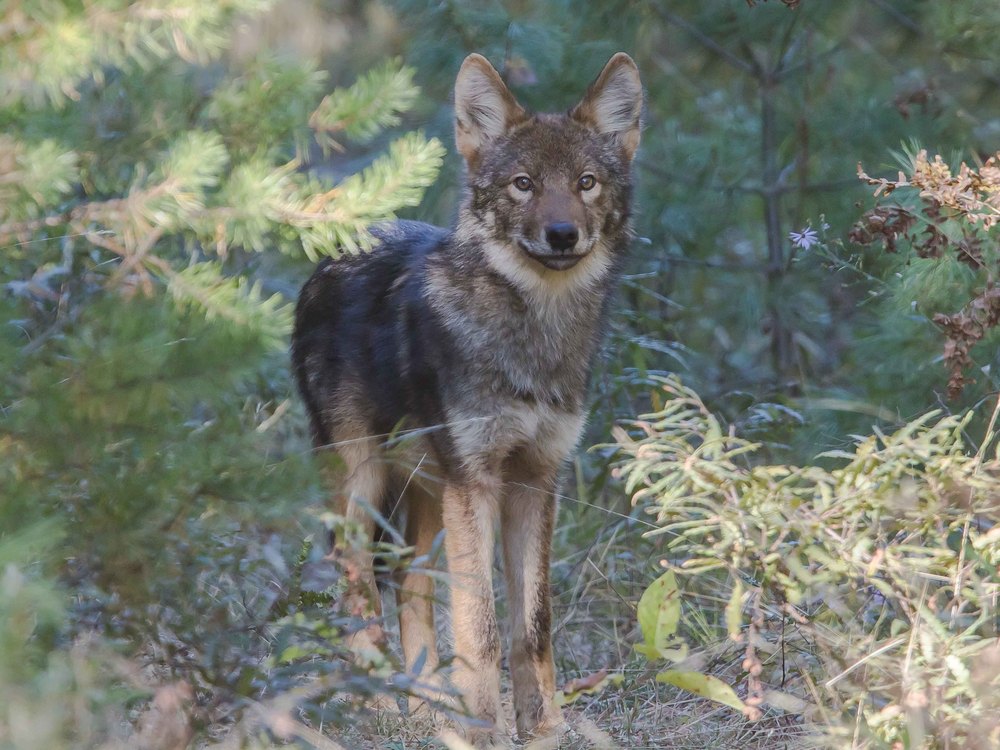
The Eastern wolf is an intermediate-sized canid, between the coyote and the larger grey wolves. Females average 24 kg and males 29 kg.[3] The coat is generally reddish-brown or tawny, often with reddish forelegs.[3]

Range
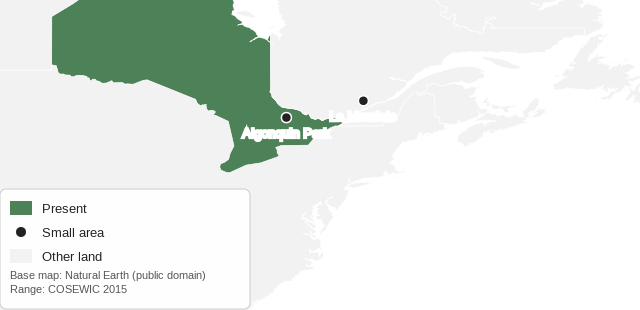
Its present range is restricted to the forests of central Ontario and south-western Quebec, the Great Lakes–St. Lawrence forest region.[7] COSEWIC gives an extent of occurrence of 126,573 km², and the management plan 154,257 km² with an area of occupancy of 31,821 km².[3][5] Named places include Algonquin, Killarney and Kawartha Highlands provincial parks in Ontario, and Papineau-Labelle, the Laurentides and Mont-Tremblant areas and La Mauricie National Park in Quebec.[5] Chambers and colleagues (2012) extend the range west to Minnesota, where it meets grey wolves, and COSEWIC deliberately uses the narrower definition around Algonquin.[6][3]
It lives in deciduous and mixed forest with few people, south of the boreal forest. Territories average about 190 to 200 km², and packs average about six wolves.[3] Litters have 2 to 7 pups, 4.9 on average.[3] The main prey is white-tailed deer, with beaver a large part of the diet and moose taken as well.[3]
Classification evidence
The dispute rests on genomes. Whole-genome work by vonHoldt and colleagues (2016) found no unique ancestry in the eastern and red wolves, which would be expected if they were long-separate North American lineages. Coyote ancestry was at least 32.5 to 35.5% in Algonquin wolves and 21.7 to 23.9% in Great Lakes wolves, against 8 to 8.5% in wolves from Alaska and Yellowstone. Only two Algonquin wolves were sequenced.[9] An earlier study also read the Great Lakes wolf and the red wolf as mixtures of grey wolf and coyote.[10]
Hohenlohe and colleagues (2017), twelve authors, answered that whole-genome data do not support a recent hybrid origin and fit an older lineage better.[11] They argued that the comparison coyotes carry wolf ancestry and that pooling Algonquin and Great Lakes wolves is a problem.[11] COSEWIC identifies Eastern wolves with a genetic score of at least 0.8, and treats animals below it as hybrids with the Eastern Coyote.[3]
History
In 1964 and 1965, research culls in Algonquin Provincial Park killed about 36% of the park’s wolves while coyotes were moving in; afterwards the Eastern wolf mitochondrial type declined and coyote DNA rose.[12] A hunting and trapping ban around the park from 2001 cut human-caused deaths in the eastern Algonquin area from about 67% to 16%.[3]
Status
COSEWIC counted a minimum of 236 mature wolves and a best-case maximum of 1,203, very likely under 1,000 (2015).[3] The 2021 management plan estimates 450 to 3,193 wolves of all ages, of which 205 to 1,466 are mature.[5] COSEWIC rated it Threatened in May 2015, and Canada moved it from Special Concern to Threatened on its species-at-risk schedule on 17 June 2024.[3][7] Quebec does not recognise wolf subspecies, and wolves there are furbearers, with hunting and trapping banned in parks and allowed elsewhere without a bag limit.[3]
Threats are hunting, trapping and poaching outside protected areas, made easier by roads, together with roads and railways, mixing with the Eastern Coyote, loss of habitat and negative public attitudes.[3][5]
Sources
- Integrated Taxonomic Information System (ITIS). Canis lycaon Schreber, 1775, TSN 1271690. Record created 2025.
- Mammal Diversity Database. Species list, Canis lycaon (id 1005944). American Society of Mammalogists, data file accessed 2026.
- COSEWIC. 2015. COSEWIC assessment and status report on the Eastern Wolf Canis sp. cf. lycaon in Canada. Committee on the Status of Endangered Wildlife in Canada, Ottawa.
- GBIF Secretariat. GBIF Backbone Taxonomy: Canis lycaon Schreber, 1775. Global Biodiversity Information Facility, record accessed 2026.
- Environment and Climate Change Canada. 2021. Management plan for the Eastern Wolf (Canis sp. cf. lycaon) in Canada. Species at Risk Act Management Plan Series.
- Chambers, S. M., Fain, S. R., Fazio, B. and Amaral, M. 2012. An account of the taxonomy of North American wolves from morphological and genetic analyses. North American Fauna 77: 1–67.
- Government of Canada. 2024. Order summary: Order amending Schedule 1 to the Species at Risk Act, Eastern Wolf. In force 17 June 2024.
- US Fish and Wildlife Service. 2020. Endangered and threatened wildlife and plants; removing the Gray Wolf (Canis lupus) from the List of Endangered and Threatened Wildlife. Final rule, Federal Register, 3 November 2020.
- vonHoldt, B. M. and 14 others. 2016. Whole-genome sequence analysis shows that two endemic species of North American wolf are admixtures of the coyote and gray wolf. Science Advances 2(7): e1501714.
- vonHoldt, B. M. and 12 others. 2011. A genome-wide perspective on the evolutionary history of enigmatic wolf-like canids. Genome Research 21(8): 1294–1305.
- Hohenlohe, P. A. and 11 others. 2017. Comment on “Whole-genome sequence analysis shows that two endemic species of North American wolf are admixtures of the coyote and gray wolf”. Science Advances 3(6): e1602250.
- Rutledge, L. Y., White, B. N., Row, J. R. and Patterson, B. R. 2012. Intense harvesting of eastern wolves facilitated hybridization with coyotes. Ecology and Evolution 2(1): 19–33.