Apis mellifera adami is the Cretan bee, the subspecies of the island of Crete. It is named for Brother Adam of Buckfast Abbey.[1][2]
Names and classification
Engel gives the author as Ruttner, 1975, from a short note in the Allgemeine Deutsche Imkerzeitung (9: 271–272).[3] Ruttner described it formally as Apis mellifera adami in 1980.[1] The IUCN gives 1977.[2] The 1980 paper names a holotype, a sample of 20 workers and 20 drones from Marathos near Heraklion, Crete, collected on 18 April 1976, held in Frankfurt. Engel, by contrast, wrote that no type had been designated.[1][3] Ruttner named it for Brother Adam (Karl Kehrle) of Buckfast Abbey, Devon, who collected native Mediterranean bees.[1] Ruttner’s own results put the Cretan bees close to bees of western Anatolia and the eastern Aegean islands, and related to syriaca and intermissa, but hardly to European races such as carnica.[1]
Description
Ruttner described a medium-sized bee with relatively long legs, short and narrow wings and a broad abdomen like that of intermissa, iberiensis and mellifera. The tongue is 6.46 mm long and the abdominal hair is short (0.30 mm).[1] He called it a decidedly yellow bee, with a strong yellow band on the third tergite, but very variable: only a few colonies were uniformly yellow, about half were mixed and three of 24 were dark. Drones are uniformly dark, and queens are dark all over.[1] The average cubital index is 1.891.[1]
Behaviour
Ruttner found it very calm on the comb, yet with considerable defence behaviour, and mass attacks at the hive entrance are possible after slight disturbance. It swarms readily, with 60 to 200 queen cells in a tight row at the comb edge, rears brood all winter, uses little propolis and robs little.[1]
Range
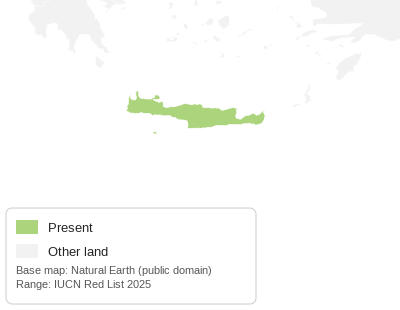
Engel and the IUCN both give Crete.[3][2] Ruttner took his samples from the east, centre and west of the island. He limited the name to Crete, although bees of western Anatolia and the eastern Aegean islands are very similar.[1]
Classification evidence
Ruttner analysed 33 characters over 404 samples. Crete forms a tight cluster that overlaps intermissa and part of the Anatolian group, and it separates clearly from Greek mainland, Cypriot and Sicilian bees. The Cretan bees differ from the Balkan carnica group in about 20 worker characters and 12 drone characters.[1]
History
Ruttner wrote that Crete has been a bee country from prehistoric times to the present, with about 10 colonies per square kilometre in the 1970s. Thyme on stony slopes, flowering in July and August, is the main source of honey.[1] Brother Adam collected samples at Chania and Heraklion in 1957.[1]
Status
Accepted: it is one of the ten subspecies of Apis mellifera that the IUCN’s 2025 assessment for Europe (Moro et al.) recognises.[2]
A study of one apiary found Cretan stocks that were crosses of adami, macedonica and ligustica.[4]
Sources
- Ruttner 1980, “Apis mellifera adami (n. ssp.), die Kretische Biene”, Apidologie 11(4): 385–400
- Moro et al. 2025, Apis mellifera (Europe assessment), The IUCN Red List of Threatened Species 2025: e.T42463639A277757621 (assessed 17 July 2025)
- Engel 1999, “The taxonomy of recent and fossil honey bees (Hymenoptera: Apidae; Apis)”, Journal of Hymenoptera Research 8(2): 165–196
- Liakos 2018, Journal of the Hellenic Veterinary Medical Society