Apis mellifera cypria is the Cyprian bee, the subspecies of the island of Cyprus.[1][2]
Names and classification
Pollmann named it Apis mellifica cypria in 1879 (p. 52).[2] Engel lists cypriaca Koschevnikov, 1900, as an unjustified emendation.[2] In northern Cyprus, Ruttner’s morphology placed it in O, but the mitochondrial type was mostly C (99 of 101 colonies).[3] Papachristoforou and colleagues found mitochondrial C1 together with microsatellites of lineage O, a double pattern that sets it apart from other subspecies.[4]
Range
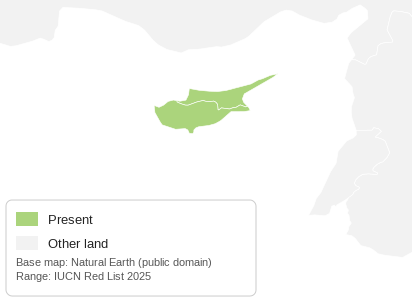
Engel says it is known only from the island of Cyprus.[2] Kandemir and colleagues sampled 12 places in northern Cyprus, and Papachristoforou and colleagues sampled six sites across the island.[3][4]
Classification evidence
In northern Cyprus, 18 colonies were measured on 39 characters. Eleven were clearly assigned to cypria (probability above 0.99), and none was related to the C-lineage subspecies.[3] A 2025 study of 2,400 workers from 160 colonies in 15 regions found the wing shape of 12 populations closely alike, and clearly separate from bees of Lemnos in Greece.[5]
History
Queens were imported to Cyprus from what is now Syria and Lebanon in the 19th century. Traditional beekeeping in trunk hives is still the main kind in eastern Cyprus.[3]
Status
Accepted: it is one of the ten subspecies of Apis mellifera that the IUCN’s 2025 assessment for Europe (Moro et al.) recognises.[1]
Importing bees from the nearby mainland may become a threat. Imported anatoliaca and possibly meda colonies are already present.[3] A 2025 study warns of rising risk of genetic erosion through the import of non-native queens.[5]
Sources
- Moro et al. 2025, Apis mellifera (Europe assessment), The IUCN Red List of Threatened Species 2025: e.T42463639A277757621 (assessed 17 July 2025)
- Engel 1999, “The taxonomy of recent and fossil honey bees (Hymenoptera: Apidae; Apis)”, Journal of Hymenoptera Research 8(2): 165–196
- Kandemir, Meixner, Ozkan and Sheppard 2006, on the honey bees of northern Cyprus, Apidologie 37(5): 547–555
- Papachristoforou, Rortais, Bouga and Arnold 2013, Journal of Apicultural Science 57
- Constantinou, Christofi, Tsaltas and Papachristoforou 2025, Apidologie