Apis mellifera carnica is the Carniolan bee, a grey, gentle bee of central-eastern Europe that is named after Carniola, now mostly Slovenia.[1][2]
Names and classification
Pollmann named it Apis mellifica carnica in 1879 (p. 45), from bees he obtained from Carniola.[3][2] Engel lists as synonyms hymettea Pollmann, 1879, carniolica Koschevnikov, 1900, banatica Grozdanic, 1926, and carpatica Barac, 1977.[3] It belongs to lineage C.[1][4][5]
Description
The Slovenian breeders’ register describes workers as medium-sized and thin, generally grey, with long legs. Their grey to yellowish-grey felt bands are wide and distinct, the hairs of the fifth abdominal segment are thick and short (0.25 to 0.35 mm), and the tongue is 6.4 to 6.8 mm long.[2] It gives the worker cubital index as 2.7 (range 2.4 to 3.0). Drones have a dark abdomen, never yellow.[2] The Slovenian Beekeepers’ Association adds bright grey hair along the edges of the abdomen.[6] In Hungary, bees with a yellow abdomen are treated as a fault in the local Pannonian type.[5]
Behaviour
The breeders’ register calls it very docile, and says it rarely stings, sits calmly on the comb and is inclined to swarm.[2] The Slovenian breeding programme selects colonies that swarm less.[6]
Range
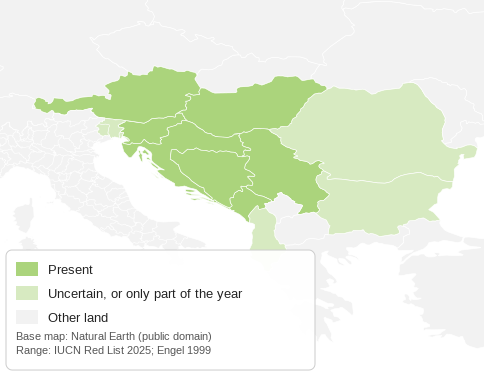
Engel says it lives south of the Alps and into northern Italy, Yugoslavia and Romania.[3] The IUCN gives central-eastern Europe.[1] The Slovenian Beekeepers’ Association lists Slovenia, a small part of northern Italy, Austria (Carinthia, Styria, Lower Austria and Burgenland), most of Hungary, part of Romania, Serbia and Montenegro, Bosnia and Herzegovina, and Croatia.[6] Ilyasov and colleagues give Slovenia, Bulgaria, Poland, Austria, Croatia, Bosnia and Herzegovina, Serbia, Hungary and Romania.[7] Bees of this subspecies are kept far beyond this range.[8] In the United States, about 38% of the colonies in a 2022 survey carried the C-lineage mitochondrial type that marks carnica.[9]
Classification evidence
Lukic and colleagues typed 232 workers from six countries across the native range. They found genetic structure within the range, and they call for the variation to be conserved in national breeding programmes.[4] Ilyasov and colleagues say that carnica, carpathica and macedonica cannot be told apart by one morphometric method, but can by others and by mitochondrial DNA.[7]
History
The Slovenian Beekeepers’ Association says that Emil Ravenegg Rotschutz began sending swarms from Višnja Gora in Carniola to Eichstätt in Germany in 1857; the breeders’ site gives 1858.[6][2] From 1857 to the end of the First World War at least 170,000 swarms were exported, and some estimates run as high as 500,000.[6] In Slovenia, beekeepers may keep only this subspecies, imports need ministry approval, and a pure-line breeding register is kept.[2]
Status
Accepted: it is one of the ten subspecies of Apis mellifera that the IUCN’s 2025 assessment for Europe (Moro et al.) recognises.[1]
Within its native range, crossbreeding with other stock is noted.[4]
Sources
- Moro et al. 2025, Apis mellifera (Europe assessment), The IUCN Red List of Threatened Species 2025: e.T42463639A277757621 (assessed 17 July 2025)
- Carniolan bee, Slovenian breeders’ site (kranjska-cebela.si)
- Engel 1999, “The taxonomy of recent and fossil honey bees (Hymenoptera: Apidae; Apis)”, Journal of Hymenoptera Research 8(2): 165–196
- Lukic et al. 2024, “Genomic diversity and population structure of Carniolan honey bee in its native habitat”, BMC Genomics 25
- Balazs et al. 2025, on the Pannonian ecotype of Apis mellifera carnica in Hungary, Biology 14: 475
- Slovenian Beekeepers’ Association, “The Carniolan bee”
- Ilyasov, Lee, Takahashi, Kwon and Nikolenko 2020, “A revision of subspecies structure of western honey bee Apis mellifera”, Saudi Journal of Biological Sciences 27(12): 3615–3621
- BeeBreed.eu, Institute for Bee Research, pages on the subspecies
- Alburaki et al. 2022, “Honey bee populations of the USA display restrictions in their mtDNA haplotype diversity”, Frontiers in Genetics