Apis mellifera ligustica is the Italian bee, the subspecies of the Italian Peninsula and the one most widely exported around the world.[1][2]
Names and classification
Spinola named it Apis ligustica in 1806 (p. 35 of his work on new insects of Liguria), so it was first described as a species and later moved to a subspecies.[3] Engel lists australis Kiesenwetter, 1860, as an unjustified replacement name for it.[3] It belongs to lineage C.[1][4]
Range
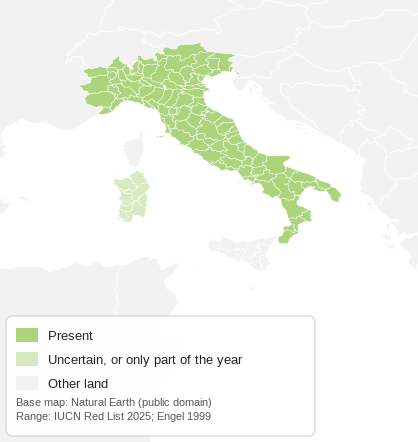
The IUCN gives the range as the Italian Peninsula.[1] Engel adds that it has been moved commercially throughout the world, and that the bees now living in Italy have hybridised much with mellifera and carnica in the north.[3] He says that unmixed populations seem to be confined to Kangaroo Island, Australia, where they are kept as a pure strain.[3] In a 2022 survey of 1,063 colonies in the United States, about 77% carried one of the two C-lineage mitochondrial types that mark ligustica (39%) and carnica (38%).[5]
Classification evidence
Franck and colleagues studied 664 colonies from 17 populations. Microsatellites confirmed C ancestry, but over most of the Italian peninsula the mitochondrial DNA is a mix of M and C types. They concluded that the subspecies has a hybrid origin.[2] The M type is absent from the main queen-producing area.[2]
Status
Accepted: it is one of the ten subspecies of Apis mellifera that the IUCN’s 2025 assessment for Europe (Moro et al.) recognises.[1]
The trade in queens and migratory beekeeping have spread non-local subspecies and crosses between them across Europe.[1] In Italy, the bees sampled as supposedly pure came from the main queen-producing area.[2]
Sources
- Moro et al. 2025, Apis mellifera (Europe assessment), The IUCN Red List of Threatened Species 2025: e.T42463639A277757621 (assessed 17 July 2025)
- Franck, Garnery, Celebrano, Solignac and Cornuet 2000, “Hybrid origins of honeybees from Italy (Apis mellifera ligustica) and Sicily (A. m. sicula)”, Molecular Ecology 9: 907–921
- Engel 1999, “The taxonomy of recent and fossil honey bees (Hymenoptera: Apidae; Apis)”, Journal of Hymenoptera Research 8(2): 165–196
- Ilyasov, Lee, Takahashi, Kwon and Nikolenko 2020, “A revision of subspecies structure of western honey bee Apis mellifera”, Saudi Journal of Biological Sciences 27(12): 3615–3621
- Alburaki et al. 2022, “Honey bee populations of the USA display restrictions in their mtDNA haplotype diversity”, Frontiers in Genetics