Apis mellifera mellifera is the European dark bee, the nominate subspecies of the Western Honey Bee. It is native from France to Scandinavia and from the British Isles east to the Ural Mountains.[1]
Names and classification
Linnaeus named the species Apis mellifera in 1758 (Systema Naturae, 10th edition, p. 576). As the nominate subspecies, it carries the same name.[2] In 1761 he changed the spelling to mellifica, which Engel treats as an unjustified emendation.[2] Engel lists several later names for it as synonyms, among them germanica Pollmann, 1879, and nigrita Lucas, 1882.[2][3] Ilyasov and colleagues call it the dark European honey bee.[3] It belongs to lineage M, the western and northern European lineage.[1][3] GBIF lists it as an accepted subspecies.[4]
Range
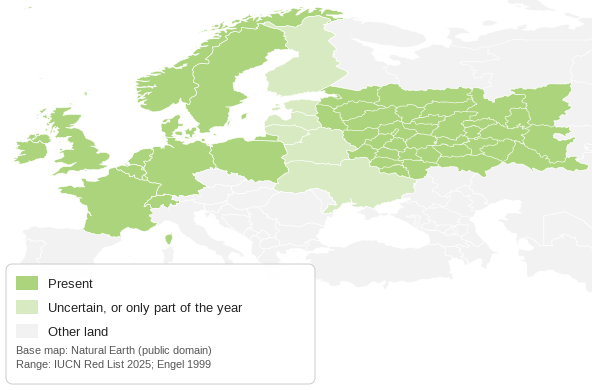
The IUCN gives the range as from France to Scandinavia and from the British Isles east to the Ural Mountains.[1] Engel describes it as originally ranging across central Europe north of the Alps, south to southern France in the west and north to southern Sweden, east to central Russia, and over the British Isles. In Ukraine it grades over the steppe into A. m. sossimai.[2] Outside Europe, a 2022 survey of 1,063 colonies from 45 US states found M-lineage mitochondrial types in 3.2% of colonies, with mellifera types in six states.[5]
Classification evidence
Whole mitochondrial genomes of 18 subspecies support the M lineage as a single group, with maximum support. The origin of the lineage is left open.[6] The Chinese subspecies sinisxinyuan is its closest relative, which stretches the M lineage to its farthest eastern known range.[1] Hybridisation with other subspecies is well documented in mellifera, even in populations in protected areas.[1]
History
The Scottish islands of Colonsay and Oronsay have been a reserve for the black bee since 1 January 2014. The Order that created it bars the keeping of any other honey bee there, to protect mellifera from hybridisation.[7][8]
Status
Accepted: it is one of the ten subspecies of Apis mellifera that the IUCN’s 2025 assessment for Europe (Moro et al.) recognises.[1]
Buchler and colleagues tested colonies of five subspecies at 20 apiaries across Europe. Colonies with queens of local origin survived on average 83 days longer than colonies with queens of non-local origin.[9] BeeBreed.eu says the subspecies is endangered by replacement and hybridisation.[10]
Sources
- Moro et al. 2025, Apis mellifera (Europe assessment), The IUCN Red List of Threatened Species 2025: e.T42463639A277757621 (assessed 17 July 2025)
- Engel 1999, “The taxonomy of recent and fossil honey bees (Hymenoptera: Apidae; Apis)”, Journal of Hymenoptera Research 8(2): 165–196
- Ilyasov, Lee, Takahashi, Kwon and Nikolenko 2020, “A revision of subspecies structure of western honey bee Apis mellifera”, Saudi Journal of Biological Sciences 27(12): 3615–3621
- GBIF Backbone Taxonomy, Apis mellifera Linnaeus, 1758, key 1341976
- Alburaki et al. 2022, “Honey bee populations of the USA display restrictions in their mtDNA haplotype diversity”, Frontiers in Genetics
- Tihelka, Cai, Pisani and Donoghue 2020, “Mitochondrial genomes illuminate the evolutionary history of the Western honey bee (Apis mellifera)”, Scientific Reports 10: 14515
- The Bee Keeping (Colonsay and Oronsay) Order 2013, SSI 2013/279
- Scottish Native Honey Bee Society, Colonsay Black Bee Reserve
- Buchler et al. 2014, “The influence of genetic origin and its interaction with environmental effects on the survival of Apis mellifera colonies in Europe”, Journal of Apicultural Research 53(2)
- BeeBreed.eu, Institute for Bee Research, pages on the subspecies