Apis mellifera sinisxinyuan is a dark honey bee of the Tian Shan mountains in Xinjiang, China, described in 2016 from its genome. It is the farthest eastern member of the M lineage.[1][2]
Names and classification
Chen and colleagues described it in 2016 as a new subspecies, Apis mellifera sinisxinyuan, in Molecular Biology and Evolution 33(5).[1] The holotype is a worker from Xinyuan, Xinjiang (43°17′51″N, 83°42′48″E, 1,709 m), held in the honey bee collection of the Institute of Apicultural Research.[1] The name refers to Xinyuan.[1] It belongs to the M lineage, and is closely related to mellifera.[1][2] The IUCN notes that this supports an Asian origin for the species.[2]
Description
The describers write that it is a dark bee with black abdomens and grey hair. The abdominal hair is very long, longer than in mellifera and almost twice as long as in ligustica and pomonella. The body is slender and small, considerably smaller than that of mellifera.[1] The cubital, sternite 6 and tarsus indices are similar to those of mellifera, and the tongue is short.[1]
Behaviour
The describers call the workers very aggressive, with excellent overwintering ability.[1] A 2024 study of colonies in an apiary in the Yili River Valley found strong cold hardiness, and that a short cold treatment raises their supercooling ability.[3]
Range
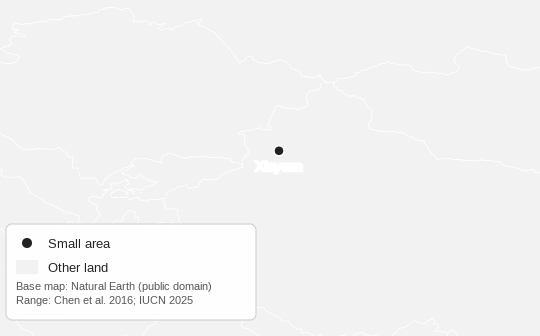
It is distributed in the Yili River Valley in western China.[1] The Tian Shan is the easternmost natural limit of Apis mellifera, and hosts two native subspecies, sinisxinyuan and pomonella.[4]
Classification evidence
Chen and colleagues sequenced the genomes of ten bees and compared them with 35 genomes from other populations. Several analyses placed it in the M lineage next to mellifera.[1] They put the split from mellifera at about 132,000 years ago, against about 30,000 years between carnica and ligustica.[1]
History
The type colonies were sampled in August 2011, in wild nests and in hives holding wild-caught swarms.[1] It should not be confused with the managed Xinjiang black bee, which was brought to the Yili Valley in the 1920s and belongs to the C lineage, close to carnica, with 10 to 15% M-lineage genes from sinisxinyuan.[4]
Status
Accepted: the IUCN’s 2025 assessment (Moro et al.) names it as a subspecies of the Tian Shan, outside its European list of ten.[2]
The describers found it only in very limited areas, largely protected from human activity by mountain barriers. They warn that warming and more human activity, including beekeeping, are a serious threat, and that hybridisation with pomonella could harm its genetic integrity.[1] A 2026 study says the spread of managed Xinjiang colonies threatens the native subspecies.[4]
Sources
- Chen, Liu, Pan et al. 2016, “Genomic analyses reveal demographic history and temperate adaptation of the newly discovered honey bee subspecies Apis mellifera sinisxinyuan n. ssp.”, Molecular Biology and Evolution 33(5): 1337–1348
- Moro et al. 2025, Apis mellifera (Europe assessment), The IUCN Red List of Threatened Species 2025: e.T42463639A277757621 (assessed 17 July 2025)
- Shan et al. 2024, on the cold tolerance of Apis mellifera sinisxinyuan, Insects 15(10): 790
- Tulaxi, Abaidula, Shi et al. 2026, “Population genomics reveals genetic diversity, introgression, and genetic differentiation in Tianshan Mountains western honeybees (Apis mellifera)”, Evolutionary Applications 19(5): e70248