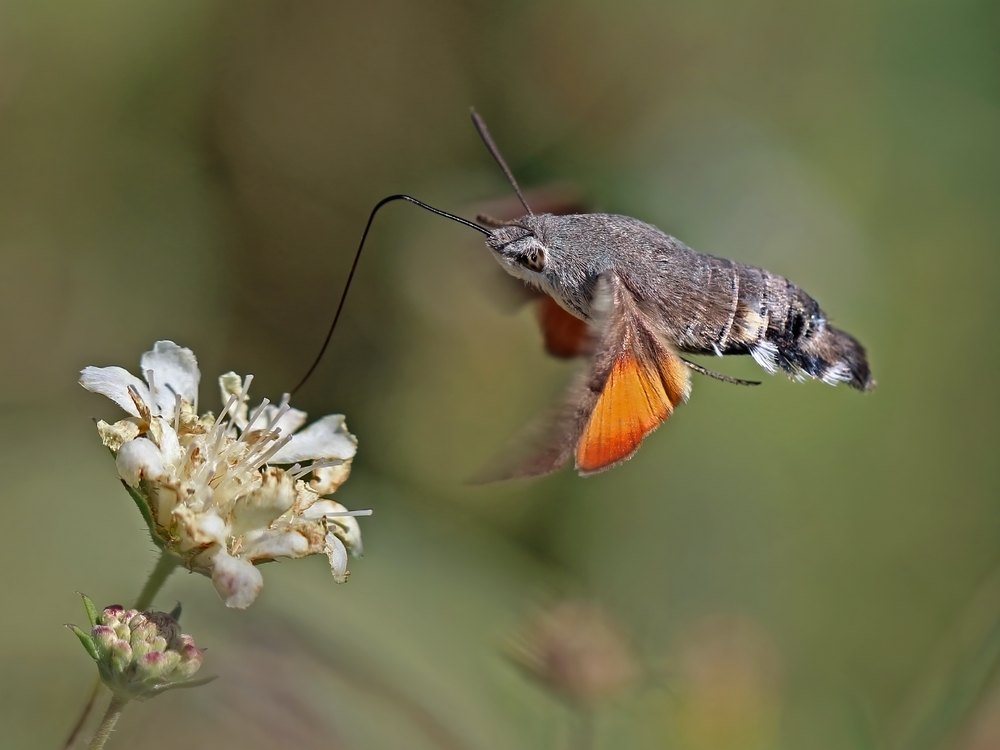
The Hummingbird Hawk-moth (Macroglossum stellatarum) is a day-flying moth with grey-brown forewings and orange-brown hindwings.[1] It hovers in front of flowers and drinks nectar through a tongue about 2.5 cm long.[2] It lives across Europe, North Africa and Asia, and reaches Britain as a visitor.[3][4] The IUCN rates it Least Concern in Europe; there is no worldwide assessment.[5]
Quick facts
Description
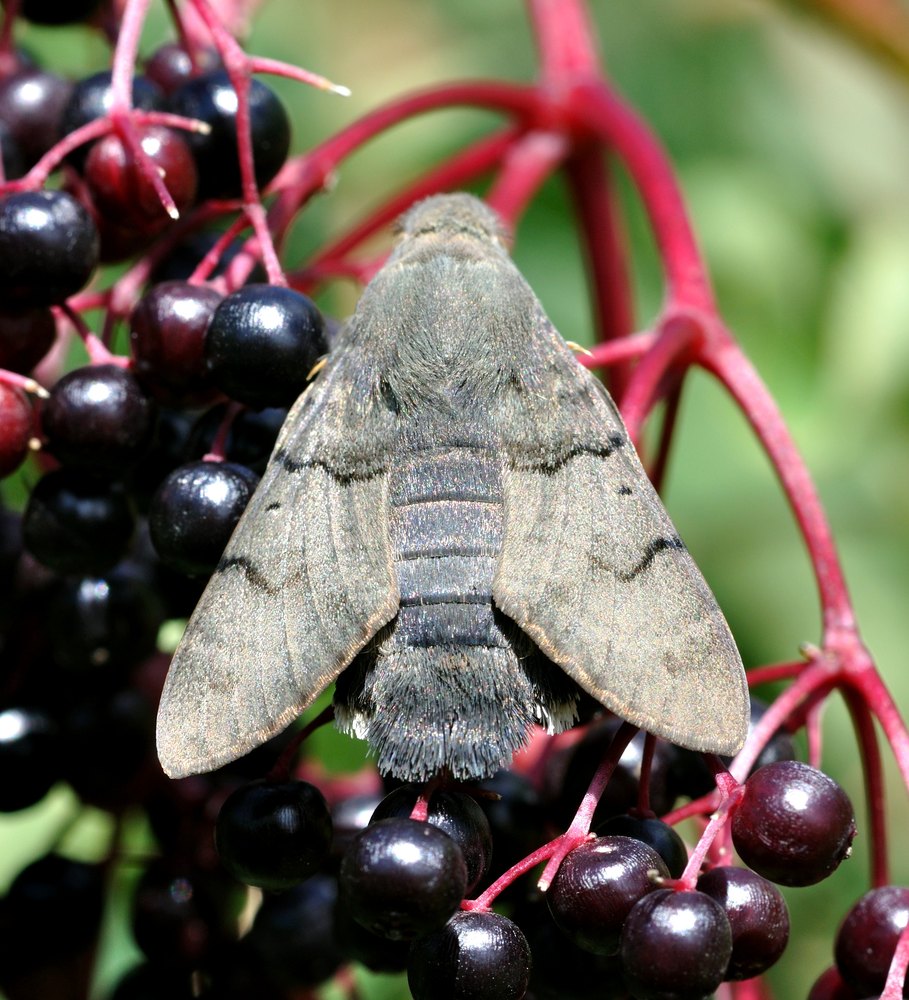
The adult Hummingbird Hawk-moth has greyish-brown forewings and orange-brown hindwings. The orange shows clearly when the moth is in flight.[1] Its body is chequered black and white.[1] At the tip of the abdomen is a two-part tuft of scales that looks a little like a small bird’s tail.[7][8]
Name
The German name Taubenschwänzchen means “little pigeon tail”. It refers to the tuft of scales at the tip of the abdomen, which looks somewhat like the tail feathers of a pigeon.[7][8] An older German name is Karpfenschwanz, “carp tail”.[9]
In other languages
| Language | Name | Meaning |
|---|---|---|
| French local | moro-sphinx; sphinx du caille-lait | caille-lait is the French word for bedstraw, the caterpillar’s food plant |
| German local | Taubenschwänzchen | little pigeon tail |
| Dutch local | kolibrievlinder | hummingbird butterfly |
| Danish local | kolibri-dagsværmer; duehale; lille duehale; karpehoved | hummingbird day hawk-moth; pigeon tail; little pigeon tail; carp head |
| Swedish local | större dagsvärmare | larger day hawk-moth |
| Norwegian local | dagsvermer (Bokmål); dagsvermar (Nynorsk) | — |
| Finnish local | etelänpäiväkiitäjä | southern day hawk-moth |
| Polish local | fruczak gołąbek | little pigeon (fruczak is a kind of hawk-moth) |
| Czech local | dlouhozobka svízelová | bedstraw long-beak |
| Slovenian local | velerilec | — |
| Catalan local | bufaforats; borinot carter | — |
| Welsh local | gwalch-wyfyn hofrol | hovering hawk-moth |
| Ukrainian local | Язикан звичайний (yazykan zvychainyi) | common long-tongue |
| Chinese | 後黃長喻天蛮 | long-beaked hawk-moth |
Names are from the national checklists listed by GBIF (France, Germany, Belgium, the Netherlands, Denmark, Sweden, Norway, Finland, Poland, the Czech Republic, Slovenia, Catalonia, the United Kingdom, Ukraine) and the Catalogue of Life. Several languages have more than one listed name; the Swedish checklist also lists stor dagsvärmare.[10][11]
Body
Size
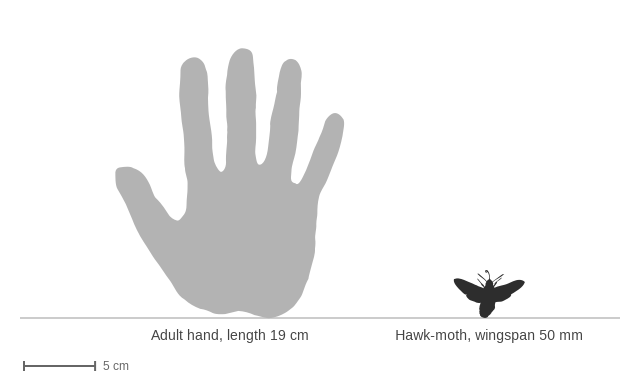
The two British authorities give different wingspans. UKMoths gives 40 to 50 mm,[3] while Butterfly Conservation gives 50 to 58 mm.[1] Two captive-bred moths from UK breeders, measured in a flight study, had wingspans of 45 mm and 40 mm and weighed 0.33 g and 0.31 g.[12]
| Weight (adult) | about 0.3 g |
| Wingspan | 40–58 mm |
Wings and flight
A moth hovering at an artificial flower in a laboratory in France beat its wings about 76 times a second (average 75.9, give or take 8.2). These moths were reared from eggs collected in France. When the wings were artificially damaged, the beat rose to 84.0 a second, and the moths still followed a flower that moved back and forth at up to 8.9 times a second.[13] In a wind tunnel, two captive-bred moths preferred a flight speed of 1.5 m/s.[12] NABU describes a faint hum from the hovering wings.[8]
Head and tongue
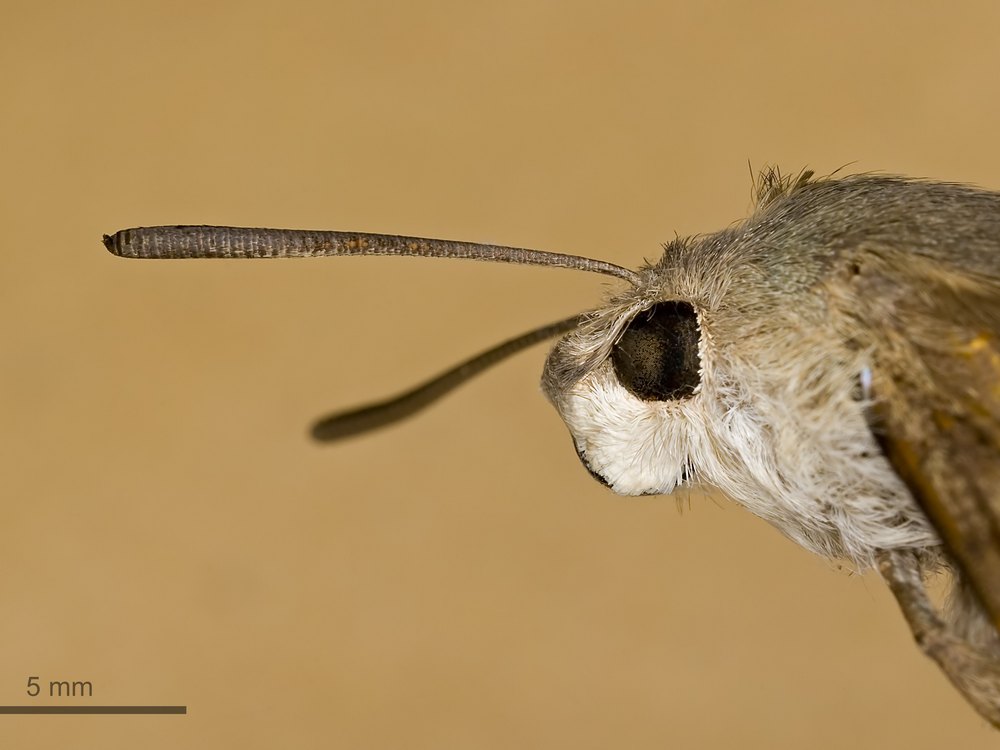
The tongue (proboscis) is about 2.5 cm long. A hovering moth guides it with colour and contrast patterns on the flower, steering the tip towards the nectar.[2]
Eyes and colour vision
The Hummingbird Hawk-moth sees in colour, using three kinds of light-sensing cell in its eyes, which respond to ultraviolet, blue and green light (strongest at about 350, 440 and 525 nanometres, nm). These values were measured in the Elephant Hawk-moth, Deilephila elpenor, and used as a stand-in in a study of this species.[2] Newly emerged moths that had never seen a flower strongly preferred light of 440 nm (blue), with a weaker preference for 540 nm (green). Brighter targets drew more visits, and discs about 32 mm across were preferred over smaller and larger ones. In these tests size mattered more than colour, and colour mattered more than pattern.[14]
Learning
The moth learns flower colours fast. Newly emerged moths trained on artificial flowers learned both to visit the rewarded colour and to avoid the unrewarded one.[15] A later study found that colour is learned much more readily than brightness.[6] Odours are learned too, but with a limit: the moths failed to learn odours on blue, the colour they prefer by instinct, and succeeded on yellow or green.[16]
Behavior
Hovering and feeding
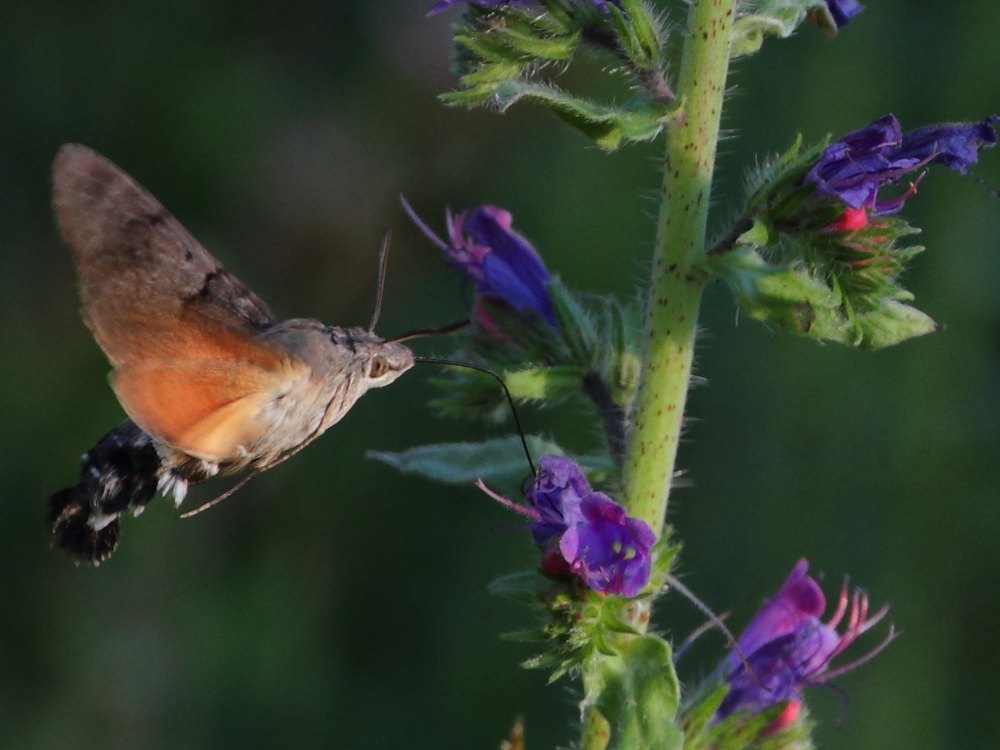
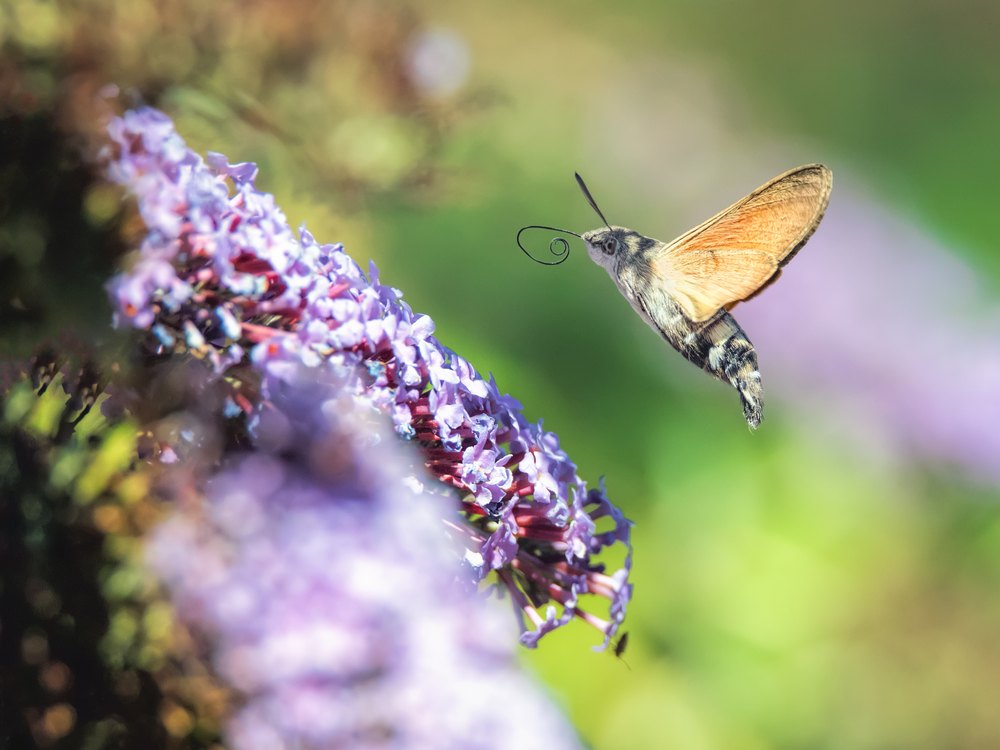
The moth feeds on the wing. It hovers in front of a flower without landing and pushes its tongue into the blossom.[2][8] NABU reports more than 100 flowers visited in five minutes.[8]
Daily rhythm
The Hummingbird Hawk-moth flies by day. In a Mediterranean summer, a study found that its numbers stayed fairly steady from sunrise to about 17:00 GMT, with an evening peak between 18:00 and 20:00. It tolerates a very high body temperature and regulates its heat well when the air is hot, which the author links to day foraging in Mediterranean summers.[17]
Migration and winter
UKMoths calls it an immigrant (a visitor that arrives from elsewhere and may not breed) that sometimes arrives in large numbers, especially after long warm spells or a southerly airflow. Butterfly Conservation describes it as an immigrant from southern Europe and North Africa that is also suspected to be resident (living there all year) in Britain.[1][3] NABU says it can travel up to 2,000 km, as far as Scandinavia, reaching Germany from late April.[8]
It overwinters as an adult, which is unusual among European hawk-moths. Butterfly Conservation lists crevices in rocks, trees, walls and unheated outbuildings as winter shelters.[1] In central Europe winter survival is only partly successful and better in mild winters.[18]
Diet
Adults
Adults drink nectar. They have an instinctive bias towards blue-violet and yellow-green flowers (see Body), but visit blooms of many colours.[14] NABU names geraniums, catchfly, phlox and butterfly bush.[8]


Caterpillars
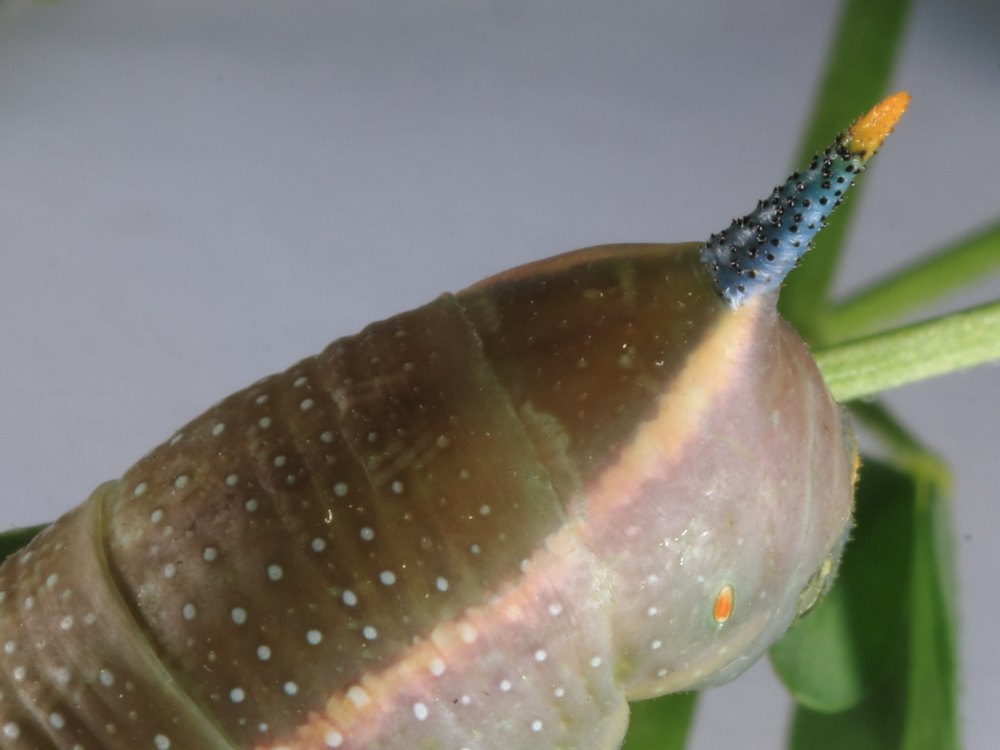
Caterpillars eat the leaves of bedstraws (Galium) and madders (Rubia). Butterfly Conservation lists Lady’s Bedstraw (Galium verum), White Bedstraw (Galium album) and Wild Madder (Rubia peregrina).[1] Lepiforum names the same two genera and records Cleavers (Galium aparine) and Wood Bedstraw (Galium sylvaticum).[18] Where the eggs are laid is told under Life cycle.
Life cycle
| Stage | Age / time | Notes |
|---|---|---|
| Egg | Laid from April to July in the records | One egg per plant, on Galium (bedstraw).[18] |
| Caterpillar | With the pupa, about 40 days in one summer rearing | Lepiforum rearing in Germany, 21 June to 31 July 2012.[18] |
| Pupa | About 32 days, one cool-autumn record | Denmark, 24 September to 26 October 2006.[18] |
| Adult | Adults overwinter in many places | See Behavior.[1][18] |
Egg
The female lays her eggs one at a time, one egg per plant, on the underside of the top leaflets or on the shoots of young Galium.[18] In Spain, three females were seen laying on wild madder (Rubia peregrina).[19]
Caterpillar
The caterpillar eats the leaves of its host plants (see Diet) and grows through several growth stages, each ended by a moult.[18] Lepiforum followed a rearing in Germany in which a caterpillar in its first stage on 21 June 2012 had become an adult by 31 July 2012, about 40 days later, in summer.[18]
Pupa
The caterpillar pupates in a loose silken cocoon among plant debris or leaf litter near the ground.[1][18] In one Danish record a caterpillar pupated on 24 September 2006 and the adult emerged on 26 October, about 32 days in cool autumn weather.[18]
Generations
The number of generations a year varies with place. In Cadiz Bay, southern Spain, Cuadrado counted three flight peaks (February to March, May and July) and described the moth there as having three generations a year, though one site had one generation and another had two.[19] NABU gives three to four generations in southern Europe and says the number is unknown in Germany.[8]
Ecology
Predators
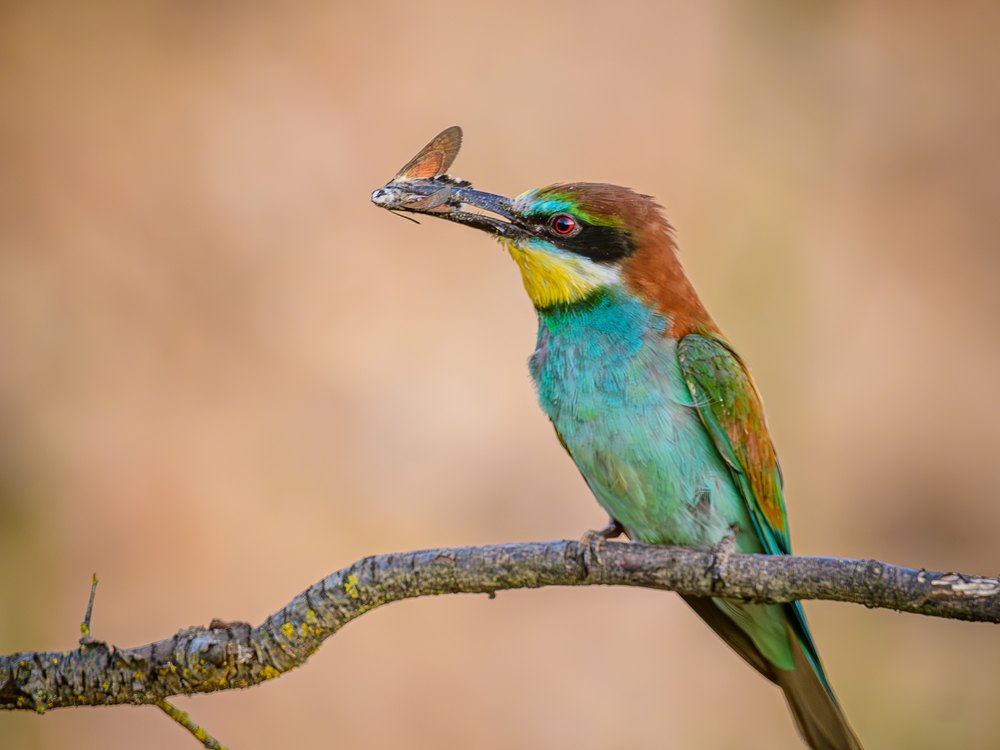
Lepiforum records one European bee-eater (a colourful insect-eating bird) taking an adult Hummingbird Hawk-moth in Baden-Württemberg, Germany, in 2018.[18]

Flower visits
Herrera recorded the moth foraging at the flowers of Lavandula latifolia (a lavender) in south-eastern Spain, at air temperatures of 19 to 36 °C.[17] The moth hovers at a flower and probes it with its tongue without landing (see Behavior).[14]
Habitat and range
Habitat
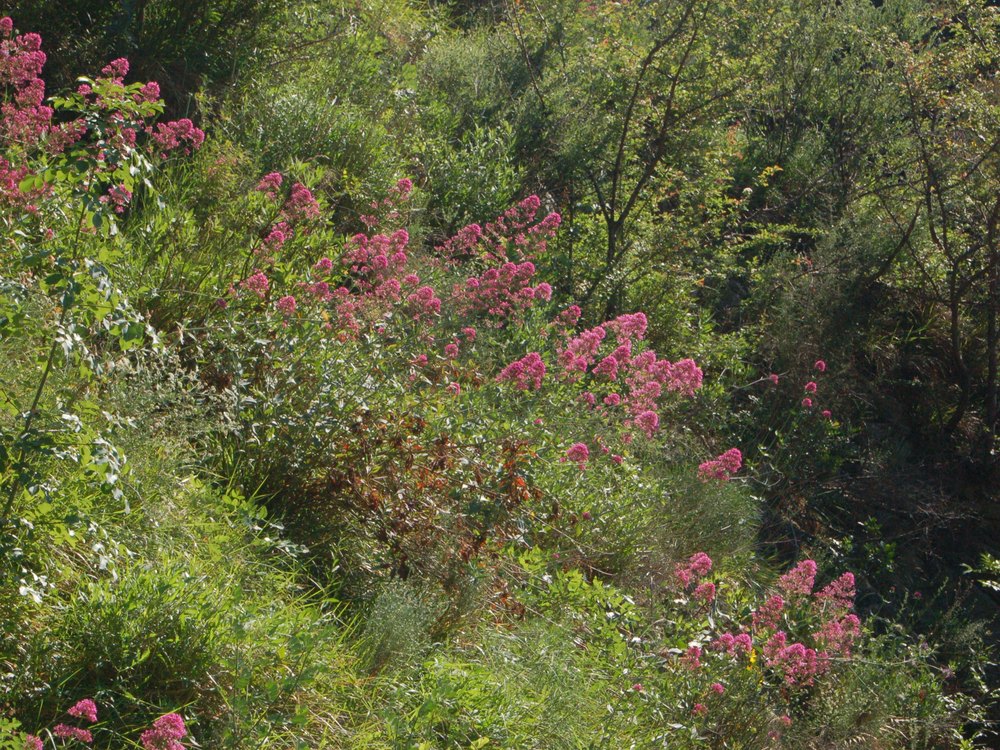
Lepiforum lists gardens, settlements, field edges, forest edges, meadows, vineyards and dirt tracks, with records from about 50 m (Lower Saxony) to about 1,150 m above sea level (Hasliberg, Switzerland).[18] Pyrgus.de adds open land, mountain pastures and large clearings.[4] The IUCN Europe assessment lists urban areas (40%), arable land (19%) and temperate shrubland (13%) as habitats.[5] In the Cadiz Bay area of Spain, a three-year survey (2014 to 2016) used plots below 80 m above sea level near the Atlantic coast.[19]

Range
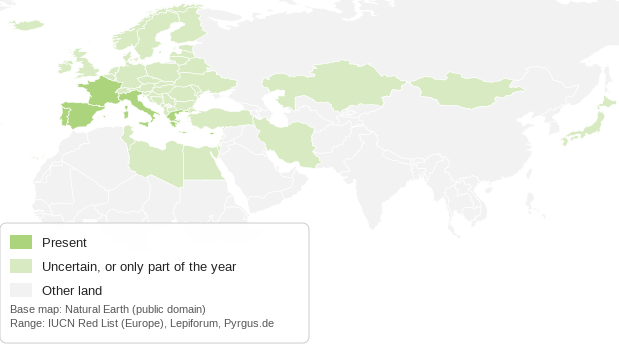
Pyrgus.de gives the range as Africa across Europe and Asia to Japan.[4] Lepiforum names records from Turkey, Iran, Israel, Kazakhstan, Mongolia, Japan, Tunisia, Libya and Egypt.[18] The IUCN Europe assessment says the species is not endemic to Europe (it also lives outside the region).[5]
Sources disagree on how much of Europe the moth lives in all year. The IUCN Europe assessment codes every European country, including the United Kingdom and the Nordic countries, as native and resident (living there all year).[5] UKMoths calls it an immigrant in Britain, the Finnish national Red List marks it “NA” (not applicable, a category for species that do not breed in the country), and Pyrgus.de says it is native mainly around the Mediterranean.[3][4][5] In Cadiz, Spain, the moth was recorded in every month of a survey from 2014 to 2016, and the author calls it likely resident.[19]
Host plants
The food plants of the caterpillars are listed under Diet. Pyrgus.de adds a breeding record on Plocama pendula on La Gomera, in the Canary Islands, and Lepiforum notes sunny, open sites for the caterpillars.[4][18]
Evolution
Fossil record
No fossil is known for the Hummingbird Hawk-moth, for its genus Macroglossum or for its subfamily, Macroglossinae.[20] A 2023 re-examination of fossils once assigned to the silk-moth and hawk-moth group (Bombycoidea) found the earliest reliable evidence in the middle Miocene (about 16 to 11 million years ago).[20] The best-supported hawk-moth fossil there is Mioclanis shanwangiana from Shanwang in China, probably a hawk-moth of uncertain subfamily.[20]
Hawk-moth family
Dated family trees rest on DNA, not fossils. Huang and colleagues (2022) place the origin of day flying in hawk-moths at about 29.19 million years ago, and found that it arose several times independently.[21] Their calculation assumed that the living hawk-moth family is between 29.6 and 44.9 million years old.[21] A 2026 study by Couch and colleagues reports that the hawk-moth subfamilies split from one another in the Eocene (about 56 to 34 million years ago).[22]
Forms and variants
No subspecies are listed for the Hummingbird Hawk-moth by GBIF, the Catalogue of Life or Funet.[9][11][23] Funet lists nine other names for it as synonyms: flavida, nigra, subnubila, fasciata, convergens, approximata, clausa, candidum and minor.[9] It marks all except flavida as infrasubspecific names, which are names given to single variants, not to subspecies.[9] GBIF lists the same names, some of them in the form Macroglossum stellatarum plus the variant name, as synonyms.[23]
Conservation
Status
No worldwide IUCN assessment exists for the Hummingbird Hawk-moth. The IUCN Red List assessment for Europe and the 27 European Union countries rates it Least Concern (assessed 2 May 2024, version 3.1, published 2026). The population trend is given as stable, although the same assessment says there is no information on the population size.[5]
The IUCN assessment also quotes national lists. The United Kingdom, Germany and Romania list it as Least Concern.[5]
Protection
The IUCN assessment says that no international legislation covers the species and that there is no specific trade information for it. It could not say whether the species occurs in a protected area.[5]
History and culture
First description
Carl Linnaeus described the moth in 1758, in the tenth edition of Systema Naturae, under the name Sphinx stellatarum.[9][23] It was later moved to the genus Macroglossum.
Names
The older scientific names are listed under Forms and variants, and the meanings of the English and German common names under Name.
Research
The Hummingbird Hawk-moth is a well-known subject in studies of insect vision and learning. Almut Kelber’s experiments on how the moths learn the colour of flowers appeared in the Journal of Experimental Biology in 1996 and 1997.[14][15] Her 2005 paper in the Proceedings of the Royal Society B compared learning of colour and of brightness, and found that the moths follow colour when the two give different answers.[6]
In Britain, Butterfly Conservation described large influxes of the moth in 2000, 2006 and 2011 and, in 2016, hoped for another.[24]
Taxonomy
| Rank | Name |
|---|---|
| Kingdom | Animalia |
| Phylum | Arthropoda |
| Subphylum | Hexapoda |
| Class | Insecta |
| Order | Lepidoptera (butterflies and moths) |
| Family | Sphingidae (hawk-moths) |
| Subfamily | Macroglossinae |
| Genus | Macroglossum Scopoli, 1777 |
| Species | Macroglossum stellatarum (Linnaeus, 1758) |
Synonyms (10)
| Name |
|---|
| Macroglossa stellatarum (Linnaeus, 1758) |
| Sphinx stellatarum (Linnaeus, 1758) |
| Macroglossum flavida (Retzius, 1783) |
| Sphinx flavida (Retzius, 1783) |
| Macroglossa nigra (Cosmovici, 1892) |
| Macroglossum nigra (Cosmovici, 1892) |
| Macroglossum subnubila (Schultz, 1903) |
| Macroglossum fasciata (Rebel, 1910) |
| Macroglossum convergens (Costantini, 1916) |
| Macroglossum approximata (Lempke, 1959) |
A selection of the oldest names. The GBIF backbone lists 13 species-level synonyms.[10]
Higher classification
The Hummingbird Hawk-moth belongs to the hawk-moth family Sphingidae, in the subfamily Macroglossinae, tribe Macroglossini and subtribe Macroglossina.[9][11] GBIF, the Catalogue of Life and Funet all accept Macroglossum stellatarum as a valid species, and Funet counts about 100 valid species in the genus Macroglossum.[9][11][23] A study of five genes in 131 hawk-moth species found Macroglossinae to be a natural group, but not the tribes and subtribes inside it.[25]
Sources
- Butterfly Conservation, Humming-bird Hawk-moth
- Goyret & Kelber 2012, PLoS ONE 7: e34629
- UKMoths, Humming-bird Hawk-moth (Macroglossum stellatarum)
- Pyrgus.de, Macroglossum stellatarum
- van Deijk, Parsons & van Swaay 2026, IUCN Red List assessment of Macroglossum stellatarum (Europe and EU27; version 3.1, assessed 2 May 2024)
- Kelber 2005, Proceedings of the Royal Society B 272: 2143–2147
- Spektrum, Lexikon der Biologie, Taubenschwänzchen
- NABU, Das Taubenschwänzchen
- Savela, Funet, Sphingidae: Macroglossinae and Macroglossum
- GBIF vernacular names of Macroglossum stellatarum
- Catalogue of Life, Macroglossum stellatarum (Linnaeus, 1758)
- Henningsson & Bomphrey 2013, Journal of the Royal Society Interface 10: 20130099
- Kihlström et al. 2021, Journal of Experimental Biology 224: jeb236240
- Kelber 1997, Journal of Experimental Biology 200: 827–836
- Kelber 1996, Journal of Experimental Biology 199: 1127–1131
- Balkenius & Kelber 2006, Naturwissenschaften 93: 255–258
- Herrera 1992, Ecological Entomology 17: 52–56
- Lepiforum, Macroglossum stellatarum
- Cuadrado 2017, SHILAP Revista de lepidopterología 45(180): 625–633
- “Critical re-examination of known purported fossil Bombycoidea (Lepidoptera)”, PeerJ 2023
- Huang et al. 2022, Insects 13: 887
- Couch et al. 2026, Royal Society Open Science
- GBIF Backbone Taxonomy, Macroglossum stellatarum (Linnaeus, 1758)
- Butterfly Conservation, “Is the UK set for a humming-bird summer?”, 9 June 2016
- Kawahara, Mignault, Regier, Kitching & Mitter 2009, PLoS ONE 4: e5719