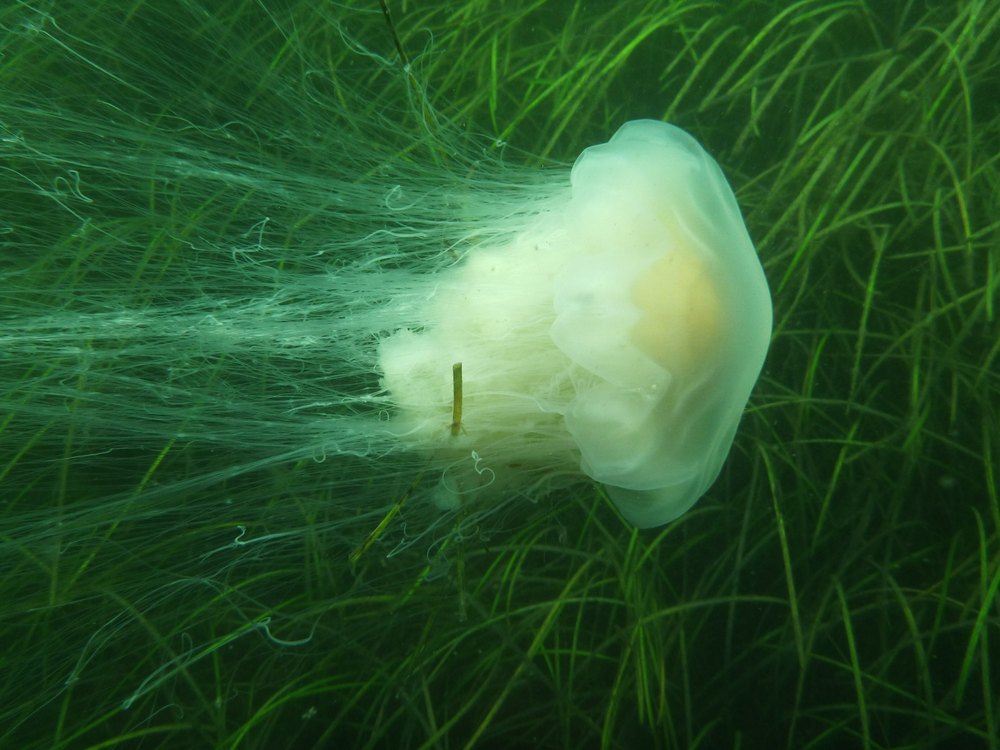
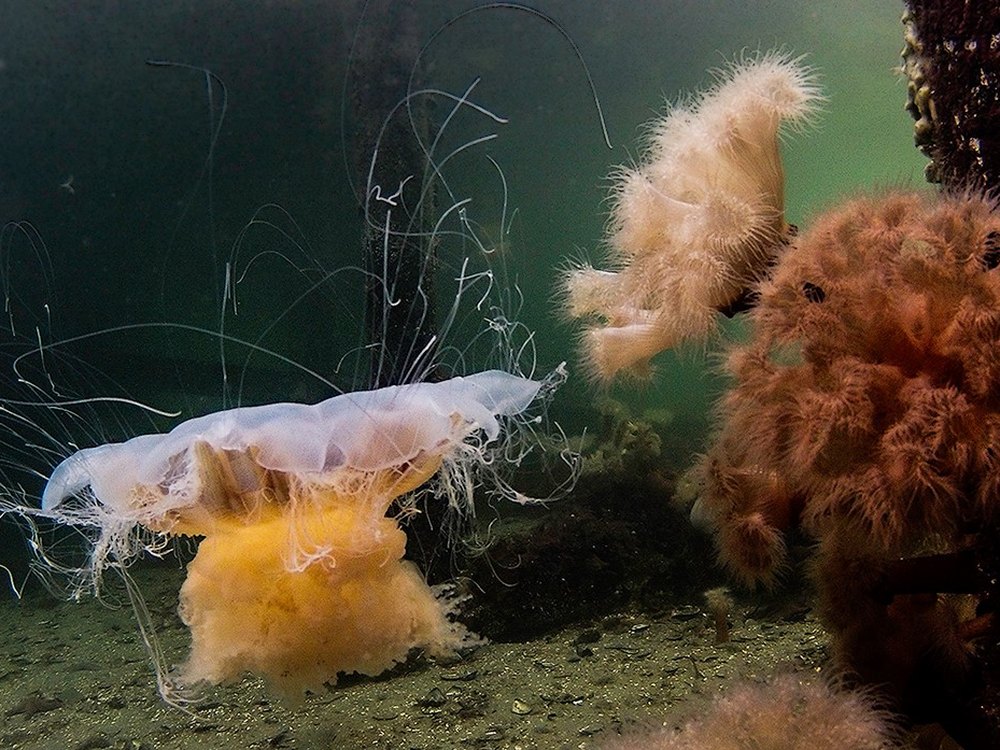
The Lion's Mane Jellyfish (Cyanea capillata) is a large jellyfish of cold northern seas. Its round bell, the dome that pulses to swim, hangs over a thick mass of frilly arms and many long, thin tentacles.[1] The tentacles carry stinging cells that can hurt people.[1][2]
Quick facts
Description
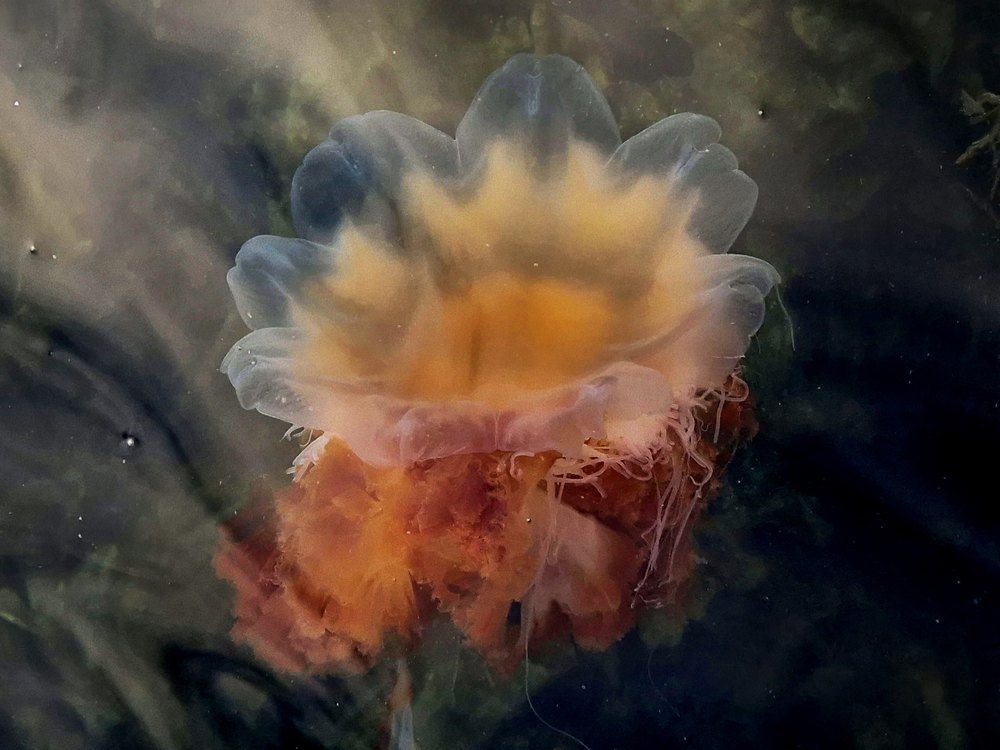
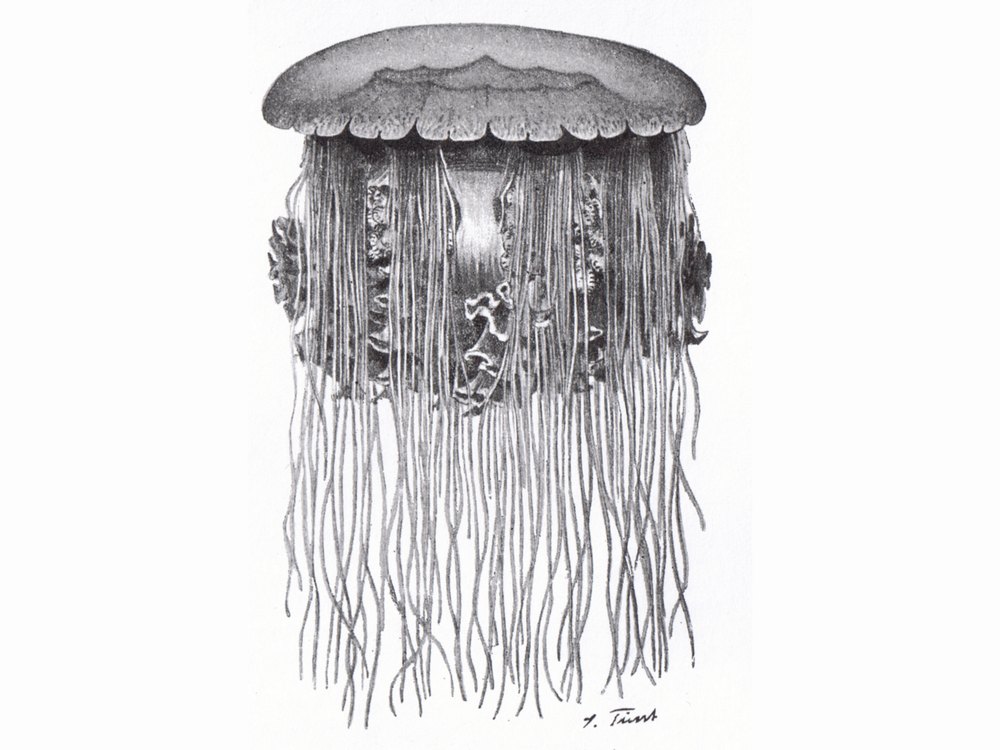
The Lion's Mane Jellyfish is a bell-shaped jellyfish with a soft, rounded dome, called the bell. The edge of the bell is split into eight lobes, a trait shared across the genus.[4] The tentacles hang from the underside of the bell in eight groups, and together they look like a thick mass of fine strands.[1] Around the mouth hang broad, frilly oral arms, which look like ruffled curtains below the bell.
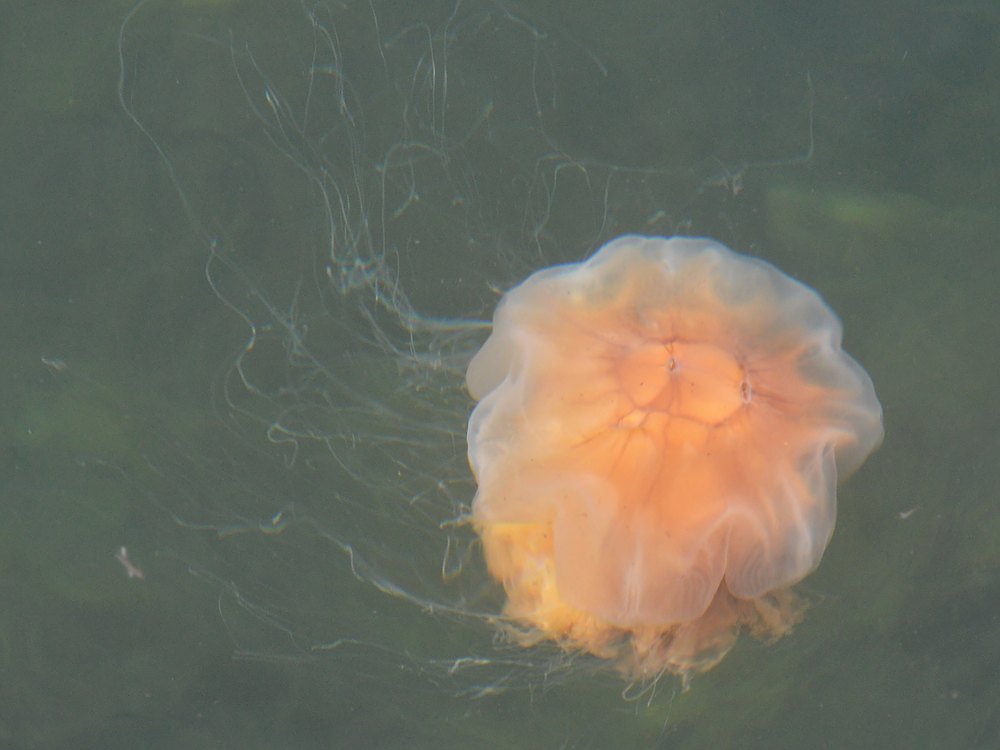
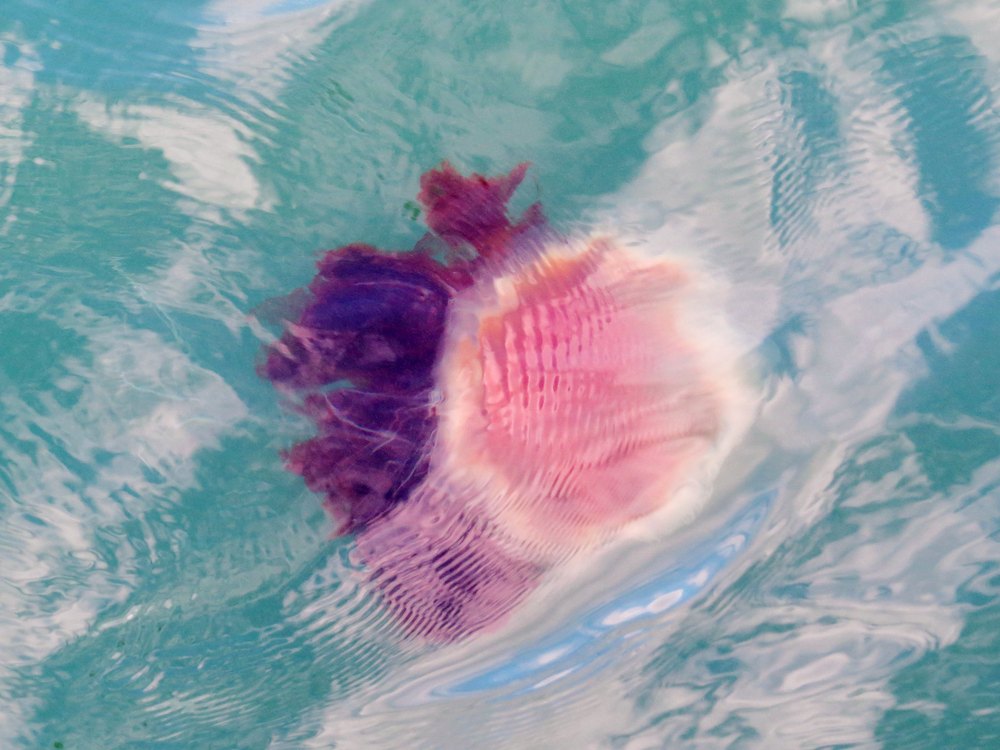
Animal Diversity Web describes the bell as pink to reddish-gold or brownish-violet.[1]
Name
The name “lion's mane” refers to the thick mass of tentacles, which looks like a lion's mane.[5] Another English name is hairy stinger.[6][7] The scientific name is Cyanea capillata. Linnaeus described the species in 1758 as Medusa capillata, from specimens of the North Sea.[8][9]
This page uses the narrow sense of the name, meaning Cyanea capillata only. The blue jellyfish C. lamarckii, the East Asian C. nozakii and the White Sea C. tzetlinii are treated as separate species.[8][9][10] The old names C. arctica, C. baltica and C. borealis are synonyms (see Forms and variants).
In other languages
| Language | Name | Meaning |
|---|---|---|
| Northern Sami local | fallasnuolga; áhkolašlieddu | — |
| Danish local | Rød brandmand | red fire man |
| Polish local | bełtwa włosiennik | — |
| Russian local | Цианея волосистая | — |
| Lithuanian local | Geltonplaukė medūza | — |
| Swedish | röd brännmanet | “red burn jellyfish” |
| Danish | rød brændegople | “red burning jellyfish” |
| Norwegian | brennmanet | “burn jellyfish” |
| Dutch | gele haarkwal | “yellow hair jellyfish” |
| German | Gelbe Haarqualle | “yellow hair jellyfish” |
| Finnish | hiusmeduusa | “hair jellyfish” |
| French | cyanée chevelue | “hairy cyanea” |
| Northern Sami | bossočolga | — |
Some of these names may also be used for the blue jellyfish.[6][7] The Sami names are from the Norwegian national list and the Danish name from the Danish national checklist, as listed by GBIF; the Polish and Russian names are from WoRMS and the Lithuanian name from the Catalogue of Life.
Body
Size
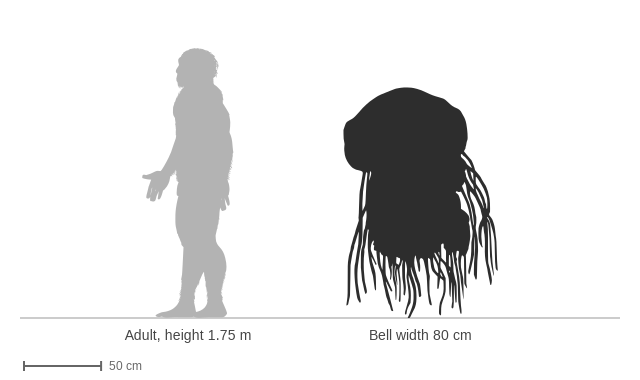
Animal Diversity Web gives a normal bell width of 30 to 80 cm and a maximum of about 180 cm.[1] The bell is the dome-shaped top of the animal. About 94% of the body is water.[1] Mayer (1910) wrote that most animals are not over 80 cm wide.[11] In studies in Swedish fjords the animals were often 11 to 20 cm across.[12] A much larger old measurement from Massachusetts is described in History and culture.
| Bell width (typical) | 30–80 cm |
| Largest | up to about 180 cm |
Tentacles
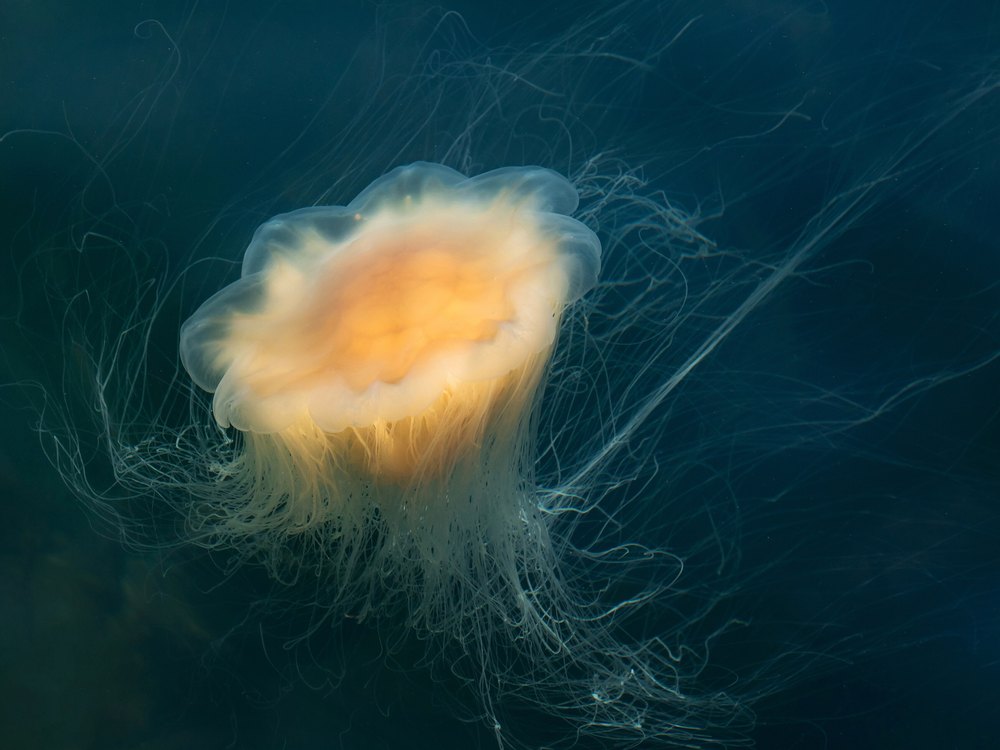
The tentacles hang from the underside of the bell in eight groups. Animal Diversity Web gives about 150 tentacles per group, which makes about 1,200 in all.[1] There are no tentacles along the bell edge.[1] Tentacles that have come off keep catching prey for weeks (see Diet).[3]


Stinging cells
A nematocyst is a stinging cell that fires a tiny harpoon. The lion’s mane carries them on its tentacles, on its oral arms (the frilly arms around the mouth) and on the upper surface of the bell.[1]
A sting causes severe pain and can affect the whole body.[2] For first aid, the NHS gives general jellyfish advice: rinse with seawater, then soak in very warm water for at least 30 minutes, and do not use ice.[13] A lab study on this jellyfish found that rinsing with seawater made the stinging cells release more venom, while 40 minutes of heat cut the damage by over 90% and ice did nothing. These were lab tests, not patients, and the authors say the advice needs to be revised.[2] The sting also harms fish: in a lab study, young Atlantic salmon (smolts) exposed to ground-up lion's mane jellyfish had gill damage that healed over about four weeks.[14]
Senses
In the genus Cyanea, the bell edge has eight rhopalia, small sense organs set between the eight lobes of the bell.[4]
Behavior
Swimming
Animal Diversity Web calls the Lion's Mane Jellyfish a continual swimmer and gives speeds of up to several kilometres an hour.[1] In Hood Canal, Washington, jellyfish carrying acoustic tags swam actively and were not simply carried by the water.[15] The animals in that study may include other species of Cyanea.

Up and down the water
The tagged jellyfish in Hood Canal moved up and down in the water over the day and night, and their depth did not change with the tide. They swam faster at night than by day, and the animals differed a lot from one another.[15]
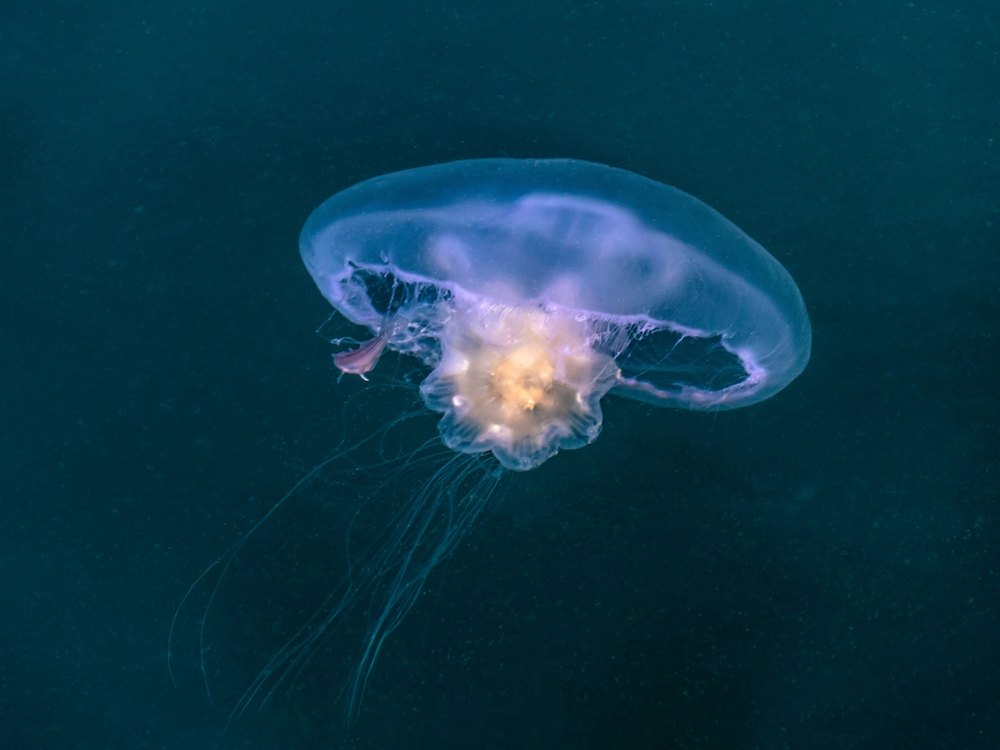
In experiments, a moon jelly (Aurelia aurita) that touches a lion's mane pulls in its tentacles, turns its bell upward and swims up at an average of 0.96 m a minute.[12]
Gatherings
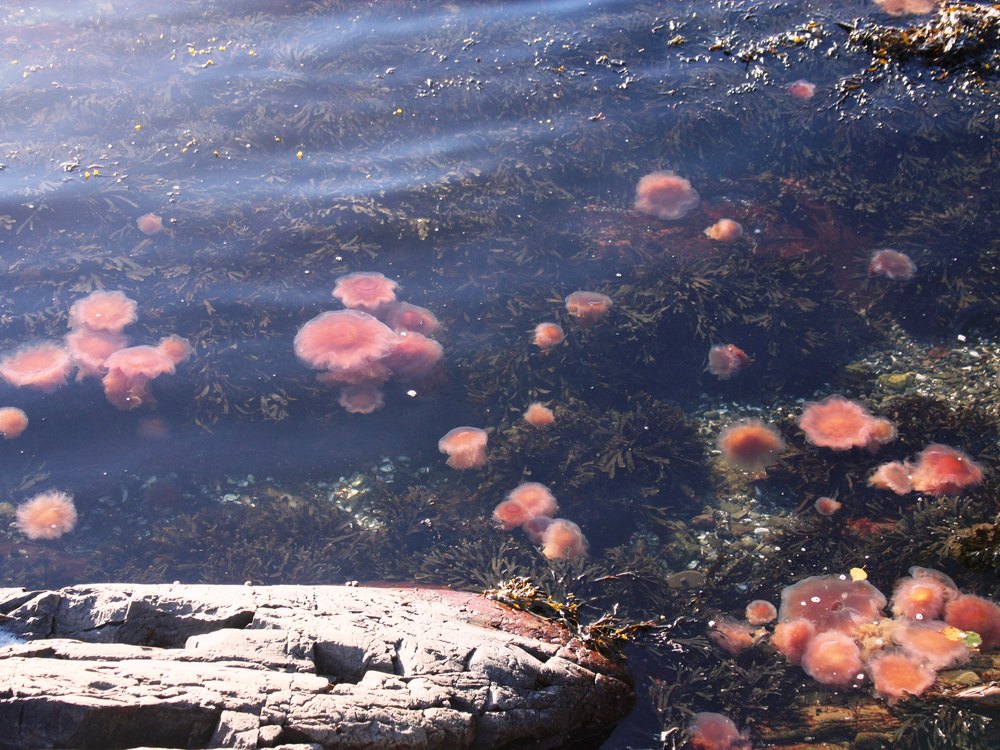
Animal Diversity Web says the jellyfish can form large groups, with gatherings kilometres long reported off Norway and in the North Sea.[1]

Diet
How it catches food
The jellyfish sinks slowly with its tentacles spread out like a net. Prey that touches them is stung and stuck, and the oral arms (the frilly arms around the mouth) carry it to the mouth.[1]
Tentacles that have come off the animal can still feed. In a test with brine shrimp, detached tentacles kept catching prey for 24 days.[3]
What it eats
Stomach contents of three jellyfish species taken together in Prince William Sound, Alaska, held mainly copepods and cladocerans (both tiny crustaceans) and larvaceans (drifting filter-feeders). A few fish eggs and larvae were also eaten.[16] The three species were Aurelia labiata, Cyanea capillata and Aequorea aequorea.
The lion's mane also eats other jellyfish. In a Swedish fjord, a study of the stomach contents of 70 animals showed that the lion's mane eats moon jellies. In the laboratory, one lion's mane took 38 hours to digest one moon jelly.[12]
It eats comb jellies too (jelly-like animals that are not true jellyfish). In the laboratory, one fed on the comb jelly Mnemiopsis leidyi, clearing up to 40 litres of water of prey an hour, but over 90% of encounters ended with the comb jelly escaping.[17]

Life cycle
| Stage | What happens |
|---|---|
| Planula | The swimming larva settles on a hard surface, sometimes after forming a cyst[4] |
| Polyp (scyphistoma) | The small stalked stage fixed to a surface; it makes more polyps and cysts without sex[4] |
| Strobila | A polyp that buds off a stack of young jellyfish in spring[4][18] |
| Ephyra | The tiny star-shaped young jellyfish, released from the stack[18] |
| Medusa | The swimming, bell-shaped adult |
Life stages
The sexes are separate, and the eggs are fertilised inside the female.[4] The fertilised egg becomes a planula, a swimming larva. It settles on a hard surface and turns into a polyp, or it first forms a resting cyst.[4] The polyp spreads without sex by making new cysts called podocysts.[4]
In spring the polyp turns into a strobila and buds off a whole stack of ephyrae, the tiny star-shaped young jellyfish. Each ephyra grows into a medusa.[4] Polyps of this species have rarely been found in the wild; a search of the southern North Sea did not find them,[19] and none are documented in the Baltic.[20]
Timing and temperature
In the Gullmar Fjord, Sweden, the young jellyfish are released from March to May.[18] In the lab, a cold winter of 5 °C made polyps bud off ephyrae. Holst (2012) expects that warming will not help this cold-water species.[21]
Ecology
Predators
The leatherback turtle is a proven predator. Cameras fixed to leatherbacks off Cape Breton Island, Nova Scotia, filmed 601 prey captures in August and September. The lion's mane made up 83 to 100% of the prey, and moon jellies (Aurelia aurita) were also eaten.[22] The prey was identified from the video, and the Cyanea of the north-western Atlantic may include more than one species.
Eating other jellyfish
The lion's mane eats moon jellies and comb jellies (see Diet).[12] The comb jelly Mnemiopsis leidyi is an invader in northern European seas, and the authors of a lab study suggest the native lion's mane may help limit it in the North Sea.[17]
Habitat and range

Where it lives
The lion's mane is a cold-water jellyfish of the northern Atlantic. SeaLifeBase gives its range as Iceland to France, north to Svalbard and east to Russia, and a depth of 0 to 85 m.[23] Around Britain and Ireland it is found on all coasts and is commonest in the east of England and in Scotland.[24] There, young animals appear from February, and large animals are seen from June to September.[24] It also lives in the Baltic Sea, where the animals form their own genetic group, separate from those of the North Sea.[20]
GBIF holds most of its records from Norway (7,652), Canada (5,103), the United Kingdom (3,997) and Sweden (1,558).[25]

Habitat
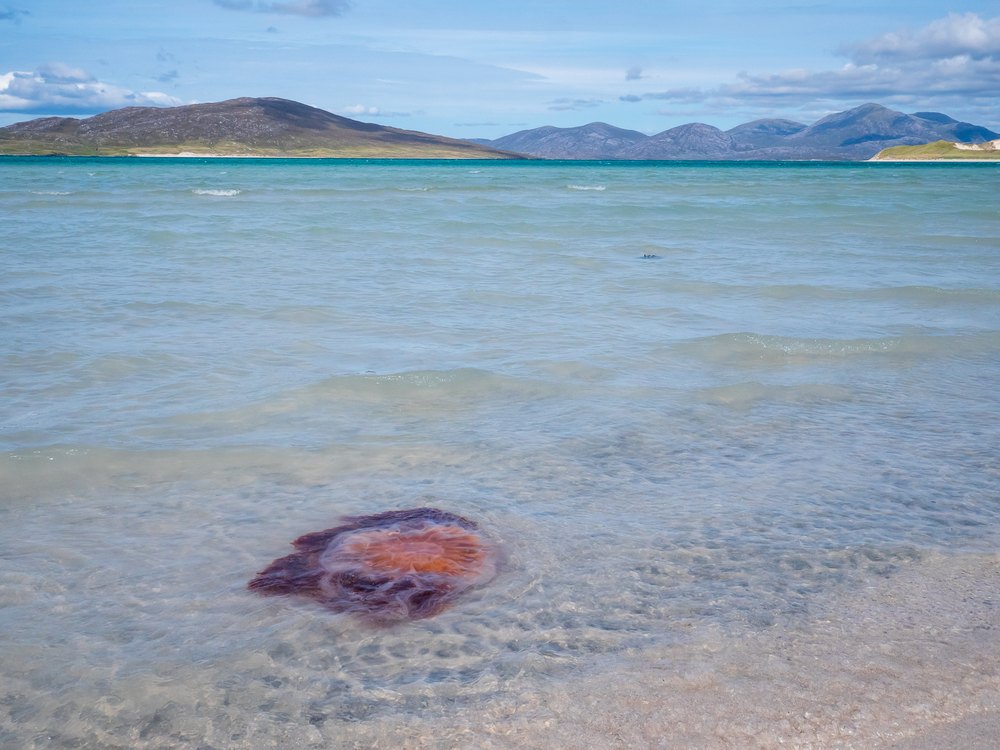
The adult drifts in open water (it is pelagic) and often washes up on beaches.[24] It is also recorded in fjords, such as the Gullmar Fjord in Sweden.[18] The small stalked polyp stage lives on the seabed.[1]


Telling it from similar species
Several close relatives look alike, so old records of the lion's mane can include other species. Cyanea lamarckii overlaps with it in the North Sea. Colour does not separate the two. The shape of the muscle folds under the bell and the warts on the top of the bell do.[26] Cyanea tzetlinii lives alongside it in the White Sea.[10] The lion's mane is not a worldwide jellyfish: the animals recorded as this species in south-eastern Australia belong to other species.[27]
Evolution
Where jellyfish sit
The Lion's Mane Jellyfish belongs to the true jellyfish (class Scyphozoa). These sit in a larger group, the Medusozoa, which also holds box jellyfish, stalked jellyfish and hydroids. Medusozoa is one of the main branches of the Cnidaria, the animals with stinging cells, together with corals and sea anemones.[28] Inside the true jellyfish, the crown jellyfish form a group of their own, and the moon jellies, sea nettles, root-mouth jellyfish and the genus Cyanea make up another, the Discomedusae.[29] How these groups split from each other is not settled, and the order Semaeostomeae, which holds the lion's mane, does not form a single natural group in a 2018 genome study.[29][28]
How old the group is
The dates are ranges, and they are for the Cnidaria as a whole, not for the true jellyfish or for Cyanea. A study of mitochondrial genes, with five medusozoans and five fossil dates to set the clock, puts the start of the Cnidaria at 741 million years ago, within a range of 686 to 819 million years.[30] A genome study says only that the Cnidaria have had more than 600 million years of separate evolution.[28] The same genome study finds that the common ancestor of the sampled cnidarians was a polyp with no medusa, so the swimming jellyfish form came later.[28]
Fossil jellyfish are disputed. In 2007 researchers described fossils about 505 million years old from the Middle Cambrian of Utah as jellyfish, some tentatively close to the groups of today.[31] A 2023 study reads the Utah and South China fossils as comb jelly-like animals instead, and names a Burgess Shale animal, Burgessomedusa, as the oldest clear free-swimming medusa.[32]
Forms and variants
No subspecies of the Lion's Mane Jellyfish are recognised. GBIF and WoRMS list Cyanea arctica, C. baltica and C. borealis as synonyms, which means older names for the same species.[9][8]
The bell colour varies a lot between animals, so it is not a safe way to tell the species from the blue jellyfish, C. lamarckii, which needs a close look at the bell or a DNA test.[26] Animals in the Baltic Sea form their own genetic group.[20] The jellyfish of the eastern United States is genetically distinct from the European C. capillata.[33] C. tzetlinii of the White Sea is a separate species and the closest known relative of the lion's mane.[10]
Conservation
Status
The IUCN Red List has not assessed the Lion's Mane Jellyfish, and SeaLifeBase lists it as not evaluated by CITES.[23]
Threats
Climate change[21]Climate change. Lab tests suggest that warming will not help this cold-water species (see Life cycle).[21] A time series in the Skagerrak from 1992 to 2011 showed no significant trend in Cyanea, in a count that may include more than one species.[34]
History and culture
Linnaeus used the name Medusa capillata already in 1746, twelve years before the 10th edition of Systema Naturae.[11]
The Agassiz record
In 1865 Alexander Agassiz published a measurement of a specimen from Nahant, Massachusetts: a bell 7.5 ft (about 2.3 m) wide and tentacles more than 120 ft (about 36.6 m) long.[35] The account gives no date for the specimen and no method. McClain and colleagues (2015) doubt the record, and the Cyanea of the eastern United States is probably another species.[33]

The 2010 New Hampshire stings
On 21 July 2010, at Wallis Sands State Park in Rye, New Hampshire, a dead jellyfish of about 40 pounds (18 kg) stung many bathers.[36][37] Reports give about 150 people stung (CBS) or between 50 and 100 (NBC).[36][37] Nine children were treated at hospital and released.[36] The event had no deaths.
The Sherlock Holmes story
“The Adventure of the Lion's Mane” is a Sherlock Holmes story by Arthur Conan Doyle, first printed in 1926 and collected in The Case-Book of Sherlock Holmes in 1927. It is set in Sussex in 1907, and the killer is Cyanea capillata.[38] Doyle's description draws on J. G. Wood's Out of Doors. Wood was stung while swimming off Margate and reports severe pain, a pang in the chest and recovery over several days.[5] The “fifty feet” (15 m) danger zone and the words “very nearly perished” are Doyle's own additions.[38][5]




Taxonomy
| Rank | Name |
|---|---|
| Kingdom | Animalia |
| Phylum | Cnidaria |
| Subphylum | Medusozoa |
| Class | Scyphozoa (true jellyfish) |
| Subclass | Discomedusae[40] |
| Order | Semaeostomeae |
| Family | Cyaneidae |
| Genus | Cyanea |
| Species | Cyanea capillata (Linnaeus, 1758)[8][9][39][7] |
Synonyms (4)
| Name |
|---|
| Medusa capillata (Linnaeus, 1758) |
| Cyanea arctica (Péron & Lesueur, 1810) |
| Cyanea baltica (Péron & Lesueur, 1810) |
| Cyanea borealis (Péron & Lesueur, 1810) |
From the GBIF backbone.[6]
Higher classification
The Lion’s Mane Jellyfish is in the family Cyaneidae and the order Semaeostomeae, which also holds the moon jellies.[8][28] WoRMS lists 19 accepted species in the genus Cyanea, among them the blue jellyfish C. lamarckii, the East Asian C. nozakii and the Australian C. annaskala.[8]
One species or several
For a long time the name Cyanea capillata was used for lion’s mane jellyfish all over the world. Dawson (2005) showed that this does not hold: animals from south-eastern Australia differ from the North Sea animals, the true C. capillata, by more than 10 per cent in the DNA he tested, and belong to C. annaskala and C. rosea.[27] Records from the Southern Hemisphere under the old name need a fresh look.[27] Closer to home, Holst and Laakmann (2014) told the blue jellyfish apart from C. capillata in the north-east Atlantic by bell structure and DNA, because colour overlaps.[26] In the White Sea, C. capillata and C. tzetlinii live in the same bay, and the authors who named C. tzetlinii warn that earlier Arctic studies may have mixed them up.[10] Databases still disagree over C. versicolor: WoRMS and GBIF keep it as a species and ITIS treats it as C. capillata.[8][9][39]
Sources
- Animal Diversity Web, Cyanea capillata
- Doyle et al. 2017, Toxins 9: 215
- Sigurdsson et al. 2024, Aquaculture Environment Interactions 16: 263–266
- Dong et al. 2008, Plankton and Benthos Research 3 (Suppl.): 118–124
- Wood, Out of Doors (1903 printing of the 1874 book), chapter “Medusa and her locks”
- GBIF, vernacular names of Cyanea capillata
- Catalogue of Life, release COL26.10, Cyanea capillata
- WoRMS, Cyanea capillata
- GBIF, Cyanea capillata
- Kolbasova et al. 2015, Polar Biology 38: 1439–1451
- Mayer 1910, Medusae of the World, volume 3
- Hansson 1997, Journal of Plankton Research 19: 195–208
- NHS, jellyfish and other sea creature stings: treatment
- Powell, Åtland and Dale 2018, Journal of Fish Diseases 41: 751–759
- Moriarty et al. 2012, Marine Ecology Progress Series 455: 1–12
- Purcell 2003, Marine Ecology Progress Series 246: 137–152
- Hosia and Titelman 2011, Journal of Plankton Research 33: 535–540
- Gröndahl 1988, Marine Biology 97: 541–550
- van Walraven et al. 2016, Marine Biology 163
- Majaneva et al. 2026, Marine Biology 173
- Holst 2012, Hydrobiologia 690: 127–140
- Heaslip et al. 2012, PLoS ONE 7: e33259
- SeaLifeBase, Cyanea capillata
- MarLIN, Cyanea capillata
- GBIF, occurrence records of Cyanea capillata by country
- Holst and Laakmann 2014, Journal of Plankton Research 36: 48–63
- Dawson 2005, Invertebrate Systematics 19: 361–370
- Kayal et al. 2018, BMC Evolutionary Biology 18: 68
- Bayha et al. 2010, Integrative and Comparative Biology 50: 436–455
- Park et al. 2012, Molecular Phylogenetics and Evolution 62: 329–345
- Cartwright et al. 2007, PLoS ONE 2: e1121
- Moon, Caron and Moysiuk 2023, Proceedings of the Royal Society B
- McClain et al. 2015, PeerJ 3: e715
- Hosia, Falkenhaug and Naustvoll 2014, Marine Ecology Progress Series 498: 103–115
- A. Agassiz 1865, North American Acalephae
- CBS Boston, 21 July 2010, large dead jellyfish stings beachgoers in New Hampshire
- NBC News, how one jellyfish stung 100 people
- Doyle 1927, “The Adventure of the Lion’s Mane”, The Case-Book of Sherlock Holmes
- ITIS, Cyanea capillata
- ITIS, Cyanea capillata, classification