Macaca fascicularis atriceps is the long-tailed macaque of Ko Khram Yai, a small island off south-eastern Thailand. It has a narrow dark patch on the crown.[1][2]
Names and classification
C. B. Kloss named it Macaca irus atriceps in 1919.[2] The holotype is an adult male in the US National Museum of Natural History, collected by Kloss on Ko Khram Yai on 30 October 1916, with paratypes from the same collecting.[2] The type locality is Ko Khram Yai, near Laem Samae San in south-eastern Thailand.[2] It is also called the Dark-crowned Long-tailed Macaque.[3]
Description
The back is buffy to medium brown, with pale yellow hair bands. The crown has a narrow, sharply edged patch of dark brown to blackish hair that reaches sideways to the middle of each eye and back to the vertex of the skull, or rarely to the back of the head.[2] The hairs in front of the ear point forward.[2] The tail is 109 to 128 percent of the head and body length in 9 adults.[2]
Range
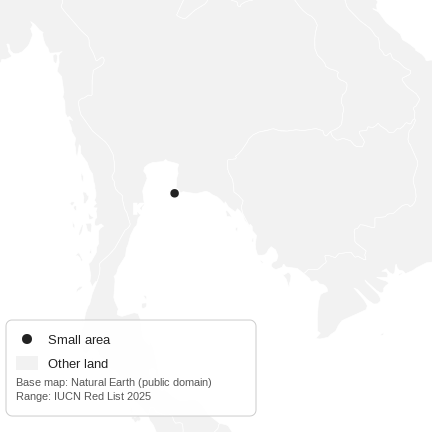
It lives only on Ko Khram Yai, off the south-eastern coast of Thailand.[2][1]
Classification evidence
GBIF and the IUCN Red List accept atriceps as a subspecies.[4][1] The Mammal Diversity Database lists no subspecies of M. fascicularis.[5] IUCN says that Groves (2001) and Fooden (1995) divided the species into ten subspecies, and that it tentatively set aside the tenth, philippinensis, following Smith et al. (2014).[1]
Fooden keeps it on the narrow dark crown patch alone.[2] Kloss had also described differences in the skull from the Con Son animals and from Indochinese macaques. Fooden re-measured six features, using 5 more Con Son adults and 32 Indochinese adults, and found that the sizes overlap in all six. Only two tendencies remained: the eye sockets are on average relatively smaller and the molars slightly larger in atriceps.[2] A 1988 list had treated atriceps as a synonym of bintangensis, a name Fooden places in the nominate subspecies.[2]
History
Kloss described it from the specimens he collected in 1916. In 1921 and 1926 he compared its skull with the Con Son animals, which he named condorensis in 1926.[2]
Status
IUCN lists M. f. atriceps as Vulnerable, in an assessment by Ang and colleagues in 2022.[1]
Sources
- Hansen et al. 2025, IUCN Red List assessment of Macaca fascicularis
- Fooden 1995, Systematic review of Southeast Asian longtail macaques, Fieldiana Zoology n.s. 81: 1–206
- Primate Info Net, long-tailed macaque fact sheet (Wisconsin National Primate Research Center)
- GBIF Backbone Taxonomy, accepted subspecies of Macaca fascicularis
- Mammal Diversity Database, Macaca fascicularis