Macaca fascicularis fascicularis is the nominate subspecies of the Long-tailed Macaque, the subspecies that carries the name Raffles gave the species in 1821 and that lives over most of the species’ range.[1][2]
Names and classification
Raffles described the animal as Simia fascicularis in his catalogue of a collection made in Sumatra.[3][4] The description seems to rest on one specimen, probably an adult female, and the holotype was not preserved.[2] The type locality is Sumatra, restricted by H. C. Robinson in 1916 to the neighbourhood of Bencoolen, now Bengkulu, in the south-west of the island.[2] Because the type locality of the species lies inside this subspecies, fascicularis is also the name of the nominate subspecies.[2]
Description
Of 868 specimens past infancy that Fooden checked, the back was buffy to yellowish grey or medium brown in 825 and dark brown in 43. The pale bands on the hairs ranged from pale yellow to golden to reddish.[2] The crown was the same colour as the back or brighter in 847 of 873 specimens.[2] The hairs in front of the ear pointed forward and formed part of a crest on the side of the face in 501 of 504 specimens, and pointed backward over the ear in only 2.[2]
Range
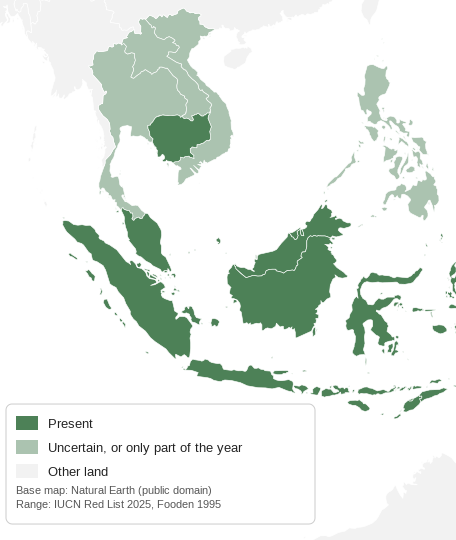
Fooden gives its range as the southern part of the Indochinese Peninsula (southern Viet Nam, Cambodia and southern Thailand) and nearby islands, the north-eastern Isthmus of Kra, the Malay Peninsula, Sumatra, Borneo, Java, the Lesser Sunda Islands from Bali to Timor, and the south-central Philippines (Cagayan Sulu, the Sulu Archipelago and western Mindanao), with their nearby islands.[2] It does not include the Con Son group, Ko Khram Yai, the Simeulue group, the Nicobar Islands, Mentawai, Enggano, Maratua, Karimunjawa, Kemujan, Komodo and many nearby islets, which are occupied by other subspecies.[2] IUCN states the range as most of the species’ range except the western fringe around Myanmar, where aurea lives, and seven small islands or island groups.[1] Fooden names three zones where it meets other subspecies: central and eastern Indochina (with aurea, or with the Rhesus Macaque), the eastern and southern Isthmus of Kra (with aurea), and eastern and central Mindanao and southern Negros (with philippinensis).[2]
Classification evidence
GBIF and the IUCN Red List both accept fascicularis as one of nine subspecies.[5][1] The Mammal Diversity Database lists no subspecies of M. fascicularis.[6] IUCN says that Groves (2001) and Fooden (1995) divided the species into ten subspecies, and that it tentatively set aside the tenth, philippinensis, following Smith et al. (2014).[1]
Fooden counts nine island populations that differ from nearby mainland animals but fall inside the variation of more distant populations of this subspecies, and so keeps them in fascicularis. Eight lie on shallow-water islands: Mursala, Redang, Lagong, Uwi, Tioman, Belitung, Ko Kut and Phu Quoc. The ninth is Nias, a deep-water island west of Sumatra.[2] He keeps southern Indochina in this subspecies for now, because the evidence for a break in mitochondrial DNA types and in resistance to Plasmodium knowlesi malaria is incomplete.[2] IUCN also includes the Philippine animals in fascicularis.[1]
History
The specimens came from a collection made for Raffles in Sumatra by P. Diard and A. Duvaucel in 1819 and 1820. Raffles’ catalogue was read to the Linnean Society of London on 5 December 1820.[2] Raffles wrote that the Malay name, Kra, is close to the cry of the animal.[3]
Status
IUCN lists M. f. fascicularis as Endangered, in an assessment by Hansen and colleagues in 2022.[1][7]
Sources
- Hansen et al. 2025, IUCN Red List assessment of Macaca fascicularis
- Fooden 1995, Systematic review of Southeast Asian longtail macaques, Fieldiana Zoology n.s. 81: 1–206
- Raffles 1821, Descriptive catalogue of a zoological collection made in Sumatra, Transactions of the Linnean Society of London 13: 239–274
- GBIF Backbone Taxonomy, Macaca fascicularis (Raffles, 1821)
- GBIF Backbone Taxonomy, accepted subspecies of Macaca fascicularis
- Mammal Diversity Database, Macaca fascicularis
- Hansen et al. 2022, Macaca fascicularis ssp. fascicularis (amended version of 2022 assessment). The IUCN Red List of Threatened Species 2022: e.T195351957A221668305