Macaca fascicularis fusca is the long-tailed macaque of Simeulue, an island off north-western Sumatra. It has blackish fur on the back and thighs.[1][2]
Names and classification
Miller named it Macacus fuscus in 1903.[2] The holotype is an adult male in the US National Museum of Natural History, collected by W. L. Abbott at Telok Dalam, now Lhok Dalam, on the east coast of Simalur (Simeulue), Indonesia, on 20 November 1901.[2] Later authors moved it to Macaca, as Macaca fusca in 1923 and Macaca irus fusca in 1940.[2] It is also called the Simeulue Long-tailed Macaque.[3]
Description
The back is blackish with pale yellow hair bands. The crown is blackish too, with hairs that have clear pale yellow bands. The outer surface of the thighs and shanks is blackish, and the hairs under the ear are pale grey and not lengthened.[2] The hairs in front of the ear usually point backward and partly cover the ears (9 of 13 specimens), and in 4 they point forward.[2] The tail is 90 to 108 percent of the head and body length in 10 adults.[2]
Range
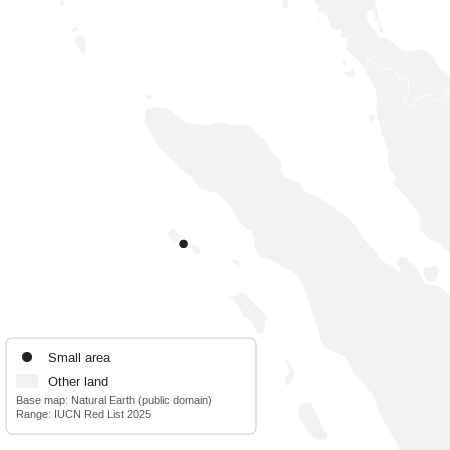
It lives on Simeulue, west of northern Sumatra, Indonesia.[2][1]
Classification evidence
GBIF and the IUCN Red List accept fusca as a subspecies.[4][1] The Mammal Diversity Database lists no subspecies of M. fascicularis.[5] IUCN says that Groves (2001) and Fooden (1995) divided the species into ten subspecies, and that it tentatively set aside the tenth, philippinensis, following Smith et al. (2014).[1]
Fooden keeps it because its back, crown and thighs are blackish and its tail is shorter than usual in the species. The animals of nearby Lasia Island are as dark but have a tail of normal length, and are treated as lasiae.[2] Two behaviour studies suggested that the size difference between males and females may be smaller on Simeulue than in Sumatra. Fooden found no sign of it in the skull measurements.[2]
History
Among the nine paratypes of fusca are two animals collected on Lasia Island in January 1902.[2]
Status
IUCN lists M. f. fusca as Critically Endangered, in an assessment by Amey and colleagues in 2022.[1][6]
Sources
- Hansen et al. 2025, IUCN Red List assessment of Macaca fascicularis
- Fooden 1995, Systematic review of Southeast Asian longtail macaques, Fieldiana Zoology n.s. 81: 1–206
- Primate Info Net, long-tailed macaque fact sheet (Wisconsin National Primate Research Center)
- GBIF Backbone Taxonomy, accepted subspecies of Macaca fascicularis
- Mammal Diversity Database, Macaca fascicularis
- Amey, Hansen, Ang & Gumert 2022, Macaca fascicularis ssp. fusca. The IUCN Red List of Threatened Species 2022: e.T39786A199564189