The peacock mantis shrimp (Odontodactylus scyllarus) is a colourful crustacean of the Indo-West Pacific. It is not a true shrimp: mantis shrimps form their own order.[1][2] It lives in burrows in sand and gravel near coral reefs and smashes hard-shelled prey with a club on each front limb.[3][4]
Quick facts
Description
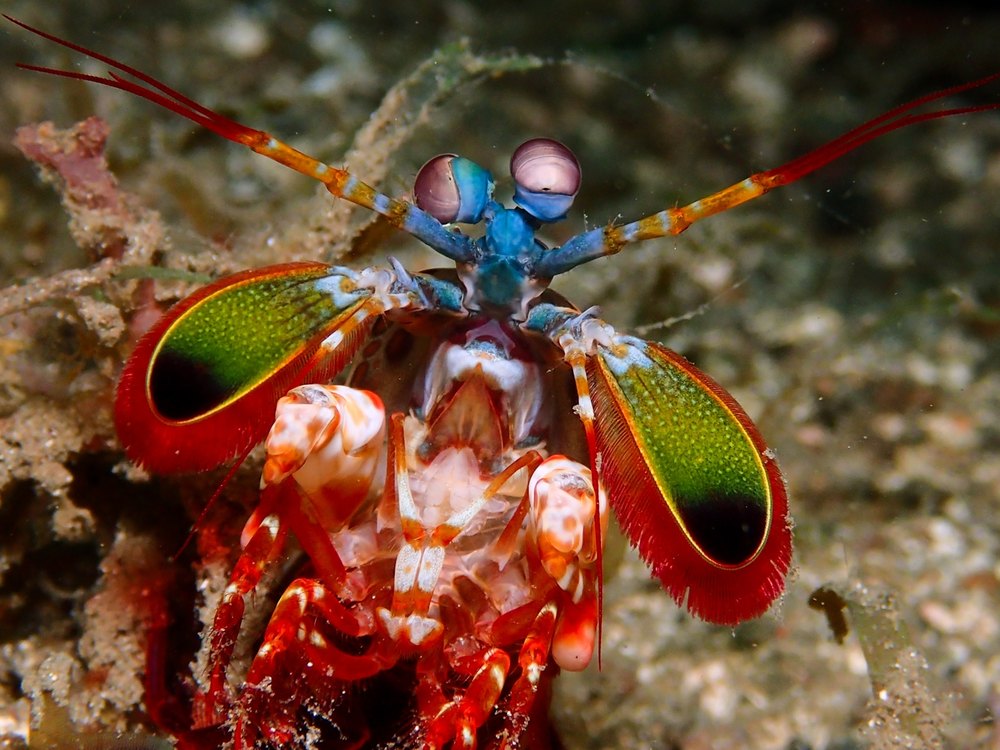
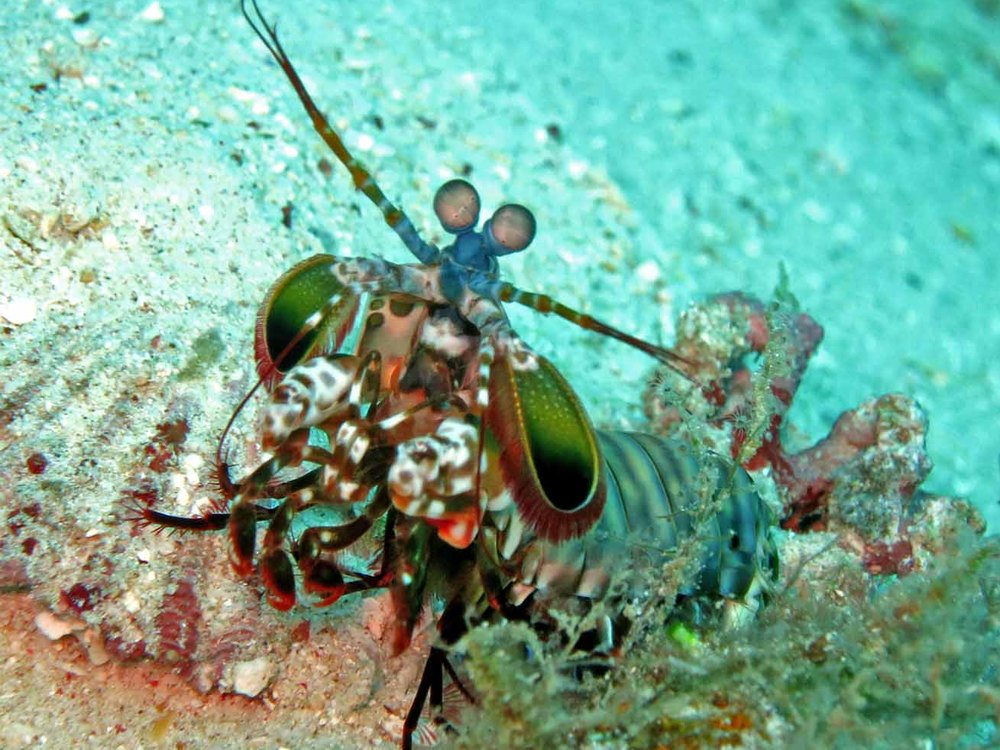
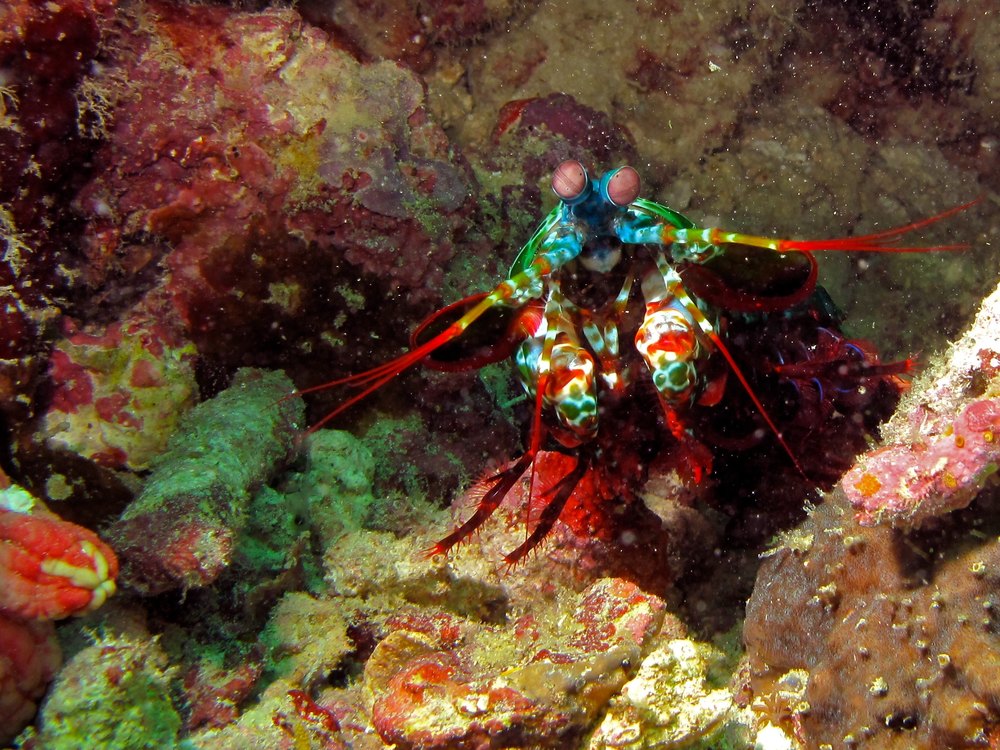
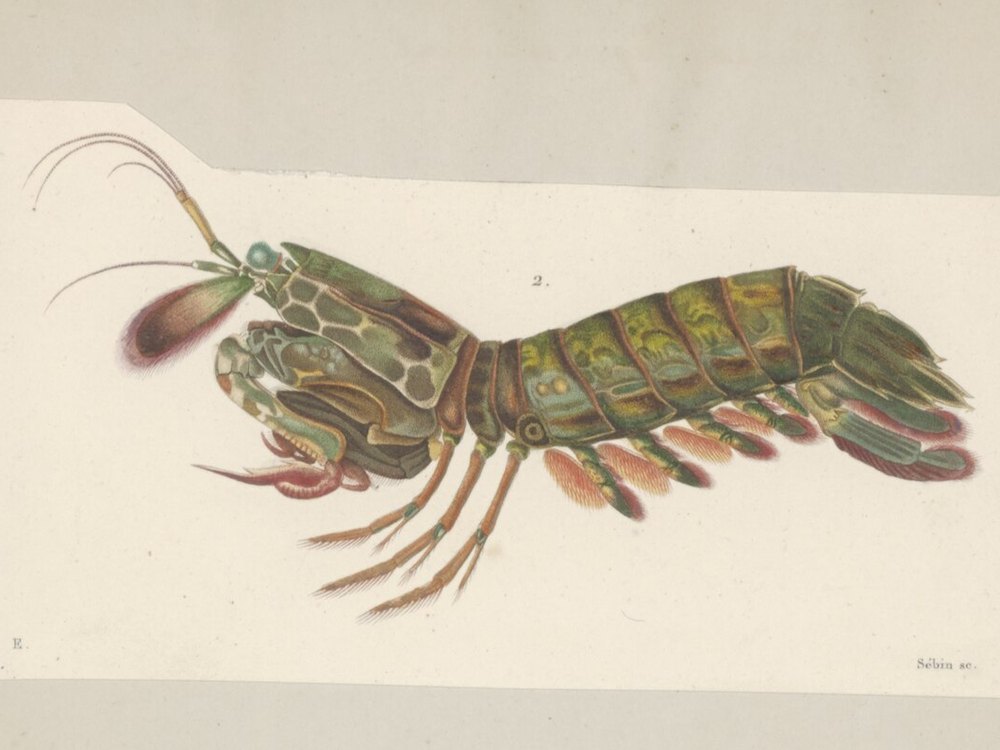
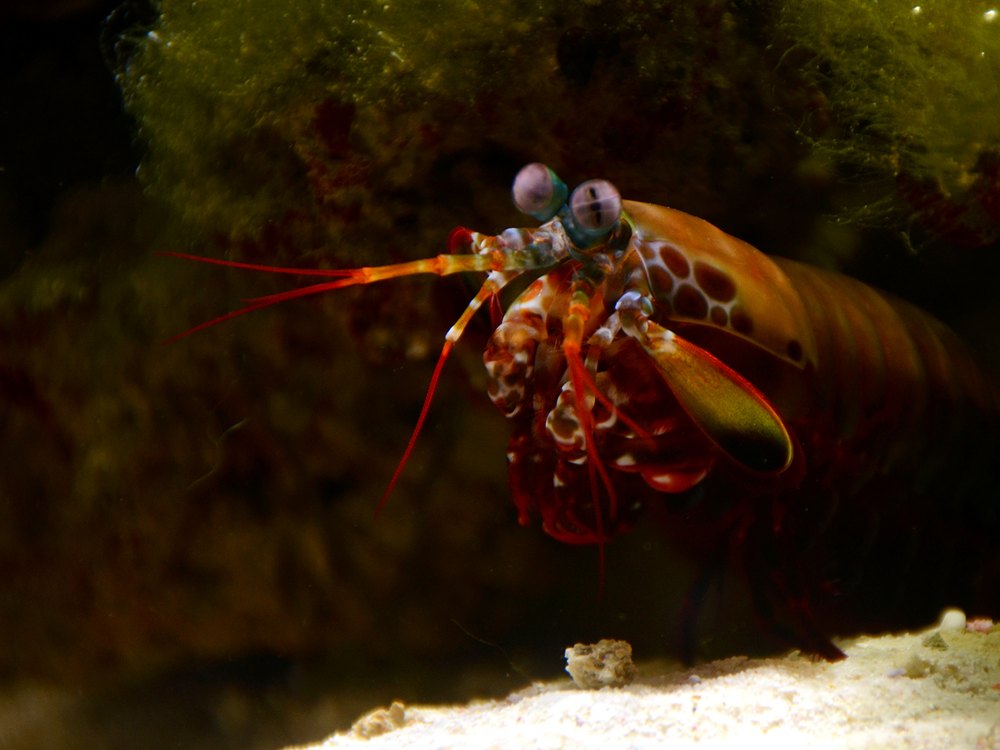
The peacock mantis shrimp has a spotted carapace, a banded tail and a tail fan edged in red or blue. The body is seen in two colours, green and red-brown. The two front limbs end in round clubs that the animal holds folded in front of its body. The eyes sit on stalks. Animal Diversity Web describes males as brighter than females.[3]
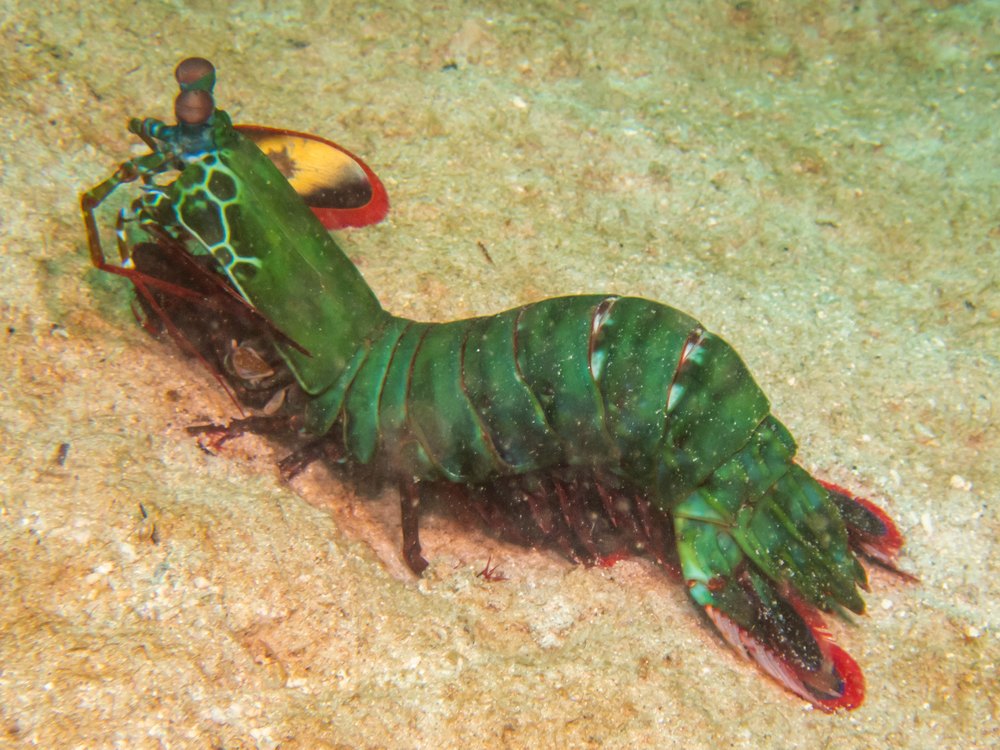
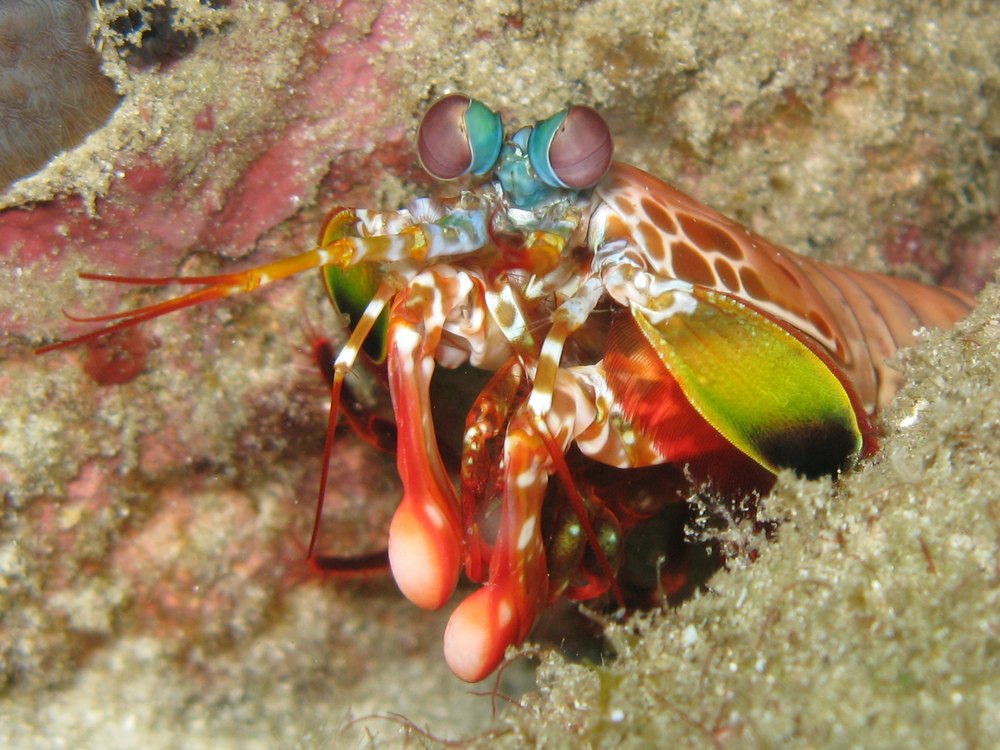
Name
The usual English name is “peacock mantis shrimp”. Other English names listed for it are harlequin, painted and coloured mantis shrimp.[1][2] A mantis shrimp is not a shrimp. Shrimps belong to the order Decapoda, while mantis shrimps form their own order, the Stomatopoda, within the crustacean class Malacostraca.[1][2][6]
In other languages
| Language | Name | Notes |
|---|---|---|
| Thai local | กั้งตั๊กแตนเจ็ดสี | — |
| Japanese local | モンハナシャコ (monhanashako) | — |
| Chinese (Traditional) local | 蟬形齒指蝦蛄 | — |
| Afrikaans local | Poumantisgarnaal | — |
| Portuguese local | Lagosta-boxeadora | — |
| French local | Squille multicolore; Crevette-mante paon; Mante de mer paon | — |
| Chinese (Simplified) | 蝉形齿指虾蛄 | — |
| German | Pfauen-Fangschreckenkrebs; Bunter Fangschreckenkrebs | — |
| Spanish | Camarón Mantis Arlequín | — |
| Dutch | Pauw-bidsprinkhaankreeft | — |
| Danish | Påfuglereje | — |
| Polish | Rawka błazen | — |
| Czech | strašek paví | — |
| Italian | canocchia pavone | — |
| Russian | Рак-богомол роскошный | — |
| Hebrew | חסילון גמל שלמה טווסי | — |
The names in other languages come from the vernacular-name lists of GBIF, which draws on Catalogue of Life, WoRMS and TAXREF.[1][2]
Body
Size
SeaLifeBase gives a maximum length of 17.0 cm (total length) for males or unsexed animals.[7] Animal Diversity Web gives a range of 3 to 18 cm.[3] The animals filmed in a strike study were 11.5 to 14.8 cm long and had been bought from aquarium dealers.[4]
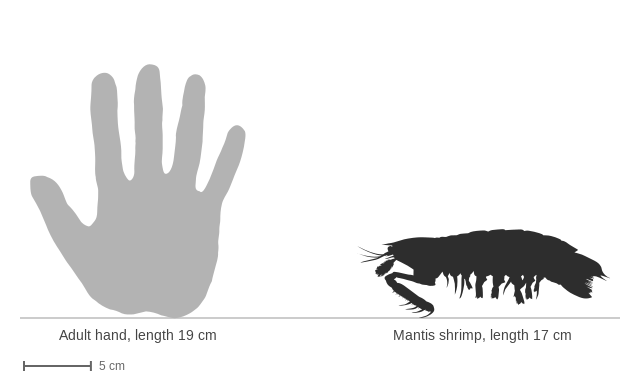
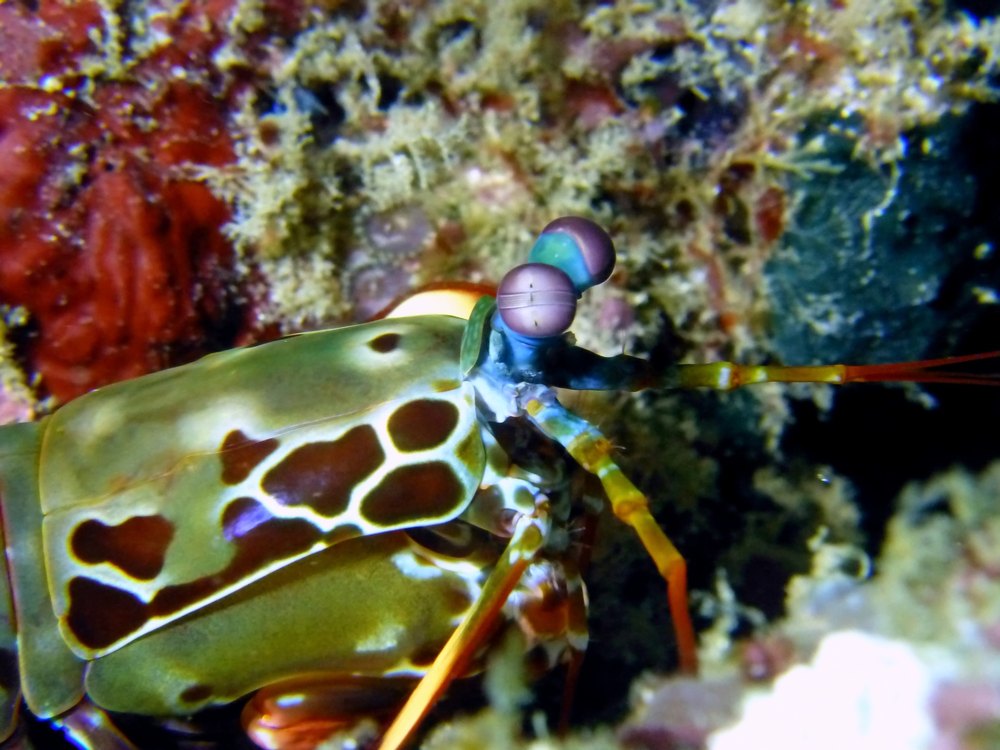
The club
The peacock mantis shrimp is a smasher. Its front limbs end in a raptorial appendage that can be used in two ways: open and extended for stabbing, or with the finger folded in and the bulbous heel exposed for hammering.[4] The club is a composite of oriented crystals of hydroxyapatite and of amorphous calcium phosphate and carbonate, with chitin fibres laid in a helical pattern.[8]
The strike is powered by energy stored in the exoskeleton. Large, slow muscles load the limb while two latches (sclerites) hold it in place, and the saddle on the upper surface, made of poorly mineralised cuticle, is compressed. When the latches are released, the saddle flattens and the limb swings out.[4] A linkage of the limb turns the input rotation into a rotation about twice as large.[4]
In high-speed video at 5,000 frames per second, captive animals of 11.5 to 14.8 cm kept at 25–30 °C struck a snail shell inside a burrow. In 50 to 58 strikes from six individuals, peak speeds reached 23.5 m/s, and the average peak speed was 13.7 ± 3.3 m/s. The sweep took 1.8 ± 0.4 ms on average, and the average peak acceleration was on the order of 10,000 m/s². The camera under-sampled the movement, so the true speeds are higher than these.[4]
Force was measured on captive animals striking a sensor underwater. Each strike gave two force peaks about 390 to 480 microseconds apart: the first from the impact of the limb, 400 to 1,501 N, and the second from the collapse of cavitation bubbles, up to 504 N. The forces are thousands of times the animal’s body weight.[9] In tests with animals of 11 to 15 cm, the average force on a flat surface was 391 N and on a curved surface 416 N.[10]
Eyes and colour vision
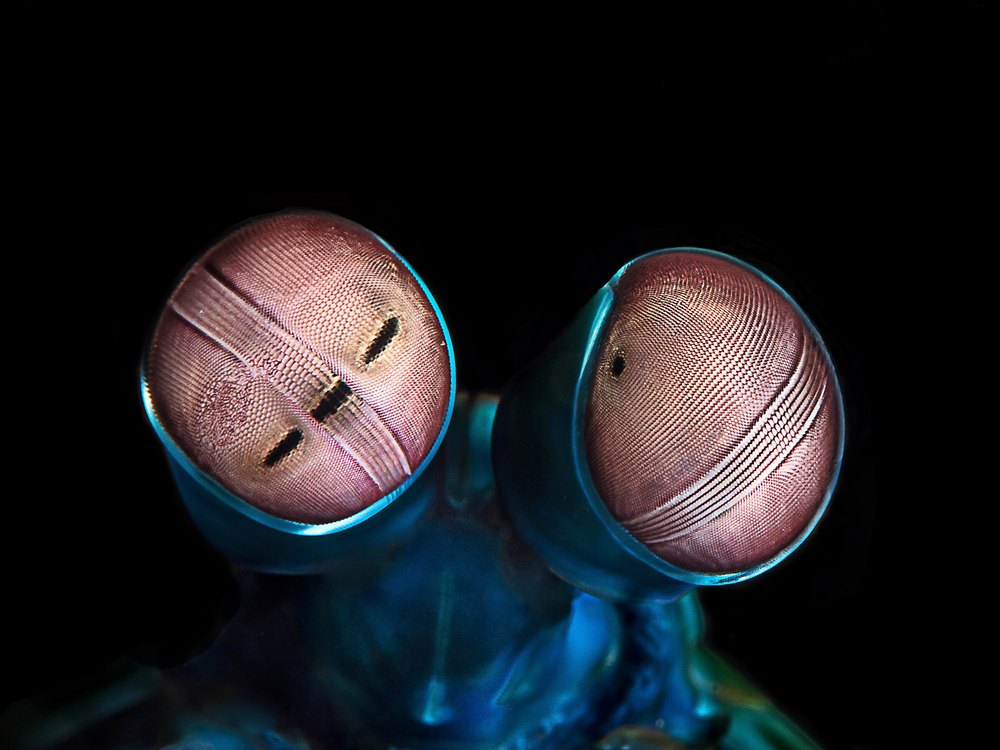
The compound eyes sit on stalks. Each has two hemispheres separated by a midband of six parallel rows of light-sensing units, found only in mantis shrimps. Three regions of one eye look at the same spot, so each eye sees that spot in three ways.[5] In the peacock mantis shrimp, ten classes of visible-light receptor have been measured, with peak sensitivity from about 400 to 550 nm. A pigment near 330 nm senses ultraviolet light, and filters in rows 4 to 6 of the midband absorb ultraviolet light at 382 nm and 305 nm.[11] For mantis shrimps as a group, one review counts 12 types of colour receptor, plus others for polarisation and brightness.[12]
In training tests, animals were taught to break into a plastic cube to reach food. They told red, green and yellow cubes from grey, but never told shades of grey apart. A blue cube excited the blue-sensitive receptors almost exactly as a grey one did.[5][12] Animals also learned to choose a food object by the direction of polarised light alone.[5]
Behavior
The peacock mantis shrimp can learn from experience. In captive tests it opened a thick-walled snail it had not met before in fewer strikes over successive days.[5] Animal Diversity Web describes pairs as usually monogamous, with an occasional change of partner, and says mating takes place in the burrow.[3]
Burrows
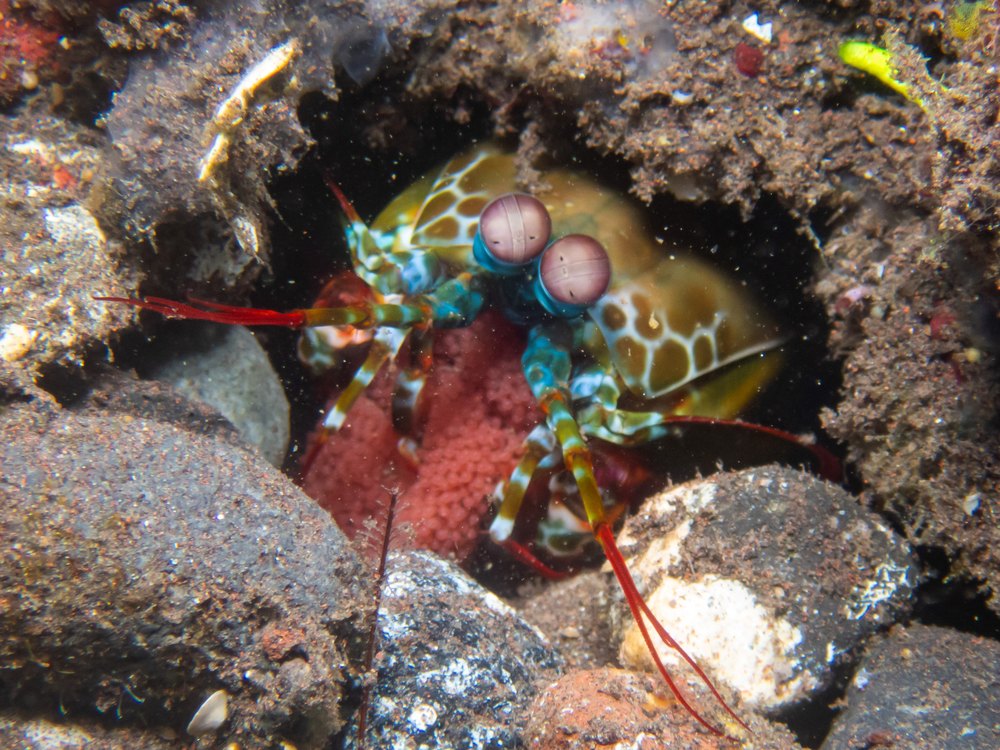
The animal spends much of its time in or near a burrow. Animal Diversity Web says it keeps making new burrows and leaving old ones, and that it is active by day and by night.[3] In tank trials, captive animals struck prey presented to them inside confined burrows.[4]
Diet
The peacock mantis shrimp is a carnivore that eats hard-shelled animals: snails, crabs and other crustaceans, and bivalves.[3] Animal Diversity Web names the scallop Annachlamys flabellata as a food in the wild and says that crabs are preferred.[3] In choice tests it took snails in preference to hermit crabs.[5] It breaks the shells with the club on its front limbs (see Body).
Captive animals in one laboratory were fed fresh snails, frozen shrimp and freeze-dried shrimp.[4] Animal Diversity Web adds that captive animals attack fish.[3]
Life cycle
| Stage | Age / size | Notes |
|---|---|---|
| Eggs | 9 to 60 days, about 40 on average | The female carries the eggs in the burrow; up to 50,000 per female[3][7] |
| Larva | – | Drifts in the plankton[7] |
| Juvenile | – | – |
| Adult | Up to 17 cm | Total length of males or unsexed animals[7] |
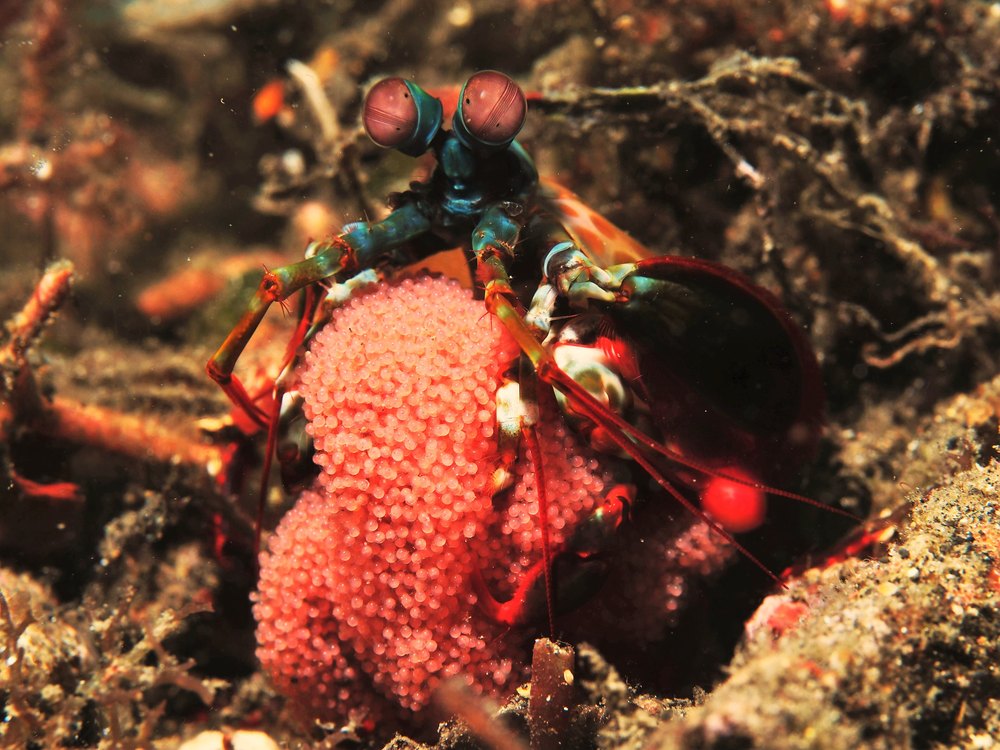
Eggs and larvae
The female holds the egg mass on her front limbs with an adhesive and keeps it in her burrow, where she cleans and aerates it. Animal Diversity Web gives a time to hatching of 9 to 60 days, about 40 on average.[3] SeaLifeBase gives up to 50,000 eggs per female.[7] The eggs hatch into larvae that live in the plankton.[7]
Ecology
The peacock mantis shrimp is a predator of hard-shelled invertebrates and a maker of burrows. Animal Diversity Web says its burrowing creates habitat for other animals.[3]
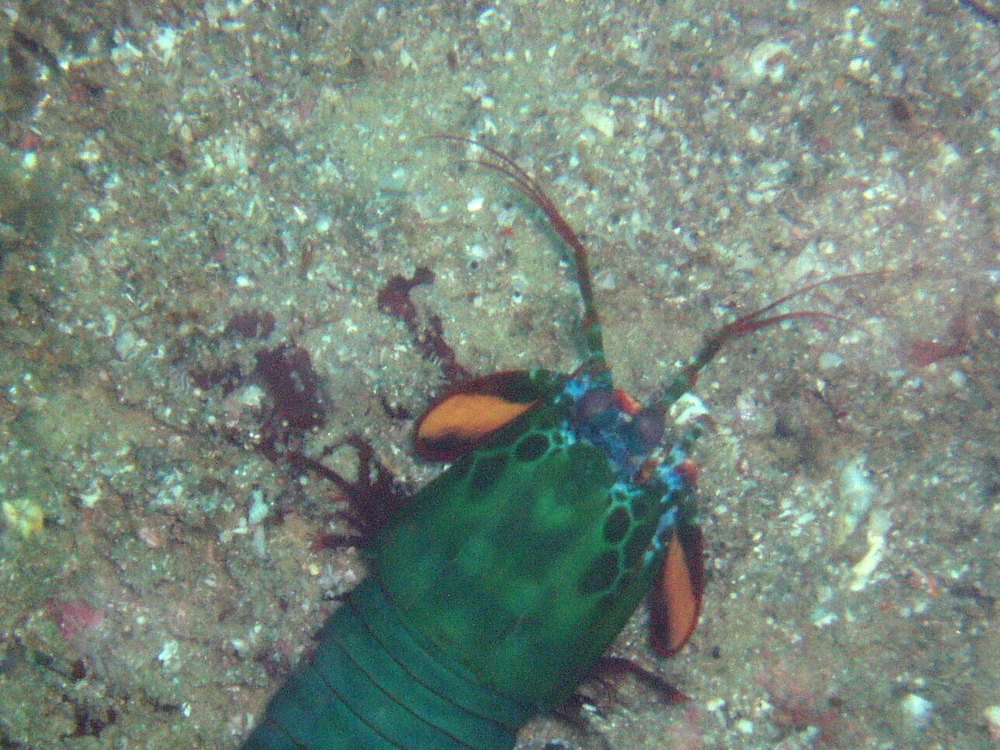
Predators
Animal Diversity Web notes that small individuals may be eaten by larger reef fish.[3]
Habitat and range
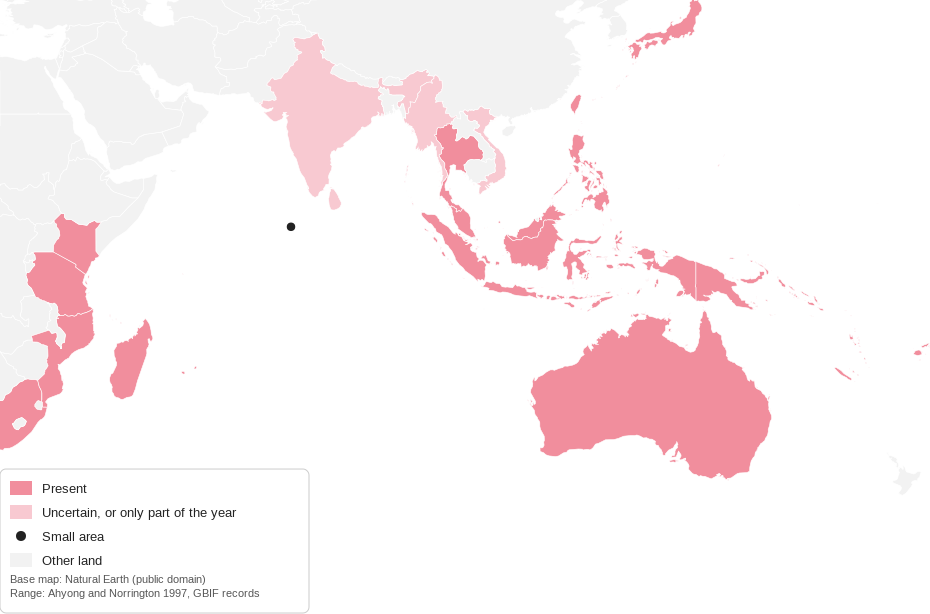
The peacock mantis shrimp lives throughout the Indo-West Pacific, from Japan and Australia westwards to Madagascar.[13] It has also been reported from New Caledonia.[13] On the east coast of Australia it reaches as far south as the Solitary Islands in northern New South Wales, and museum specimens come from Mauritius.[13] Animal Diversity Web places it between eastern Africa and Guam.[3] WoRMS lists it as native in the western and central Indo-Pacific, Japanese waters and the Australian shelf.[2] Most GBIF records come from Indonesia (858) and the Philippines (387), followed by Australia, Malaysia, Thailand, the Maldives, Taiwan and Tanzania.[14]
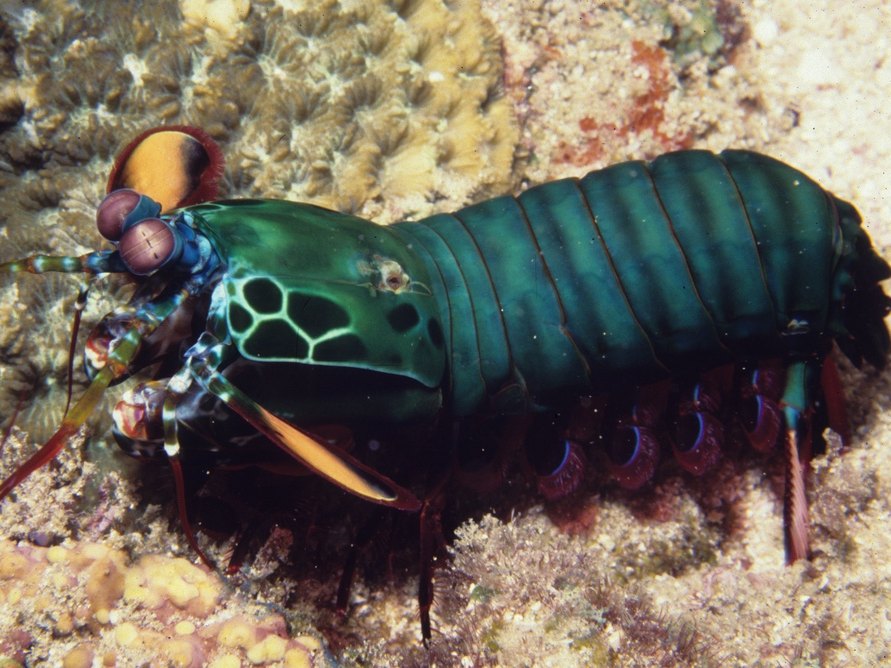
It lives on tropical reefs, in U-shaped burrows near the base of the coral on sand and gravel.[3] SeaLifeBase describes it as reef-associated, living in existing burrows on shallow, rough bottoms, often on or near coral reefs, from the shore down.[7]
Depth
Animal Diversity Web gives a depth of 3 to 40 m, most often 10 to 30 m.[3] SeaLifeBase gives 0 to 100 m and reports it on a reef flat at 36 m.[7]
Evolution
The oldest known relatives of the mantis shrimps are two extinct groups, the Palaeostomatopoda and the Archaeostomatopoda, from the Palaeozoic.[15] Fossils of the archaeostomatopod Tyrannophontes from the Pennsylvanian (late Carboniferous) Wea Shale Member in Nebraska show what appear to be the earliest gilled, two-branched limbs known in stomatopods.[16] The Mesozoic and Cenozoic fossils all belong to the Unipeltata, and they are sparse compared with those of the decapods.[17]
A 2017 study of three mitochondrial and two nuclear markers in 38 species, calibrated with seven fossils, dated the split of the living mantis shrimps from their closest crustacean relatives to about 340 million years ago (95% credible interval 401–313).[17] It put the origin of the specialised smashing claw at about 126 million years ago (174–87), after the spearing claw.[17] A 2025 study that added 77 body features and whole mitochondrial genomes dated the common ancestor of the living Unipeltata to about 143 million years ago and found that smashing and spearing limbs both evolved early in the group.[18]
Forms and variants
No subspecies are recognised for the peacock mantis shrimp in GBIF or WoRMS.[1][2]
Conservation
The peacock mantis shrimp has not been evaluated for the IUCN Red List: GBIF, SeaLifeBase and Animal Diversity Web all give its status as Not Evaluated.[1][7][3] Neither Animal Diversity Web nor SeaLifeBase shows a CITES listing for it.[3][7]
History and culture
First description
Linnaeus described the species in 1758 under the name Cancer scyllarus.[1][2] The genus Odontodactylus was named later, by Bigelow in 1893.[1][2]
Study
In 2004 Patek, Korff and Caldwell published high-speed film of the strike of Odontodactylus scyllarus in Nature. The filming was done with a BBC crew and a rented camera.[19][20] A 2005 paper measured the forces of the strike, including the impact of the club and the cavitation that follows it,[9][10] and a 2007 paper described the spring and latch that drive it.[4]
Aquarium trade
Aquarists keep the peacock mantis shrimp because it is brightly coloured and very active. Animal Diversity Web says it can crack aquarium glass and be aggressive to tank mates, and that it sometimes enters aquaria by accident, hidden in collected rock or coral.[3] A UC Berkeley news release says that club-equipped mantis shrimps have broken the glass walls of their tanks in captivity.[20]


In popular culture
The webcomic The Oatmeal has a comic on mantis shrimps titled “Why the mantis shrimp is my new favorite animal”.[21]
Taxonomy
| Rank | Name |
|---|---|
| Kingdom | Animalia |
| Phylum | Arthropoda |
| Subphylum | Crustacea[6] |
| Class | Malacostraca[1][2] |
| Subclass | Hoplocarida[24] |
| Order | Stomatopoda (mantis shrimps)[6][2] |
| Suborder | Unipeltata[24] |
| Superfamily | Gonodactyloidea[24] |
| Family | Odontodactylidae[1][2] |
| Genus | Odontodactylus Bigelow, 1893[1][2] |
| Species | Odontodactylus scyllarus (Linnaeus, 1758)[1][2] |
Synonyms (3)
| Name |
|---|
| Cancer scyllarus (Linnaeus, 1758) |
| Gonodactylus bleekeri (A.Milne-Edwards, 1868) |
| Gonodactylus elegans (Miers, 1884) |
From the GBIF backbone.[23]
Accepted name
GBIF and WoRMS both accept Odontodactylus scyllarus (Linnaeus, 1758) as the name of the species.[1][2] WoRMS lists the original name Cancer scyllarus as a superseded combination, and both databases list Gonodactylus bleekeri (A. Milne-Edwards, 1868) and Gonodactylus elegans (Miers, 1884) as synonyms.[1][2] Mantis shrimps are not shrimps: they are stomatopods, an order of their own, while the true shrimps belong to the order Decapoda.[6][2][1]
Higher classification
WoRMS and ITIS place the order Stomatopoda in the subclass Hoplocarida, while GBIF goes straight from the class Malacostraca to the order.[2][6][1] The genus Odontodactylus has eight accepted species in WoRMS: brevirostris, cultrifer, hansenii, havanensis, hawaiiensis, japonicus, latirostris and scyllarus.[2]
Relationships and open questions
The place of the Stomatopoda among the malacostracans depends on the analysis: in a study of crustacean phylogenomics the order took different positions in different analyses.[22] The 2017 mantis shrimp tree found that the superfamily Gonodactyloidea, which holds the family Odontodactylidae in older schemes, is not a natural group, and the support along the backbone of the tree is moderate to low.[17]
Sources
- GBIF, Odontodactylus scyllarus (Linnaeus, 1758)
- World Register of Marine Species, Odontodactylus scyllarus
- Animal Diversity Web, peacock mantis shrimp
- Patek et al. 2007, Journal of Experimental Biology 210: 3677–3688
- Cronin, Caldwell & Marshall 2006, International Journal of Comparative Psychology 19: 297–317, “Learning in stomatopod crustaceans” (includes the colour-training tests of Marshall, Jones & Cronin 1996)
- ITIS, order Stomatopoda
- SeaLifeBase, Odontodactylus scyllarus
- Weaver et al. 2012, Science 336: 1275–1280
- Patek & Caldwell 2005, Journal of Experimental Biology 208: 3655–3664
- Patek & Caldwell, “Snail smashing forces of the peacock mantis shrimp”, Society for Integrative and Comparative Biology meeting
- Cronin et al. 2014, Philosophical Transactions of the Royal Society B, filtering and polychromatic vision in mantis shrimps
- Streets, England & Marshall 2022, Journal of Experimental Biology 225: jeb243699
- Ahyong & Norrington 1997, stomatopod crustaceans of the Macleay Museum
- GBIF occurrence records, Odontodactylus scyllarus, counted by country on 28 November 2026
- UCMP Berkeley, Stomatopoda
- Bicknell et al. 2024, American Museum Novitates 4028
- Van Der Wal et al. 2017, PeerJ 5: e3844
- Van Der Wal et al. 2025, Molecular Phylogenetics and Evolution 207: 108346
- Patek, Korff & Caldwell 2004, Nature 428: 819–820
- UC Berkeley news release, 21 April 2004
- The Oatmeal, “Why the mantis shrimp is my new favorite animal”
- Schwentner et al. 2018, Proceedings of the Royal Society B, crustacean phylogenomics
- GBIF backbone, Odontodactylus scyllarus, synonyms
- ITIS, Odontodactylus, classification