Macaca fascicularis lasiae is the Long-tailed Macaque of Lasia, a small island about 120 km west of northern Sumatra in Indonesia.[1][2] The IUCN Red List lists it as Critically Endangered.[2]
Names and classification
Lyon named it Pithecus fuscus lasiae in 1916, from two males collected on Lasia by W. L. Abbott in January 1902: an adult (the holotype) and a late juvenile.[1] Miller had earlier counted the Lasia animals with the monkeys of nearby Simeulue, which he named fusca in 1903, and several later lists treated lasiae as a synonym of fusca.[1] Fooden kept it as a separate subspecies in 1995.[1] The IUCN Red List 2025 and GBIF list it among nine subspecies. The Mammal Diversity Database lists no subspecies of the species.[2][3][4] It is also called the Lasia Long-tailed Macaque.[5]
Description
The back, crown and thighs are blackish, and each hair carries pale yellowish rings that are hard to see on the crown. The hair beside the ears sweeps back over them in one of the two animals examined and forward along the cheek in the other. The hair below the ears is pale greyish brown and not elongated, and the shanks are pale greyish brown.[1] The one adult measured had a tail 118 percent of the head-and-body length.[1]
Range
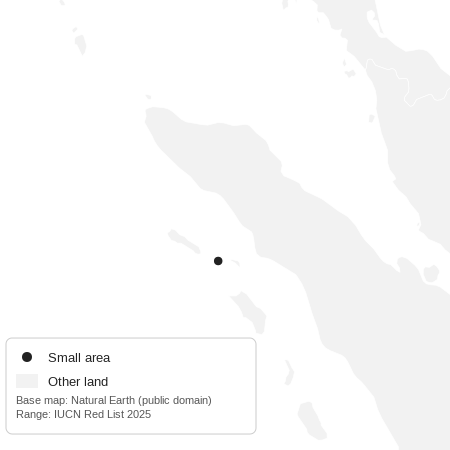
The subspecies lives on Pulau Lasia, a small island about 6 by 3 km, southeast of Simeulue.[1] Macaques live on Lasia and Simeulue, but not on Pulau Babi, which is 3 km south of Lasia.[1] The IUCN gives Lasia Island as its range.[2]
Classification evidence
The Lasia monkeys closely resemble those of Simeulue (fusca). The tail is the main difference: the two Lasia specimens have clearly longer tails than 13 Simeulue specimens, a difference Miller and Lyon both noted. In Fooden’s key, lasiae has pale shanks and a tail longer than 112 percent of the head and body, while fusca has blackish shanks and a shorter tail.[1] Fooden judged the longer tail to be the older condition and the shorter Simeulue tail to be a later change.[1] The dark colour of both island subspecies contrasts with the yellowish-brown to golden-brown back of the pale population on Tuangku, 50 km east of Lasia.[1] Fooden’s working idea is that the ancestors crossed the sea on natural rafts about 160,000 years ago and darkened after being cut off, a hypothesis he said later evidence could test.[1]
Status
The IUCN Red List 2025 lists lasiae as Critically Endangered, citing the 2022 assessment by Amey, Hansen, Gumert and Ang.[2]
Sources
- Fooden 1995, Systematic review of Southeast Asian longtail macaques, Fieldiana Zoology n.s. 81: 1–206
- Hansen et al. 2025, IUCN Red List assessment of Macaca fascicularis
- GBIF Backbone Taxonomy, Macaca fascicularis (Raffles, 1821)
- Mammal Diversity Database, Macaca fascicularis
- Primate Info Net, long-tailed macaque fact sheet (Wisconsin National Primate Research Center)